12 Christian Community Development

Studying this lesson will help you:
- Compare and contrast Christian relief ministry with transformational development.
- Explain why and how Christian community development offers greater hope when integrated with local churches.
- List and evaluate four approaches to meeting global human needs.
- Describe some of the most critical dimensions of global human need and comprehend the nature of poverty.
- Describe the difference between absolute poverty and relative poverty.
- Explain how poverty results from broken relationships, misuse of power, and fear.
See page vii in this book for an explanation about the strategic sequencing of lessons 12–15.
When Jesus said, “You always have the poor with you” (Mark 14:7), it seemed like He was saying that God will never change the plight of the poor. But Jesus was actually quoting a well-known line from Deuteronomy:
For the poor will never cease to be in the land; therefore I command you, saying, “You shall freely open your hand to your brother, to your needy and poor in your land.” (Deut 15:11)
Jesus was affirming that God’s people were at all times expected to be caring and generous with the poor.
On another occasion, we read that “Jesus was going through all the cities and villages, teaching . . . and proclaiming the gospel of the kingdom,” but He was also “healing every kind of disease and every kind of sickness” (Matt 9:35). The next line says that Jesus was gazing upon the crowds of people. This vision moved Him. “Seeing the people, He felt compassion for them, because they were distressed and dispirited like sheep without a shepherd” (9:36).
We could easily expect that Jesus would call His followers to look upon this group of people and then to respond to their different needs. But Jesus was drawing their attention to something more than physical or social needs. He called them to pray for God to fulfill a great work of drawing many people to Himself. He said, “The harvest is plentiful, but the workers are few. Therefore beseech the Lord of the harvest to send out workers into His harvest” (Matt 9:37–38). Of course, the people had needs, but Jesus was lifting their vision to see a living harvest, ripe and ready to be gathered to God.
In this lesson we will explore how God in our day is fulfilling His ancient promise to bring blessing upon every people through and with “the seed,” or the descendants, of Abraham (Gen 22:18; 26:4; 28:14). The risen Jesus is the great seed of Abraham. People who place their faith in Him are joined with the risen Jesus and become children of Abraham (Gal 3:29). God is now fulfilling His promise to Abraham by bringing blessing among every people group through and with His people.
Transformation
God’s work of blessing brings sustained changes in the hearts and relationships of individuals, families, and entire communities. These changes come about by God’s hand, working with and through His people among the broken and impoverished. He is bringing the healing and hope of His long-promised blessing through His church.
I. A Vision from Failure
A Kenyan woman named Florence Muindi tells her story. She brought her skills as a medical doctor to an overlooked area of Africa. But she soon found herself in an endless cycle of responding to the same sicknesses without dealing with the root causes of illness and poverty. She resolved to find an approach that combined preventive and curative health care, along with ways of bringing spiritual well-being. She made another effort and once again found all that she could do was still insufficient.
Then came the crucial vision: Instead of people exerting themselves, as she says, “playing the hero . . . it would be Christ working through His churches” (p. 409). She learned that if she looked to Christ working through His church, then mission workers would not separate efforts to meet physical needs from efforts to touch spiritual needs.
The vision was the hope of the life of Christ Himself flourishing through His church. She and others soon formed an organization helping local church leaders to understand their needs. They helped local leaders to envision and plan the changes and interventions that could bring about sustainable transformation.
II. A Better Balance: Moving with Momentum Toward a Goal It’s easy to speak of balancing our words of good news with doing good deeds that Jesus might do. But the difficulties that people face cannot be solved with holistic talk about balance. Calling for a balance between good deeds and gospel words can still leave local people thinking that outsiders are the source of hope. The better way is what Hawthorne calls “bicycle balance,” in which local leaders, along with outside workers, labor with momentum toward a greater goal of local churches flourishing with blessings in their communities.
As we learned in lesson 1, God’s way of bringing about blessing involves His people acting with righteousness to bring about justice. The Lausanne Covenant develops a similar idea, calling us to work toward reconciliation with God as well as working toward reconciliation throughout societies.
III. Approaching a World of Need
When Christian missionaries encounter poverty and human needs, it isn’t hard to see the problems. The difficult part is knowing just what approach to take to address the numerous needs and accomplish evangelism and church planting.
A. Four Approaches to Human Need. Four strategies have been used in recent history for meeting basic human needs. See the matrix below, from Samuel J. Voorhies’s article. Identify what is valid about each strategy, as well as its strengths and weaknesses. Be sure to grasp the significance of the matrix. Two of the approaches look to local resources and leadership, expressed by the words, “Help from within.” The other approaches, seen under “Help from without,” may set up an increased reliance on resources coming from outside. Another helpful angle to consider when evaluating human needs is whether meeting the immediate needs outweighs dealing with underlying causes. To what extent should missionaries and local Christians be involved in any or all these approaches?
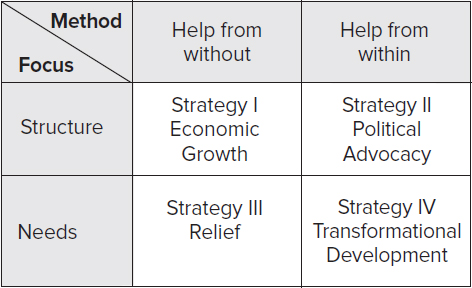
1. Economic Growth often focuses on macro-statistics and issues of a country instead of microeconomic factors such as adequate food, fuel, and health for each family.
2. Political Advocacy often focuses on oppressive regimes, violations of human rights, and exploitative commercial structures that widen the gap between the “haves” and “have-nots.”
3. Relief aims to provide basic survival necessities for victims of war, natural disaster, and prolonged injustice.
4. Community/Transformational Development focuses on both adequate assessment and the use of personal and community abilities and resources. The goal is to meet basic needs with local leadership and resources. The term “transformational development” is synonymous with the term “community development.”
B. Limitations and Potential. Each approach carries limitations and potential. While a lengthy consideration of economic growth and political advocacy is beyond the scope of this course, note the following evaluations:
1. Economic Growth has not proven to bring lasting help to the poor except when it is accomplished by means of what Voorhies calls “transformational development.”
2. Political Advocacy is best done by and for insiders rather than outsiders. It holds little promise without transformational development.
3. Relief aims at short-term survival. Unless a long-term plan is initiated from the start, relief efforts can produce the “rice Christian” syndrome. “Rice Christian” refers to the stereotype, almost never true, that people have converted to Christianity because a staple food, such as rice, was offered to them as an inducement.
4. Transformational Development aims to enable a community to meet its own basic needs. Unfortunately, even transformational development efforts flounder without a foundational shift in values within the community. Therefore, there is a need for Christian transformational development, which aims to bring about a new expression of church life that exhibits and multiplies the values of the kingdom of God.
IV. Christian Community Development
Since relief efforts are crucial to preserving life, relief work and appeals for funding often get a higher profile. Meanwhile, many mission leaders have been focusing their efforts on development. Different leaders may use slightly different terminology to describe their work, but their efforts basically aim toward the same vision of bringing enduring transformation in Christ’s name and by His power. Five different terms are commonly used to describe this approach:
- Transformational Development. Community developers aim to enable local people to mobilize local resources to meet basic needs in an enduring way throughout an entire community.
- Christian. Development workers seek to base the changes upon the values of the kingdom of God as revealed in Scripture. When people are changed and begin to emulate Christ’s own character and concerns, many others throughout the community have examples and encouragement to participate in selfless service, trust, and industrious hope. When Christian missionaries seek to do development work, they usually aim to plant new churches or renew existing churches as the basis for the crucial worldview and value shifts needed for lasting change.
- Transformational. The aim is for people and entire communities to be changed, not merely impacted in a passing way. Christian community developers do not view the sought-after changes as being accomplished by an exercise in social engineering. Christ Himself is seen as the source of significant transformation.
- Holistic. The entire range of human needs is addressed.
- Integrated. All aspects of the ministry are tied together, linking diverse endeavors such as training in literacy, digging wells, or enabling indigenous worship leaders.
With these ideas and terms in mind, examine three case studies: The first presented by Voorhies in Africa, the next by Gustafson in Southeast Asia, and then the Guzmáns in the Middle East. Note that all three development efforts involved the work of teams.
A. God at Work Changing People and Their Communities. Voorhies tells a story of a fruitful development effort. Some aspects worth noting:
- Problems and Resources. Don’t miss the first step, which is identifying the resources, after which the problems are considered. Would you have listed the problems or the resources first? As Voorhies describes the outcome, ask yourself how each of the different needs was met. Observe how much better it was to deal with the needs together on a community-wide basis.
- How Was Worldview Changed? What was the basis for the change in worldview? What was the place of the new church and its worship in the transformation? Consider the beautiful balance of God being recognized and people working together with hope: “We can do it ourselves with God’s help, and to His glory, we will become all that we can be.”
- Voorhies Lists Ten Principles. Notice which principles emphasize the role of local people in bringing about change and which principles emphasize the work of God. How can the role of outsiders work with both?
B. Enabling Jesus Christ “to Be Born into Northeastern Thai Culture.” James W. Gustafson presents a case study that highlights the place of local churches in providing a foundation for the “true transformation of society.” The developers have gone to great lengths to plant churches that are remarkably in tune with Northeastern Thai culture. Why does the cultural relevance of the new churches help them deal with other community needs? What does he mean when he says, “Development must serve, not lead” (p. 469)? How does this emphasis prevent the “rice Christian” syndrome as described previously? Gustafson describes an example of the “microcredit” system of offering small nonmonetary loans to a “cooperative project.” It is important to understand how this approach differs from relief efforts that give away resources. How does Gustafson’s team operate in the reality of hope? Which principles on Gustafson’s list match items on the list that Voorhies provided?
C. Christ’s Love Demonstrated in a War-Torn City. The Guzmáns, both medical professionals from Latin America, worked with a team from other Latin American countries. Not all development work takes place in remote, rural agrarian settings. Their work took place in a Middle Eastern urban area ravaged by war and under constant threat of violence. Their team worked on different levels. They worked to rebuild the infrastructure with medical services and government agencies throughout the region. They also dealt with many specific needs in local communities. Some things to note in their story:
- Incarnational Living. They cultivated relationships with high government leaders as well as with nearby households and neighbors.
- Scripture. They worked to make the Bible available and understandable so that lasting changes would be based on the values of the kingdom of God and the example of Christ. Although their team highlighted medical services, they also helped translate portions of the New Testament.
- Avoiding Inducement. They raise the important issue of how to integrate gospel communication with the provision of humanitarian services. They describe the problem of so-called rice Christians converting to obtain benefits. The Guzmáns feel they have avoided this problem by offering the same services to all and by motivating their work in Christlike love.
V. Understanding the Needs of the World
Jesus’s words in Matthew 25 present six categories of suffering. There is good reason to see the identity of “these brothers of Mine” in 25:40 as apostolic people sent by the Messiah rather than suffering humanity in general. But regardless of how one interprets the parable of Matthew 25, the six categories of suffering help sort out the great needs that we find throughout the world. We dare not merely react to the needs in a superficial way. For us to respond to these needs in accordance with the purpose of God, we must grasp some of the complexity and extent of the suffering.
The next article, written by some leaders of World Relief, one of the important service agencies, warns that a sense of powerlessness to deal with the needs of the entire world can lull us into inactivity. We should refuse to view the world with despair that assumes the difficult situations are God’s will. Instead, the Bible makes it clear that God is fulfilling His purpose to bring blessing upon every people.
Take special note of the analysis of these problems. Hunger, for instance, is not really caused by a shortfall of food supplies. It is caused by a myriad of problems, the chief of which is distribution. The most common response to illness has focused primarily on the treatment of disease. We are learning that many diseases can be eradicated. Many maladies are manageable through efforts to bring primary health care and education to the many communities.
The Spirit of the Lord GOD is upon me,
Because the LORD has anointed me
To bring good news to the afflicted;
He has sent me to bind up the brokenhearted,
To proclaim liberty to captives
And freedom to prisoners;
To proclaim the favorable year of the LORD
And the day of vengeance of our God; . . .
So they will be called oaks of righteousness,
The planting of the LORD, that He may be glorified.
Then they will rebuild the ancient ruins,
They will raise up the former devastations;
And they will repair the ruined cities,
The desolations of many generations. (Isa 61:1–4)
Jesus read this passage and announced that it was at least partially fulfilled in His day and in His person (Luke 4:16–30). But consider how these words may be relevant for those who follow Jesus today. Underline the phrases that express purpose (such as “to proclaim liberty . . . “).
How is the presence of the Spirit of God related to the act of sending? The liberated captives and brokenhearted become “the planting of the LORD” for God’s glory. They also become the ones who restore what was devastated. How can these verses encourage and guide those who are working among the urban poor?
VI. The Urban Frontier of Change and Hope Pioneer urban missionary Viv Grigg describes the crying need for development efforts in the cities of the world.
A. The Nature of Poverty. Grigg helps us understand the nature of urban poverty. There are key distinctions between “absolute poverty” and “relative poverty.”
1. Absolute poverty describes situations in which people have an absolute insufficiency to meet their basic needs.
2. Relative poverty describes situations in which people are on the margins of society. A person’s standard of living is compared in relation to others in the community or nation. A family may be regarded as poor if they do not have a telephone or a car in North America. A family lacking a telephone or a car in India may not be considered impoverished at all. If neither family is suffering from an absolute lack of food, shelter, or clothing, then their poverty is relative poverty.
B. Communities of Hope. Why is Grigg’s distinction between “slums of hope” and “slums of despair” important when dealing with the huge complex of needs in cities? While aid, development, organization, and politics all play a role in addressing urban poverty, Grigg reminds us that “in the preaching of the cross comes the vanquisher of this slow death that grips the city.” Ultimately, this “vanquisher” intends to use “movements of the righteous” to turn the destructive tide. The challenge, Grigg admits, is how to generate movements of disciples among these poor and subsequently among the rich. Why does he propose a strategy of bringing the gospel to the entire city from the economic underside? Do you see other possibilities? From the small excerpt of Grigg’s writing, what community development principles can you see Grigg applying in an urban context?
VII. Poverty and the Power of the Gospel
How we view the world’s needs will shape our response. Bryant L. Myers challenges us to take another look at poverty.
A. The Standard View: Poverty as Deficit. While it is obvious that poverty is a lack of basic necessities, it may be misleading to view poverty as a problem that can be eradicated by economic solutions.
B. A Better View of Poverty: Poverty Is More Than Deficit. Understanding the causes of the deficit helps us know how the gospel can bring about sustainable change. Watch for the features of the worldview being described.
1. Broken Relationships. The Bible suggests that broken relationships are at the root of the ills and grief of the poor. It leads us to understand the history of the impoverished and see the complexity of their predicament.
2. Misused Power. There has been controversy over the idea that people are poor because they have somehow suffered an abuse of power. Examining the plight of most poor communities often reveals some kind of exploitation.
3. Fear. Prolonged severance from blessing and safety sets in motion structures of fear that often invite a debilitating servitude to idolatry.
C. The Gospel as Truth and Power. Poverty is essentially a spiritual issue. Only the gospel—all of it—contains the hope that the poor will be enabled to live in communities where relationships are restored, abusive power is broken, and fears are allayed.
 Conclusion of Certificate Readings for this lesson.
After studying this section, you should be able to:
- Answer the charge that Christian missionaries destroy cultures.
- Describe how sustainable change comes about through the power of the gospel and empowered local leadership of new churches.
- Compare and contrast how different mission workers deal with expectations and ideas about money.
- Explain how church planting, when properly integrated with development efforts, can avoid the “rice Christian” problem.
VIII. Transforming or Destroying?
Do the changes that missionaries bring sometimes destroy the culture? So goes the stereotype of missionaries as cultural imperialists. Is this perception based on historical fact, or is it a myth perpetuated by critics and writers antagonistic to Christianity? Is the seemingly enlightened policy of “leave the innocents alone” a realistic option in today’s world? As modernity and technology press global change at a breathtaking pace, negative change will take place if Christians do not intervene in positive ways. In these stories related by Don Richardson, look for principles of appropriate culture change that can guide missionary work in tribal cultures.
IX. Missions and Money
Regardless of how well missionaries may succeed in finding the best entry roles, they are eventually required to assume a long-term role in society. These long-term roles are almost always complicated by financial expectations. This is true to some extent even when the missionaries are not from wealthy countries. Phil Parshall tells the fascinating story of how one missionary in a poor country dealt with these complex issues.
A. Different Views. Joseph Cumming contrasts the different ideas about how money is expected to work in Muslim and Western societies. Many of these points of contrast can also be found in societies other than Muslim ones.
B. Different Roles. Westerners are usually assigned roles by the receiving community, even if they are unaware of those roles and expectations. Parshall describes how he worked to live at the financial level of the people, earning the designation of “brother” instead of “VIP.”
C. Righteous Rich? Some of the experiences of Jonathan J. Bonk are relayed in the introduction to his short sidebar. He proposes that missionaries should closely examine the local society, seeking to identify a local role that corresponds in some way with what he calls “the righteous rich.”
D. Possible Solutions. Parshall says that there are no easy answers. Attempts must be made at adjusting lifestyles. Careful attention must be given to establishing policies about the support of local Christian leaders. Decisions must be made about loaning money. Care should be taken to recognize how money from Westerners compromises the testimony of local followers.