CHAPTER 94
Viv Grigg

Viv Grigg is a wandering pioneer in the underside of global cities, following the Spirit in establishing communities of faith and catalyzing religious and social movements that uplift the poor. He is professor of urban leadership at William Carey International University and trains slum and city leaders globally. He is an imperfect father, grandfather, husband, writer, and prophetic voice for justice.
From Cry of the Urban poor, Authentic Press, 2006. Used by permission of the author.
What if the size of the Muslim world or the Hindu population doubled every ten years? Furthermore, suppose that these population blocs were found to be among the most responsive to the gospel on the earth. How would this affect our present strategies for Christian mission? Would we take up the challenge?
The Answer Is a Dramatic “Yes!”
Yet the number of urban migrants and slum dwellers in the world’s major cities constitutes as many people as those who are either Muslim or Hindu; it doubles in size every decade, and all indicators show it to be a responsive group. Logically, missionaries must swing their strategies to make these groups a higher priority.
The majority of migrants to the megacities will move into the slums (Bangkok), squatter areas (Manila), shanty towns (South Africa), bustees (India), bidonvilles (Morocco), favelas (Brazil), casbahs (Algeria), ranchitos (Venezuela), ciudades perdidas (Mexico) and barriadas or pueblos jovenes (Peru). I will describe these in general with the term informal settlements.
These tend to be slums of hope. Their occupants have come in search of employment, have found some vacant land, and gradually have become established. They are building their homes, finding work, and developing some communal relationships similar to those of the barrios or villages from which they have come. In slums of hope, social forces and expectations often create a high degree of receptivity to the gospel.
Missions today should continue to reach out to the last tribes and fulfill prior commitments to the rural poor. But new mission strategies should also focus on megacities. The poor loom large in the heart of God. Among the most reachable people groups today are poor migrants who have moved to the city and are living in informal settlements.
Almost all of the world’s population growth in the next decades will be in cities. Rural populations will tend to remain at present levels.
There is usually one megacity per country. A megacity tends to drain resources from its entire country. Its bureaucracy locks up the potential for growth in the smaller cities. The next largest city, as a rule, is only 10 percent the size of this megacity. Chiang Mai, the second largest city in Thailand, for example, is thirty times smaller than Bangkok.
Hope in the Midst of Despair
A friend of mine, a Kiwi businessman, asked two men on the streets of Calcutta, “What business would you get into if you were to make it off the street?” They replied, “We would establish a tea stall.”
Several further discussions led to the conclusion that it was a worthy goal for $100. To find a piece of unoccupied street took ten days of searching. They only had to pay the police a reasonable two rupees each day for protection, but paying the local mafia cut their profit margin to zero. Unable to pay the mafia, members of the family were beaten up.
Calcutta has more poverty and more grades of poverty than any other city in the world. I walk down the street, and an underfed wraithlike figure, baby on hip, comes after me pleading, pleading. There are four of them fighting each day for this territory. An amputee shakes his cup on the corner; an old man lies on the path further along, near death.
There is a level of poverty still lower than that experienced by beggars, street-dwellers, or bustee-dwellers—the poverty of those who are approaching death. The dying are faces along the streets. An old man, his eyes fixed. Some passers-by leaving a few coins. A visit with the Brothers of Charity to the street-sleepers under an unfinished overpass. A plaintive plea from a silver-haired mother shivering violently with fever for some coins to buy medicine. Behind her, two pot-bellied little boys displaying their first-degree malnutrition.
Calcutta daily demands that we face not just poverty, not just inhumanity, but also this gray face of approaching death. The burden is increased by the knowledge that the continued large number of children born in poverty is expected to force people off the rural land in the next generation. The fact is that there is no more land, no more subdivision of farms possible. Increased agricultural productivity will only add to the migration, for it will increase the number of living children without bettering the quality of rural life.
Differences between First- and Third-World Urban Poor
It would be a mistake to consider that the poor are to be found only in slums or squatter areas. Or that the people in the slums are necessarily all poor. Slums and poverty are not to be equated. And even among the poor, there is a class structure or ranking. What then are the relationships between squatters and poverty?
Absolute poverty is a term used to describe poverty when people have an absolute insufficiency to meet their basic needs—food, clothing, housing. Indeed, many who are in absolute poverty starve to death. Within this category, there are many levels. For example, we may talk of first-, second-, and third-degree malnutrition.
Relative poverty is found in the developed world and is measured by looking at a person’s standard of living relative to others in the community or nation. It is sometimes called secondary poverty. Relative poverty is a measure of the extent to which people are on the margins of society.
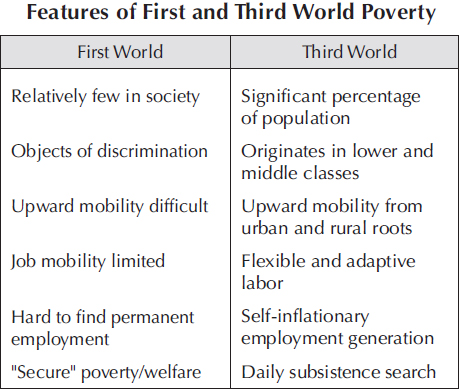
The measure of relative poverty is often in terms not of a material or economic level but of a capacity to own and consume goods and services and to have opportunities for development. It is often an exclusion from opportunity and participation, a marginalization from society.
Relative poverty is a low material standard of living in comparison to present social perspectives of how one should live well within a particular society. To be without a car in a New Zealand city, for example, means one is poor and largely unable to participate in society. This is not true in Lima, Peru. An International Labor Organization study uses a measure of disposable income to establish the standard poverty line, dividing the total available income in the country by the population, thus determining this level relative to others within the nation.
Thus, when talking of poverty in areas with informal settlements, we are generally talking of something that occurs at a level not even to be seen among the poor of a Western country (though this phenomenon is also increasing in the West). The middle class of Calcutta is poorer than the poor of Los Angeles.
In terms of response, it is more fruitful to focus on squatter areas, which tend to be slums of hope.
The definition of poverty is also, to a large extent, a historically perceived issue. The poor of Manila are not as poor as the middle class of England even four hundred years ago. But they are poor compared with the present-day middle class in any country in the world. Our definition of poverty has changed with the availability of technology that enables us to enjoy a healthier and happier life.
Poverty can also be defined in terms of what people and society could be, in terms of a future vision of a reasonable, or ideal, lifestyle. Biblical scholars have recently clustered their definitions around the theme of shalom in the Old Testament—peace that comes out of a just and secure society.
Slums of Despair, Slums of Hope
The physical characteristics and culture of each informal settlement differ from country to country. But the processes that generate them and the resultant evils are universal among the major cities of the Third World countries.
We need to distinguish between established, innercity slums and new squatter communities because the latter are often more open to the gospel.
Innercity slums are decaying tenements and houses in what were once good middle- and upper-class residences. They may be described as slums of despair, attracting those who have lost the will to try and those who cannot cope. Yet here too are the recent immigrants, living near employment opportunities, and thousands of students, seeking the upward mobility of education.
In Sao Paulo, approximately half of the migrant poor that come to the city find their first residence in favelas, or shanty towns. The other half move to the corticos (rundown innercity housing), then within four years move down into the favelas. In Lima these are called tugurios.
In innercity slums of despair, there is little social cohesion or positive hope to facilitate a responsiveness to the gospel. Since they are older poor areas of several generations of sin, they are not responsive and hence do not constitute a high priority for church planting.
In terms of response, it is more fruitful to focus on squatter areas, which tend to be slums of hope. Here, people have found a foothold in the city, some vacant land, jobs, and some communal relationships similar to the barrio back home.
The Task Ahead
Into this urban landscape Jesus speaks the words, “And this is eternal life, to know You, the only true God, and Jesus Christ whom You have sent” (John 17:3). The confrontation of life with death involves aid, development, organization and politics. But the issues of this world are not determined by politics and force, but by the mysteries of grace and faith. In the preaching of the cross comes Jesus, the vanquisher of this slow death that grips the city. Eventually it must be movements of the righteous who can turn the flood tide.
Defining poverty, its types, causes, and potential responses, is an important step in the process of generating such movements. An understanding of the breadth of need and the range of potential responses enables us to reflect God’s heart as we love and serve the urban poor. 
RETURN TO LESSON 12: Christian Community Development
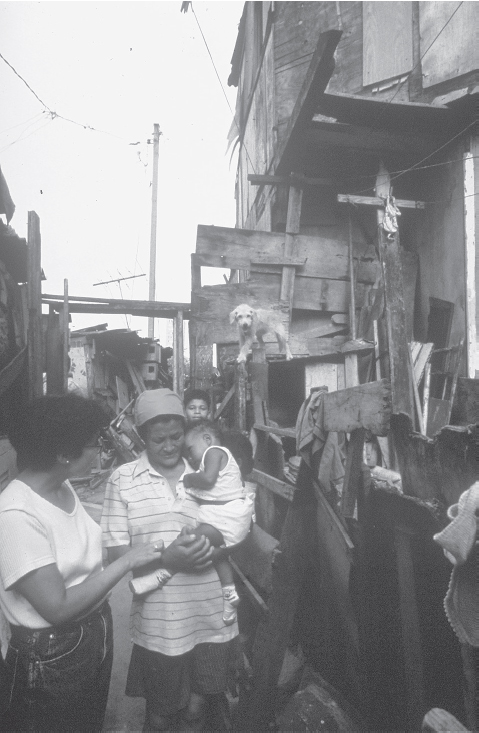
Photo courtesy of International Mission Board, Richmond, VA.