Pigs, Ponds, and the Gospel James W. Gustafson
James W. Gustafson is a founding member and president of Global Development Network, a nonprofit development foundation in Thailand. He spent 27 years as a missionary in Thailand, serving in church planting and community development. He was also the executive director of World Mission for the Evangelical Covenant Church of America from 1998 to 2002.
For decades, Christians have talked about integrating evangelism and development in world mission, but there have been obstacles.
The foremost obstacle perhaps has been a narrow definition of evangelism, limiting it to the verbal presentation of the gospel. The gospel of Jesus Christ, however, is not simply a spoken word; it is a living word. The gospel is life. It is the incarnation of the word of God into the cultures and lives of humankind.
The secular definition of development has been a second obstacle for mission-minded Christians. The secular approach to development focuses most often on economic growth. With the goal of increasing profit, this focus becomes individualistic and often pits entrepreneurs against one another. This emphasis on individualism and self-at-tainment contrasts with the word of God. The Bible focuses on the good of the group, teaching self-denial, and service to others. As Christians, it’s important to remember that our definition of development comes from the principles and values of God’s word, not from Wall Street.
A third obstacle to integrating development with evangelism arises when it is attempted by Christians who are not living out the transformation of Christ in their own lifestyles. I am deeply concerned about what I feel is a departure from the gospel of grace in the church today. Many have been duped by a religious value system which teaches that humans must work at being morally good. It is only as Christians truly understand and believe the gospel of God’s grace—living out that grace in every aspect of organizational life and work—that grace results in the ongoing transformation both of the church and the society around it.
Another obstacle to integrating development with evangelism is that the church is presented in many settings as a cultural foreigner. This is especially true in Global South countries, where local cultures have often been seen by missionaries in the past, explicitly or implicitly, as sinful, while Western church forms were held up as pure. The result was that culturally relevant forms of church life were not explored or established. As a result, Christianity remained foreign to the hearts and minds of the local people.
Integrated Holistic Development
As a missionary for the past twenty-seven years in Northeast Thailand, working in an area known as Issaa n, I was part of a ministry that has sought to overcome these obstacles to integrate development, church planting, and evangelism. Several North American missionaries and a large staff of Northeast Thai are engaged in what we call “integrated holistic development.” It is “development” in that it seeks to transform people from what they are into what they are meant to be in Christ. It is “holistic” in that it deals with the whole person, with all areas of life. It is “integrated” in that all aspects of the ministry are tied together and do not function or exist independently.
The ministry has one primary focus, that of enabling Jesus Christ to be born into Northeast Thai culture. Team members gifted in “holy gab” go out into villages to talk about Jesus. They don’t talk about religion. Instead, they say, “We’re not here to change your religion, because all religions are basically the same; they’re all about making people good.” Then they talk about knowing the Word, the Living Word who is Jesus Christ, Jesus who is above all religions. Many who have responded positively to this method of sharing the gospel were religious people searching for truth, yet not finding it in Buddhism. They agree that they can’t possibly live up to the demands of religion, but by accepting Jesus they can find salvation. These new believers quickly began sharing the good news with their family members and friends. In this way, the church continues to expand spontaneously.
Some of our team members focus on training. They develop contextualized theology and study materials to ground new believers in the word of God. Those who study the materials teach others. Instead of translating English materials into Thai, the team has Thai theologians working with missionaries to write Thai materials for Thai people. This has led to the multiplication of churches.
Our team also has some people who specialize in the arts. It’s their job to get the gospel into the cultural forms and expressions of the Thai people. In these churches gospel stories are told by means of Thai drama and dance forms. Worship songs with Thai tunes are accompanied by Thai instruments. Through all these means, Jesus comes alive to the Northeast Thai and can be understood by them.
The Northeast is the poverty belt of Thailand. There is a great need for development work, but we believe development must serve, not lead. Our development is always based in the local church. It is not viewed strictly as a means of evangelism. Rather, it is seen as a way for the local church to impact the social, economic, and physical lives of the people.
RETURN TO LESSON 10: How Shall They Hear?
The centerpiece of our development work is the Udon Patina Farm, a complex of three different ecosystem farms which demonstrates sustainable agriculture in the region. One of the farms involves a system of fish ponds, ducks, and pigs. When duck and pig manure is composted with grasses on the surface of the ponds, the fish thrive on the phyto-plankton that multiply. Pond water and dead fish provide organic fertilizer for the grasses and trees growing along the pond dikes. Ducks also feed on pig manure. The pigs, fish, and ducks can be used for food or sold for profit to support the church work. These farms are the models for cooperative projects undertaken at the village level.
A Cooperative Project in Action
The village of Nong Hua Koo provides a good look at a cooperative project in action. Kitlow is a typical villager. He is a tenant farmer on someone else’s land. Since half of his harvest goes back to the landlord, he was constantly in debt to moneylenders. His children often did not have enough to eat. Wunde is typical as well. Although he owns a small rice field, the climate and the soil of the region are not good for growing rice. He, too, was often forced to borrow from moneylenders to make ends meet until harvest. With interest rates of 120 percent or more, it was impossible to make a decent living. The Issaan Development Foundation approached the church where Kitlow and Wunde are members. They offered help to start a fish-duck-pig cooperative. The foundation would lend the initial stock of animals, provide training in the business, and donate a grant to buy land. For their part, co-op members would find land for sale, build pig and duck pens, dig a fish pond, and agree to work together. Eventually, they would pay back the loan with their own animals.
Kitlow’s and Wunde’s families, along with five others, accepted the offer. Now that the co-op is established, each family works for it one day a week. From this, they earn enough selling pigs and fish to avoid moneylenders. They don’t go hungry because they eat about half the fish they raise. They tithe their profits to the church and also use another 10 percent for village projects like stocking the pond used for fish for the elementary school’s lunches. Neighbors notice not only the generosity but the unusual cooperation as well. They see members filling in for someone who is sick or less able, yet still sharing the profits equally. Village cooperatives like this one improve the economic situations of participating families and provide resources for the church. Most importantly, they provide the opportunity for members to live out their faith—learning to love, serve, and forgive each other.
In addition to agricultural projects, the foundation also helps local churches impact their communities with vocational training in skills like sewing or mechanics, with primary health training, and with meeting the basic needs of the rural poor. All the programs focus on the participation of groups of people rather than individuals. In this way, new communities are being established in Northeast Thailand filled with people who are being transformed. The people grow in a new relationship with God, with others and with nature. In response to God’s grace, they develop a dynamic new lifestyle, the result of a change in their entire value system.
There are seven basic principles at the heart of this ministry:
1. Authority
Central to all of our activities is a firm belief in the authority of the word of God. The gospel of God’s grace, with all its implications, forms the set of beliefs on which all policies and practices of the ministry are based.
2. Integration
Every aspect of the ministry is tied together by the grace of God. We manage our organization and our lives by grace. We plan, implement, evaluate, and correct problems by referring to the principle of grace as our model and guide, by depending on the power of grace.
3. Flexibility
We try to do everything possible to allow God’s grace to be communicated to the Northeast Thai. To reach that goal, we are willing to change anything and everything about our organizations if necessary.
4. Contextualization
People communicate clearly only if they share a common culture. Effective communication is what is understood, not necessarily what is spoken or meant. Thus, the worship and life of the local church, as well as the structure and management system of the development programs, have grown out of local Northeast Thai culture.
5. Power Encounter
As the gospel of grace is incarnated into Northeast Thai culture and into every area of our ministry, it is brought to bear on the local cultural value system in a powerful and effective way. The result is transformation at the level of values and mindsets.
As the local church in every culture is enabled and equipped to reach into its own context with the power of God’s grace, evangelism and development will merge to bring about the true transformation of society.
6. Process/Broker Approach
The institute and foundation are in a process/broker relationship with the local church. Process means going “down and in.” Development starts with people themselves, especially with the poor at the bottom of society. It begins with dialogue that involves them in a participatory approach. The broker function involves going “up and out.” The foundation can link local churches to outside settings and resources. It can assess markets as well as research technology.
7. Local Church Focus
The local church as the basic unit of Christian society is the obvious starting point for holistic development. The final goal is that the local church become the local development organization that impacts its own larger community with the transforming power of God’s grace.
This ministry has not been without problems. The first was the tendency to grow too large. An increasing number of staff meant that the basic philosophy behind the work became watered down, especially in the lives of those at the periphery. When we reduced the size of the organizations, we were able to realign ourselves with our basic core values. As we had grown larger, there was also a tendency to have the financial support of the organizations become the highest priority. When we found that we were more focused on support for operational costs than on mission, we knew we must cut down to a more manageable size.
Another problem was a failure to relate honestly and to address wrong values in ourselves and in others. Thai culture, just like Western culture, has a natural tendency to avoid such encounters. We needed to learn how to talk to each other and to counter each other in love. Other problems in our work could be mentioned, but they all come back to the central point: the more we have learned to deny ourselves, to accept our weaknesses, and to depend on God in every detail, the more we have found His wisdom and strength to be sufficient for all our needs.
The role of mission agencies, Christian aid agencies, and local development organizations includes the ongoing integration of evangelism and development at the local church level. Both elements are critical ingredients of the mission of the church, and this is where the transformation of society begins. As the local church in every culture is enabled and equipped to reach into its own context with the power of God’s grace, evangelism and development will merge to bring about the true transformation of society.
RETURN TO LESSON 12: Christian Community Development
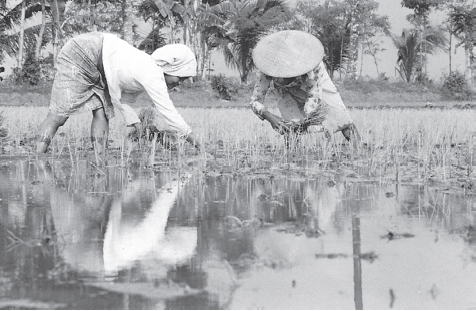
Photo courtesy of World Vision International, Monrovia, CA.