7 Eras of Protestant Mission History

Studying this lesson will help you:
- Recall the approximate dates, emphasis, leaders, and student movements associated with each of the three eras of Protestant mission history.
- Explain the four stages of mission activity.
- Explain the tensions of the transitions between the three Protestant eras.
- Use the E-Scale to describe the cultural distance of missionaries from their intended hearers.
- Use the P-Scale to describe the comparative sociocultural distance of would-be followers of Christ from existing churches.
- Describe the increase of the non-Western missionary force in recent years.
- Define “people blindness.”
- Describe the shift of Christianity to the Global South.
We have surveyed the expansion of the World Christian Movement through the major epochs of the last two millennia, focusing on the extension from one cultural sphere to another. In this lesson we’ll focus on how that continuing expansion became an explosion during the last two hundred plus years.
The pace of growth is accelerating so quickly that more people have followed Christ in the last one hundred years than in all the previous centuries combined. And there are more people alive today who call themselves Christians than in all the previous generations combined. The majority of those who name the name of Christ are from the Global South. Christianity has become a truly global movement, with its most vibrant and growing churches flourishing in the Global South.
At times, this phenomenal expansion has nearly brought itself to a halt. Whenever the harvest is great, growing crowds of new Christians often make demands upon missionaries for nurture, training, and strengthening in the faith. This can deflect the attention of missionaries away from other regions or peoples that have yet to hear. Were it not for the many determined leaders whose minds were set on finishing the entire task of world evangelization, the movement might have stalled long ago. We’ll examine some key figures and features that have kept propelling wave after wave of workers to the least evangelized places.
Why dig into these episodes of history? Because we stand at a critical moment. The entire World Christian Movement is focused on completing the evangelization of all peoples and places. But legitimate demands of our homelands and home churches can easily deter us from the difficulty of the remaining task.
Finishing
Some set their hearts on finishing what God has begun. They are the ones who come to know something of the expanse of God, who is the Beginning and the End of all that lasts. It should be no surprise that these finishers are actually the ones who begin the things that matter. They order their steps with strategic simplicity, not hesitating nor hurrying but tenaciously continuing to do whatever it takes to finish the task God has given them.
We’ve already begun to explore a thrilling phenomenon in our day: Mission workers are not only going to every part of the world—they are coming from every part of the world. Missions and churches of the Majority World in Latin America, Asia, and Africa are the new vanguard of missionary sending.

I. The Stages of Protestant Expansion
During its first two hundred years, the Protestant movement did nearly nothing to bring the gospel to the nations. After mission structures were launched, and with years of painstaking effort, the first wave of Protestant missionaries began to see the fruit of their labors. Much of the early success preoccupied missionaries with the care of new converts. The demands of nurturing the growing churches often hindered missionaries from pushing on to lesser-evangelized areas. While many were dealing with the needs of younger churches, other visionaries recognized new mission frontiers and called for new ventures.
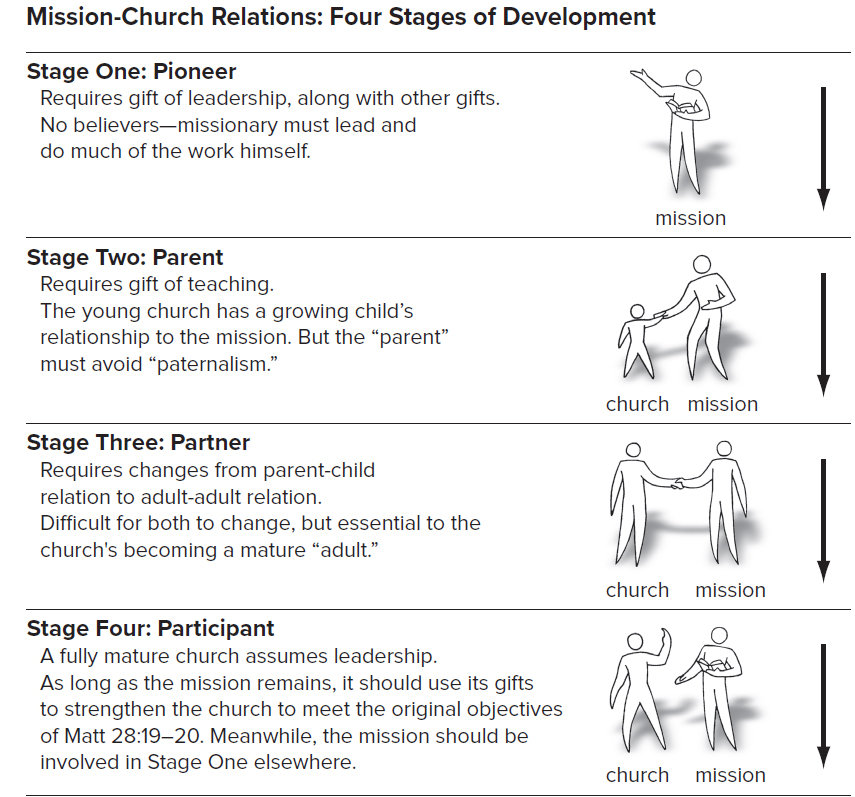
A. Four Stages. Most mission efforts pass through four stages of development in the relationship between the mission agencies and the national churches they seek to plant. Understanding these stages will help us recognize why churches and missions often pursue different mission priorities. Missionaries themselves struggle to prioritize the allocation of limited resources. Crucial decisions rest on “identifying the maturity level” of the new church and weighing its demands against the priority of evangelizing the unreached.
1. Pioneer Stage—first contact with a people group.
2. Parent Stage—expatriate missionaries train national leadership.
3. Partner Stage—national leaders work as equals with expatriates.
4. Participant Stage—expatriates are no longer equal partners but only participate by invitation.
B. Three Eras. Ralph D. Winter presents the development of the Protestant mission effort in three bursts of activity. Each of these surges focused on bringing the gospel to unevangelized parts or populations of the world. These bursts of activity have come to be known as the “Three Eras” of modern missions.
1. The First Era: To the Coastlands. William Carey did more than any other person to lift the vision of Protestants to the importance of fulfilling the commission of Christ. But Carey also saw the crucial need to form mission structures. Carey’s Enquiry had widespread influence, awakening mission interest in Europe and in other parts of the Protestant world. Most mission structures of this era emerged from Europe with ties to denominations.
The location of Carey’s mission to Serampore, India, was typical of many of the mission efforts of that day. First Era missions primarily operated in the coastal trade cities of the colonial powers; thus, it can be generalized that they focused on the “coastlands.” There were two important features of this era: an astonishing readiness to sacrifice and keen insight into mission strategy.
2. The Second Era: To the Inland Areas. Hudson Taylor was one of the most influential leaders of the next era. He called for efforts to complete the task of evangelizing the inland areas of China that were largely untouched by the gospel. Eventually, he felt he had to launch a mission structure to carry out this focus. The newly formed mission was typical of the many “faith missions” that arose during this time, which were independent of denominational control. The recruits of this era sometimes ignored much of the developed missiological wisdom of the earlier era but eventually planted churches in almost every geographic region. By 1940, the reality of the establishment of churches in every part of the world was celebrated as the “great new fact of our time.” To many, world evangelization appeared to be virtually finished. Some missions began to bring missionaries home from mission fields, presuming that the day of missions was over.
3. The Third Era: To the Unreached Peoples. This era was set in motion by Cameron Townsend and Donald McGavran, clarified by a fifth figure: Ralph D. Winter himself. Townsend focused attention on the linguistic groups lacking a Bible translation, and McGavran pointed out bypassed social groupings. The two approaches were ethnolinguistic (“horizontal” groupings viewed by linguistic or ethnic differences) and sociocultural (“vertical” groupings taking into account the subtle cultural traditions and social prejudices). These two ways of viewing the mission turned the question from “where?” (or in what place mission was being done) to the question of “whom?” (or for what people was mission being directed).
McGavran focused on studying people movements, which drew attention to people-specific mission, churches, and priorities. By focusing on the languages that lacked translations, Townsend turned attention toward the linguistically defined groups that had not been evangelized. But it was Winter who brought the insights of McGavran and Townsend together, using McGavran’s idea of people groups and extending Townsend’s idea of which peoples lacked sufficient testimony to follow Christ. Winter distinguished which people groups had already been evangelized to the point that the gospel would continue to spread without outside help and which people groups would require a special mission effort to bring about a sustainable movement to Christ. Winter and others developed the term “unreached peoples.” Many new service and mobilization mission structures emerged. Non-Western or Majority World mission agencies are beginning to surpass the numbers and influence of earlier missions. Decades ago, McGavran would sometimes declare that the present hour was the sunrise, not the sunset, of missions.
C. A Doable Task. Winter presents the hope that this could be the final era in which the task of establishing church movements in every people is completed. We can speak of this being the final era because this task is a once-in-history achievement. Never has the global Christian movement been so close to finishing this task.
1. One Global Movement. Winter pointed out that since the task has always been a global task, we should expect non-Western mission efforts to play an increasingly major role.
2. The Rise of Non-Western Missions. Winter characterizes the First Era as a time when European missions were prominent. During the Second Era, American missions played a major role. Decades ago, Winter foresaw that non-Western missions would eventually become more numerous and influential than either European or American missions.
II. Non-Western Pioneers Leading the Way
Yvonne Wood Huneycutt walks through the three eras that Winter laid out in his article, adding important details. However, her primary focus is the unique characteristics of the Third Era, including the important role that Winter played in this era.
A. Two Transitions Between Eras. Perhaps the most important aspect of Winter’s analysis of Protestant missions that Huneycutt explains is the tumultuous transitions between the eras. Each of the explosions of Protestant mission vision for the frontiers has roughly proceeded through the four stages of development (pioneer, parent, partnership, and participation). However, the overlap of these eras has resulted in confusion. In some cases, because of the success of the previous era, some missionaries were recalled and some declared that missionaries were no longer needed. At the same time, others envisioned new frontiers that demanded new workers. The pressing need in pioneer fields is for missionaries to complete their roles in the pioneer and parent stages. After that point, many missionaries need to move on to other unreached peoples or strategically serve in the partnership and participation stages, encouraging the national church toward developing its own pioneer missions.
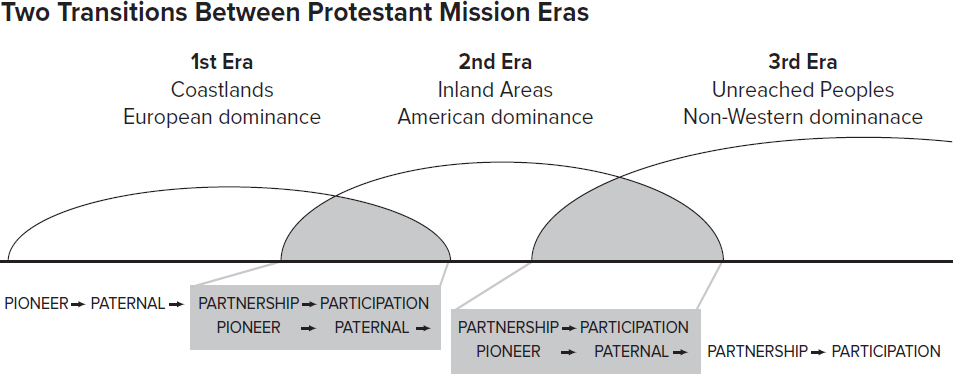
Periods of conflict and confusion of mission priorities during overlap of the Eras
B. Majority World Missions in the Second Transition. Huneycutt highlights Winter’s prediction that non-Western, or Majority World, missions would become increasingly important in the final era. Huneycutt explains that the present transition has additional complexity because of the welcome rise of Majority World missions. Majority World mission efforts are displaying the same kind of bold, finish-the-task vision of earlier eras, with a resolute focus on finishing the task of evangelizing earth’s remaining unreached peoples. But missions from the Majority World are facing two broad issues that tend to prolong conflict or confusion about mission priorities:
1. Widening the Mission? Huneycutt says that Majority World missions will find it challenging to prioritize the initial planting of churches among all peoples. The need to mobilize churches to carry out the responsibility of working toward justice and righteousness in their own societies seems to be a competing priority. There is no question that working toward justice and the transformation of society should be considered part of the mission of existing churches. The issue is how to prioritize finishing the global task of world evangelization.
2. Narrowing the Mission? Huneycutt points out another area of confusion that is especially pertinent to Majority World sending structures. Many of these missions are based in countries such as India, Indonesia, or Nigeria, which have many unreached people groups within their borders. The natural sense of responsibility for people groups within one’s own country can become a limiting factor if peoples in other countries are never considered. Christians from every country share the responsibility to see the entire world evangelized. Says Huneycutt, “[The Majority World] has not been given a minor commission but a Great Commission” (p. 269).
C. The Central Role of Local Leaders in Each Era. Winter and Huneycutt highlighted the contributions of several key expatriate missionary pioneers. However, merely highlighting the headlines and major contributions of each of these men might make it seem like they were operating alone. Although pioneers might begin only with an expatriate community supporting and caring for them, no enduring work happens without the contribution of local leaders. From the beginning, missionaries have employed strategies aimed at moving through the four stages of development, raising up local leaders and local churches. Pam Arlund helps provide a fuller picture of each era by accentuating the contributions of some of the local partners who helped establish a lasting, local work in each era.
III. Advance to and from Latin America God’s work in Latin America started later than in Asia and Africa, but the gospel has long been flourishing throughout the continent. Two Latin American leaders present the story of how lands claimed by empires eventually became fertile ground for gospel growth and missionary sending. Through two great movements—the arrival of Christianity by Catholic conquistadores and the later emergence of vibrant Protestant and Pentecostal witness—God has moved through flawed vessels to sow seeds of lasting spiritual transformation. Now, the region stands not merely as a recipient of the gospel but is taking a leading role in advancing the gospel of Christ throughout the world.
IV. The New Macedonia
In 1974, Ralph D. Winter addressed the Lausanne Congress on World Evangelization in a way that brought much-needed light to the confusion of the second transition. By calling for a new thrust of mission to the bypassed people groups, Winter helped many recognize the malady that he called “people blindness.” Winter later titled his paper “The New Macedonia,” after the call for help in Acts 16:9. The influence of this address has been widespread and long-standing. You will read only a portion of it here.
A. To Finish the Task. Winter identifies three different kinds of evangelism, distinguished by the cultural distance that the evangelist spans in communicating effectively with intended hearers.
1. The “E-Scale” has been a widely used reference tool for describing and comparing evangelistic difficulties and needs.
- E-0. Evangelism of people who are part of Christian families and churches. It is basically rebirth and renewal within the church. No real cultural barriers are crossed.
- E-1. Evangelism of people outside the church but within one’s culture. Only one barrier is crossed: the membership boundaries of the church. This kind of evangelism is the “most powerful” because people are far more likely to understand what is being communicated in ways that they can pass on to others like themselves.
- E-2. Evangelism of people from different but similar cultures. Two barriers are crossed: the barrier of belief in Christ and an additional cultural distance sufficient to require separate church fellowships.
- E-3. Evangelism of people from radically different cultures. To emphasize the greater cultural distance of an evangelist attempting to communicate in a different and potentially hostile environment, it is suggested that evangelists attempt to cross at least three barriers in E-3 efforts. For example, for a Ugandan to work with an Asian people group, it would require crossing the church membership barrier, a language barrier, and a major lifestyle barrier. E-3 is the most difficult kind of evangelism.
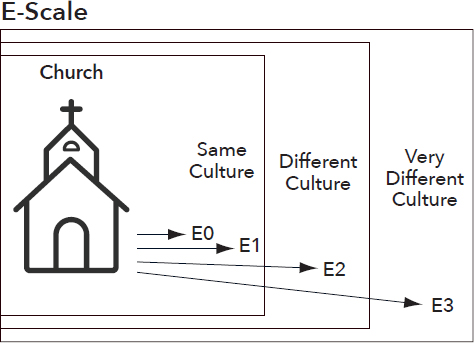
2. Cultural Rather than Geographical Distance. Winter uses Acts 1:8 as a rough parallel to the distinctions of the E-Scale. Geography does not matter nearly as much as the breakthrough to culturally different people groups.
B. The Master Pattern of Evangelism. This was, according to Winter in 1974, “first for special E-2 and E-3 efforts to cross-cultural barriers into new communities and to establish strong, ongoing, vigorously evangelizing denominations, and then for that national church to carry the work forward on the really high-powered E-1 level” (p. 237). E-3 evangelism is essential so that the more powerful E-1 evangelism can be conducted by the newly planted churches.
C. People Blindness. This refers to a limited outlook that fails to notice the subgroups within a country. This blindness is a significant barrier to developing an effective mission strategy. Society should be seen, as McGavran suggested, as a complex mosaic of peoples. God loves and values each people group within the larger mosaic of society.
D. The “P-Scale” was also developed by Winter years after the Lausanne Congress in 1974. The P-Scale looks at evangelization from the vantage point of unevangelized peoples. It evaluates the cultural distance that potential converts need to move in order to join the church most relevant to their own culture. It’s important to grasp the difference between the E-Scale and the P-Scale. The E-Scale gauges the cultural distance crossed by those who do evangelism. The P-Scale looks at the cultural distance that those who are evangelized would be required to cross in order to be part of an existing church. The P-Scale and E-Scale correspond to the barriers dubbed the “Wall and the Canyon” by Hawthorne (pp. 100–101).
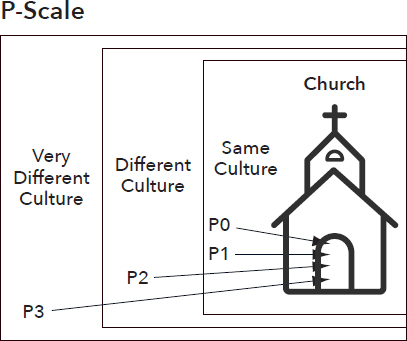
- P-0. Identifies church members who need spiritual renewal. No distance lies between them and following Christ according to the customs of their church. It is more a matter of revival.
- P-1. Identifies people who live in cultures that have a culturally relevant local church movement capable of evangelizing them.
- P-2. Identifies people who live in a culture that has no church relevant to their people group, but there is a church in a “near” culture. To follow Christ, the potential convert would have to cross both a cultural barrier as well as the belief barrier by adopting the social and cultural values of a local church within a people other than their own.
- P-3. Identifies people who live in a culture without a relevant church. There are no nearby cultures similar to their own within which churches have been established. To follow Christ, they would have to surmount significant cultural and social boundaries.
V. The Bridges of God
Donald A. McGavran is one of the previously mentioned pioneers who set in motion the Third Era of Protestant missions. We will read an excerpt from his influential book The Bridges of God. His lasting contribution is the call to evangelize entire peoples who are culturally isolated from the gospel.
A. Western Individualism. The presumptive individualism of the West means that many fail to recognize that most of the people throughout history who have become Christians have done so with their friends, family, and clan. Because one doesn’t easily distinguish between peoples, collective movements are sometimes not recognized.
B. Peoples and Multi-individual Decisions. McGavran defines what is meant by “a people” and describes the dynamic of group decisions to follow Christ.
C. People Movements. These movements—marked by a group decision to follow Christ but also to retain their identity and social relationships as a people group—should intentionally be sustained and nurtured to maturity. Bringing about “a people movement to Christ” is McGavran’s original phrase. This is another way to describe the essential missionary task as mentioned by Winter.
Do you not say,
“There are yet four months, and then comes the harvest”? Behold, I say to you, lift up your eyes and look on the fields, that they are white for harvest.
Already he who reaps is receiving wages and is gathering fruit for life eternal;
so that he who sows and he who reaps may rejoice together. For in this case the saying is true,
“One sows, and another reaps.”
I sent you to reap that for which you have not labored; others have labored, and you have entered into their labor. (John 4:35–38)
Jesus took His followers on a training mission to Samaria. He wanted them to see the immensity of the harvest as well as the interdependency they would need to complete the task. Read Jesus’s words in John 4:35–38. What does it mean to “enter the labor” of another person? Have you ever done this? Is it possible for you to take part in the huge harvest ahead without involving the partnership of other generations or cultures?
VI. The Growing Non-Western Mission Force Beram Kumar and Bruce Koch describe the maturity, vigor, and diversity of the non-Western mission force.
A. Already Effective. Kumar highlights how non-Western missionaries are already especially effective because of trends such as migration and increasing government restrictions. Non-Western missionaries have been particularly effective in the midst of crisis and disaster relief and in settings in which only transnational tentmaking teams can function well. Kumar calls for an increase in partnership between missions of the West and their non-Western counterparts as equal and able partners. He anticipates a powerful end-time harvest as these partnerships increase.
B. Already More Missionaries from the Non-West. There is a difference between foreign and cross-cultural mission. Foreign mission means working in another country. Cross-cultural mission does not only take place in foreign countries. Many non-Western missionaries do cross-cultural work in their home countries. Some estimates of the numbers of Western and non-Western missionaries only considered whether the missionaries were foreign. When the totals of missionaries from the West and from the non-West include both foreign and domestic cross-cultural workers, it becomes clear that the number of non-Western missionaries is growing at a much faster rate than many realized—as much as eight times faster than those from the West during the 1990s. It has been projected that the number of non-Western cross-cultural missionaries surpassed those from the West sometime around 2005.
 Conclusion of Certificate Readings for this lesson.
After studying this section you should be able to:
- Describe a “people movement.”
- Describe the phenomenon of “new Christianities.”
- Explain how Christian mission is moving from the non-Western world.
- Explain the significance of the Student Volunteer Movement’s watchword.
VII. The Coming of Global Christianity
In recent decades, the tremendous growth and diversity of Christian movements in the Global South means that the stereotype of Christianity as the religion of the “West” is no longer a reality. Not only are there more Christians than ever before, but there are also more cultural forms of Christianity than ever before. No longer is mission flowing from “the West to the rest.”
A. The Shift to the South. Philip Jenkins says that in the last century, the “center of gravity” of Christianity (that is, the bulk of the number of followers) gradually shifted to the south, away from the northern areas of Europe and North America. Already, the largest Christian communities are in Africa and Latin America. Looking ahead, it is important to note that the increase in numbers is only one aspect. The changes of the coming decades will be much more sweeping than an increase in numbers. Expect many different patterns, styles, and forms of Christianity to be practiced.
B. New “Christianities.” Todd Johnson and Sandra S. K. Lee follow the trends of recent growth of the Christian movement. In the past century, the gospel has grown rapidly in Africa, Latin America, Asia, and Oceania—what is often called the Global South. As non-Western churches, theologies, and mission efforts continue to increase, new cultural forms of Christianity will likely emerge with different relationships with non-Christian neighbors. We should expect, according to Johnson and Lee, “new cultural forms of Christianity” or “Christianities.” For global Christianity, this “astonishing diversity” presents both great peril and opportunity.
VIII. Farewell to “The Great Century”
We return to McGavran’s assessment of the strategic approach in the first two eras of Protestant mission. We need to understand this pattern well so that we do not inadvertently slip into an approach that fits the colonial era. Western individualism, when combined with a sense of cultural superiority, can sometimes divert well-intentioned missionaries into repeating a subtle form of the mission station approach. Many of the early workers of the Second Era ignored both the hard-won wisdom of First Era missionaries and the lessons to be gained from mistakes.
A. Across the Gulf of Separation: Exploratory Mission Station Approach. Missionaries encountered great cultural differences. The usual approach was to establish a mission station and draw converts in a “gathered colony” style. The pattern of conversion was extraction from family, culture, and relationships. Evangelism was slow and often reached some of the least influential members of the community.
B. The Fork in the Road: Mission Station or People Movement? Hopes for large movements were often frustrated because of the vicious cycle of extracting converts out of their people. This led to a meager response, which in turn produced a mentality that abandoned the vision of large people movements following Christ. In contrast, there were several significant occasions of people movements. These were usually not sought by the missionaries and, in fact, were often resisted by them.
C. Resulting Churches Contrasted: Gathered Colony Versus Christward Movements. Gathered colony churches are dependent on missionaries. McGavran describes how missionaries were somewhat successful during the First and Second Eras but came to be inundated by demands of pastoring and governing the institutionalized churches, schools, and hospitals that were established (p. 231). There was often a vested interest in the status quo and little sustained effort to evangelize beyond the immediate vicinity of the mission station. In contrast, the Karen and the Chura case studies exemplify the dynamism of people movement churches (pp. 231–32). Take note that in both cases, an early convert from their people was far more influential than the foreign missionary. In both cases, missionaries (even the notorious Adoniram Judson!) were doubtful of the value and appropriateness of these movements. God blessed the movements anyway. McGavran’s point is that missionaries must now recognize the beginnings of such God-given movements and seek to enhance them.
IX. Student Power in the Three Eras
The three great waves of Protestant missionaries did not suddenly appear out of thin air. Their work was always birthed and marked by sustained united prayer and the mobilizing zeal of students. Winter has observed that a student movement was associated with each of the eras.
A. First Era Fuel: The Haystack Prayer Meeting. Samuel Mills, impacted by the Great Awakening, joined other students in a gathering that met by a river, and during a storm, they took refuge under a haystack. This particular meeting was the initial impulse for much of the early American missionary enterprise. They formed “The Society of the Brethren” with the goal of mobilizing others.
B. Second Era Fire: The Student Volunteer Movement (SVM). David M. Howard says that no single factor has wielded a greater influence in the worldwide outreach of the church in modern times than the SVM. Their watchword was “The evangelization of the world in this generation.” Howard describes the decline of the SVM because present-day movements could repeat the same mistakes.
C. Third Era Fusion: The Student Foreign Missions Fellowship (SFMF) and InterVarsity Christian Fellowship. The SFMF was formed specifically to continue and extend the mission mobilization vision of the SVM. A few years later, the SFMF became the Missionary Department of InterVarsity Christian Fellowship, widely known for the Urbana student missionary conventions. Other structures continue to mobilize students, lay people, and local churches. Mobilization of missionaries in non-Western countries is being done by a multitude of diverse movements.
X. New Sending Movements
It is good to be acquainted with the scope and growth of global movement that you are part of. As one person put it, mission is no longer “from the West to the rest.” We live in a time of new sending movements from different parts of the world. Several non-Western leaders briefly summarize how mission is emerging from their part of the world.