CHAPTER 60
Beram Kumar

Beram Kumar is the executive director of Strategic Missions Partnerships (STAMP), a missions agency focused on reaching unreached people groups (UPGs). STAMP is involved with UPGs from 14 countries in Asia. Kumar is also involved with a number of other regional and global efforts including SEALINK (Southeast Asia UPG Network) and Tentmakers International Movement.
I have heard the phrase “emerging leaders” used many times to describe church leaders from the Global South.
I am constantly amused by this phrase, which has been used for the last thirty-plus years. Surely these “emerging leaders” have emerged by now. Consider the leaders of the Korean church, which has seen a third of its population now professing to be Christian believers. Or consider the Indian church with thousands of church planters working across the country and beyond. Or consider the South American church that has sent workers beyond the Spanish-speaking world to the Middle East and Asia. Or think of the Chinese church, whose growth long ago surpassed Communist Party membership. Many other amazing things are happening in the Global South. How can we continue saying that these leaders are “emerging?”
For over forty years now, the Global South has been home to more Christians than the Global North. Two-thirds of the global church now live in the Global South. How can this be, if their leaders were still just emerging? Sadly, this outdated perspective has now spread to the more affluent leaders of urban centers in the Global South as well. I hear leaders of urban churches in the Global South refer to some of their rural and tribal coworkers as “emerging leaders.” Many of the pillars of these urban churches, oddly enough, are leaders who moved from rural areas to the cities to work and serve the Lord. They were not “emerging” before moving to the city and supposedly “emerged” when they arrived in the city. In reality, they were already leaders before moving to the city. The Lord’s table is big enough for all of us. There are no first-class versus economy-class seats. We all sit as equals, whether from the north or south, regardless of whether we live in the city or the countryside. We are invited to rediscover in the days ahead the depth of our Lord’s amazing prayer, that the Father will make us one. As the Apostle Paul wrote to the church in Ephesus, He is our Peace, who has broken down every wall and made us one (cf. Eph 2:14). What amazing days lie ahead of us. Days when we become true colaborers in His kingdom.
We can already see glimpses of this. The mission networks that I know and am involved in are already led by leaders from both the north and south, seated as equals around a round table. We have also the fruit of the last forty-plus years of prayer for a move of God among every people group. We are now tracking thousands of movements emerging, almost all of them among unreached peoples. This can only be God’s hand at work. It would not be humanly possible, even with the brightest minds and great-est strategists, to see what we are seeing among some of the least-reached peoples of the world. Communities of disci-ples are going out and building another community of disciples, who in turn go out and build another, and on and on, with each community of disciples forming house churches contextually relevant to their situation. All these movements have a role for everyone. An outsider may bring the gospel seed that catalyzes these movements, but leadership arises from inside the movement itself. No one is tagged as “emerging.” We immediately recognize God’s hand on these leaders as we see Him trusting these new leaders to shepherd thousands of others.
We immediately recognize God’s hand on these leaders as we see Him trusting these new leaders to shepherd thousands of others.
For too long “emerging leaders” has often meant, “They are great but not yet where we are.” We are now seeing this attitude breaking down more and more. I truly believe we will experience greater days ahead, as we all take our rightful role in bringing all peoples to know the glory of Jesus! 
CONTINUE READING Sidebar: The Surging Non-Western Mission Force
The Surging Non-Western Mission Force Bruce A. Koch
Bruce A. Koch has served with Frontier Ventures since 1988. In 1991, he participated in an ethnographic survey of a large unevangelized city. He served as the associate editor of the third and fourth editions of the Perspectives curriculum. Since 2012, he has led the Perspectives Global Service Office.
In a book titled From Every People, Larry Pate made a bold projection in 1989.1 He estimated that by the year 2000 the majority of Protestant missionaries would be from the non-Western world. This startling projection created great interest and was often quoted.
We are greatly encouraged and challenged by the commitment of the church in what is now “the Majority World” to finish the task of world evangelization.
In 2004, Michael Jaffarian pointed out that Pate’s projection compared the total of both foreign and domestic missionaries in the non-West with only foreign missionaries from the West.2
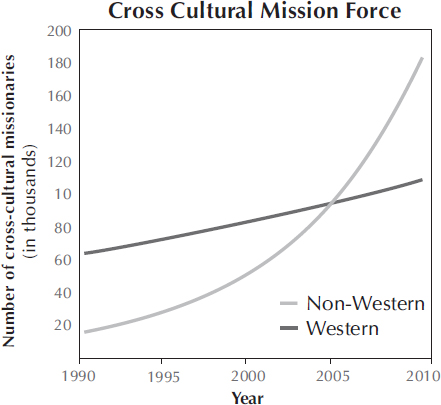
To correct the distortion, Jaffarian compared only the foreign missionaries from both worlds. His results showed that the non-Western foreign mission force had grown by a very impressive 210 percent from 1990 to 2000, compared to a 12 percent growth in the Western foreign mission force. Nevertheless, in the year 2000, the Western foreign mission force was still more than 3.5 times larger (70,000) than its non-Western counterpart (20,000).
Jaffarian’s analysis raised the question, “What would we see if we compared totals of both foreign and domestic cross-cultural missionaries?” Such a comparison would effectively ignore the factor of crossing borders. Making the same adjustments that Jaffarian made, I found that between 1990 and 2000 the Western cross-cultural mission force was only 56 percent larger, instead of 350 percent larger as Jaffarian had found when comparing only foreign missionaries. During this decade the non-Western force grew eight times faster than its Western counter-parts. By projecting the two growth rates to 2010, I produced the graph to the right. While Pate’s method may have been flawed, he was correct in alerting us to an un-deniable trend. If the reported data was anywhere close to reality, Pate was not far off. The cross-cultural mission force from the non-Western world may have surpassed the cross-cultural mission force from the traditional Western sending countries sometime around 2005.
I had hoped to update this analysis with more recent data from Operation World, the source that Jaffarian and I used. Unfortunately, it is no longer possible to get reliable data on missionary sending because of security concerns and the highly decentralized, less institutional modes of sending from the non-Western world. But by all accounts, the trend continues to be an observable reality.
We are greatly encouraged and challenged by the commitment of the church in what is now “the Majority World” to finish the task of world evangelization. As Beram Kumar points out, the non-Western mission force is no longer emerging—it is surging.
RETURN TO LESSON 7: Eras of Protestant Mission History
Notes
1. Larry D. Pate, Every People: A Handbook of Two-Thirds World Missions (Monrovia, CA: MARC, 1989), 47, 51, 54.
2. Michael Jaffarian, “Are There More Non-Western Missionaries than Western Missionaries?,” IBMR 28, no. 3 (2004): 129–30.