CHAPTER 59
Jason Mandryk

Jason Mandryk leads the Operation World team and is the author of the seventh edition of the publication of the same name. He has served with WEC International and Operation World as a researcher, analyst, and writer since 1995, focusing on global trends in religious demographics, mission, and prayer movements.
This article was originally inspired by a talk given at the Lausanne Younger Leaders Gathering in 2006. It has subsequently taken different forms, including the following iteration, updated in 2024.
Before examining a topic so weighty, we do well to remind ourselves that the gospel is spread through the work of the Holy Spirit and is not primarily the work of man. The gospel itself is eternal, unchanging, powerful, and entirely within the purview of a sovereign God. There can be no doubt as to “the state of the gospel”—it is very much alive and well!
With that in mind, then, we turn to the state of our task—how far have we come, and how far must we still go, to fulfill the Great Commission? There is much to celebrate in our generation, but we temper this with the reality that billions of people—from thousands of different people groups—have not yet had an opportunity to worship the Lord Jesus, or for some, even to hear about Him in a meaningful way. We educate ourselves on the progress and challenges of the modern global church in order to think, pray, and act strategically regarding mission.
The State of Global Christianity
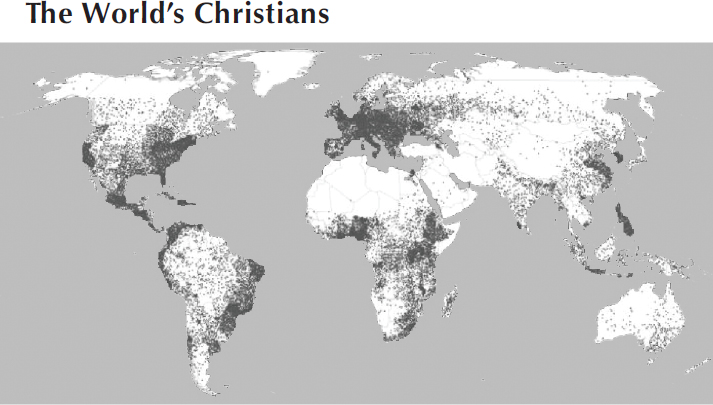
By analyzing the geographical spread of the world Christian population (in relationship to that of other world religions), we see that Christianity—unlike any other religion—has truly spread throughout the earth. Christianity is no longer primarily a Western phenomenon. The world Christian population now spans six continents, reaching deeply into Latin America, Africa, and Asia. In every single country, there are groups of Christians gathering together to worship and follow Jesus. Our faith is truly global.
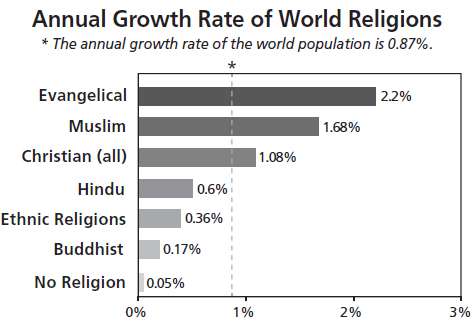
There are more Christians alive in the world today than at any other time in history; nonetheless, Christians comprise roughly the same percentage of the world population as before. In 1900, the world population was 34.4 percent Christian, compared to only 32.2 percent in 2000.1 That is not much change—actually a slight decrease. Generally, the world’s population growth rate and the overall growth rate of Christianity as a whole have remained parallel for the last 120 years. On the other hand, our research leads us to believe that the annual growth rate of evangelical2 Christianity globally is currently greater than any world religion, including Islam. Much of the evangelical Christian population growth is due to an increase in new adherents, whereas nearly all of the growth of Islam is due to high birth rates.
The statistics only bear witness to one dimension of the marvelous story unfolding among the peoples of the earth. Now within thousands of different cultures, we find distinct expressions of Christian faith. The building we enter, our portrayal of Jesus in visual media and art, the style of our worship, and our practice of prayer—all these vary from place to place, as do the people with whom we gather, the size of the gatherings, and the liturgy we share. Our faith is one of amazing diversity.
Christianity in the West
Nearly all the early fathers, great reformers and icons of the modern missionary movement represent Western cultures and civilizations, exemplifying the strength of an earlier Western church. Sadly, Christianity in the West is now experiencing significant statistical decline. The last hundred years brought a monumental transition: Western Christians now constitute a minority of the world church.
Europe
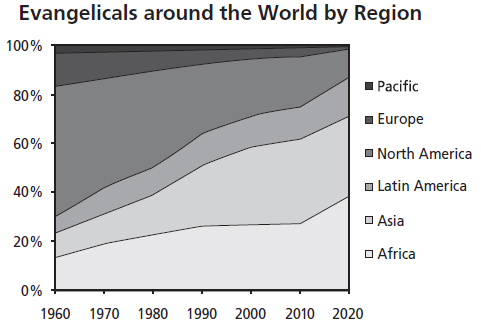
European Christians have declined from around 70 percent of the world Christian population in 1900 to around 20 percent today. Europe is the continent where Christianity has been declining in the most pronounced fashion. In many European countries, fewer than one out of one thousand people hold an evangelical faith. We now best describe Europe as a post-Christian continent, with post-Christian worldviews and values.
However, the state of European Christianity is not entirely dark. Reformation is underway within the European church—energetic, dynamic new expressions of faith manifest in the postmodern, post-denominational, even post-structural church. The rise of house churches, megachurches, organic churches, and charismatic renewal movements reinvigorates traditional confessions of the Christian faith. Even in the midst of great challenge, many Europeans are beginning to apprehend Jesus as relevant, not just for all cultures but for all generations as well.
An unstoppable tide of both legal and illegal immigrants pours into Europe, rapidly changing the face of the region. Many come from countries where Christian witness is restricted or limited, and they have never experienced the gospel—until now. Others bring with them a thriving Christian faith, ready to share the gospel with Europeans. In Europe as with no other region, devoted believers are shedding historic differences to work together for the glory of God in prayer, research, and evangelism.
North America
Will the church in North America follow the path of the declining church in Europe? Currently, North American Christians constitute relatively the same percentage of the world Christian population as they did in 1900. However, recent changes have seen much of the younger generation divest themselves of their Christian heritage. While evangelicals currently exert a significant influence in business, government, and the public sector in the USA, what it means to be an “evangelical”, or even a Christian, is a matter of conflict and controversy.
It remains shocking and scandalous that such an ostensibly Christian country remains the world’s largest purveyor of pornography, violent media, godless consumerism, and cultural shallowness. The American church too often falls victim to these same cultural trappings, failing to make the impact on society it should.
As in Europe, the vital faith of some immigrant populations is reinvigorating stagnant mainline denominational churches. In some cities, multiethnic megachurches are emerging as the dominant expression of urban evangelicalism. In an effort to remain relevant to every generation, new expressions of church—much like those in Europe—are altering the posture of the North American church. It is a crucial moment for North American Christianity as it seeks to be relevant amidst an increasingly post-Christian West.
Christianity in the Majority World
By 1887, after one hundred years of Protestant missionary activity, there were approximately three million Protestant converts, out of billions, in the Majority World. Today, over one hundred years later, the numbers have drastically changed. While Western Christians declined as a proportion of the world Christian population, dramatic growth of the church in Africa and Asia has propelled Majority World Christians to account for two-thirds of the world’s Christian population. With this profound shift, we now have a faith that is much more representative of the global population and reflective of God’s love for all peoples. I believe that today is the most exciting time possible to be a Christian!
Africa
By the end of the twentieth century, Christianity had become the majority religion across sub-Saharan Africa. In 1900, there were 8 million Christians; by 2020 there were 655 million.3
Despite many challenges and hardships, African evangelicals were sending out an estimated thirteen thousand cross-cultural missionaries at the time of the last publication of Operation World. There is ample evidence that the African sending movement has grown significantly since then. The spread of Christianity across much of Africa in the last sixty years is astounding.
Millions have responded to the gospel, but in many cases, ungodly customs and worldviews plague the church. The new generation (often third-generation African believers) now takes a clear stand against such false teachings. There is critical need for theological institutions, for curriculum appropriate to the African context, and for African theologians who can immerse their own people in Scripture in a fitting manner. A Christianity planted in African soil should look fully African and fully biblical.
Lack of infrastructure, widespread disease, devastating wars, and unstable or corrupt governments all contribute to keeping millions of Africans, in over a thousand people groups, largely unevangelized. The relationship between Islam and Christianity is a major challenge for the continent, and the potential for widened conflagration and confrontation between these two groups is high. The African Christian diaspora, particularly in Europe, is increasingly numerous, globally networked, evangelistically ambitious, and spiritually confident. We watch eagerly as God continues His extraordinary work through the African church.
Asia
As in Africa, the church in Asia has experienced rapid growth, climbing from 22 million in 1900 to around 378 million in 2020.4 Christianity is the fastest-growing religion in a number of Asian countries. What is notable about church growth in much of Asia is that much of the spread of the gospel is in new places where followers of Jesus were few or none until recently.
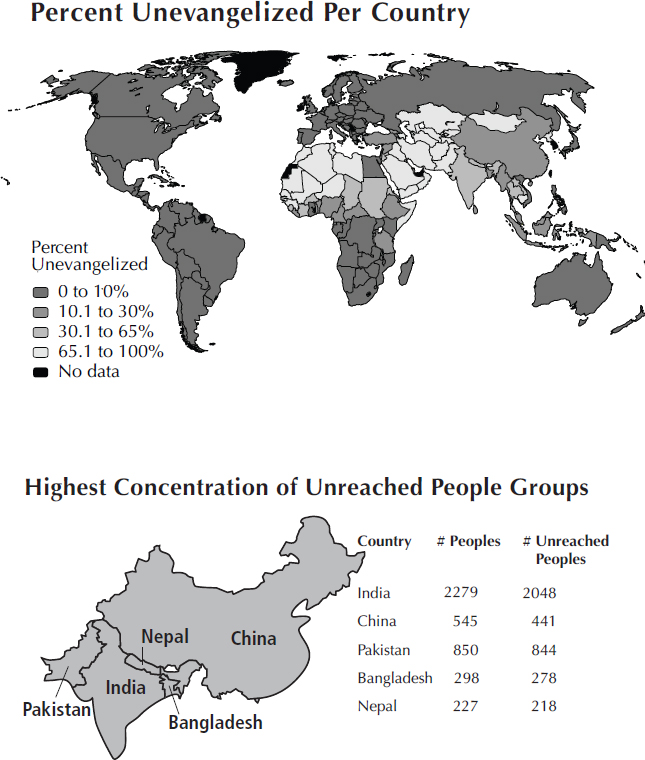
Yet, the least evangelized peoples on earth are pre-dominantly Asian. The remaining challenge can feel over-whelming in scale. Asians comprise 81 percent of the non-Christians in the world and around 84 percent of the unevangelized. Many Asians face the same physical and societal challenges faced by Africans. The mission vision in Asia has grown spectacularly, beginning with missionaries from Asian churches to their own people, but now including unprecedented cross-cultural outreach. India and South Korea lead the way in these efforts, but mission movements from other Asian nations are rapidly taking shape.
With great Christian growth in Asia has come wide-spread persecution. In almost every Asian country, the price for demonstrating faith in Jesus can be very high. Believers are frequently harassed, arrested, and even killed. Opponents shut down congregations by force or prevent them from functioning properly. These are days of both great peril and promise for the steadfast Asian church.
Latin America
Evangelical growth in Latin America in the twentieth century was spectacular, but the twenty-first century has been even more impressive. From 1900 to 2020, evangelicals grew from about 700,000 in number to well over 100 million, much of it connected to the dynamic Pentecostal and charismatic movements. The growing presence of Bible-reading evangelicals in Latin America has in turn had a pro-found impact on the Roman Catholic Church there (over 80 percent of Latin Americans had some affiliation with the Catholic Church in 2000).
Despite a large Christian population in most Latin American countries, whole regions of several countries remain distinctly less reached than neighboring regions. This is particularly true in the northeastern states in Amazonia (Brazil) and in a number of states in Mexico—often the regions with large concentrations of indigenous peoples. Church splits and inadequate discipleship among believers sometimes hamper healthy growth in the Latin American church. Still, there has been rapid growth and maturation of mission vision in Latin America, with many initiatives and much interest focused on reaching the least reached peoples of the world.
The Pacific
The Pacific region is broadly experiencing a decrease in Christian population, due to the demographic dominance of Australia and New Zealand. Widespread secularism has eroded the foundation of Christianity established so faithfully by Protestant missionary work of the nineteenth century. In the Pacific islands, however, some groups are thriving amidst this backdrop of emigration, decline, and the growth of nominalism and marginal Christian sects.
Some renewal, similar to that in Europe, is revitalizing parts of the church in Australia and New Zealand, accompanied by renewed mission vision. A number of Pacific Island peoples impacted by Protestant mission in the nine-teenth century have taken their own vibrant Christian faith to effectively reach out to indigenous minorities else-where, most notably in the Americas. There remain some unreached people groups in the Pacific, a mix of indigenous groups and diaspora peoples from parts of Asia.
The Middle East
The birthplace of the church has experienced significant decline in its Christian population within the last century. Widespread conflict, discrimination, persecution, emigration, and some nominalism have significantly lessened the Christian presence in many Middle Eastern countries. But we are also seeing the birth of a new expression of the church in this long-suffering region, fueled by global prayer. In many places Christians have been communicating the gospel to their Muslim neighbors in unprecedented ways.
There are signs of the Holy Spirit moving in these lands. The rise of an aggressive brand of Islam endorsing terrorism and violence, together with strict enforcement of Shari’a law in some Islamic nations, has led to much soul-searching within Islam itself. Media ministries have already had a positive impact sharing the gospel through radio, satellite TV, digital media, and the internet. These programs not only share the message of Jesus but also encourage and teach millions of Christians across the Middle East. More Muslims are turning to Christ in the Middle East than at any other time in history.
The State of Global Mission
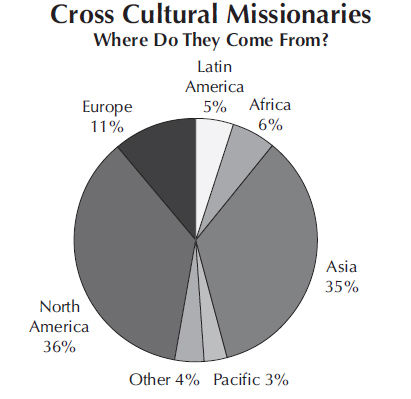
The explosive growth of the Majority World church is aweinspiring, but perhaps more astonishing still is the accompanying rise of numerous viable Majority World mission movements. Today, the Majority World church sends out at least as many cross-cultural missionaries as does the Western church. Mission activity is no longer pre-dominantly a West-to-the-rest activity. We must now see mission as everywhere to everywhere.
Mission activity is no longer predominantly a West-to-the-rest activity. We must now see mission as everywhere to everywhere.
Because of the great increase of missionaries from many lands, one might wonder which country has the most efficient5 missionary-sending church. One might think of South Korea, Norway, or even the USA—all of which are good guesses. In terms of missionaries sent per congregation, Singapore has long been a global leader. Reliable and consistent data is hard to come by for missionary figures. But different sources have pointed to the unlikely nations of Mongolia and Palestine in recent years as the most effective senders on the basis of Christian population. In fact, of the entire global Protestant community, the most efficient missionary-sending countries are generally not wealthy. These countries do not usually have Christian majorities, and most lack multiple centuries of Christian history. Many missionaries sent out from these churches are first- or sec-ond-generation believers. The zeal of the Majority World mission movement shames our wealthy and well-resourced countries.
For example, God is using the Latin culture and enthusiasm to take the gospel around the world, often to places that have never received the gospel before. The skills that Brazilians and many other Latinos have with football (soccer), music, and dance, among others, assure them a warm reception in many countries otherwise hostile to the gospel. Their passion, joy, and fervor have already opened many doors.
Millions of Christians from the Philippines and Indonesia work in wealthier nations as domestic servants, nurses, seafarers, engineers, and nannies. God places them in homes of influence within cities and cultures typically unwelcoming of White Westerners and others. They have relationships with children and wives who might otherwise be sheltered and shielded from the gospel. Filipinos and Indonesians are embracing this great mission opportunity.
One of the most ambitious missionary visions of recent history has been that of the Chinese house church networks to send as many as one hundred thousand bivocational kingdom workers into the nations lying south and west of them, retracing the ancient Silk Routes to Jerusalem. If any church in the world today is equipped to suffer and endure in these hard places, it is the long-suffering Chinese church.
The biggest and fastest-growing churches in Europe are mostly planted by African believers. Africans have an impressive ability to persevere, assimilate, and access places others seem unable to reach. The Nigerian church birthed Vision 50/15, a vision to mobilize fifty thousand Nigerians over fifteen years to take the gospel through the North African Islamic nations all the way “back to Jerusalem”. With so much prayer focused on Israel and so much missionary vision aimed in Jerusalem’s direction, we should believe for much celebration there in coming years.
The Remaining Task
For the first time in history, followers of Jesus dwell in every country on earth. In some cases, they must gather in secret for fear of persecution, but they are there. Too often, however, the world’s Christian population does not intersect with the world’s unevangelized population. Massive concentrations of peoples have yet to experience the gospel, and we must go to them.
Billions of people live in the countries and regions of the world dominated by faiths that do not confess Jesus as Savior. The unevangelized are living in the very places where other major world religions have their heartlands and strong-holds. Looking at raw numbers, we find a cluster of just six countries—India, China, Pakistan, Bangladesh, Afghanistan, and Nepal—where 1.3 billion unevangelized people live.
Every human being who has a physical or spiritual need is a valid ministry opportunity for those who desire to incarnate the love of Jesus, regardless of where they live. At the same time, it is easy to see where the greatest concentrations of the unevangelized are. In Matthew 24:14 Jesus says, “This gospel of the kingdom will be proclaimed throughout the whole world as a testimony to all nations, and then the end will come.” Just in terms of these six nations above, the challenge we face in reaching them is clear. However, when Jesus used the word we translate “nations,” He was not speaking about modern geopolitical entities. Jesus was speaking about ethnic identities, people groups. Suddenly, the challenge increases in scope and complexity.
Unreached People Groups
Thousands of yet “unreached” peoples exist throughout the world today, spanning every religious tradition, even some nonreligious. The six Asian countries mentioned above are likewise home to the largest numbers of unreached peoples.
Meeting the challenge of reaching unreached peoples must involve the global church. Believers in places like India and China are vital to meeting the challenge of the unreached or “hidden peoples” living in their midst who might otherwise be difficult to identify and access. For example, the Muslim Hui are a minority group in China, often living in remote areas, practicing a minority religion. Reaching them requires sensitivity to their distinct culture and worldview. The Fulani are nomadic pastoralists of the Sahel of Central and West Africa. They are well-known custodians of Islam for the region and highly influential there. Reaching them requires a unique strategy—an oral and mobile Christianity that follows them as they move with their livestock. Marsh Arabs have existed since the time of King Nebuchadnezzar. They build their homes out of the reeds that grow in the marshes of southern Iraq. The Marsh Arabs remain virtually untouched by the gospel even though they have existed as a people for thousands of years. These are just a few of the thousands of unique and distinct unreached peoples that are known to the Christians who live near them.
Imbalanced Sending
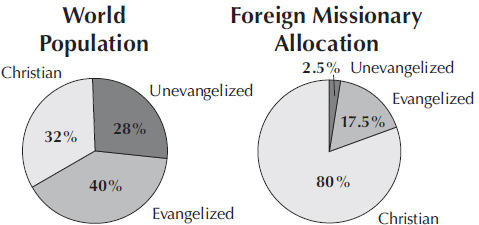
After nearly twenty centuries of Christian missionary activity, approximately 28 percent of planet Earth remains unevangelized. It would be reasonable to expect that most of our missionary efforts are focused there. Unfortunately, we send a very small proportion of all foreign missionaries (one out of thirty) to the unevangelized world. As a result, in the least reached places there are often less than twenty missionaries for every one million people. In some places, there are even less than three foreign missionaries per one million people. These numbers are staggering, as is the scale of the task we face today. We must send multitudes of missionaries to these long-overlooked places and peoples.
Pressing Global Needs
The Lausanne Movement and others have helped us understand that the gospel is about more than simply words and a one-time conversion experience; it is about holistic, transformational blessing for individuals, families, and communities. Some of the most pressing needs and issues facing humanity in our day are the challenges of reaching women and children (majority populations among the unevangelized), of bringing hope in the midst of brutal, hopeless, oppressive poverty, or of bringing light and hope to refugees, immigrants, and internally displaced peoples. Other urgent issues include the desolation wrought by conflict and disease, the degradation and destruction of the environment, the upheaval brought by rapid urbanization, the acuteness of increasing water and food shortages—and these are but a few. The global church must go out addressing each of these issues if the church is to incarnate Christ and demonstrate the values of God’s kingdom to the world.
Getting the Job Done
What will be the “state of the gospel” in twenty, fifty, or another one hundred years? What progress of the gospel will the numbers reveal? The unevangelized of the world are unevangelized today because they have been the hardest to reach, the hardest to find, and are at the center of spiritual strongholds that resist and oppose the gospel. The scale of the remaining task is staggering, but Jesus has promised to be with us until the gospel of the kingdom has been preached as a testimony to all nations. Here are a handful of principles that will help us accelerate this process:
Priorities
Recent reports claim that only one out of one hundred believers has any meaningful involvement in the Great Commission. Imagine the difference that would result from just shifting this from one to two believers out of one hundred. That kind of shift might seem negligible, but it would double the resources engaged in the task.
Sacrifice
To see the job done, we need to lay down our careers, our finances, our time, sometimes our relationships, and occasionally even our very lives, on the altar before God.
Partnership
True collaboration yields incredible fruit. Partnership must increase between people who pray, send, train, and go to the nations. Partnership must increase between churches and missions from different parts of the world, each offering its strengths and gifts. Partnerships must increasingly develop around reaching specific people groups. For example, there are already networks committed to praying for and reaching the aforementioned Hui, Fulani, and Marsh Arab peoples.
Unity
Multicultural teams are a particularly compelling expression of unity in the body of Christ, especially in this age of conflict and division. What better way to demonstrate the reconciling power of the gospel than through a team with a German, Brazilian, South African, Nigerian, Korean, and New Zealander all working together? This diversity of culture in a field team not only helps each member shed cultural baggage often mistaken for Christian values but also communicates profoundly to other peoples about the validity and relevance of the gospel to every culture.
Prayer
There is incredible power in prayer. Fervent, united prayer was one of the “means” that William Carey’s Enquiry concluded was a necessity for the evangelization of the world. Carey also believed that prayer was perhaps the only thing that all denominations could do together in a truly united fashion. The motto of an earlier edition of Operation World was, “When man works, man works, but when man prays, God works.”
In recent decades, we have experienced an exponential increase of prayer for the nations, for the unreached, and for people from other faiths to encounter the risen Christ. The advent of the digital age has accelerated collaborative prayer initiatives. It is no coincidence that we are seeing unprecedented breakthrough in the same era as unprecedented intercession.
We can strategize, harmonize, dialogue, and worship—we can equip ourselves with the best financial resources and the most astute missiology available—but without prayer, we will not see spiritual strongholds broken down, nor the unevangelized peoples experiencing the benefits of the gospel. The “state of the gospel” may not intrinsically change, but the impact of the good news is, for God’s own reasons, connected to the prayerfulness of the global church. Dick Eastman put it best: “The degree to which prayer is mobilized is the degree to which the world will be evangelized.”6 
RETURN TO LESSON 8: Pioneers of the World Christian Movement
Notes
1. “Status of Global Christianity, 2024, in the Context of 1900–2050,” edited by the Center for the Study of Global Christianity, accessed January 19, 2024, https://www.gordonconwell.edu/wp-content/uploads/sites/13/2024/01/Status-of-Global-Christianity-2024.pdf.
2. The term “evangelical” is used in many different and often contradictory ways. In the Operation World framework and this article, the term refers to Christian groups who generally emphasize the following: (a) The Lord Jesus Christ as the sole source of salvation through faith in Him. (b) Personal faith and conversion with regeneration by the Holy Spirit. (c) Recognition of the inspired word of God as the only basis for faith and Christian living. (d) Commitment to biblical witness, evangelism, and mission that brings others to faith in Christ.
3. “Status of Global Christianity, 2024.”
4. “Status of Global Christianity, 2024.”
5. We define country efficiency, in this case, as the fewest number of Protestant/Anglican/Independent believers per Protestant/ Anglican/Independent missionary.
Graphics Sources
“The World’s Christians” map (Operation World).
“Annual Growth Rate of World Religions” graph (Growth rate for evangelicals derived from the Operation World Database. All other growth rates are from Status of Global Christianity, 2024, in the Context of 1900–2050, edited by the Center for the Study of Global Christianity. Source: https://bit.ly/3uABMVk [consulted Jan 19, 2024]).
“World Evangelicals by Region” graph (Operation World, updated 2023).
“Cross-Cultural Missionaries: Where Do They Come From?” graph (Operation World, 2010). “Percent Unevangelized Per Country” map (Momentum Magazine).
“Highest Concentration of Unreached People Groups” map (taken from “Countries with the Most Unevangelized” Momentum Magazine; updated with Joshua Project data January 2024).
“World Population/Foreign Missionaries” pie charts (Operation World).