CHAPTER 61
New Pioneers Leading the Way in the Final Era
Yvonne Wood Huneycutt

Yvonne W. Huneycutt has worked with the Perspectives on the World Christian Movement course since 1991 in various capacities, from local class coordinator to regional director to instructor, author, and trainer. She is currently on staff with Perspectives Global, serving the dozens of national Perspectives programs around the world. She is the author of propelled by hope: The Story of the perspectives Movement.
In 2006 a strategic gathering of mission leaders from dozens of countries was held in a largely Muslim nation. As I looked on that gathering of no more than three hundred people, I realized that I was beholding clear evidence of the fruit of the labors of God’s people in generations past. And yet, at the same time, I was getting a glimpse of what could be our greatest hope for the future. We worshiped, prayed, and planned together for the completion of world evangelization, specifically aiming for the beginning of gospel movements in every people.
The emergence of the third millennium is revealing a portrait of God’s family that has been in His heart since He asked Abraham to count the stars. Remarkably, the family portrait looks vastly different than it did fifty or even ten years ago! Brothers and sisters have been added to the family from every country and all but a few thousand people groups.
I found it marvelous, but not surprising, that the event was organized, hosted, and led by seasoned leaders from the Majority World. Ralph Winter, along with others, anticipated years ago that we would likely see non-Western (or Majority World) mission structures superseding the dominance of European and American mission structures in terms of numbers and influence.
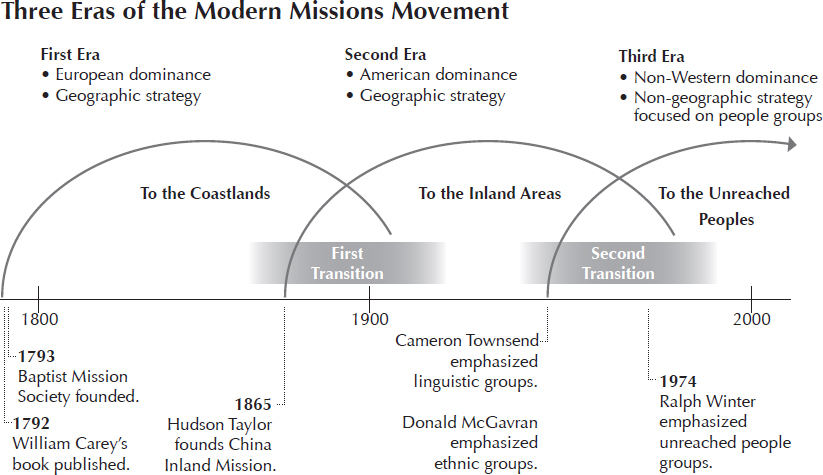
Winter’s anticipation of the rapid growth and effectiveness of Majority World missions was framed in his article “Four Men, Three Eras, Two Transitions: Modern Missions.”1 He distinctively observed how Protestant mission surged in three eras, each focused on a more exacting understanding of what it would take to finish the Great Commission. During this season of transition, I think it is worthwhile to revisit Winter’s concept of “Three Eras.” We should take note of the challenges that daunted and distracted earlier generations so that we can work together wisely to complete the task of world evangelization.
First Era: To the Coastlands
The First Era is marked by William Carey, who was convicted of the church’s mission responsibility by his study of Scripture and was exposed to remote peoples by the journals of explorer Captain Cook. His passion was not silenced by the prevailing theological argument that the Great Commission was given only to the first twelve apostles. It is said that when he was told, “Sit down, young man. When God chooses to win the heathen, He will do it without your help or ours,” Carey picked up pen and paper, and in 1792 wrote a little book with a big title: An Enquiry into the Obligations of Christians to Use Means for the Conversion of the Heathens (only half the title). This short book launched the first outpouring of Protestant mission endeavors to the coastlands of every continent. In the fervor of eliminating Catholic institutions, Protestants had over-looked the necessity of forming their own mission structures. The word “means” in Carey’s title referred to needed mission structures. The widespread influence of Carey’s work inspired the formation of one of the earliest Protestant mission agencies. A year later, Carey was on his way to India. Within a few years, several new Protestant mission agencies, denominational in nature, began to spring up in England, Europe, and eventually America.
The mission movement Carey awakened in England was further propelled by a student mission movement in America. University students influenced by Carey’s book were praying for student interest in foreign missions when they were caught in a rainstorm and fled under a hollowed-out haystack to seek shelter. This “Haystack Prayer Meeting” ignited a fire of mission passion that blazed across America and eventually to Europe. Although the initial surge of Protestant missionaries came from English soil, the First Era was dominated by Europeans who followed the colonial explorers to the coastlands and islands of the earth. Disease and almost certain death awaited them, so much so that some First Era missionaries to Africa packed their belongings in coffins, as statistics told them they wouldn’t last more than two years. Yet, as Winter states, they continued to go “in virtually a suicidal stream.”
Second Era: To Untouched Inland Areas
The second of Winter’s “Four Men” is Hudson Taylor. A young man less than thirty years old, Taylor’s broken heart for the unreached millions in the interior of China launched the Second Era of Modern Missions. When existing missions resisted his appeals to send missionaries to the interior regions of China, Taylor formed a new mission which he named the China Inland Mission. The focus on identifying the people and places which were not yet evangelized set off a wave of new mission structures aimed at reaching interior regions or inlands.
The China Inland Mission enlisted missionaries from a variety of denominational backgrounds to evangelize the inland provinces. In spite of warnings by church leaders that he was sending young people to their deaths, Taylor persisted. Taylor’s faith inspired others and eventually dozens of new mission agencies unaffiliated with particular denominations—faith missions—were created bearing names like Sudan Interior Mission and Regions Beyond Missionary Union. A powerful student missions movement that began at Oxford University in England jumped “across the pond” to American universities, igniting the remarkable Student Volunteer Movement (SVM). The SVM produced so many American missionaries in the first half of the twentieth century that the Second Era exhibited American dominance.
Third Era: To Unreached Peoples
The first two Eras were defined by geographic strategies to finish the Great Commission. For 150 years missionaries had spread the gospel on the coastlands and then pushed further to the interior of every continent. “By 1967, over 90% of all missionaries from North America were working with strong national churches that had been in existence for some time,” Winter notes. With the breakup of colonial powers in the mid-twentieth century, national churches were not only ready for their colonial overlords to leave but in some cases the missionaries as well. Missionaries began to return from the field in droves. Many thought the missionary task was finished. Or was it? As Winter wrote, “Unnoticed by most everyone, another era in missions had begun.”
An SVM recruit named Cameron Townsend headed to Guatemala to distribute Bibles. While trying to offer a Bible in Spanish to an indigenous Indian, the Indian reportedly asked Townsend, “If your God is so smart, why can’t he speak our language?” Townsend realized that the gospel must be made available in every language no matter how small the group may be. He urged existing mission agencies to research and translate Scripture into the bypassed languages. Unsuccessful in persuading others to this task, Townsend formed a mission agency he named Wycliffe Bible Translators.
While Townsend was shining a light on overlooked languages, a third-generation missionary in India named Donald McGavran noticed how the gospel made sudden surges in some caste groups and yet had negligible influence in others. He described a phenomenon of rapid gospel advance among socioethnic populations which he called “people movements.” McGavran’s most widely known book, The Bridges of God, spread the idea that the gospel could advance swiftly amidst a people group but entirely miss other peoples in the same region.
The Fifth Man: Ralph Winter
It was Ralph Winter, a colleague of McGavran at the School of World Mission at Fuller Seminary, who developed McGavran’s ideas in an important but different way. Winter reasoned that because the gospel does not usually flow naturally from one culture or caste to another, even if they speak the same language, entire population segments are being overlooked. Not only language but also cultural and societal affinity groups must be taken into consideration in church planting.
The gospel must be made available in every language no matter how small the group may be.
Winter named Cameron Townsend and Donald McGavran as the third and fourth of the “Four Men” who pioneered new eras focused on finishing world evangelization. However, it seems to me that a fifth person should be included among these pioneers: Ralph Winter himself. At the Lausanne Congress on World Evangelization in 1974, Winter introduced the concept of what are now known as “unreached people groups.” Using research and statistics, he demonstrated that in order to finish the Great Commission, special efforts were required to make the gospel understandable and available within every population segment. To accomplish this, a culturally appropriate church movement is needed within every people group. Winter’s Lausanne address rocked the world of missions. Six years later, in 1980, Winter promoted the Edinburgh World Consultation on Frontier Missions. This 1980 consultation made the phrase “a church for every people” common among mission movements all over the world, but particularly among the newly emerging mission structures of the non-Western world.
Like the previous two eras, the Third Era produced a slate of new mission agencies, but this time focused upon unreached people groups. Many new Western agencies took on names like Frontiers or Mission to Unreached Peoples. Furthermore, during the last two decades of the twentieth century, hundreds of mission agencies were formed in non-Western countries. Today there are more missionaries sent out from Majority World churches than from the West. The Third Era is now in full swing and even though the mission force is rapidly changing to a more non-Western face, the vision of completing world evangelization remains the same: that Christ would be named and glorified among every people group. In order for that to happen, there must be an initial breakthrough of the gospel resulting in an indigenous Christ-following movement within every people.
Today there are more missionaries sent out from Majority World churches than from the West.
Transitions
Ralph Winter pointed out that the three eras did not neatly follow one after another, overlapping and creating confusion and conflict regarding the mission task during the transition between eras. While First Era work was still underway, the Second Era called for fresh, new efforts that had been overlooked by the First. “For us today it is highly important to note the overlap of these first two eras,” Winter wrote. “The 45-year period between 1865 and 1910 (the beginning of the Second Era and the ending of the First Era) was a transition between the strategy appropriate to the mature stages of the First Era and the strategy appropriate to the pioneering stages of the Second Era.” Likewise, while Second Era mission efforts were being turned over to national churches in the 1970s and 1980s, new efforts were underway focusing on overlooked unevangelized people groups, sometimes in the very neighborhoods of culturally different existing churches.
Widening the Mission?
As the Majority World mission force is now being sent from just about every part of the world, the transition to the Third Era focus is unfolding with extra complexity. Many Western missionaries are still active in countries with mature churches that are now sending their own missionaries to other lands. Western missionaries generally continue in these settings by working in partnership with local leaders. Yet this kind of situation can easily confuse priorities so that the mission task is defined in ever-widening ways. Today’s church is increasingly aware of desperate needs in every corner of the world and seeks to integrate the work of societal transformation into its mission mandate.
Wherever churches already exist, there always remains a need for not only continued evangelism but also for works of mercy and justice and for the transformation that Christ’s kingdom inspires. This is rightly seen as the ongoing work of the church within society. But it should not be confused with the essential missionary task of the initial planting of a kingdom community within every people. Where the church is minuscule or does not yet exist, newly planted indigenous churches need to be discipled to bring forth the kind of redeemed people who will pursue the work of transformation in their societies. Many good kingdom works can be done by outsiders within an unreached population group, but sustainable, deep-level transformation occurs as the body of Christ is established within that people group, transforming individuals and communities from the inside out.
Narrowing the Mission?
A point of confusion that may be as great as the widening of mission is what we might refer to as a “narrowing” of mission. The church can limit its scope of mission to only include the unreached within its national borders or its own people in other countries. For example, the mission vision of the church in India could easily become limited to reaching the many tribes and communities within the borders of India. Or in the case of Chinese churches, mission efforts from Chinese churches have rightly pursued the evangelization of the Chinese diaspora all over the world. But if Chinese missions go no further than their own people, they will have fulfilled only a fraction of what they could have pursued. Neither India nor China has been given a minor commission but a Great Commission.
It is heartening to see the Majority World missions enthusiastically embracing the Great Commission. Korean churches were among the first to pioneer among peoples along the old Silk Road. Churches in China have long pursued a vision of doing their part, focusing their efforts upon the remaining unreached people groups in Asia and the Middle East. African mission movements are mobilizing thousands of missionaries into Islamic North Africa and the Middle East. Latin Americans are major players in evangelizing the peoples of North Africa. Indonesians are moving out of the islands into other Asian lands. Filipino and Indian witnesses can be found employed in numerous Arab nations. Arab and Persian believers are reaping the harvest in refugee communities in Europe. This does not mean that the Western church should conclude that its role today is limited to funding and prayer. The commission to “go into all the world” has not been rescinded for the Western church.
Partnership and Pioneering in the Final Era
The Third Era has revealed that there are still many people groups where the church does not exist and that require a pioneering strategy. However, today the pioneering is being accomplished by Western and non-Western mission structures. What is necessary now is partnership in pioneering. The non-Western church is on an equal footing with the Western church in finishing the remaining task. Because the people groups remaining to be reached are non-Western themselves, the Western church has much it can learn from its Majority World partners. Likewise, the non-Western church has much it can learn from the mistakes and successes of two hundred years of Protestant mission.
Envisioning the fullness of the Third Era, Winter noted that “a world-wide network of churches that can be aroused to their central mission” implied that “this could and should be the final era.” An increasing global mission force and an ever-diminishing number of peoples requiring an initial breakthrough of the gospel should continually encourage us to labor together toward the vision of an evangelized world. An American friend, describing his work in a Muslim country, told me that some Muslims have been attracted to Jesus but have been reluctant to become followers of Christ, saying things like, “Christianity is a Western religion. I will be persecuted if I become a Christian.” Then, my friend said, the Chinese mission workers arrived. Their ethnicity and their experience of suffering have helped dissolve the objections, accomplishing what no Westerner could do.
Thinking back to that 2006 global gathering, one particular group delightfully surprised me: the Kazakhs. In the 1990s my church adopted the Kazakhs for prayer and sent a missionary. I visited Kazakhstan in 1994 and worshiped with the first indigenous Kazakh church in modern history. The church has grown remarkably since then. Only a few years later, although the Kazakhs were still considered to be an unreached people group themselves, a Kazakh leader stood before that assembly and reported on the missionaries they were sending to other peoples in other lands.
We live in a world that is more evangelized than it has ever been in history, largely because of the resolute vision of a few to fulfill the task of world evangelization in every place and in every people. Now that we see the mission task being pursued faithfully by a global church, what will we see in the years to come? Is it possible that within the near future we might see a complete portrait of God’s family that includes some from every ethne? 
RETURN TO LESSON 7: Eras of Protestant Mission History
There are still many people groups where the church does not exist and that require a pioneering strategy.
Notes
1. An early version of Winter’s ideas is found in the article, “The Long Look: Eras of Mission History,” published in the first edition of Perspectives on the World Christian Movement in 1981. All quotations of Ralph D. Winter in this article are from “Four Men, Three Eras, Two Transitions: Modern Missions,” in Perspectives on the World Christian Movement: A Reader, ed. Ralph D. Winter and Steven C. Hawthorne, 3rd ed. (William Carey Library, 1999), 253–61.