6 Expansion of the World Christian Movement

Studying this lesson will help you:
- Tell an overview of how the gospel has continued to extend to most of the peoples on earth since the days of Christ.
- Describe the expansion of the gospel to different geographic areas and cultural regions in the West during each of the five four-hundred-year periods since Christ.
- Explain how the gospel advanced with reference to different mechanisms of mission: involving people coming or mes-sengers going, both voluntarily and involuntarily.
- Recall some key mission leaders, their strategies, and the move-ments that resulted from their efforts.
- Explain some of the challenges and responses to the gospel as it came to and expanded into Asia.
- Explain some of the challenges and responses to the gospel as it came to and expanded into Africa.
- Describe the sociological evidence that associates prolonged missionary pres-ence with positive, measurable improvements in quality of life.
We have seen how the plot of the entire Bible unfolds steadily toward the fulfillment of God’s global purpose. But what happened after Acts 28? Many Christians have been told that some early believers endured living in catacombs as Rome burned around them. Then, in popular understanding, the medieval Dark Ages supposedly reduced the Christian movement to no more than crusades and chaos until the Reformation. If this is really what happened, then God’s promises to bless the nations were more hype than hope. After the first century, did God get frustrated with His followers for long centuries and abandon His intention to see the gospel go to the ends of the earth? Has God only recently awakened to bright possibilities of missions in the modern world? Or is God an opportunist, achieving some good things when the situation seems ripe but allowing eons of darkness to roll by without action?
The core question is this: Is there an intended goal or culmination to history? Many historians say no, explaining any apparent significant succession of events as only a mirage. Believers in Christ, however, have only to recall that Jesus Himself announced the kingdom of God by declaring, “The time is fulfilled!” (Mark 1:15). That statement alone should be enough to awaken us to the reality that there is a magnificent purpose in all history. All Scripture throbs with the steady pulse of God’s purpose through the years. The kingdom of God has come in great measure. And the kingdom will come with even greater power. The God of all nations is the God of all generations. He can be fully followed by those who know Him as the God of all history.
Momentum
It’s often hard to sense the accelerating pace of God’s work in history. Many live encased in the present moment and tend to miss the momentum of the mighty God of the ages. But would God tell us so much of His story and His purposes without intending for us to follow Him through history? Those who know God’s history can better lay hold of God’s intended destiny.
Why delve into the archives? It’s not a matter of memorizing the dates and names of past popes and rulers. It’s a matter of tracing the hand of God as He fulfills His purpose. Those who follow history from God’s perspective are not disappointed. They are the ones who can sort out the unfolding “plot” from that which may be interesting but is only peripheral.
In this lesson we’ll follow how the blessing of Christ extended successively from one region and people to another. We’ll see the drastic consequences for the Christian movement when the blessing of the gospel of God was not extended. We will also see the spread of the blessings of Christ’s kingdom throughout the world.

I. God Advances His Purposes through History
History is not a random drift of human events—it is the epic unfolding of God’s purposeful story. Scripture reveals a God who initiates history with intention and will bring it to a glorious completion. In contrast, nonbiblical frameworks often distort or diminish this divine drama. For those just beginning to explore how God moves through history, these conflicting views can create confusion. That’s why it’s vital to step back, see the larger sweep of God’s purposes, and locate ourselves within His advancing mission.
II. The Drama Moving through All History: As the Waters Cover the Sea
Bob Blincoe traces the movement of God as He has been drawing to Himself obedient worshipers from every people throughout the ages. Beginning at Jerusalem, he uncovers the patterns and people through which God has relentlessly advanced His purpose—discipling the nations and unfolding His glory among all peoples.
A. Five Epochs through More than Two Thousand Years. Dividing history into five four-hundred-year periods is a device to help us remember and follow the developing story. Even though fascinating patterns and recurrent themes do emerge, Blincoe does not mean to imply that history follows rigidly patterned four-hundred-year cycles.
B. Removing Cultural Barriers. In every epoch, Blincoe reveals how God stirred His messengers to unleash the gospel so it could advance without obstruction. Repeatedly, they faced resistance—not to Christ Himself but to cultural forms that obscured Him. Watch how, as the message was released from those limiting forms, new peoples awakened to the glory of Christ and began to follow Him with joy.
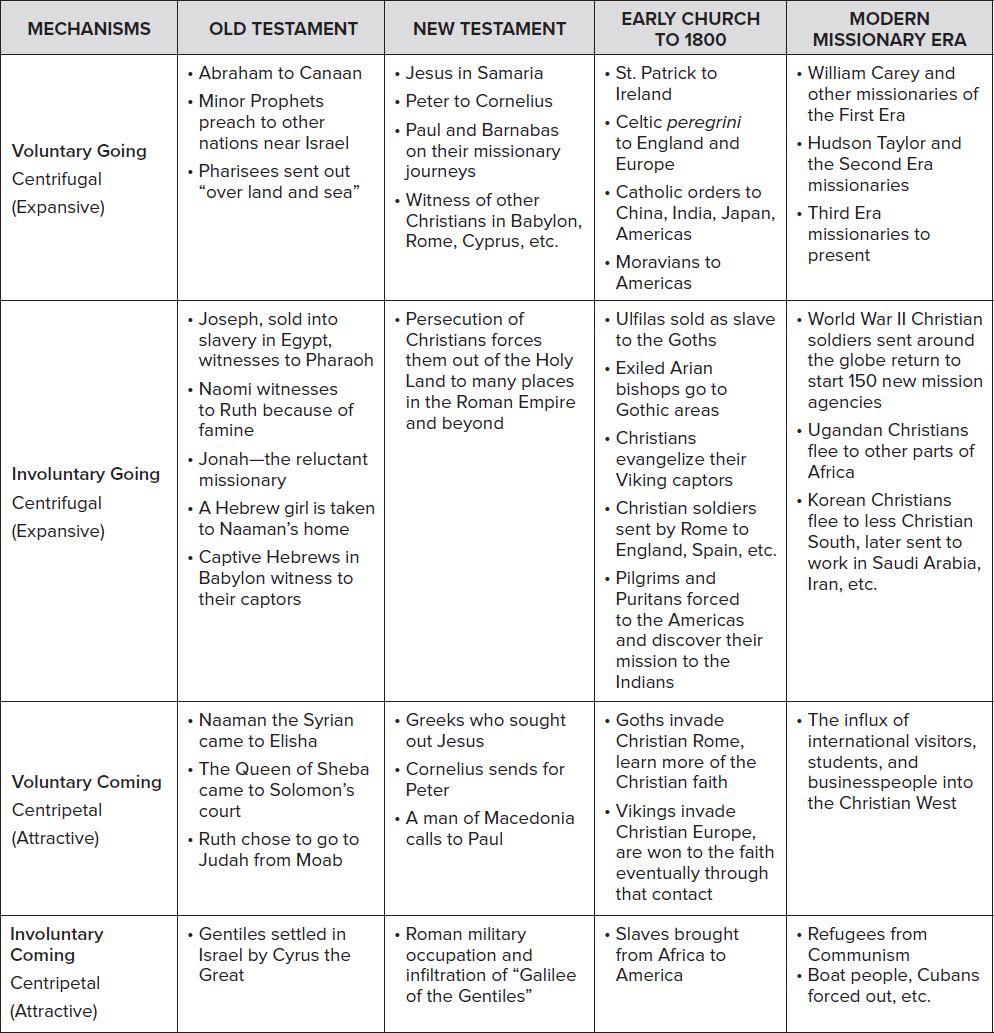
C. Four Mechanisms of Mission. Not every epoch is marked by God’s people faithfully launching out in cross-cultural mission. During much of history, there seems to be little, if any, such obedience. Does this mean God’s story slows down and stops? Not at all! Blincoe points out that God manages to extend His blessing even when His people are unwilling to speak of Him. To see this wonderful continuity throughout history, it will help to recognize four mechanisms of mission. These concepts expand on the distinction of centripetal (coming) and centrifugal (going) mission explored in lesson 2. These four mechanisms demonstrate how God presses His mission forward with or without the full cooperation of His chosen people (see table on next page):
1. Voluntary Going (of messengers)
2. Involuntary Going (without initial missionary intent)
3. Voluntary Coming (of listeners)
4. Involuntary Coming (occasions of forced settlement among God’s people)
III. Epoch 1: Throughout the Roman Empire (To AD 400)
A. Mechanism. The gospel advanced by all four mechanisms. The “voluntary go” pattern was reflected by Paul’s missionary band. The “involuntary go” pattern was seen in the dispersion of Christians during times of persecution.
B. Advance. As the gospel spread throughout the Roman Empire, the early church reached a landmark decision in Acts 15 to de-Judaize their message. Now, non-Jewish peoples did not have to take on Jewish cultural forms to follow Christ. As such, Christ began to be translated into new languages and new cultures, opening a door of faith to many peoples.
Once Christianity became the official religion of the Roman Empire, it began to carry the political and cultural stigma of being Roman. This, along with the church’s lack of initiative to appoint missionaries to new areas and the church’s assumptions about having new peoples become Roman to follow Christ, led to delays in missionary endeavors.
IV. Epoch 2: The Irish Missionary Movement (AD 400–800)
A. Mechanism. Although Patrick initially was an “involuntary goer” as he was sold into slavery in Ireland, he later went back to Ireland voluntarily, the land where he had been enslaved. Out of this, God initiated one of the largest movements of “voluntary goers” (the Irish peregrini, or “wandering evangelists”) seen until that time.
B. Advance. Patrick de-Romanized the gospel, bringing forth a church in Ireland that was culturally different from Roman churches. Bold witnesses for Christ moved to new places to evangelize people in distant lands. They then established mission monasteries for the purpose of carrying the gospel to even more remote places. The gospel spread to Ireland, Germany, England, Kiev, and the Netherlands.
While they were ministering to the Lord and fasting, the Holy Spirit said, “Set apart for Me Barnabas and Saul for the work to which I have called them.” Then, when they had fasted and prayed and laid their hands on them, they sent them away. So, being sent out by the Holy Spirit, they went down to Seleucia and from there they sailed to Cyprus. (Acts 13:2–4)
How distinct was Paul’s missionary band from the Antioch church? Examine the two aspects of the “sending” of Paul’s missionary band in Acts 13. In verse 3, the Greek word for “they sent them away” has more to do with releasing and setting loose. The following verse, “being sent out by the Holy Spirit,” contains a different, more forceful Greek word for sending that suggests something like military command.
Was the missionary band commanded by the church, or commended to God’s care and control? How did their prayer and fasting play a part in recognizing the composition of the team? How does the expression “ministering to the Lord” suggest that their mission vision was directed toward and for God?
V. Epoch 3: To the Vikings and Slavs (AD 800–1200)
A. Mechanism. The Viking conquerors were themselves conquered by the faith of their captives. Once again, an “involuntary go” pattern is observed as some Christian women were forced to marry their captors. Monks and priests taken to Scandinavia against their will declared Christ to the Vikings.
B. Advance. The gospel spread to Scandinavia and some Slavic areas. It was common for entire peoples to become Christians as a group. Group conversions led to some nominalism among Christians at this time. With the invention of a new alphabet and the initiation of Bible translation, Slavic peoples were able to follow Christ in their own language and within their own cultural traditions.
VI. Epoch 4: Islam Rising, Christianity’s Reversal, and Francis of Assisi’s “Not Yet” (AD 1200–1600)
A. Mechanism. The “voluntary go” of the Crusades was one of the most misguided efforts of the church in history. However, many Roman Catholic orders continued to faithfully spread the gospel in remote places throughout the earth. Protestant churches were formed during this time, but they generally did not send out missionaries.
B. Advance. The Crusades were the main occupation of the churches at this time, but they did not advance the gospel; rather, they (likely) hindered it. However, Roman Catholic monastic orders spread the gospel as far as Asia and the Western Hemisphere.
VII. Epoch 5: To the Ends of the Earth (AD 1600–2000)
A. Mechanism. Beginning with a group of refugees in Germany, the Moravian movement launched more voluntary goers than all the rest of Europe. They inspired an Englishman named William Carey, who wrote a book that launched Protestants into missions.
B. Advance. Protestants began to implement the means and methods of sending missionaries to ever more remote places.
VIII. Advance to the East
In the first millennium, the gospel spread further eastward than westward. In the East, however, the gospel encountered major intercultural state religions, such as Zoroastrianism, Buddhism, Hinduism, and Taoism. By contrast, as the gospel moved throughout the Roman Empire in Europe and Africa, it encountered smaller, local “ethnic” religions that offered less resistance. In lands to the east, Christianity spread widely, but in almost every case, Christians remained a minority until the last few generations. Scott W. Sunquist lists five major advances, of which the first and last have been the most effective:
1. Persian Advance (first millennium)
2. Franciscan-Mongol Interlude (1206–1368)
3. Jesuit Advance (1542–1773)
4. Protestant Advance (1706–1950)
5. Asian Indigenous (1950–present)
IX. Advance to Africa
Samuel Kebreab describes how the gospel flourished in Africa. God has been steadily and powerfully at work across the African continent, weaving a redemptive storyline through waves of history—transforming conflict, colonization, and cultural change into a glorious advance of Christ’s kingdom. This is no accident of history but the unmistakable fulfillment of God’s promise to bring His blessing to all peoples. Kebreab follows five waves of the gospel in Africa:
1. How the Gospel Entered Africa
2. The Decline of Christianity in the Face of Islam
3. Gospel Advance in the Midst of Colonization
4. Missionaries Arrive in Large Numbers and the Gospel Spreads
5. From Africa to the Rest of the World
X. The Fruit of the Movement: Transformation
The key idea throughout this lesson is the continuity of history. God has been relentlessly unfolding His purposes throughout the generations and centuries. Not all times are equal. There are periods of decline and apparent inactivity. But God’s mission purpose has never been fully dependent on human activity. We identified the nature of mission history as a prolonged struggle, virtually a spiritual war. We’ve seen how God has used different mechanisms and movements. We presented God’s purpose as that of fulfilling His promise to bless the nations. Have the nations been blessed? Is God accomplishing His purpose? What has been the outcome? According to one popular view, Christianity has been a source of hindrance and damage to the best interests of societies all over the world. This view is not correct. Although there have been many disappointing and destructive things done in the name of Christ, the overall positive impact of the person of Jesus Christ on the societies of the world has been incalculable.
A. Does Christian Mission Bring Blessing or Harm? The ongoing controversy surrounding Christian missions usually alleges that Christian mission has served colonial powers and other destructive forces that exploit indigenous cultures. Robert D. Woodberry challenges these ideas, which are usually sourced in anecdotes and fiction. He does this with verifiable sociological data. If the net result of the presence of missionaries is that societies are harmed, we would expect conditions to be worse in settings where missionaries have been working longer or in greater numbers. But Woodberry says that the data shows exactly the opposite. In situations where missionaries have been present and have been at liberty to work, societies are better off in seven different measurable areas of human thriving: literacy, educational enrollment, infant mortality, life expectancy, economic development, freedom from corruption, and political democracy.
B. The Ideal and Goal of the Kingdom. According to the famous historian Kenneth Scott Latourette, the ideal and goal of the kingdom of God had vastly shaped history after Jesus. Latourette documented the increase of the World Christian Movement in various bursts of increasing magnitude and frequency. In Latourette’s view, the Christian movement entered its greatest expansion ever in the last century. The movement exploded just as he thought it might. Latourette not only told the story of the ongoing movement of Christianity, but he also summed up the fruit of the movement:
From individuals who have been inspired by Christ and from the Church has issued movement after movement for attaining the Christian ideal. That ideal has centered around the kingdom of God, an order in which God’s will is done. It sets infinite value upon the individual. . . . Its goal for the individual cannot be completely attained this side of the grave, but is so breathtaking that within history only a beginning is possible. Nor can it be reached in isolation, but only in community. In Christ’s teaching love for God, as the duty and privilege of man, is inseparably joined with love for one’s neighbour.
The ideal and the goal have determined the character of the movements which have been the fruits of Christianity. Although men can use and often have used knowledge and education to the seeming defeat of the ideal, across the centuries Christianity has been the means of reducing more languages to writing than have all other factors combined. It has created more schools, more theories of education, and more systems than has any other one force. More than any other power in history it has impelled men to fight suffering, whether that suffering has come from disease, war, or natural disasters. It has built thousands of hospitals, inspired the emergence of nursing and medical professions, and furthered movements for public health and the relief and prevention of famine.
Although explorations and conquests which were in part its outgrowth led to the enslavement of Africans for the plantations of the Americas, men and women whose consciences were awakened by Christianity and whose wills it nerved brought about the abolition of . . . slavery. Men and women similarly moved and sustained wrote into the laws of Spain and Portugal provisions to alleviate the ruthless exploitation of the Indians of the New World.
Wars have often been waged in the name of Christianity. They have attained their most colossal dimensions through weapons and large scale organization initiated in Christendom. Yet from no other source have there come as many and as strong movements to eliminate or regulate war and to ease the suffering brought by war. From its first centuries the Christian faith has caused many of its adherents to be uneasy about war. It has led minorities to refuse to have any part in it. It has impelled others to seek to limit war by defining what, in their judgment, from the Christian standpoint is a “just war.” In the turbulent middle ages of Europe it gave rise to the Truce of God and the Peace of God. In a later era it was the main impulse in the formulation of international law. But for it the League of Nations and the United Nations would not have been. By its name and symbol the most extensive organization ever created for the relief of the suffering caused by war, the Red Cross, bears witness to its Christian origin.
The list might go on indefinitely. It includes many another humanitarian project and movement, ideals in government, the reform of prisons and the emergence of criminology, great art and architecture, and outstanding literature. In geographic extent and potency the results were never as marked as in the nineteenth and twentieth centuries. (A History of Christianity, vol. 2, Reformation to the Present, rev. ed. [Harper & Row, 1975], 1470–71)
XI. Mission Strategy
R. Pierce Beaver adds more color and depth to some of the historical figures we have mentioned. He explores different approaches to mission strategy in times preceding William Carey. As you read about each of the following figures and periods, consider the different approaches that missionaries have used to advance the gospel. When exploring the mission work of previous centuries, it is important to acknowledge that some of their actions were setbacks and sometimes brought more damage than blessing. At the same time, it’s important to recognize the lasting strategic value of many of the efforts. We have much to learn from the seasoned wisdom of earlier experiments and advances.
The list below highlights some important cross-cultural communication issues that we’ll explore later in the course. Allow the accounts to whet your appetite to read beyond what the Perspectives course can provide. Pay particular attention to four broad areas of mission strategy:
- Adaptation. Ways in which the local culture was respected and valued or the message was adapted in gospel communication.
- Civilizing. Civilizing and Christianizing were often assumed to be synonymous. To what degree were the churches resulting from mission efforts allowed to reflect their local culture? Or were they instead brought into alignment with a foreign missionary’s culture or civilization?
- Conquest. Missionaries in some cases followed colonial or imperial powers. Did they intend to bring peoples under the political sway of their home countries? Were they perceived as facilitating control, or even exploitation, by foreign powers?
- Development. Missionaries often introduced significant ways of meeting basic human needs. At times these efforts were considered a part of the civilizing process or possibly part of an economic conquest.
A. Boniface. Beaver characterizes this key figure of the monastic movement as exhibiting a true sending mission. He went to convert tribes rather than extend a political domain. To encourage group conversions of entire tribes, he used what we have come to call a “power encounter.” An example of Boniface using a “power encounter”: He cut down the sacred trees of other gods to expose their impotence, confronting them with the power of Christ. He established churches, monasteries, and schools. Ultimately, however, he was perceived by those he reached as an instrument of imperial expansion.
B. The Crusades. Tragically, the Crusades warped mission into conquest. The effect of the Crusades reverberates to this day in most of the Muslim world. The Crusades highlight two other notable monastic figures, Francis of Assisi and Ramon Lull, who sought to preach the gospel to Muslims instead of violent conquest.
C. Colonial Expansion. Portuguese, Dutch, Spanish, French, and British imperial expansion was often associated with mission efforts but in different ways. Methods often hinged on whether to first “Christianize” or “civilize.”
D. Strategists of the Seventeenth Century. Sunquist already mentioned some of the innovative aspects of Jesuit mission strategy as the gospel was taken to the East. Now note Beaver’s discussion of the experiments and experiences of these Jesuit missionaries, especially Roberto de Nobili (India) and Matteo Ricci (China). Some of their creative approaches are still considered models by missionaries today.
 Conclusion of Certificate Readings for this lesson.
After studying this section you should be able to:
- Describe some of the features of social transformation that have resulted from mission efforts.
- Describe the two functional structures of the church throughout the centuries by using the terms “modality” and “sodality.”
- Describe Sanneh’s assertion that translating the Bible into local languages revitalized local cultures and limited colonial efforts to subjugate people.
XII. The Two Structures of God’s Redemptive Mission
We’ll now resume reading Winter’s article, “The Two Structures of God’s Redemptive Mission,” which we began studying in lesson 5. Winter states that the church has grown and extended itself in mission by following forms found within the social structure of the day as well as forms found in the Bible. Throughout history, even though superficial details change, when we speak of the “church,” we see two fundamental structures: the congregational structure and the mission structure. Winter introduces the sociological terms “modality” and “sodality” to identify these structures at different points in history.
- Modality structures are inclusive, nurture-oriented, structured fellowships (for example, a church congregation or a secular town).
- Sodality structures are second-decision, task-oriented, structured fellowships (for example, a mission society, a hospital, or a military force).
Both structures exist in civil and religious societies. Both are found in the Bible. Both are legitimate and necessary in God’s redemptive mission. Sodality structures nourish and extend the church. Modality structures strengthen and support mission efforts of every kind. They work together in an important symbiosis.
A. Redemptive Structures prior to and during the First Century. The congregational structure followed the synagogue patterns of the day. The mission structures had precedent in the Jewish rabbinical mission efforts, but they soon became highly dynamic missionary bands, similar to Paul’s small groups that traveled and planted churches.
B. Early Development within Roman Culture. Local congregational structures recognized bishops with territorial jurisdiction, following the pattern of the Roman magisterial territories. The Roman term for these territories was “diocese.” The mission structures that emerged—the monastic movements—borrowed patterns from Roman military practice. Protestants have generally held stereotypical impressions of monasteries as places where ascetic monks fled the world. In reality, the monastic movements were largely responsible for bringing the blessing of the gospel to the world.
C. The Medieval Synthesis. The survival of parish church structures came to depend largely on the more committed devotion of the monastic movement. Several of the largest mission endeavors in Christian history arose from the monastic movements. As monastic movements became inadvertently wealthy, however, local rulers demanded and took control of their leadership, resulting in spiritual decline and decay.
D. The Protestant Recovery. Earlier, we asked why Protestants celebrated the gospel but failed dismally to extend it to other lands and languages. For nearly two hundred years, there was virtually no mission outreach. Winter, along with Latourette and other scholars, points to what may be the greatest error of the Protestant movement: The Reformers abandoned sodality structures. Because monastic life was rejected, there was virtually no interest in preserving or extending the mission structures. William Carey called for Christians to “use means” to complete the commission of Christ. By “means,” he meant organized mission structures. He called for the formation of mission societies. Once Protestants organized sodality structures, whether denominational or interdenominational, the number of Protestant missionaries exploded.
E. Contemporary Misunderstanding. Protestant missions were initially organized without denominational backing. Gradually, the once-independent structures became increasingly regulated and eventually were dominated by denominational leaders. This brought both health and problems to the mission expansion. As a result, a later wave of mission structures called “faith missions” was launched, which was actually a second surge of nondenominational initiative (what we will call Second Era missions in lesson 7). Some strong, highly regarded denominational leaders have recognized the importance of some mission structures that were not tied to any denomination. But overall, there has been dubious limited support for independent mission structures.
XIII. The History of Transformation
The fruit of changing society toward the peace and justice of God’s kingdom was not a matter of passive hope. The missionary movement has been an almost constant force for positive change. Paul Pierson tells the story.
A. Monasticism. Look again at the tremendous heritage of the monastic movement. This movement, properly understood, has been salt and light in God’s hand throughout many centuries.
B. Forerunners. The church has had tremendous impact on the nations when the core values of the gospel bloomed and bore fruit over time. The Puritan, Pietistic, Moravian, and Wesleyan movements each brought a greater focus on biblical hope for transformed personal and community life. It’s not surprising that a vision for evangelization went hand in hand with a vision for profound social transformation.
C. A Striking Contrast of Reality and False Report. William Carey is recognized as the father of modern mission. What is not often known is the phenomenal breadth of his endeavors and the incredible changes that continue because of his work. In contrast is the stereotype of missionaries who ruin cultures. Pierson mentions some of the truths about the falsely maligned missionaries to Hawaii.
D. A Striking Comparison. Not every place that Christianity has touched has been transformed to the same degree. There are, of course, many factors contributing to the different impact that the gospel has had in different places. One key factor is the vision and labor of missionaries to include local leaders in an intentional transformation of community life.
Read the section “Striking Comparison” (p. 184) to imagine the dramatic differences in just one situation. There had been minimal influence from the Catholic Church on both sides of the river. What factors were part of the different outcomes on the different sides of the river? What does this suggest about the need for integrated community development?
E. The Different Routes toward Fruit. Missionaries have labored in education, health care, agriculture, and ministries for oppressed people, particularly women and slaves. Pierson does not so much provide a summary as a sample of the contributions of Christian missions. He is offering just a few specific examples of a huge movement. The impact of the Christian movement has been so pervasive that it may be impossible to ever trace the entire impact. But it’s safe to say that there has never been a greater source of betterment of the human situation than the global Christian movement in terms of education, health care, and the status of women and slaves.
XIV. Strategies of Mission
We return to Beaver’s survey of mission strategy. Why not get busy working on today’s urgent needs? But first, we should consider the value of examining old strategies of bygone centuries. The history of strategy is bursting with practical significance for anyone who plays any part in the missionary enterprise. Some of God’s servants in the past accomplished amazing things by incredible displays of love, wisdom, and sacrifice, while others have floundered, even with admirable intentions.
If your part in mission is primarily to support others who are frontline missionaries, your acquaintance with these issues will give you a wider panorama of vision, enhancing your decisions and encouragement. If you eventually work in cross-cultural mission yourself, even for a short term, an awareness of strategic breakthroughs and blunders can help you make a contribution of lasting value.
A. Early Protestant Missions
1. New England Puritans. The American mission experience to reach the “Indians” began with what seemed to be an attempt to “civilize” them in special towns prior to “Christianizing” them. Evangelism by extracting converts from the larger tribal societies ended up forming a separated people who could not “pass on the contagion of personal faith.” The “Praying Indian” towns may have been set up to protect the Christian Indians from both pagan Indians and pagan colonists. However, the “Praying Indian” towns were eventually burned down by unruly settlers from Europe. Notable figures in this chapter of mission effort were John Eliot and David Brainerd.
2. Danish-Halle Mission. An early, famous Protestant sending mission from Europe attempted some of the most innovative approaches to contextualize the message and assume effective roles to communicate the gospel. Two leaders stand out: Bartholomew Ziegenbalg and Frederick Schwartz.
3. Moravians. Beaver describes the Moravians’ efforts to respect local cultures. They expected that the resulting movements would be different from their own. They taught new believers skills that established them economically.
B. The Great Century of Protestant Missions. The nineteenth century has been referred to as “the Great Century” because of the phenomenal advance of the gospel in every geographic area of the globe.
We’ll continue to read R. Pierce Beaver’s summary of mission strategy, which provides fascinating details about this period. To help you follow the story through the first eighteen centuries of mission strategy, we pointed out four themes in section XI: adaptation, “civilizing,” conquest, and development. Now as we read Beaver’s comments about the nineteenth century, we will focus on these three themes:
- Contextualization. Because of a low view of the value of other cultures, the idea of “civilizing” the different societies to Western ideals was assumed.
- Control. Models of “conquest” were dismissed, partly because the colonial era had largely subjugated the unevangelized regions. Conquest was replaced by the far more subtle issue of control.
- Transformation. Development efforts multiplied. Beaver uses the term “transformation.”
1. Mission Structures. Operating mission structures was a new endeavor for Protestants. Confusion from the sending church structures about control of the mission operation dampened much of the early effectiveness. The issue of control from the European homelands was so great that mission structures were dominated by sending churches. William Carey’s efforts were hindered by this confusion.
2. Mission Objectives. The general aim was individual conversions, church planting, and social transformation.
- Christianization or Civilization? Local cultures were seen as primitive and superstitious. The approach of changing their culture as an initial effort to prepare the way for “Christianization” eventually gave way to the idea that the gospel itself would have a transforming power on the culture. William Carey and the “Serampore Trio” provided a valuable pattern in pioneering the idea of independent churches and emphasizing the power of the gospel in transforming society.
- Stations or Churches? The mission station approach had pressed converts into a social and economic dependency on missionaries. Carey aimed for an educated, independent leadership and laity gathered in churches. Mission leaders Rufus Anderson and Henry Venn proposed the famous “three-self “ formula to describe the independent churches that they wanted their missionaries to aim for. In their day, they had a limited influence. But near the end of the nineteenth century, there was another emergence of colonial paternalism. This led to a hasty “evolution” of authority from the mission structures to the native churches in the earlier part of the twentieth century.
- Transformation and Education. William Carey went further than most of his counterparts in later generations by envisioning a highly educated leadership. Different views on transformation were related to different theological assumptions about the kingdom of God at the turn of the century. Missionaries worked industriously to establish medical and educational systems.
3. Comity and Continuity. The practice of “comity” exemplifies the long heritage of unity in mission efforts. Such recognition of diverse parts of the church paved the way for national and international missionary conferences, which have continued to this day.
4. Transition to a New Age of Mission. Beaver mentions Roland Allen’s ideas as a radically different strategy. Compare his summary of this strategy to what Carey, Venn, and Anderson pressed toward. Allen articulated a new level of simplicity in strategic intent that was devoid of colonial infrastructure. Note how Beaver describes the churches that result from Allen’s theory as “spontaneously missionary.” Then, the next paragraph mentions that several mission organizations were dissolved.
Which dynamic was at work? The onward surge of mission or the dissolution of mission structures? This confusion is a telling example of the two minds of Protestant mission at two significant transitional periods. We’ll examine these transitions in greater detail in lesson 7.
Beaver’s assessment of a radical new strategy may be a simplification of church and mission structures, and a hope for tremendous transformation that was not dependent on Western colonial culture and power. Beaver’s final statement of the “central task of the church” refers to the mission calling of the church in general. In lesson 9 we’ll identify an essential missionary task that can be completed, which opens the way for every kind of flourishing of the blessing of the kingdom of God.
XV. The Relationship between Missions and Colonialism Lamin Sanneh challenges the notion that mission efforts advanced colonialism. He does this by highlighting a paradox: Where Christian missionaries concentrated on local Bible translation, previously oppressed minorities gained a sense of national pride. Therefore, much missionary effort in general, and translation in particular, strengthened local peoples, revitalizing them and their confidence in their culture. Translation efforts limited the dominating colonial powers.