CHAPTER 38
How the Gospel Flourished in Africa
Sam Kebreab

Samuel Kebreab is a Disciple Making Movement (DMM) coach and a mission researcher. He serves with Partners International as Partnership Director for the Horn of Africa region. He also serves with MANI (Movement for African National Initiative) as the regional coordinator for the Horn of Africa and leads the Vision 5:9 Training Task Force.
The continent of Africa has a rich history of flourishing civilizations. Unfortunately, this history is often unknown, even though key biblical events in the life of Abraham, Isaac, and Jacob took place in Africa. The people of Israel transformed from a tribe to a nation in Egypt, a country in Africa. Jesus also lived in Egypt for some years as a young boy. Additionally, at least two of the first mission-sending leaders that commissioned Paul and Barnabas to the gentiles were Africans (Acts 13:1). Simeon called Niger (“Niger” meaning “black” in Latin) was likely a dark-skinned man from Africa, while Lucius of Cyrene was from current day Libya, in North Africa.
While there is much to be celebrated in African history, the continent has also suffered under cruel despots, endured nearly constant conflicts and warfare, carried out and been subjected to slavery, and been exploited by both national and foreign governments and corporations. The amazing and surprising out-come of so many evil historical events in Africa is that Jesus is now loved and worshiped in the hearts of many Africans today. The story of how this happened can be seen as a succession of waves.
Wave 1: How the Gospel Entered Africa
Many of the people present on the day of Pentecost were from Africa. In addition, Queen Candace’s treasurer in Acts 8, the Ethiopian eunuch, was from an area of modern-day Sudan. The oldest churches in Egypt (called Coptic churches) consider Mark, the Gospel writer, to be the first apostle to evangelize Egypt. Due to the early planting of churches across North Africa, many early Christian leaders came from Egypt. The Egyptian church came to be called the “Church of Bishops” because so many notable church fathers came from North Africa, including Clement of Alexandria, Origen, Tertullian, Cyprian, and Augustine. Many of their writings are still respected and studied today.
One of the many remarkable stories of how God continued to achieve His purposes in Africa is the story of two brothers: Frumentius and Aedesius. These two brothers took the gospel to northern Ethiopia in the 300s AD. These two Syrian brothers were shipwrecked while sailing to India from their home in the Middle East. After they were rescued, they were taken to the court of a local king in an area of Ethiopia known as Axum. When the king discovered the brothers were highly educated, the king assigned them to teach his son. The two brothers trained the young prince in the Christian faith.
In the 400s, nine other Syrian missionaries went to that same kingdom. The “Nine Saints,” as they were commonly known, consolidated Christianity throughout Ethiopia. They founded monasteries and translated the Bible. Today’s Ethiopian Orthodox Church emerged out of their efforts. This region is the only known region in Africa that has continued to embrace Christianity for more than 1,700 years.
The amazing and surprising outcome of so many evil historical events in Africa is that Jesus is now loved and worshiped in the hearts of many Africans today.
Wave 2: The Decline of Christianity in the Face of Islam
By the 600s, an army from Arabia had invaded Egypt and extended their rule across northern Africa. Initially, people in the area welcomed the Arabic invasion as a chance to escape the rule of the Orthodox churches, which had become intertwined with the political power of the Eastern Roman Empire. Thus, two centuries after the Arab invasion, the North African churches ceased to exist, though Christianity and the Coptic Church continued as a minority religion in Egypt.
The expansion of Islam in Africa is attributed to many factors. One factor was the widespread establishment of many Quranic schools by Islamic missionaries. In these schools, African children memorized the Qur’an in Arabic. Other factors included avoiding slavery since a Muslim is not allowed to enslave another Muslim1 and avoiding special taxes that were imposed only on Christians.2 Others converted to gain economic trade with prosperous Muslim kingdoms.
Wave 3: Gospel Advance in the Midst of Colonization
The Portuguese were the first Europeans to colonize Africa. Soon other European countries followed suit. The climax of colonization came in 1885 when fourteen European countries met in Berlin to ratify an agreement to partition Africa according to each country’s territorial claims. What ensued after the Berlin Conference was full-blown colonialism.
As early as 1491, Catholic missionaries from Portugal began to arrive in the Congo region. At that time, the king, his family, and many of the people in the region began to follow Christ. The church that emerged in Congo continued to grow for about the next 150 years but eventually disappeared. Its disappearance can be traced to the lack of local leaders and the rise of local tribal warfare as they began to attempt to capture slaves to sell to foreign powers, such as Portuguese traders.
One of the reasons why there was little missionary work in Africa during the 1600s and 1700s was because the slave trade had created political instability and unrest in many parts of Africa. Tribes constantly attacked each other in order to acquire slaves.
The abolition of slavery in the early 1800s in Europe opened the way for missionary efforts and the successful replanting of Christianity in Africa. Some missionaries were prominent in the effort to eradicate slavery. The most prominent of them was David Livingstone from Scotland. Long after slavery had been outlawed in Livingstone’s homeland, Arab slave traders continued to capture and sell Africans as slaves. Livingstone sought to bring about business opportunities that would benefit local African villages and people and bring awareness to the ongoing slavery problem. Once slavery was abolished, a major obstacle to the spread of the gospel was removed.
Even though missionaries were connected to colonial powers, they also often resisted these powers. For example, missionaries in Congo sent back horrific pictures to Europe of horrible excesses in sugar fields. Missionaries condemned and resisted some of the actions of the colonial powers. In some cases, they publicized and resisted the harmful actions and policies of the colonial powers.
Although the period of colonialism was negative in many ways, it also was a period of great increase in the worship of Jesus within Africa.
Wave 4: Missionaries Arrive in Large Numbers and the Gospel Spreads
Although the period of colonialism was negative in many ways, it also was a period of great increase in the worship of Jesus within Africa. God continued to achieve His purposes in the midst of difficult and sometimes damaging historical circumstances. The growth of local churches and disciples was so large that this period has been called “the fourth great age of Christian expansion.”3 During the colonial period, which ended in 1970, the number of Christians increased fourteenfold.
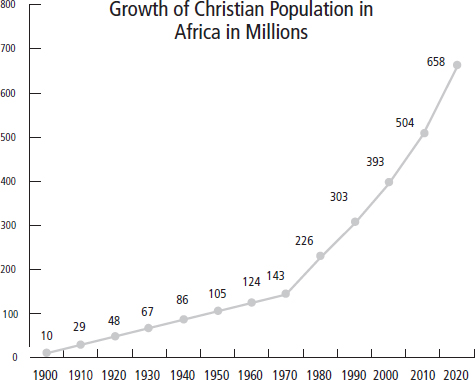
Although harmful things took place, God still brought life. What was the reason for this growth in Africa? Here I give two main reasons:
1. The Mission Schools4
Perhaps the single most effective way that Christianity spread in Africa in the twentieth century was through mission schools. For example, it is said that in Nigeria in 1949, 99 percent of the schools were run by the missions.
At this time, the local evangelists and disciples in training were often sent out to local villages to teach “bush schools.” In these schools, local leaders would teach the Bible and lead prayers. These schools ran in sub-Saharan Africa from 1900 to 1930. During that time, Christians quadrupled (from 4 million to 16 million) in that region.
The mission schools taught the Bible and used it as a textbook to teach reading. Testimonies such as the one below are numerous:
“Many boys came to instruction to learn to read and write, things to their advantage. Then behold! In the midst of their craving to read and write, the Word of God in their reading books overwhelmed them. . . . They become Christians, saved by Jesus, children of God. So, it was with me.”5
2. The Rise of Local African Leadership
Today, Africa has many local leaders. Some of these leaders are part of global denominations, while others have formed African Independent Churches (AICs). One of the notable leaders includes William Wade Harris, who is said to have permanently changed the religious geography of the Ivory Coast, or Cote D’Ivore. There were years when Harris baptized more than 100,000 people.6 Another influential African leader is Simon Kimbangu, who served in Congo and started a movement that became one of the three leading churches in that Congo.7 Similarly, Nigeria has thousands of independent churches founded by Nigerians. Such Africanled churches have changed the religious landscape of West Africa. Tens and hundreds of thousands came to embrace Christianity because of these movements.
Wave 5: From Africa to the Rest of the World As noted earlier, Africans were involved in the first organized sending effort in the early church. So, it is not surprising to see God’s hand in sending from Africa.
In March 2016, five hundred and sixty delegates from more than fifty countries gathered in Addis Ababa, Ethiopia, for the third consultation of the Movement for African National Initiatives (MANI). At the end of the threeday meeting, the consultation issued this declaration:
We have come to Addis Ababa to open ourselves to hear what God is saying to us regarding his mission in and from the African continent. God has reassured us of his love for us as his church and has inspired us to recommit ourselves to his mission in this world. As Ethiopia reminds us of Africa’s earliest response to the Gospel of Jesus Christ and the faithful preservation of our faith throughout the centuries, we want to erect a spiritual memorial to declare that the Church in Africa will not rest until the whole world is filled with the knowledge of the glory of the LORD, as the waters cover the sea (Habakkuk 2:14). From Addis to everywhere . . . until Jesus comes.8
With the majority of the evangelical population being in the Global South, particularly in Africa, the conviction that Africa should change from harvest field to harvest force is gaining momentum. Africa has begun taking its global share in sending African workers to many parts of the world where the unengaged and unreached are. Wellknown African mission organizations such as the Nigerian Evangelical Mission Association (NEMA)9 and the East Africa Sending Office (EASO)10 are sending thousands of African missionaries to the rest of the world. If we were able to combine the number of missionaries that are being sent from the various African denominations, indigenous ministries, and mission agencies, the number would be higher.
Much collaborative effort must be exerted to see this trickle of missionaries become a flood. This will require bold and visionary leadership, obedient disciples who have the passion to see the lost reached by the gospel, and a biblical mission strategy.
May the living God empower and guide the churches of Africa to labor together until the whole world is “filled with the knowledge of the glory of the LORD, as the waters cover the sea” (Hab 2:14 KJV)! 
RETURN TO LESSON 6: Expansion of the World Christian Movement
Notes
1. Ogbu U. Kalu, ed., African Christianity: An African Story (Asmara, Er: Africa World Press, 2007), 108.
2. Peter Falk, The Growth of the Church in Africa (Grand Rapids: Zondervan, 1979), 64.
3. Elizabeth Isichei, A History of Christianity in Africa: From Antiquity to the Present (Grand Rapids: Eerdmans, 1995), 1.
4. I have included here the churches/mission stations’ training for indigenous catechists and evangelists that are frequently linked to the mission schools. Roland Oliver, The African Experience: From Olduvai Gorge to the 21st Century, 2nd ed. (Colorado: Westview Press, 236–41).
5. Oliver, 236.
6. Oliver, 284–86.
7. Oliver, 199–204.
8. MANI, “Declaration by Mani Continental Consultation” (Addis Ababa, Ethiopia, March 7–11, 2016), https://maniafrica.com/mani/wp-content/uploads/2016/06/MANI-2016-declaration-Final-E-Copy.pdf.
9. NEMA has sent more than 2,500 missionaries from Africa to the rest of the world. Peter Vumisa, “The African Missionary,” in Evangelical Christian Missions: An African Perspective, ed. Peter Vumisa (Sun Press, 2012), 119.
10. The East African Sending Office has sent more than fifty couples from East African countries to places such as China, Pakistan, India, Bangladesh, and other 10/40 Window countries.