CHAPTER 37
Scott W. Sunquist

Scott W. Sunquist (PhD, Princeton Theological Seminary) is president and professor of missiology at Gordon-Conwell Theological Seminary. Previously, he was a professor and dean of the School of Intercultural Studies at Fuller Theological Seminary, taught missiology and Christian history at Pittsburgh Theological Seminary, and lectured at Trinity Theological College in Singapore.
Jesus was born in Asia, died in Asia, and His earliest followers from West Asia evangelized to the east as well as to the west. In Acts 2, we read that among the pilgrims who were in Jerusalem at Pentecost were some from present-day Iran (Elam, Parthia, Media), Iraq (Mesopotamia), and Turkey (Cappadocia, Pontus, Asia, Phrygia, and Pamphylia). As Christianity spread to the east, it spread outside of the Roman Empire into Persia, Rome’s enemy. The ongoing enmity between the empires forced Persian Christians to develop their own uniquely Asian forms of worship, theology, and practice.
They held their own church councils as well. The early Asian Christians, mostly from present-day Syria, Iraq, and Iran, would worship facing east as the sun was rising. They would stand with outstretched arms, imitating the cross, honoring the resurrection. These Persian Christians were proud of the fact that Persians were the first to worship Jesus as a baby in a manger, since God had used the stars to tell the magi (Persian astrologers) that the Savior was born in western Asia. Asian sermons were more poetic (like Psalms) than didactic (like Romans) and their common language was Syriac, not Greek or Latin. Within the first four centuries, Christianity spread throughout and beyond the Persian Empire. However, it was only in Asia that the followers of Jesus encountered larger, well-established, intercultural, “world” religions. The encounters with these intercultural religions—Zoroastrianism, Buddhism, Hinduism, Taoism—which often became state religions, were a much greater challenge to the spread of Christianity than the smaller, local “ethnic” religions of Europe and Africa.
Christianity in Asia has had five advances. For convenience’s sake, we identify them by the primary groups involved: Persian (first millennium), Franciscan-Mongol (1206–1368), Jesuit (1542–1773), Protestant (1706–1950), and Asian indigenous (1950–present). The first and the last—the most effective advances—were rooted in the commitment of Asians to engage in cross-cultural missionary work to other Asians. However, without the intervening work of Franciscans, Jesuits, and Protestants, the foundation for the most recent Asian missionary work would not have been in place. Asian Christianity is indebted to the early Asian wandering missionary monks, to Western missionaries, and to present-day East Asian missionaries.
Persian Advance
In the earliest days Asian Christianity spread along the trading routes, both land (“Old Silk Route”) and sea. Some of the earliest Christian communities were established along the southern shorelines of India, first southeast and later southwest. According to fairly reliable traditions, it was the Apostle Thomas who traveled to India, establishing the earliest Christian communities before being martyred by an angry Hindu mob. Indian Christianity survived these early persecutions, but Hindu reaction, along with the Hindu caste system itself, greatly limited the opportunity for Christian witness in India.
The common language in this early trans-Asian trade was Syriac, a dialect of Aramaic, which was Jesus’s mother tongue. Many of these early tentmaker missionaries were traders of Jewish background, carrying the message of the Messiah along with their goods as they traveled and settled in Central Asia. Persia during this era was the archenemy of the Roman Empire (during the Parthian Dynasty in 247 BC–226 AD and continuing during the Sasanian Dynasty in 226–651). Travel across the enemy lines was difficult, and so the Asian Church developed independently of the Roman Church (Latin-speaking) and had only limited contact with the Greek-speaking Orthodox Church. Therefore, Persian Christians studied in their own monastic schools in cities such as Nisibis, Mosul, or Seleucia-Ctesiphon (in present-day Iraq). Many were converts from Zoroastrian dualism, and so their theology was more interested in ritual purity, the cosmic conflicts between good and evil, and in God as being the Creator of all. Persian Christians were zealous missionaries, traveling throughout Central Asia as far as China to preach the gospel, start monasteries, and plant churches.
By 635, the Persian monk Alopen led a missionary band to the city of Xi’an, the capital of the Tang Dynasty in China. It was a good time to arrive in Xi’an. The Tang Dynasty was fairly young and therefore open to ideas from the West. And so the Persian monks (often called Nestorian) were invited to translate their Scriptures in a house very near the emperor’s residence. A public document survives from that era in the form of the ten-foot-tall “Nestorian Monument” erected in 781. According to it, monasteries and churches were started throughout the country, and the new religion was well received in China. However, as is often the case in Asia, Christianity thrives or is crushed as dynasties change. In this case, as the Tang Dynasty was in decline, foreign religions (including Buddhism and Zoroastrianism) were persecuted. Eventually Buddhism adapted and found a home in China, but Christianity was severely persecuted for centuries. Most people in the West completely forgot about the Christian presence in China. Christianity survived in the region, but worship continued in Syriac, a language that was no longer understood.
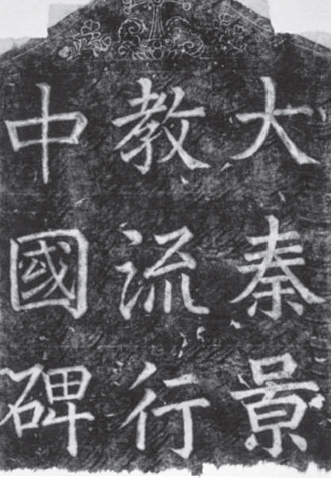
A portion of the Chinese text on the Nestorian Stele at Hsi-an-fu, commemorating the “Luminous Religion” (Christianity), which arrived in the Middle Kingdom as early as AD 635.
Back in the home base of Persia, the Arab Muslim conquest (circa 650) initially gave Christians freedom to worship. Slowly, restrictions were added that prevented Christians from repairing, building, or renovating churches. They were also prevented from evangelizing or marrying outside of their own community. With these restrictions in life, worship, and travel, the Persian missionary movement to the East came to an end. Christianity survived, but it was stunted by its isolation and restrictions.
Persian Christians were zealous missionaries, traveling throughout Central Asia as far as China to preach the gospel, start monasteries, and plant churches.
Franciscan-Mongol Interlude
The second advance was brief and it carried on a common theme: dynastic rule redirects Christian development. The Chinese were conquered by the Mongols, who had no objection to the various religions they encountered. Under leaders like Genghis Khan and his grandson Kublai Khan, the Mongols conquered and absorbed cultures from Korea to Poland. Innocent IV (1245) had sent John of Carpini, of the Order of Friars Minor, to placate more than to convert the Mongols. He arrived in 1246 with a letter from the pope imploring the Khan to convert, be baptized, and submit to the pope’s authority. This strange missionary tactic only raised the ire of Guyuk Khan, whose armies were already at the gates of Hungary. Guyuk responded that the pope and the kings of Europe must send tribute to the Mongols.
When Marco Polo returned (1271) from his seventeen-year sojourn in China among the Mongols, Kublai Khan had given him a letter for the pope requesting one hundred teachers to teach the Mongols about Christianity. The request was never fulfilled because the popes in Europe were more concerned about defending themselves militarily than they were interested in extending the gospel spiritually.
As a late and weak response to Kublai Khan (who had died by then), John of Montecorvino arrived in Khanbaliq (Beijing) in 1294. John received permission from the new Khan to stay, preach his religion, and translate his message. His noble missionary work lasted until his death, thirty-four years later (1328). It was reported back to Europe that the Roman Catholic Church was supported by the imperial court. Two major churches and two Franciscan houses were built, and many Mongols were baptized. However, the Mongols were foreign rulers and their brief empire began to decline in the mid-fourteenth century. When the Mongol Empire collapsed, the few small Catholic communities collapsed with it. Royal favor comes and goes.
Jesuit Advance
The third major advance came in the tumultuous six-teenth century. Christian communities in India and Persia had remained small but were full of life and energy. Yet they were mostly cut off from other Christian contacts. As the Portuguese and Spanish began to move out from Iberia, they came with zeal for discovery and profits but also with the commission from the pope to Christianize the lands they discovered. Most of the Portuguese sailors had little interest in missionary activities, but they brought Dominicans, Augustinians, Franciscans, and later, Jesuits (Society of Jesus) on their ships. Jesuit missionaries first turned their attention to South India. Through the creative approach and innovations of Francis Xavier, they also pioneered in Malacca, the Molucca Islands, Japan, Vietnam, Siam (Thailand), and China. In all of these regions and many different empires, the Jesuits valued the local languages and cultures. Because of this esteem, the works of the Jesuits have lasted. The Jesuit churches have survived since the late sixteenth century, often in the midst of great persecution. However, their adaptation to local cultural contexts has been controversial.
In China, the Italian missionary Matteo Ricci insisted that a local name for God be used. He also allowed Chinese Catholics to continue honoring their ancestors through the use of ancestor tablets by interpreting such rituals to be an expression of the fifth commandment rather than idolatry. Non-Jesuits and the papacy disagreed. In India, Roberto de Nobili presented himself as a sannyasi, or one who renounces worldly comforts in order to follow a spiritual path. As such, he lived as an Indian holy man who followed Christ. His approach attracted both lower- and upper-caste people, but his method came into conflict with the church. Alexandre de Rhodes, the French Jesuit who worked in Vietnam, adapted his Eight Day Catechism to the particular questions that came from the local Confucianists, Buddhists, and Taoists (called the “triple religion” or tam giáo). This missionary approach sought to understand the local culture and present Catholic teaching in a way that did not unnecessarily offend that culture. It also sought to equip local men and women to lead the church. For various reasons, the Christian communities in these countries experienced severe persecutions. In Japan came the rise of the Tokugawa, circa 1603. In China the Qing Empire rose to power circa 1636. In Vietnam there were ongoing conflicts between the North and the South until Gia Long unified the country in 1802. In India the missionaries experienced resistance from Hindus and from the Muslim Mughal Empire. In all of this, the Christian communities struggled but survived under local leadership.
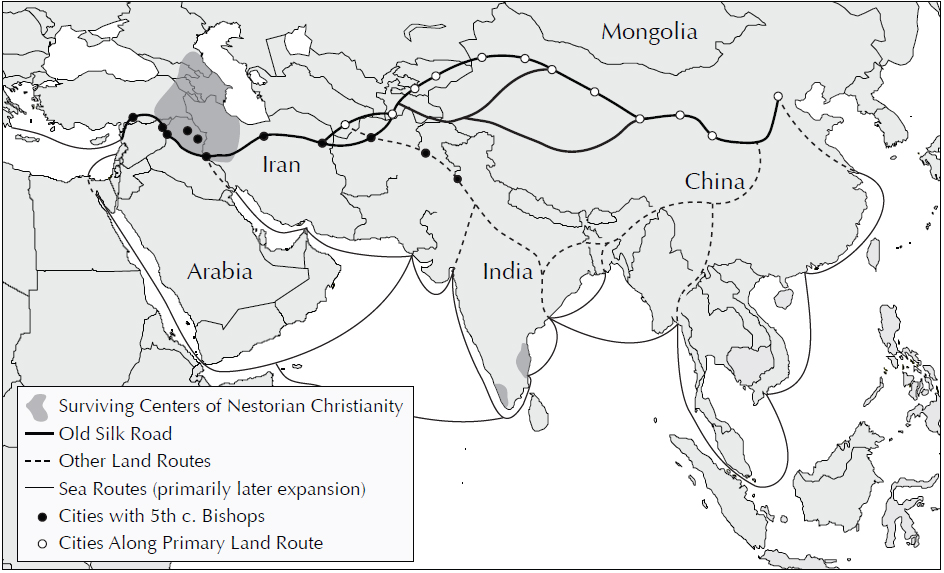
Trade routes upon which the gospel traveled to Asia.
Protestant Advance
Protestant Christianity did not really begin until the Danish-German mission sent its first missionaries, Bartholomew Ziegenbalg and Henry Plutschau, to India in 1706. The work did not become a significant movement, however, until the first decades of the nineteenth century. Whereas Roman Catholic missions were supported by the kings of Spain and Portugal, the Protestant missionaries were often at odds with the private companies that provided the transportation to Asia: the Dutch and British East India Companies.
The missionary work was important and foundational, but the greatest work and growth occurred under Asian leadership.
Protestant work in Asia differed in other ways from Roman Catholic work. Protestants worked to translate the entire Bible. Between 1727 and 1920, Protestants translated the Bible into fifty Asian languages and the New Testament into another fourteen languages. Protestants also placed much more emphasis upon education, especially in the local languages. Protestant missionaries across Asia established the foundation for the modern university movement in Asia by the middle of the nineteenth century. Protestants in Asia also began pioneering advances in medical work. They introduced the earliest forms of inoculation, surgery, and leprosariums. In education, they introduced modern science and mathematics along with the study of the Bible.
Protestants often introduced Western social mores, dress, and customs as part of the gospel message. However, most of the spread of Christianity in Asia was accomplished by Asians. Therefore, local forms and practices of Christianity tended to emerge as local leaders taught the Bible in local languages. In Korea, for example, the first Protestant believers in Jesus traveled to Manchuria to ask the Bible translator, John Ross, to come and baptize a group of Koreans. They had believed in Christ by reading Gospels that Ross had translated in China with a Korean helper.
One of the major tensions in Protestant missionary work in Asia was whether Asians needed Western knowledge and culture, or only the Bible and very basic education. Many missionaries kept their message wrapped in Western assumptions of empire, progress, and the superiority of their own culture. They pushed for Westernstyle higher education, teaching Western subjects and knowledge. Others were more focused on the three-self principles (self-support, self-governance, and self-propagation) and were less concerned about developing schools for higher education and institutions that required outside support.
In most regions the greatest impact of Protestant missions was among the poorer tribal groups, such as the Dalits (or outcastes) and other minorities. Protestant churches were established, the greatest growth of which came after the Pacific War, as colonies gained independence. As Western dominance decreased, Asian Christianity increased. The missionary work was important and foundational, but the greatest work and growth occurred under Asian leadership.
Asian Indigenous Outreach
Although Asians have always had a role in spreading and developing Christianity in Asia, most of the history of Christian advance has been greatly handicapped under the oppressive melet system of Zoroastrianism, the dhimmi system of Islam, and the caste system of Hinduism. In the aftermath of Western and Japanese colonialism, Christianity is developing in many regions of Asia with great vigor. Where there is still a strong national religion (Iraq, Iran, Saudi Arabia, Thailand, Bangladesh, Israel), Christianity has been slow to grow or has even declined.
In most countries of Asia, Christianity has been growing primarily through the efforts of Asians. Much of the church growth in India is from the over twenty thousand Indian missionaries working cross-culturally in their own country. Christianity is stronger than ever in countries like Nepal, Cambodia, Vietnam, and Laos because of missionaries from India, Korea, Malaysia, Taiwan, China, and Singapore. Many Asians are creatively working in foreign countries and planting churches while involved in trade, manual labor, or manufacturing.
Two of the greatest examples of church growth are Korea and China. In South Korea, Christianity has grown to be nearly one-third of the population since the partition from the North. In China, Christianity has grown from about two million in 1950 to over 100 million today, probably the greatest growth in history within two generations. Almost all of the growth is due to Chinese efforts.
Many Asians are creatively working in foreign countries and planting churches while involved in trade, manual labor, or manufacturing.
Today, in a reversal of the first seven centuries, Christians from China are committed to taking the gospel back to the West, both by land and by sea. Thus, the first and fifth movements of Christianity in Asia have been from the margins to the margins: from West Asia to East Asia and now from East Asia to the West. 
RETURN TO LESSON 6: Expansion of the World Christian Movement