CHAPTER 36
Yvonne Wood Huneycutt

Yvonne W. Huneycutt has worked with the perspectives on the World Christian Movement course since 1991 in various capacities, from local class coordinator to regional director to instructor, author, and trainer. She is currently on staff with Perspectives Global, serving the dozens of national Perspectives programs around the world. She is the author of propelled by hope: The Story of the perspectives Movement.
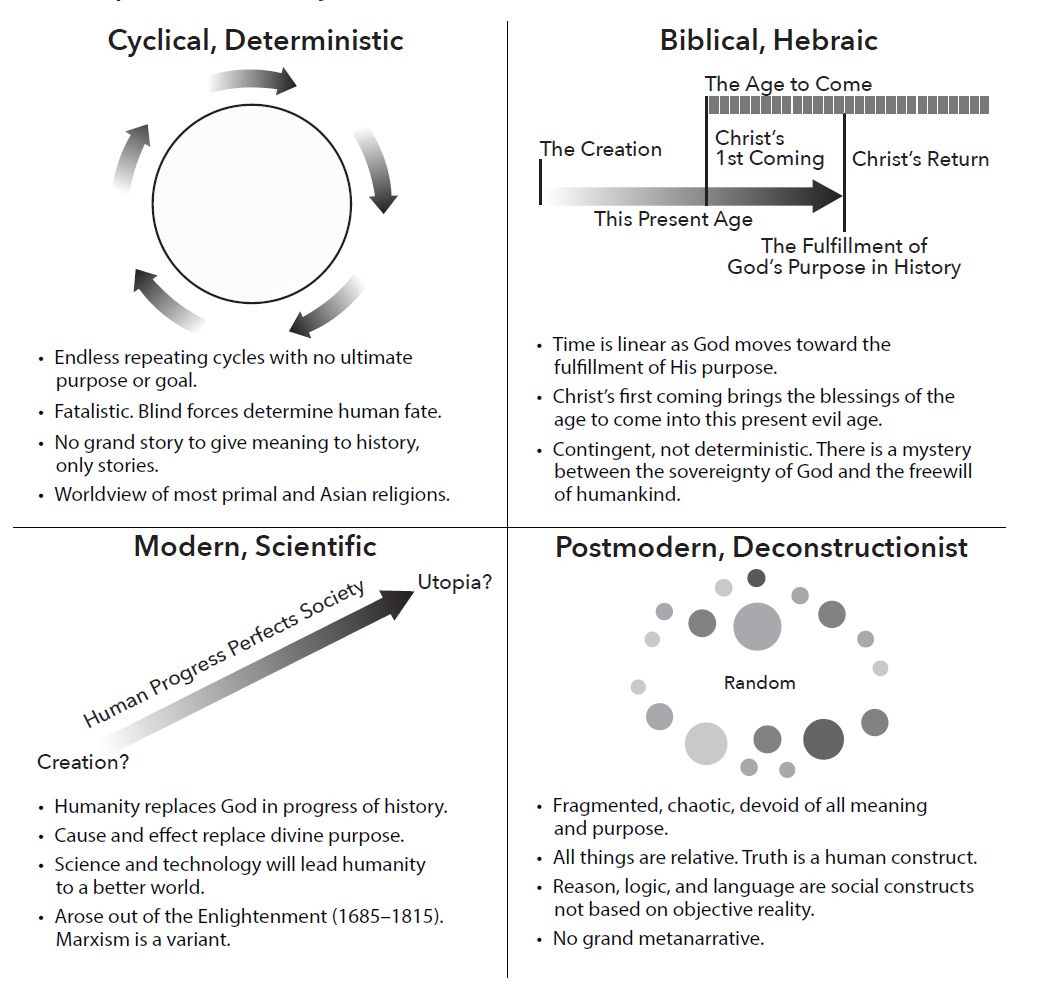
A Christian perspective on history is that of an unfolding story, initiated and concluded by the Creator God. God oversees and acts within history in ways that will ultimately bring about His global purpose. This is the biblical view of history. There are, however, alternate views of history that conflict with the biblical view. Understanding these conflicting views can aid in discerning competing worldviews in contemporary society and our place in history as we embrace God’s purpose.
Cyclical
In many times and places, people have seen history in what can be called a cyclical view. In this view, all of history is a series of endlessly repeating cycles without any ultimate purpose or goal. It takes its cue from the repeating life cycles of nature. Many people from ancient times have held this view, and it is still quite common today. The fate of humans is often understood as determined by blind forces.
In terms of a grand overarching story, missiologist Lesslie Newbigin remarks,
The great religions of Asia have not been interested in the construction of a universal history. All the religions that have their origin in the Indian subcontinent have seen the human story in terms of recurring cycles. . . . The story can never come to a point. There is no point in a circle, and so there is no story to tell. There are only stories.1
Biblical
By contrast, the biblical view of history is the unified story of one God revealing His dealings with people and creation throughout all times and places. It is often described as the Judeo-Christian or Hebraic worldview. In this view, God initiated history in creation, is working throughout all generations, and will bring all things to fulfillment. God is not some cosmic spectator. He initiates and intervenes in the affairs of humanity according to His purpose. And yet, God does not control all things in a deterministic way. There is a mystery in the relationship between God’s sovereignty over the affairs of humanity and the free will that God gives to people. Because history is moving toward the completion of God’s purpose, time is linear, leading to a culmination. Thus, it is a unified, all-encompassing, view of history. The meaning of life and the purpose of humankind can be found within the purpose of God.
Modern
Emerging out of the biblical view of history, the Enlightenment thinkers of the eighteenth century in Europe also saw history moving forward, but humans, instead of God, were seen as bringing history to its zenith. In this view, “enlightened” humanity was regarded as leading the world toward progress through technology and science in order to move out of the irrational, superstitious Dark Ages of humanity. This view of progress undergirded the colonial project of global European domination. It remains a prevalent worldview. The world is seen as moving forward and changing by the dynamics of cause and effect that can be analyzed, not according to any divine purpose or intervention. A variation of the modern view is Marxism, which strives toward a manmade utopia.
Postmodern
After two World Wars, the postmodern view arose in reaction to the failure of humanity to engineer a modern world. In the postmodern view, history is fragmented, chaotic, and devoid of purpose and meaning. Jean-François Lyotard, considered the father of postmodernism, famously stated, “I define postmodern as incredulity toward metanarratives.”2 Metanarratives are overarching stories about history and the goals of humanity. In a postmodern worldview, there is no grand story that is true, that makes sense out of the events of history, and that can be appealed to as a universal basis for judgment. In critiquing postmodernism, Newbigin states, “Its main feature is the abandonment of any claim to know the truth in an absolute sense Truth-claims are really concealed claims to power, and this applies as much to the claims of science as to those of religion.”3 The post-modern worldview has affected societies across the world, especially among younger generations.
In contrast with these alternate ideas of history, the Bible reveals a grand metanarrative: a great God who pursues His purpose throughout every people and place. Individuals can realize their dignity, meaning, and worth within God’s purpose, finding hope in this greater story. 
RETURN TO LESSON 6: Expansion of the World Christian Movement
Notes
1. Lesslie Newbigin, The Open Secret: An Introduction to the Theology of Mission, rev. ed. (Grand Rapids: Eerdmans, 1995), 86.
2. Jean-François Lyotard, The Postmodern Condition: A Report on Knowledge, trans. Geoff Bennington and Brian Masumi, Theory and History of Literature 10 (Minneapolis: University of Minnesota Press, 1984), xxiv.
3. Lesslie Newbigin, “Religious Pluralism: A Missiological Approach,” Studia Missionalia 42 (1993): 231.