CHAPTER 40
Ralph D. Winter

Ralph D. Winter was the general director of the Frontier Mission Fellowship (FMF) in Pasadena, CA. After serving ten years as a missionary among Mayan Indians in the highlands of Guatemala, he was called to be a professor of missions at the School of World Mission at Fuller Theological Seminary. Ten years later, he and his late wife, Roberta, founded the mission society called the Frontier Mission Fellowship. This in turn birthed the U.S. Center for World Mission and the William Carey International University, both of which serve those working at the frontiers of mission.
It is difficult to give a brief but fair summary of the last two centuries. In this period, more people by far lived and accomplished more for the kingdom of God than in all previous history. What actually happened? Most historical treatments of this time leave out the Christian dynamics. The overriding purpose of this essay is to tell the story of the dramatic changes and growth in Protestant Christian missions from the days of William Carey in the late 1700s to the modern time.
Christians often make little connection between prophecy of future events and missions. They see the Bible as a book of prophecy, both in the past and for the future. Yet, as Bruce Ker has said so well, “The Bible is a missionary book throughout. The main line of argument that binds all of it together is the unfolding and gradual execution of a missionary purpose.”
Only recently have I come to a new appreciation of the fact that the story of missions begins long before the Great Commission. The Bible is very clear that God told Abraham he was to be blessed to be a blessing to all the families of the earth (Gen 12:1–3). Peter quoted this on the day he spoke in the temple (Acts 3:25). Paul quoted the same mandate in his Letter to the Galatians (3:8).
“The Bible is a missionary book throughout. The main line of argument that binds all of it together is the unfolding and gradual execution of a missionary purpose.”
This mandate has been overlooked during most of the centuries since the apostles. Even my own Protestant tradition plugged along for over 250 years minding its own business—and its own blessings (like Israel of old)—until a young man of great faith and incredible endurance appeared on the scene.
The First Era
A young man from England, William Carey, was criticized by other believers when he began to take the Great Commission seriously. When he had the opportunity to address a group of fellow local ministers, he challenged them to give a reason why the Great Commission did not apply to them. The ministers rebuked Carey, saying, “When God chooses to win the heathen, He will do it without your help or ours.” He was unable to speak again on the subject, so he patiently wrote out his analysis and entitled it An Enquiry into the Obligations of Christians to Use Means for the Conversion of the Heathens.
The resulting small book convinced a few of his friends to create a tiny mission agency. Thus, the small organization became the method or “means” of which he had written in the title of his little book. The structure formed by that agency was flimsy and weak, providing only the minimal backing he needed to go to India. However, the impact of his example reverberated throughout the English-speaking world. His little book became the foundational document of the Protestant mission movement.
However, William Carey was not the first Protestant missionary. For years a group known as Moravians sent mission workers from Germany to the most remote parts of the earth in Asia, Africa, and the Americas. But Carey’s little book, in combination with a revival happening at the time, quickened vision and changed lives in both Europe and North America. The response was almost instantaneous: a second missionary society was founded in London, two more in Scotland, another in Holland, and then still another in England. It soon became apparent to everyone that Carey was right when he insisted that organized efforts in the form of mission societies were essential to the success of the missionary endeavor.
About the same time in America, five college students, inspired by Carey’s book, An Enquiry, met to pray for God’s direction for their lives. This unobtrusive prayer meeting in 1806, later known as the “Haystack Prayer Meeting,” resulted in the first mission agency ever formed in the United States—the American Board of Commissioners for Foreign Missions. Perhaps even more important, they started a student mission movement that became the example and forerunner of other student movements in missions to this day.
In fact, during the first twenty-five years after Carey sailed to India, a dozen mission agencies were formed on both sides of the Atlantic, and the First Era in Protestant missions was off to a good start. Realistically speaking, however, missions in this First Era was a pitifully small, low-budget operation when compared to the major preoccupations of most Europeans and Americans in that day. The idea that we should organize in order to mobilize, send, and care for missionaries did not come easily, but it eventually became an accepted pattern.
Carey’s influence led some women in Boston to form women’s missionary prayer groups, a trend that led to women becoming the main custodians of mission knowledge and motivation. After some years women began to go to the field as single missionaries. Finally, by 1865, unmarried American women established women’s mission agencies which, like Roman Catholic women’s orders, only sent out single women as missionaries and were run entirely by single women at home.
There are two bright notes about the First Era. One is the astonishing demonstration of love and sacrifice on the part of those who went out. Africa, especially, was a frightening continent to Europeans and North Americans at the time. All mission outreach to Africa, prior to 1775, had largely failed. Of all Catholic and Moravian efforts, nothing substantial remained. Not one known missionary of any kind existed in Africa on the eve of the First Era. The gruesome statistics of almost inevitable sickness and death that haunted, yet did not daunt, the decades of truly valiant missionaries who went out after 1790 in virtually a suicidal stream cannot be matched by any other era or cause.
Very few missionaries to Africa in the first sixty years of the First Era survived more than two years. As I have reflected on this measure of devotion I have been humbled to tears, for I wonder if I or my people today could or would match that record. Can you imagine our university students today going out into missionary work if they knew that for decade after decade nineteen out of twenty of those before them had died almost on arrival on the field?
A second bright spot in this First Era is the development of high-quality insight into mission strategy. The movement had several great mission strategists. In regard to sending structure, they clearly understood the value of the field structures being allowed a life of their own. For example, the London Missionary Society experienced great success partly due to its freedom to make decisions without consulting church leaders. One of the key leaders at that time, named Henry Venn, described the value of missions forming new churches. Except for a few outdated terms, his description sounds as if it were said in our day:
Regarding the ultimate object of a Mission . . . to be the settlement of a Native Church under Native Pastors upon a self-supporting system, it should be borne in mind that the progress of a Mission mainly depends upon the training up and the location of Native Pastors; and that, as it has been happily expressed, the “euthanasia of a Mission” takes place when a missionary, surrounded by well-trained Native congregations under Native Pastors, is able to resign all pastoral work into their hands, and gradually relax his superintendence over the pastors themselves, until it insensibly ceases; and so the Mission passes into a settled Christian community. Then the missionary and all missionary agencies should be transferred to the “regions beyond.
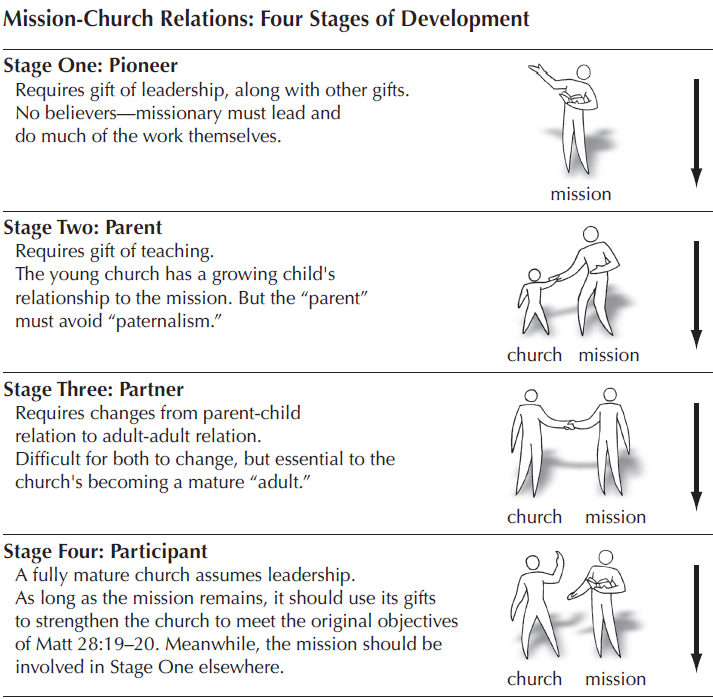
These missiologists were recognizing the stages of mission activity recently described in the alliterative sequence:
Stage 1: A Pioneer stage—first contact with a people group.
Stage 2: A Parent stage—expatriates train national leadership.
Stage 3: A Partnership stage—national leaders work as equals with expatriates.
Stage 4: A Participation stage—expatriates are no longer equal partners but only participate by invitation.
Slow and painstaking though the labors of the First Era were, they did bear fruit, and the familiar series of stages can be observed, which goes from no church in the pioneer stage to infant church in the parent stage and to the more complicated mature church in the partnership and participation stage.
It is rare for a missionary to experience the entire sequence of stages within their lifetime of work. The stages more likely represent the work of a succession of missionaries.
As the First Era was entering its final stages in 1865, there was a strong consensus in both Europe and North America that the missionaries should go home when they had worked themselves out of a job. Since the First Era focused primarily on the coastlands of Asia and Africa, we are not surprised that actual withdrawal would come about first in a field where there was nothing but coastlands.
Thus, symbolizing the latter stages of the First Era was the withdrawal of all missionaries from the Hawaiian Islands, at that time a separate country from the United States. Withdrawing missionaries from Hawaii was done with legitimate pride and fanfare and fulfilled the highest expectations, then and now, of successful progress through the stages of missionary activity.
The Second Era
In the same year that the missionaries were leaving Hawaii, another British young man named Hudson Taylor launched a new mission agency with the express purpose of working beyond the coastal areas in the interior regions. Like Carey, in spite of the advice to do otherwise, Taylor established the first of a whole new breed of mission agencies that emphasized the inland territories. Up to that point, missionaries had largely gone only to coastal areas. Taylor also followed Carey’s example by studying statistics, charts, and maps and praying. When he suggested that people in the interior of China needed to be reached, he was told you could not get there, and he was asked if he wished to carry on his shoulders the blood of the young people he would thus send to their deaths.
With only informal medical training, without any university experience, much less missiological training, and a checkered past in regard to his own individualistic behavior while he was on the field, he was merely one more of the weak things God has used to confound the wise. Even his early strategies were breathtakingly erroneous by today’s standards. Yet God strangely honored Taylor’s vision of reaching the world’s least-reached places. Taylor seemingly had a divine wind behind him. The Holy Spirit spared him from many pitfalls, and he eventually formed an organization called the China Inland Mission. It eventually would help place over six thousand missionaries on the field, almost exclusively in the interior of China. It took twenty years for other missions to begin to join Taylor in his special emphasis—the unreached, inland areas.
One reason the Second Era began slowly is that many people were confused. There were already many missions in existence. They questioned whether more mission agencies were needed. Yet as Taylor pointed out, almost all existing agencies were confined to the coastlands of Africa and Asia or islands in the Pacific. People questioned, “Why go to the interior if you haven’t finished the job on the coast?”
Taylor traveled widely throughout Europe and the United States to challenge others to start new agencies. As a result, directly or indirectly, over forty new agencies were started that wanted to go to unreached inland areas. Their names indicated their goal to bring the gospel to une-vangelized inland places: China Inland Mission, Sudan Interior Mission, Africa Inland Mission, Heart of Africa Mission, Unevangelized Fields Mission, Regions Beyond Missionary Union.
As in the early stage of the First Era, when things began to move, God brought forth another student movement. This one lasted much longer than what had come before. It was called the Student Volunteer Movement for Foreign Missions. In the 1880s and ‘90s, there were far fewer university students than today. Nevertheless, the Student Volunteer Movement successfully mobilized one hundred thousand people who were willing to give their lives to evangelize the world. Twenty thousand of those who joined the movement actually moved to other countries. As we understand it now, the other eighty thousand, who had also indicated that they were willing to go, stayed home to serve as senders, to mobilize others, to enlist prayer, and to staff mission agencies’ home offices.
However, as the fresh new university students of the Second Era burst on the scene in other lands, they did not always grasp why the older missionaries of the First Era had turned over responsibility to national leadership, who were from the least educated levels of society. First Era missionaries were in the minority at that time. The wisdom they had gained from their experience was bypassed by the large number of new university-educated recruits. Thus, in the early stages of the Second Era, the new missionaries, instead of going to unevangelized areas, sometimes assumed leadership over existing churches instead. These new missionaries sometimes forced First Era missionaries and local national leadership into the background. In some cases, this caused a huge step backward in mission strategy.
By 1925, however, the largest mission movement in history was in full swing. By then Second Era missionaries had finally learned the basic lessons they had first ignored and produced an incredible record. They had planted churches in hundreds of new settings, mainly inland. By the 1940s the reality of the younger churches around the world was widely acclaimed as being “the great new fact of our time.” The vitality of these churches led both national leaders and missionaries to conclude that local churches scattered throughout the world could finish the job of world evangelization. More and more people wondered if, in fact, missionaries were no longer needed. Once more, as at the end of the First Era, it seemed logical for missionaries to be sent home from many areas of the world.
During the overlapping years of the First and Second Eras, there was confusion. Some foreign missionaries were supporting the maturity of the churches they had planted. But at the same time, waves of other foreign missionaries were calling for new work in untouched areas. It is important to understand this tension because we probably are in such a time in our day as we see the Second Era overtaken by the Third Era.
At the World Missionary Conference in Edinburgh in 1910, there was a hopeful exploration of ways the world could be evangelized. But shortly after that conference came the shattering of World War I, followed by the even greater tragedy of World War II. These wars brought about the collapse of colonial structures. By 1945 many churches around the globe were ready not only for the end of the colonial powers but for the withdrawal of the missionaries as well. While there was no widespread outcry, “Missionary go home,” as some have claimed, the understanding of how mission was to be done had changed dramatically. Many mission fields had matured beyond the need for pioneering and were then partnering with locals. Some areas were even ready for missionaries to take a step back and become participants in independent, vibrant, mature local churches.
In 1967, the total number of career missionaries from America began to decline. Why? Christians had been led to believe that all necessary work had been established. By the late 1960s, over 90 percent of all missionaries from North America were working with strong national churches that had been in existence for some time.
The facts, however, were not that simple. Unnoticed by most everyone, another era in missions had begun.
The Third Era.
This era was begun by a pair of young men of the Student Volunteer Movement: Cameron Townsend and Donald McGavran. Cameron Townsend was in so much of a hurry to get to the mission field that he didn’t bother to finish university. He went to Guatemala as a “Second Era” missionary, building on work that had been done in the past. In that country, as in almost every mission field, there was plenty to do by missionaries who were working with previously established national churches.
But Townsend was alert enough to notice that the majority of Guatemala’s population did not speak Spanish. As he moved from village to village, trying to distribute Scriptures written in Spanish, he began to realize that evangelism in the Spanish language would never reach all of Guatemala’s different ethnic peoples. He was further convinced of this when a Native American man asked him, “If your God is so smart, why can’t he speak our language?” He was just twenty-three years old when he began to work to make the gospel available in every language.
Like William Carey and Hudson Taylor, Townsend saw that there were still unreached frontiers, and for almost a half century he called attention to the overlooked tribal peoples of the world. He started out hoping to help older mission agencies reach out to tribal people. Like Carey and Taylor, he ended up starting his own mission, Wycliffe Bible Translators, which is dedicated to making the Bible accessible in all needed languages. At first, he thought there must be about five hundred unreached ethnic groups in the world. (He was judging by the large number of ethnic languages in Mexico alone). Later, he revised his figure to one thousand, then two thousand, and now the number of languages is known to be closer to seven thousand. As his conception of the enormity of the task increased, the size of his organization increased.
Townsend saw that there were still unreached frontiers, and for almost a half century he called attention to the overlooked tribal peoples of the world.
At the same time Townsend was beginning his work in Guatemala, Donald McGavran was beginning to understand the seriousness, not of linguistic barriers, but of India’s complex ethnic realities. While Townsend focused on language barriers to the spread of the gospel, McGavran focused on socioeconomic barriers.
McGavran’s main insight was that social and economic barriers between peoples slowed the spread of the gospel. Flowing out of that insight, McGavran began to understand how to nurture church-planting breakthroughs within ethnic groups. He understood that there was a “bridge of God” to each unique people that would then lead to the establishment of a locally led church that could grow. He began to understand in a new way that, until such a break-through is made, neighbor-to-neighbor evangelism is difficult and church planting cannot take place.
McGavran did not found a new sending agency. (Townsend did so only when the existing missions did not properly respond to the linguistic challenge). McGavran’s active efforts and writings spawned both the church growth movement and the frontier mission movement. The church growth movement was devoted to expanding the church within already reached groups, while the frontier mission movement was devoted to taking deliberate actions to reach the remaining unreached groups.
As with Carey and Taylor before them, Townsend and McGavran attracted little attention for about twenty years. But by the 1950s both had wide audiences. Wycliffe Bible Translators continued to grow. In 1965, McGavran formed the School of World Mission and Institute of Church Growth at Fuller Theological Seminary.
Editor’s note: At the Congress on World Evangelization held in Lausanne, Switzerland, in 1974, McGavran was one of the leading voices. In his presentation, he called attention to his colleague Ralph D. Winter, who would also address that assembly. Winter proposed the idea of recognizing the value of focusing on people groups in order to complete world evangelization. Winter described the remaining task of world evangelization as requiring different kinds of cross-cultural efforts. Winter’s address greatly influenced many to envision the global task as doable when seeing the work of evangelization as planting culturally appropriate churches amidst people groups. See Winter’s address in chapter 54.
By 1980, a conference similar to the important mission conference held in Edinburgh, Scotland, in 1910 was held. One of the primary purposes of this second Edinburgh conference was to focus precisely on the overlooked groups these leaders were emphasizing.
More recently many have begun to realize that groups of socioethnic peoples are not the only overlooked peoples. Many other groups, some in the middle of partially Christianized areas, have been completely overlooked. These peoples are being called “unreached people groups.” These peoples are so different from the cultural traditions of any existing church that unique missions strategies are necessary for the planting of indigenous churches within their particular cultures.
If the First Era was characterized by reaching people living in coastland areas and the Second Era by inland territories, the Third Era must be characterized by the more difficult-to-define, non-geographical category that we have called “unreached people groups”—people groups who are socially distant from existing churches.
In today’s world there are thousands of known people groups. In order to offer each people group a way to follow Christ within their own culture and family structures, it will take a distinct and intentional missionary effort.
A Doable Task
The task is not as difficult as it may seem, for several surprising reasons. In the first place, the task is not an American one, nor even a Western one. It will involve Christians from every continent of the world. We know of tens of thousands of mission agencies in the non-Western world—and the number is increasing.
Because the modern world is becoming more and more interdependent, “closed countries” are less of a problem. There are no countries today which admit no foreigners. Many of the countries that are typically thought of as being closed—like Saudi Arabia—are in actual fact actively recruiting thousands of skilled people from other nations. And the truth is, they prefer Christians to boozing, womanizing, secular Westerners.
The Third Era could and should be the final era. God has not asked us to reach every nation, people group, and tongue without intending it to be done.