CHAPTER 92
God at Work Changing People and Their Communities
Samuel J. Voorhies

Sam Voorhies has 40 years of experience working in the faith-based international humanitarian arena. He has lived and worked across Africa for 12 years, serving as global director for leadership and organizational development with World Vision International and working in over 100 countries with 40,000 staff. He currently leads a global consulting firm focusing on leadership and organizational development.
We drove for hours across Africa. After driving for two days on unpaved, rough roads, we finally reached our destination. In the small town we met the project officer for a development project we had come to observe. A small office for the project was located there because it was the nearest place to the remote development project that had telephones or electricity.
The staff of the development project told us why the project was launched. They explained that the area had once been a game preserve, but it was considered so remote that it had been neglected by the government. There were no basic human services such as education, healthcare, or water. When people were forced to settle in the area, a previous government administration had made promises, but these had never been fulfilled.
While some mission work had been carried out in the area, few NGOs (nongovernmental organizations) or Christian aid agencies had come to bring any help. Finally, these few workers explored how it might be able to help carry out transformational development in the area. The first step was to go through a process with community leaders and members to identify their community resources. With resources in view, they looked together as to how these resources could be used to solve the community’s problems. It wasn’t hard to see the problems:
- They lacked a clean source of water.
- There were no health services.
- There were no school facilities.
- The food production was inadequate to provide enough to supply the people until the next growing season.
- There had been no churches in the area.
- The area had been neglected by government and NGOs.
We were assured, though, that we would find something different after we endured the rough three-hour ride to reach the community. Before we could step from the truck, women, men, and children had gathered, singing a song in the local language, “Up with development—we can do it ourselves with God’s help, and to His glory we will become all that we can be.” I was inspired by the enthusiasm and commitment of these people. They had so little, yet, in very difficult circumstances with little help, they were doing so much.
Sitting with the crowd under a big tree for the next hour, we heard progress reports from community representatives about what the people had done for themselves and what the agency had helped them to do. Then we were invited to walk around the community and see some of the improvements that they had made.
They showed us their former water supply—a pool of dirty water. “This is where we used to get our drinking water. It is the same place the animals drink from,” said one of the ladies. We walked a little further and there was a new well. It was covered with a concrete slab, surrounded by a neat fence with a pump for retrieving clean water from deep underground. With a big smile the lady began to pump the water. “It’s clean—would you like a drink?” she asked. I tasted the clean, fresh water. Another lady explained,
When we drank from the pool, our children were always sick with stomach problems and diarrhea. Now they are much healthier.
A little further on we saw a field where some beautiful corn was growing. “I was given a loan of improved seed and trained in planting methods and using organic fertilizers to double the amount of corn I will harvest,” said a farmer. He continued,
The amount of corn I will get from this field will not only be enough to feed my family, but I will have enough left over to sell and help pay my children’s school fees. I am planning to save some money each year and in three years, I will be able to buy oxen, cultivate more land, and grow more crops.
As we walked on to the primary school, a young boy pointed to a fig tree. “This is where we used to sit for our lessons. There was no chalkboard or chairs—just the hard ground,” he explained. We went inside to the new classroom where desks had been built and a big chalkboard covered the front wall. “Now we can learn our lessons much better!” exclaimed another student.
After finishing our walk, we sat together under the tree again. I asked them what had been the most significant achievement of the project so far. They responded,
We are together now and organized to help ourselves. We can meet and talk about our problems and how we can solve them together. Before we were isolated, living apart and not helping each other. We realize that we can do something to help better our lives. We don’t have to wait on the government.
We realize that as women we were loved and valued by God. We can contribute something to the development of this community. Our husbands now treat us with respect and we have more time to spend with our children. The men have stopped drinking.
We now have clean water and healthier children. We don’t have to walk so far for water and that gives us more time with our families.
It has been a dream come true. We never imagined that we could have our own well and have pure, clean drinking water. We praise God for His faithfulness to our prayers through the work of the Christian aid agency.
The results of this project may seem like simple things. The availability of clean water; mothers with healthier children, who do not have to walk so far to get help when sick; children who have a school where they can sit and learn, and who can now hope and plan for the future; people with more confidence in themselves and their ability to work together and help change their future. Yet these technical and social interventions were much more. They were a powerful witness for the gospel. With the assistance of dedicated local Christian workers, people understand that this assistance comes because God loves them and has demonstrated His care for the community through other believers.
People understand that this assistance comes because God loves them and has demonstrated His care for the community through other believers.
The community had pulled together. With some assistance from the agency, they organized committees in collaboration with the government and traditional leadership to take responsibility for and lead the development initiatives in the community.
People in the community were working together to bring about changed lives, to support each other in sustained programs, and to meet both physical and spiritual needs. Churches were started to offer instruction in God’s word and to build hope through prayers, playing a vital part to demonstrate kingdom values. People recognized that their help ultimately came from God and they sought to know more about Him, giving Him glory and sincere thanks.
Does it sound too good to be true? Are there problems, failures, conflicts, and differences? Of course. More needs to be done at the political level to change policies. Issues of gender and the environment need more careful consideration. More training is needed to equip the local pastors and to provide biblical resources. Yet, the truth is that we are seeing simple efforts by ordinary people bring about marvelous changes in their own societies. These people are practicing principles that we have come to call the process of holistic Christian transformational development.
It is “development” because it refers to the intentional process of facilitating change throughout a community or region. The idea of “transformation” speaks of change in the whole of the person—material, social, and spiritual—as well as in the community—economics, social, and political. It is “Christian” transformation because there is a vision of people throughout whole communities being changed to be like Christ, “being transformed into His likeness” (2 Cor 3:18). Christian transformation longs for the living Christ to bring about substantial changes for good through the practice of kingdom values.1
CONTINUE READING: Principles of Holistic Christian Transformational Development
Different Perspectives of Development
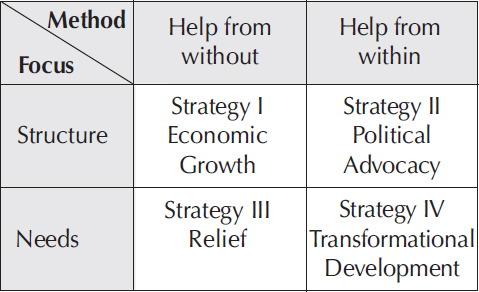
There are four basic approaches to alleviating poverty. The four strategies can be compared by setting two basic methods against two basic foci of action in a simple matrix. Each of these strategies has been referred to as “development.” Each has a different focus concerning the nature of the problem and, therefore, the nature of the solution.
The matrix suggests two approaches to development. One focuses on aid brought from outside while the other seeks to facilitate changes from within. Each approach has validity. For the most part, they are interdependent and complementary. Each aspect should be considered as Christians seek to meet basic needs of human communities in the name of Christ.
Strategy 1: Economic Growth
External aid usually comes in the form of money or technical assistance. In the recent past, the World Bank and the IMF (International Monetary Fund) have led economic development programs by providing loans on the basis of nations agreeing to “structural adjustment.” In the long run, this is intended to lower government debt and increase trade and production to bring in more revenue, benefiting all. In the short run, it usually means many people lose their jobs with no alternative sources of income. Those with some income have less purchasing power because of increased inflation and currency devaluation.
Simple efforts by ordinary people bring about marvelous changes in their own societies.
Christians have kept such global economic policies in view, but have rarely depended on them to bring the desired changes. Mission efforts particularly have focused instead on bringing about microeconomic development for helping the poor. Time and again it has been demonstrated that when determined people are provided with training and a small amount of capital, they can achieve economic success in their local context.
For example, one woman in Malawi was given a small loan (about $40) to start a small bakery. She baked various “fast-food” items like rolls and muffins and sold them in the market each day. From this small investment, she was able to pay back the loan in six months and generate enough surplus income to send her four children to school. She was also able to purchase clothes, soap, school supplies, and food to supplement what they grew. She and her husband had not had this buying power before. As a result of her business success, she indicated they were able to support their local church. She was now earning as much as a local primary school teacher. When asked if she had a “dream” or future plans, she explained that she had plans to expand her business and open a restaurant. When asked what was the source of her success, she mentioned the training provided by the aid agency but then gave credit to God for what she had been able to achieve.
Strategy 2: Political Advocacy
In contrast with seeking to bolster the existing government, the political advocacy strategy tends to challenge the national government along with systems of international trade and economic policies. The systems are seen as the primary problem. This approach calls for direct interface with governments at local, national, and international levels. Changes are sought in the areas of unfair and unfavorable government policies as well as international trade agreements.
Throughout history, Christians have been a powerful force in policy matters such as land reform, refugee rights, and the abolition of slavery. While it is important that Christians continue to address these kinds of issues, their primary role today must be to support and assist local people to take the lead in calling for internal political change. Nationals must take the leading role in their situation. Western Christians can also act as advocates back home at points where they see their own government’s policies perpetuating injustice for the poor.
Political advocacy has not been seen to bring about lasting positive change without some measure of Strategy 4 (Transformational Development). Structural and policy changes will only be as effective as the people who are implementing them. Without personal spiritual liberation, development will always be limited by the greed and corruption of individuals. Working to promote justice and peace is a biblical mandate and must be done with great prayer and sensitivity. Success will be limited, however, if not combined with the spiritual development of the individuals who run governments and implement policies.
Strategy 3: Relief
Relief aims to address the emergency needs of victims of war, famine, disaster, and prolonged injustice. Christian organizations have launched massive relief efforts, but these efforts only bring temporary help and must not be confused with development. Relief primarily focuses on what the outsider must do to help the victim, not what the people must do to help themselves. Such relief efforts can be viewed as detrimental if prolonged because they take away incentive for local production and development.
Some have criticized relief efforts coupled with evangelism for producing “rice Christians”—someone who becomes a Christian to assure himself and/or his family of getting daily food. Relief assistance must never be conditioned on one’s beliefs or on having to hear a gospel message. Relief must be given freely in love without condition, just as Jesus gave and loved freely without condition (John 13:34–35). It is this kind of love that identifies us as Christ’s disciples to the world. Relief aid stops people from dying so there can be a restart of long-term growth and life. It is long-range hope that moves Christians to search for answers to deep-seated problems.
In such disastrous circumstances of war and famine, relief carried out unconditionally by Christians can be a powerful gospel witness. After receiving a day’s portion of grain from a Christian aid camp in the height of a drought, one nomadic Muslim man was overheard saying, “If this is the way Christians love those they don’t even know, surely this is enough for me to believe in their God.”
Strategy 4: Transformational Development
Transformational development addresses the causes of poverty with a long view. In deeply impoverished remote rural areas as well as many urban settings, the problems are usually quite complex. There may be a lack of infrastructure, such as passable roads or working vehicles, to bring crops to market or supplies to the community. Basic health care is often unavailable. A lack of a steady, clean water supply can devastate entire regions. Fuel is essential but in very scant supply in some areas. Approaching the complex of difficulties requires long-term local attention at the community level. Local people need to take leadership to bring about sustained changes.
The Christian development workers facilitate change from within the society for an entire community or area. The core transformation is at the point of values and vision. Concerning vision, people come to see that their community can be made different and that they are not locked in an unchangeable despair. Concerning values, people come to see afresh that they are valuable. Understanding the values and hope of the kingdom of God greatly helps those who labor at this kind of development.
RETURN TO LESSON 12: Christian Community Development
Principles of Holistic Christian Transformational Development
I see ten fundamental principles and values of holistic transformational development. Each of them has a rich biblical foundation.
1. Recognize the value of people. Respect and value people in the context of their local culture.
2. Understand and respect local culture. Yet discern that while each person is intrinsically valuable, every culture has both positive and negative aspects that may or may not be compatible with biblical teaching.
3. Believe in the person’s capacity to contribute and determine his/her future. Help people meet their basic needs with dignity and self-respect. No matter how poor, every community and every individual has something to contribute. Identifying and starting with local resources is a key to people’s sense of ownership and self-dignity.2
4. Make people, rather than technology, the focal point. When local people are involved in making decisions, they ultimately take responsibility for determining their future.
5. Realize that poverty includes physical, material, spiritual, and social dimensions. Involve the whole person—mind, body, and spirit—in any development effort. Avoid segregating these. Address the whole problem and the whole person.
6. Approach development in a way that seeks to communicate Christ through word—communicating the gospel of Christ; deed—serving as Christ would, bringing healing and exemplifying righteousness; and sign—working with God’s help so that Christ’s kingdom life is demonstrated.
7. Realize that all interventions into a group of people (social, technical, economic, or educational) carry a message that must be understood and interpreted from the recipient’s worldview.
8. Recognize that God is already at work in the community. Part of the external facilitator’s task is to discover what God is doing and support what may already be happening as a bridge to how God wants to bring revelation.
9. Believe that transformation in a person comes through a relationship with Christ. There is no substitute for a living, growing faith.3
10. Recognize churches as foundational for sustained and abundant transformation. To strengthen existing churches, or to plant new ones where none exist, forms a powerful community of transformed lives empowered by God with hope and kingdom values.
The Hope of Abundant Life
In Ethiopia, the Antsokia Valley had been ravished by a famine in which some twenty people were dying every day from starvation. Today, this valley is a garden of hope for its people and those in the surrounding communities. Over seven thousand households, some forty-five thousand people, have gone from the brink of starvation and destitution to abundance through a transformational development program. New innovations for crops, animal husbandry improvement, and reforestation were adopted. The result was that people are now growing an abundance of food and have a safe, sustainable environment in which to live. Through the lives of Christians working in the community to help carry out these development efforts, hundreds of people have come to Christ. These new believers now attend the first church to be established in the area.
As one man noted, “I resisted the call of Jesus from the witness of many of the development workers. But as I continued to be involved in development work, their accountability and dedication to the spiritual and physical work touched my heart. I watched them praying and talking about ways we could have a better life. Then last year I received Jesus. Now I share the joy, responsibility, and work that the staff shared with us. I now understand why the staff came to share with us and help us improve our living.”4
Where there was death, today there is life—abundant life—where children and families are healthier, happier, and have the assurance of eternal life through Jesus Christ our Lord. 
RETURN TO LESSON 12: Christian Community Development
Strategic, rather than Static, Holism Steven C. Hawthorne
Steven C. Hawthorne leads a mission and prayer mobilization ministry called WayMakers. After co-editing the Perspectives course and book in 1981, he launched a series of research expeditions among unreached peoples in Asia and the Middle East.
In recent days, many have been careful to describe our mission as something more than a spiritual enterprise to get people saved. Our mission is also to see that people are served in physical, economic, and social ways.
Declaring Good News and Displaying Good Deeds
One common way to describe this way of mission is to use the word “holism” (sometimes spelled “wholism”). A holistic approach to mission suggests that the work of mission is not limited to speaking the gospel message but in some way deals with the entire array of God’s purpose for humankind. The usual approach is to call for a balance of activities by mission workers: declarations of the gospel should be accompanied, or balanced, by displays of good deeds.
Coworking with Christ for Blessing
We need to see and understand the great needs of our world. But let’s also lift our vision toward the hope of what Christ intends to do through and with His people to bring lasting change for good. We take seriously and joyously the promise God made to Abraham and his descendants: He has promised that His people will become His gift of blessing amidst every people of the earth. Biblical ideas of blessing go far beyond moments of happy emotions. The biblical blessing God promised to and through Abraham and his descendants brings a measure of fullness of life: a growing relationship with God and an increasing peace among the peoples. These relational changes support a measure of flourishing economy, education, health, and even artistic beauty.
We take seriously and joyously the promise God made to Abraham and his descendants: He has promised that His people will become His gift of blessing amidst every people of the earth.
Foreign mission workers from wealthy or powerful places often try to provide these aspects of blessing. But foreign deeds and donations cannot be sustained. To bring forth the lasting measures of blessing, the inception of growing local church movements is necessary.
Bicycle Balance
Calls for balancing good deeds and gospel words can leave us seeing foreign workers as the source of blessing. If we recognize Christ—the promised seed of Abraham—as the supernatural source of blessing, then we can enter mission work focused on the hope of the risen Christ working with and through His church to bring forth sustained measures of blessing.
By focusing on this goal, we can labor with momentum that gives us a better balance. Like riding a bicycle, we find balance when we move with momentum toward a goal. Instead of trying to balance the activities of evangelism with different kinds of social endeavors, we can work together strategically toward the hope of growing churches that serve their own communities with the miraculous flourishing of the blessing of Christ.
Notes
1. Tetsunao Yamamori, ed., Serving with the Poor in Africa: Cases in Holistic Ministry (MARC Publications, 1996).
2. Samuel J. Voorhies, “Community Participation and Holistic Development,” in Yamamori, Serving with the Poor, 123–48.
3. John R. Cheyne, Incarnational Agents: A Guide to Developmental Ministry (New Hope, 1996).
4. Mulugeta Abebe, “From Relief to Development in Ethiopia,” in Yamamori, Serving with the Poor, 15–27.