CHAPTER 87
Barbara F. Grimes

Barbara F. Grimes was a member of Wycliffe Bible Translators from 1951 until her death in 2014. She worked with her husband among the Huichol Indians of Mexico, where they produced the Huichol New Testament and other literature. She was the editor of ethnologue: Languages of the World from 1971 to 2000. She and her husband also translated Scripture with speakers of Hawaii Pidgin into that language.
Text adapted from “‘Reached’ Without Scripture?,” International Journal of Frontier Missions 7, no. 2 (1990): 41–47. Used by permission of
After this I looked and there before me was a great crowd that no one could count, from every nation, tribe, people and language, standing before the throne and before the Lamb. (Rev 7:9 NIV)
We have been commanded to make disciples of all peoples. To do this, every communicator of the gospel—evangelist, teacher, development worker, or church planter—makes choices about which language they will use for ministry. Too often the choice of which language to use is made on the basis of what is easiest for the communicator, rather than what communicates best to the hearers.
Conducting ministry in the mother tongue of hearers is obviously more effective. But for ministry that really reaches unreached peoples, mother tongue ministry is not just valuable, it is crucial. The necessity of mother tongue ministry and the use of mother tongue Scriptures becomes clear by looking at the kind of disciples and churches that we would like to see.
Making Mother Tongue Disciples
A lot of what a disciple is commanded to do involves language. Being a disciple of Jesus Christ involves getting to know Him personally. That requires adequate comprehension of the good news and of God’s word. Understanding and knowledge are repeatedly emphasized throughout the Scriptures. The Apostle Paul said it was his responsibility to make the message clear (Col 4:4).
But being a disciple involves more than passive comprehension. A disciple is commanded to witness to his faith, encourage other Christians, exhort those who need it, pray, give praise, give thanks, sing, memorize God’s word, teach his own children, teach younger people, instruct one another, and meditate. Disciples exercise gifts of the Spirit that involve verbal behavior such as communicating wisdom, passing on knowledge, prophecy, interpretation of tongues, fulfilling the functions of appointed messengers, and being evangelists, pastors, and teachers. Some persons are to read Scripture publicly, to teach, preach, and interpret any foreign language used in church.
The mother tongue is the language people learn first at their mother’s knee, in which they learn to think and talk about the world around them, interact with people closest to them, and acquire and express their values. It is the language which becomes part of their personality and identity, and which expresses ethnicity and solidarity with their people. People can handle the verbal skills required for adequate comprehension of the good news and for functioning as a disciple in their mother tongue; the question is whether or not they can do those things in their second language.
Planting Churches That Endure
It is possible to plant churches without mother tongue clarity, but it is almost never desirable. Without Scriptures in the mother tongue, churches are not able to sustain spiritual depth into succeeding generations. They have difficulty answering false teachings, waging spiritual warfare, and avoiding syncretism. Many in or around the church fail to recognize that the Christian God is the universal God to whom all must answer. It’s not hard to see why churches without this are not only hindered from reaching out to others in their own community, they often do not get a vision for obeying God’s missionary call to go elsewhere.
Two approaches often distract gospel communicators from doing the more difficult and lasting work to make disciples in the local mother tongue: first, in multilingual situations there is a perceived possibility of conveying the good news adequately in a second language, and second, there is often a hope that bilingual language brokers will carry the message to others within their community.
A lot of what a disciple is commanded to do involves language.
Multilingual Populations
Careful study of how different languages are used in multilingual societies has given important insights to sociolinguists in recent decades. Multilingual people use each of their languages in different circumstances with different people to talk about different topics. This is done with varying degrees of success in speaking and understanding and with different psychological connotations. It is important for those who want to communicate the most important message in the world to be aware of these factors, lest both they and their message be misunderstood or rejected.
The second language is learned in certain situations and depends on the amount and kind of contact an individual has had with it, and his desire and need to learn it. Thus, there are differences in fluency across a population. It is not possible to judge the bilingual proficiency of a population by looking at only a small sample of the population. It is necessary to investigate how groups of different ages, sexes, regions, and educational levels use their languages and to study any other factors which may influence contact with the second language in that culture. The importance of reaching everyone for Christ, including women, older people, the uneducated, and those in remote areas, justifies the time and effort needed to carry out a reliable investigation of these differences.
Working with Bilingual Brokers
Often eager mission efforts look for rapid communication by routing the message through a bilingual person. This approach, used extensively in missions with dubious results, has been called “the language broker model.” In this model, a bilingual person hears the message or reads Scripture in his or her second language and then is expected to transfer the meaning into his mother tongue for the benefit of those who do not understand the other language. Unfortunately, few people are able to do that kind of transfer without extensive training and experience in that skill. Most bilingual speakers of minority languages have learned their second language through direct oral contact outside a classroom and lack training in language transfer.
The Scriptures are often available to those churches only in a second language. This model avoids having to translate the Scriptures into the first language but assumes that spontaneous paraphrases of Scripture are adequate. There is no guarantee that such impromptu paraphrases done repeatedly by various speakers in different situations are at all accurate. The language broker model often results in a bilingual elite in the church being the only ones eligible to become leaders. Others to whom God may have given the gifts of teaching, preaching, and other gifts involving using language may be hindered by lack of sufficient bilingual proficiency to function in the second language.
From Every Language
Wise good news communicators will work for lasting results. They will do the challenging work of linguistic assessment and Bible translation. They’ll do this difficult work with the people in mind and with the outcome in view. They will endeavor to bring the gospel to every people in a language that they not only understand, but that the people will use to become mature disciples, build the church, extend the good news, and worship God in meaningful ways for their own people. It’s not enough for a few people to understand part of the message. For God to hear His praise spoken by flourishing churches “from every language,” His communicators must do the important work of bringing God’s word in a way that speaks to their hearts and homes in every language. 
CONTINUE READING Sidebar: Bible Translation
Bible Translation: How Many Languages to Go? Barbara F. Grimes
In 1951, the Ethnologue was created to try to find out where Bible translations were still needed. By 1974, research had progressed so that all known languages in the world were included. The list is refined as research continues and language surveys are done to assess the need in each language.
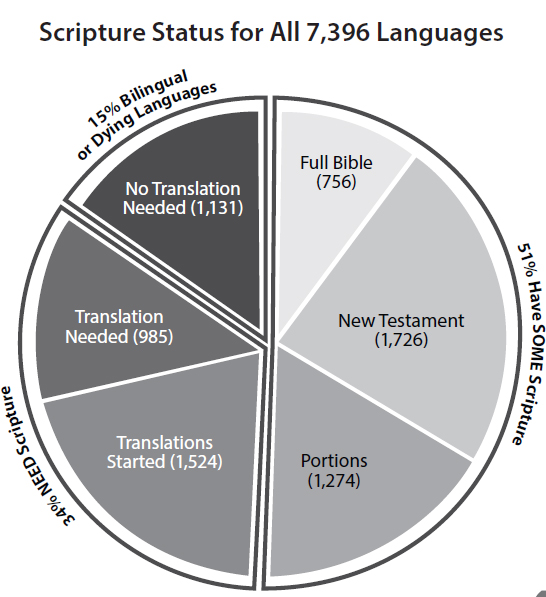
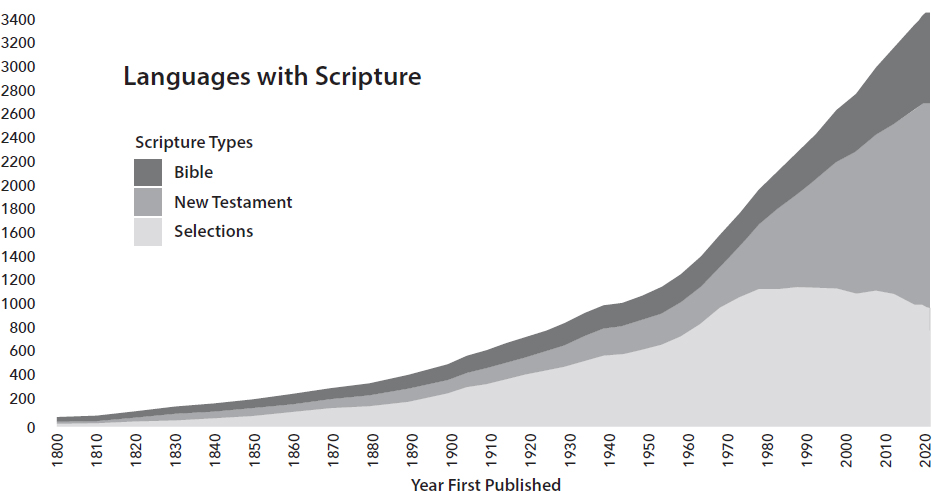
According to the Wycliffe Global Alliance, there are 7,396 known languages. Just over half of all languages have at least some Scripture today (as of 2024): 10.2 percent have full Bibles, 23.3 percent have New Testaments, and 17.2 percent have some books translated. Fifteen percent of languages do not need translation because they are either dying languages or sufficiently bilingual to use another language. Of the remaining 33.9 percent, translations have already started in 1,524 languages (20.6%), leaving 985 languages (13.3%) where translations have yet to be started.
It is not enough for people to have only one book of Scripture to become mature, growing disciples. With more than 3,700 languages without a Bible or New Testament in a language that speaks clearly to them, there is still a huge translation task before us to give every people access to the word of God.
Source: Wycliffe Global Alliance 2024.