CHAPTER 86
Bruce A. Koch

Bruce A. Koch has served with Frontier Ventures since 1988. In 1991, he participated in an ethnographic survey of a large unevangelized city. He served as the associate editor of the third and fourth editions of the Perspectives curriculum. Since 2012, he has led the Perspectives Global Service Office.
Look at the nations and watch—and be utterly amazed. For I am going to do something in your days that you would not believe, even if you were told. (Hab 1:5 NIV)
God’s promise to bless all the “families of the earth,” first given to Abraham four thousand years ago, is becoming a reality at an ever-increasing pace in our day. Although some may dispute certain details, the overall trend is indisputable: Biblical faith is growing and spreading to the peoples of the earth as never before in history.
Amazing Progress of the Gospel
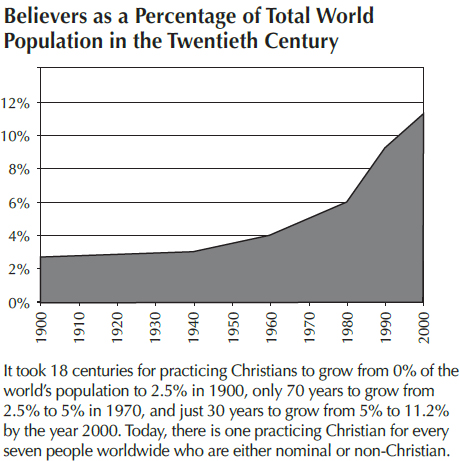
One in every eight people on the planet is a practicing Christian1 actively engaged in their faith. The number of believers in what used to be “mission fields” in the nineteenth and twentieth centuries now surpasses the number of believers in the countries from which missionaries were originally sent. More missionaries are now sent from non-Western churches than from the original mission-sending countries in the West. In Latin America, evangelicals, charismatics, and Pentecostals are growing at least twice as fast as the global population. Christians in China have grown from fewer than one million to as many as 130 million believers in the last seventy years. In sub-Saharan Africa, Christianity has increased from 8 percent in 1900 to over 50 percent in AD 2025. In the 1980s, Nepal was still a staunch Hindu kingdom with only a tiny persecuted church. Today, it has hundreds of thousands of believers.
A Major Paradigm Shift
Much of this growth can be attributed to the surge of missionaries that went out after World War II. However, by the early 1970s, with the collapse of colonialism and the church established in nearly every country in the world, some began to discuss the need for a “post-mission” era. It was argued that it was time to bring the missionaries home and let the national churches reach “their own people.”
Ralph D. Winter was one of the founders of the “frontier mission movement,” which has dominated mission thinking for the last fifty years. In a keynote address given at the Lausanne Congress on World Evangelization in 1974, Winter challenged the global church to view the biblical concept of “nations” in terms of people groups—not geopolitical countries. He pointed out that seven out of eight non-Christians in the world lived in cultures where there were no churches.
Winter challenged the global church to view the biblical concept of “nations” in terms of people groups—not geopolitical countries.
Winter’s compelling message led to a dramatic shift in priorities and mission strategies focused on those cut off from the gospel by cultural and linguistic barriers. At the time, he estimated that there were seventeen thousand “people groups” with no gospel witness.
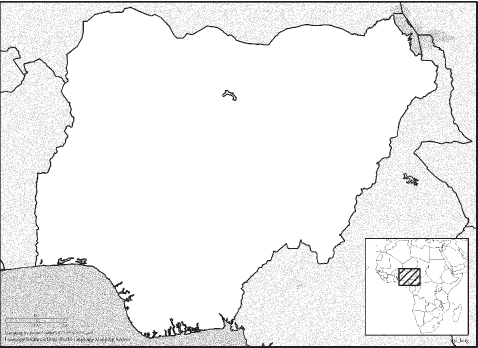
Nigeria and Surrounding Countries
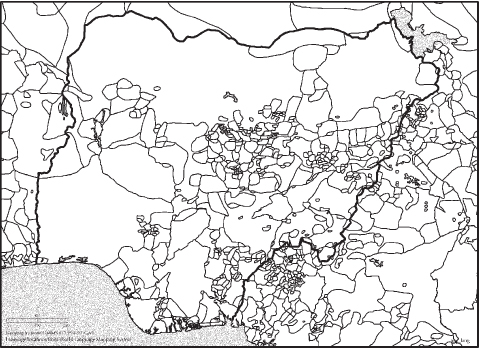
Ethnolinguistic Peoples by Language of the Same Area
Winter pointed out that the gospel often expands within a community but does not normally “jump” across cultural boundaries between peoples, especially those created by hate or prejudice. Believers can readily influence their “near neighbors,” whose language and culture they understand, but religion is often intertwined with cultural identity. Therefore, religious beliefs do not easily transfer from one group to another.
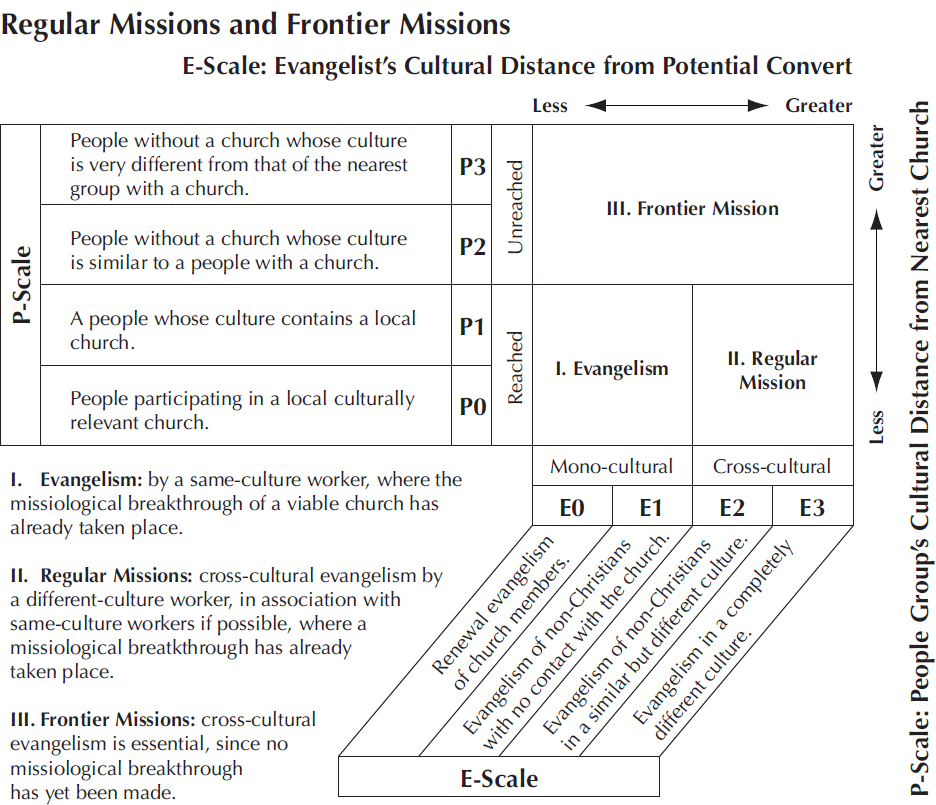
When believers reach out to their friends, relatives, or others within their own culture, this is referred to as E1 evangelism (see E-Scale diagram). This is the most effective form of evangelism. However, even if every believer in the world successfully brought all their friends and relatives to a faithful belief in Christ, there would still be billions of people cut off from the gospel, sealed off by barriers of language, culture, and prejudice.
The presence or absence of a culturally relevant church is measured on the P-Scale, not the E-Scale. Individuals are unlikely to follow Jesus in cultures where relevant churches do not exist. No same-culture evangelism can take place if no church exists within that culture. The people within such groups are no more spiritually “lost” than your cousin who has never gone to church, but unlike your cousin, there is no church made up of people like themselves with whom they can fellowship (see P2 and P3 in diagram). Such individuals live in groups that we refer to as “unreached.”
While there are still tens of millions who have never heard the name “Jesus,” there are hundreds of millions more who may have heard of Jesus and may even have a high regard for Him (which is true for nearly all Muslims) but cannot see a way to become His disciples while remaining within their natural community. They face barriers ranging from the relatively trivial to the seemingly insurmountable. Many barriers are often mere cultural traditions rather than biblical requirements.
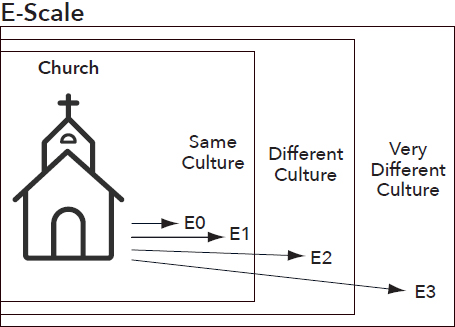
The E-Scale compares the cultural distances that Christians need to move in order to communicate the gospel. E0 refers to the evangelism of church-going Christians. E1 is reaching one’s own culture across the barrier of “church culture.” E2 is cross-cultural evangelism into a similar but different culture. E3 evangelism is taking the gospel to cultures very different from that of the messenger.
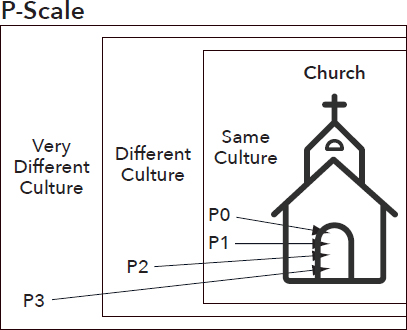
The P-Scale compares the cultural distances that potential believers need to move in order to join the nearest church. A P1 people has a culturally relevant church. A P2 people is in contact with similar cultures in which a culturally relevant church exists. The only churches a P3 people is in contact with, if any, are very foreign and composed of people very different from themselves.
Cornelius in Acts 10 would have had to cross the barrier of circumcision as an adult male—a painful price to pay to be accepted as a convert into the synagogue fellowship with the Jewish believers of his day. A Muslim Turk today faces similar obstacles if he desires to become a “Christian.” All his life, he has been told, “To be a Turk is to be a Muslim.” To him, Christianity is the religion of the “infidel” Crusaders, who brutally ravaged the land and peoples of Turkey, both Muslim and Christian alike. To people from this back-ground, to become a Christian is to become a traitor, turning your back on your family, community, and country.
“A Witness to All the Nations”
Jesus said, “This gospel of the kingdom shall be preached in the whole world as a testimony to all the nations, and then the end will come” (Matt 24:14 NIV).
This verse tells us what we should watch for and work toward in this age. Jesus indicates that before “the end” comes, there will be “a witness to all the nations.”
The “nations” Jesus referred to are not countries or nationstates. The wording He chose (the Greek word ethne) points to all the non-Jewish peoples outside of the nation of Israel. Matthew 24:14 makes it clear that it should be a priority to ensure that every people has a testimony of the gospel of the kingdom.
Jesus did not provide a list of the ethne that would one day follow Him. He did not define the concept of peoples or “nations” for us, although we glean clues from the rest of the biblical narrative. What matters is not that the peoples can be definitively identified and counted but that God has invited us to join Him in a task that can and will be completed. This is evident as the curtain of heaven is drawn back in Revelation 7:9, revealing a great multitude from every tribe, tongue, people, and nation.
By “witness,” Jesus meant that the “gospel of the kingdom” would be proclaimed openly throughout entire communities. The gospel of the kingdom is about Christ prevailing over evil, liberating people so that they can live obediently and freely under His lordship and blessing. God desires a persuasive display of that kingdom breakthrough exhibited in every people. What better representation of God’s kingdom than a community of people living under Christ’s authority?
FOUR APPROACHES TO PEOPLE GROUP THINKING
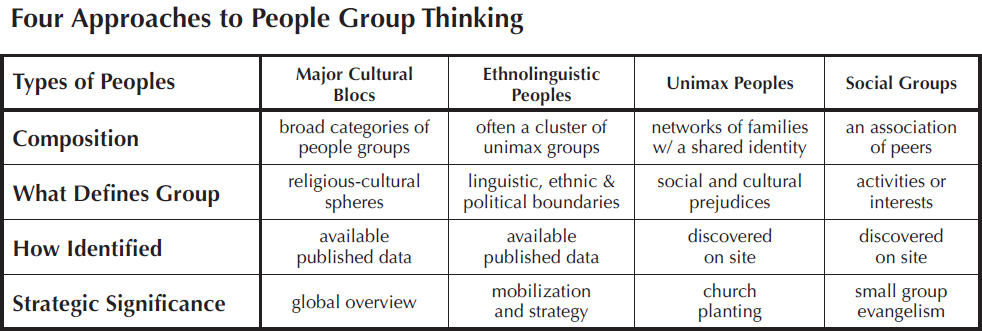
To examine the “all nations” mandate of Jesus strategically, mission leaders use various methods to categorize people into groups. Here are four useful ways of segmenting humanity: blocs of peoples, ethnolinguistic peoples, unimax peoples, and social groups. Each approach assists in engaging the bypassed peoples in our world. The first two are particularly useful for summarizing the overall task, partnerships, and training needed to approach known peoples. The latter two are more applicable for those who are on the field working to establish new fellowships of believers. Each approach holds value and corresponds to a distinct aspect of strategic thinking.
1. Blocs of Peoples for Global-Level Perspective and Strategies
Blocs of peoples represent a limited number of categories into which we can place people groups to summarize the task.
Major cultural blocs: We can group peoples, particularly “unreached” peoples, along major cultural lines according to the predominant religion within each group. The major cultural blocs of unreached peoples include Muslim, Hindu, Buddhist, ethnoreligious, nonreligious, and others. This model has been used to analyze the distribution of the global mission force in relation to these major categories of people groups.
Affinity blocs: Patrick Johnstone has proposed a model that combines sets of closely related ethnolinguistic peoples into “people clusters,” which are further aggregated into “affinity blocs” based on language, history, culture, and other factors. The twelve blocs that represent the majority of the least evangelized peoples are African Sahel, Cushitic, Arab World, Iranian, Turkic, South Asian, Tibetan, East Asian, Southeast Asian, Malay, and Eurasian. This approach allows mission organizations to explore strategic partnerships aimed at reaching related peoples.
What matters is not that the peoples can be definitively identified and counted but that God has invited us to join Him in a task that can and will be completed.
2. Ethnolinguistic Peoples for Mobilization and Preparation
An ethnolinguistic people is an ethnic group distinguished by its self-identity with traditions, common descent, history, customs, and language.
Ethnolinguistic peoples are what most people think of when they think of people groups. Lists, such as the Joshua Project list, include profiles, photos, and metrics that describe primarily ethnolinguistic peoples.2
“Ethno-” refers to common ancestry. Since the original mandate given to Abraham was expressed as blessing all the “families (mishpahah) of the earth,” taking genetic descent into account is an appropriate variable in missiologically identifying significant groupings of people. However, we must recognize that many forces can break down families or cause groups to blend. Individuals may or may not have a strong sense of their ethnicity, which only matters if it plays a significant role in their core identity.
“-linguistic” refers to common language. Language is an integral component of any culture. People groups are often identifiable by unique languages or dialects, but not always. For example, the Laz people from the Black Sea region of Turkey are often recognized by other Turks not only for their distinctive facial features but also for their unique “romantic” pronunciation of Turkish.
Sometimes, what appears initially to be a unified ethnolinguistic group turns out to be several smaller groups. Cameron Townsend, the founder of Wycliffe Bible Translators, began his Bible translation work with the Cakchiquel of Guatemala. The translators who followed him discovered that the Cakchiquel did not need just one translation; rather, they required translations for four distinct dialects.3 If they were producing gospel recordings instead of written translations, they might have had to address even more dialectical differences.
Mission researchers have compiled fairly comprehensive lists of ethnolinguistic peoples over the last fifty years, enhanced by feedback from observers on the ground.4 These lists have assisted the global church in engaging and reaching thousands of people groups.
People blocs and ethnolinguistic lists are especially useful for mobilizing the church where the need is most apparent. They help identify cultures and peoples currently beyond the reach of the gospel. Both approaches stimulate prayer and lead to planning and engagement in people group–focused evangelism and church planting.
3. Unimax Peoples, the Focus for Movements to Christ
To pursue the biblical mandate of incorporating the fullness of human diversity into God’s family, the lens we must use is whether the gospel is accessible in all segments of humanity in forms they can understand and embodied in movements they are willing to join.
A unimax people is the maximum sized group sufficiently unified to be the focus of a single movement to Christ, where “unified” refers to the fact that there are no significant barriers of either understanding or acceptance to stop the spread of the gospel.
In 1982 (see sidebar), mission leaders developed a unique working definition for a “people group.” This definition begins with a list of characteristics that can make people perceive themselves as having a common affinity for one another, including ethnicity and language. It further states, “For evangelistic purposes, it is the largest group within which the gospel can spread as a church planting movement without encountering barriers of understanding or acceptance.”
The first statement in the definition identifies typical cultural elements that create social cohesion and shared identity. The second statement is pragmatic, defining peoples in terms of the flow of the gospel. This definition, based on “evangelistic purposes,” accommodates the dynamics that change how we organize ourselves as humans. While ancestry, shared history, and other cultural attributes are certainly relevant in determining collective cultural identities, the strength of people group boundaries and cohesiveness can vary significantly. Our understanding and strategies must consider shifting allegiances and identities influenced by today’s forces of globalization, migration, and urbanization.
[skip sidebar (you will return to it)]
Mission Leaders Agree on Strategic Definitions Bruce A. Koch
In March 1982 a group of mission leaders came together in Chicago for a meeting sponsored by the Lausanne Strategy Working Group and the Evangelical Fellowship of Mission Agencies. It was designed to help bring clarity and definition to the remaining missionary task. At no time before or since this meeting has as large or as representative a group gathered for two days to focus specifically on the
necessary definitions for a strategy to reach the unreached peoples. Two basic definitions came from this meeting:
1. A People Group is a “significantly large grouping of individuals who perceive themselves to have a common affinity for one another because of their shared language, religion, ethnicity, residence, occupation, class or caste, situation, etc., or a combination of these.” For evangelistic purposes it is “the largest group within which the gospel can spread as a church planting movement without encountering barriers of understanding or acceptance.”
2. An Unreached People Group is “a people group within which there is no indigenous community of believing Christians able to evangelize this people group.”
Every person on Earth exists on a spectrum ranging from strongly cohesive collectivist societies, which are largely homogeneous on one end, to highly individualistic, diverse societies, with weaker and broader social bonds on the other. This may explain why some individuals in modern Western societies question the validity of people group thinking. They may belong to multiple social groups within their contexts. However, none of those social groups constrain their beliefs and behaviors as the persistent core identity does for those raised in cultures where the entire community works to preserve the shared traditions and beliefs.
The unimax definition above is a restatement of the second part of the 1982 definition and aims to distinguish this approach to defining peoples from other approaches. It reflects four essential elements:
- Maximum sized group: The aim is not to break larger groups down into smaller subgroups (although that is often the case); it is to identify the “largest” groups through which movement to Christ may be able to spread. In 1923, Mustafa Kemal Atatürk, the founder of modern Turkey, sought to homogenize the diverse peoples within the nation into one people with a strong national identity. To the degree he succeeded, he made it easier to spread the gospel to a greater number of people within a single movement to Christ. Sometimes, groups that did not interact much in their homeland band together with a new shared identity and allegiance as immigrants in a new land.
- Sufficiently unified: At times, we may discover that a larger group has significant divisions. Rivalries among major clans within the Somali people were so severe that the country became a failed state, unable to be centrally governed. It is unlikely that the Somalis could be reached with a single break-through. Even in more individualized societies, movements often follow the lines of cultural subgroups.
- Barriers of understanding: Even if people speak the same language, the words they use may carry different meanings, or they may have radically different narratives about the world they live in. The gospel must be communicated in such a way that it is received as good news in new contexts.
- Barriers of acceptance: Some barriers to the gospel are related to it being perceived as foreign or as a threat, but the greatest hindrances to the spread of the gospel are tied to the perceived social costs of following Jesus in communities when doing so is viewed as a betrayal. This raises serious questions such as, Who will I marry? Will I be cut off from my family? Will I lose my livelihood? These types of fears and costs are particularly acute in communities where Christ has never been followed.
The unimax approach seeks to identify the barriers hindering the flow of the gospel with a vision of ensuring that no one is cut off from the opportunity to follow Jesus without having to leave their family and community.
Jungle tribes and other small, geographically remote peoples are always single unimax peoples. In villages, towns, and cities, the situation becomes more complex, and outsiders must learn to observe the sociocultural barriers that limit interaction and influence between groups. Religion, class distinctions, education, political and ideological convictions, historical enmities, customs, behaviors, and more all have the potential to create strong prejudicial boundaries that can define unimax subgroups within ethnolinguistic peoples or larger mixed societies.
The unimax approach seeks to identify the barriers hindering the flow of the gospel with a vision of ensuring that no one is cut off from the opportunity to follow Jesus without having to leave their family and community.
4. Social Groups Are Useful for Evangelism
A social group is a relatively small association of peers who share an affinity for one another based on a common interest, activity, or occupation.
When gospel witnesses move into an unevangelized frontier setting, they have to learn a great deal just to be able to live, communicate, and better understand the people God has sent them to bless. After the initial phase of cultural learning and adaptation, the question is how to begin building relationships within groups or networks into which the gospel can take root.
Often, we can effectively share our life in Jesus with individuals by engaging specialized social groups. These groups may include women in a cooking club, fellow students, professional colleagues, sports teams, trade associations, and more. There are countless opportunities for this type of group-focused outreach in our world today. Starting with small social groups can serve as a bridge to building communities of faith within larger, more stable unimax groups that are discovered through engagement.
However, such social groups lack the size, generational depth, and lifelong engagement to be considered people groups. They are not necessarily expressions of a person’s core identity and worldview. Nevertheless, they hold great value as conduits through which the gospel can flow between peoples.
Four Approaches to People Group Thinking
Data Can Only Approximate Reality
As history unfolds and global migration continues to increase, more people groups are being dispersed throughout the globe. This phenomenon is called “diaspora.” Today, many agencies recognize the strategic value of reaching the more accessible fragments of these “globalized peoples.”
The powerful forces of urbanization, migration, assimilation, and globalization are changing the composition and identity of people groups. Research and data can only provide a rough approximation of the complex ways humanity clusters itself into groups.
The ethnolinguistic approach to identifying people groups may work well enough in the homelands of many unreached peoples. However, in the current age of global migration and urbanization, both international and domestic, we need to approach cities with fresh eyes. It is essential to understand how individuals shift their allegiances and identities while often retaining the core worldview of the group into which they were born. Urban settings create numerous exciting possibilities for the gospel to flow between groups.
We can utilize the flexible nature of the unimax definition to guide our approach to peoples in complex environments. The unimax approach challenges us to discover peoples by observing which population segments are being overlooked because they do not understand the gospel and cannot envision a way to follow Jesus while still maintaining their relationships with family and friends.
THE ESSENTIAL MISSIONARY TASK
The essential missionary task is to establish a viable indigenous churchplanting movement that has the potential
to renew extended families and transform entire societies. It is deemed viable because it can grow on its own. Indigenous means that it is not perceived as foreign. As a church-planting movement, it continues to reproduce intergenerational fellowships capable of evangelizing the rest of the people group without outside assistance. Many refer to this achievement of a viable indigenous church-planting movement as a missiological breakthrough.
We have succeeded when individuals within the society (including those outside the church) recognize that the movement belongs to their culture. When this level of cultural adaptation is achieved, the dynamic, life-changing love of Jesus can move freely throughout the entire people group. We can regard this goal as the minimal achievement necessary in every people group to give individuals the opportunity to say “yes” to Jesus Christ and His kingdom.
Regular Mission and Frontier Mission
It is helpful to distinguish between “regular mission” and “frontier mission”:
- Regular mission: Involves efforts to make disciples and bring about blessing and transformation within cultures where churches are already well established. The focus is on strengthening and expanding the existing Christian community.
- Frontier mission: Focuses on achieving break-throughs within “unreached people groups” who have little to no access to the gospel. These groups are often isolated by cultural, linguistic, or geographical barriers.
This distinction is valuable because work in pioneering contexts (1) often demands a longer commitment, (2) is typically more challenging, requiring specialized understanding and training, and (3) helps prioritize efforts that lead to breakthroughs within previously bypassed peoples.
Closure: A Breakthrough in Every People
In the 1970s, the Lord began to open the eyes of many to the reality that the irreducible, essential mission task of achieving a breakthrough in every people group is something that can actually be completed. In fact, the “all peoples” mandate of the Great Commission is the only command given by God to His people that can be fulfilled. This fulfillment of the essential missionary task is often referred to as closure.
To speak of evangelizing every person as a goal is not helpful since every day, hundreds of thousands of children are born. However, making disciples within every people group is achievable because there are thousands of groups, not billions, and that reality remains relatively stable. We also know it will happen because God pulled back the curtain on eternity and allowed John to see the great multitude from “every tribe, tongue, people and nation” (Rev 7:9).
Jesus gave the mandate, and He alone, as the Lord of the harvest, will decide when the fullness of the gentiles has come in—the fullness of God’s global family.
In 1974, missiologists estimated that there were approximately twenty-four thousand people groups in the world, seventeen thousand of which were considered “unreached.” Today, just fifty years later, this number has decreased to less than five thousand. Nearly all the remaining groups on the ethnolinguistic lists have gospel workers among them.
Reached or Unreached? Verifying the Presence of a Viable Church Movement
Establishing a viable, indigenous church-planting movement is a process. A group is not “unreached” one day and suddenly “reached” the next. Researchers strive to confirm the presence or absence of church movements through direct observation; however, comprehensive, reliable sources of direct observation are often unavailable.
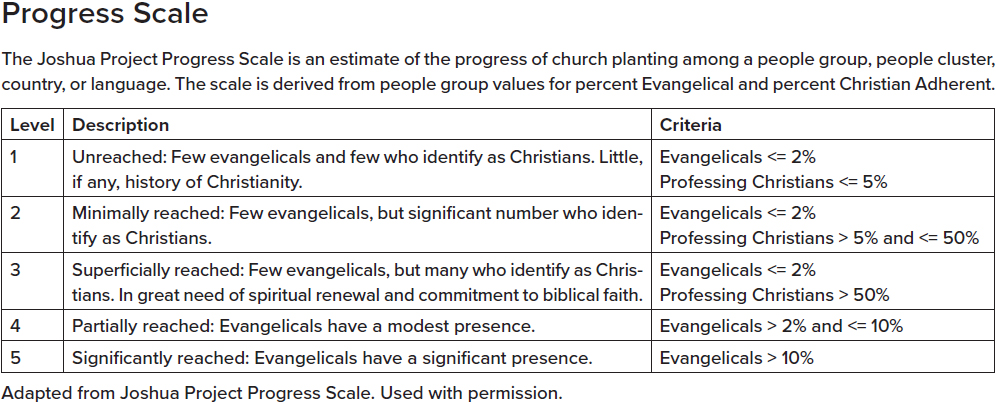
Out of necessity, researchers needed a way to categorize peoples based on published quantitative data rather than subjective direct observation. They eventually settled on a combination of less than 2 percent evangelical and less than 5 percent professing Christians as the criteria for determining whether a group was reached or not.5 It is important to note that the intention remains to ascertain whether there is a viable church movement.
However, there are some issues with this approach: (1) There is no comprehensive system for collecting consistent and reliable data. (2) Researchers do not currently have a way to regularly, systematically, and comprehensively update their statistics, which would be necessary to reveal movements by tracking growth over time. (3) The size of a group matters. If a group of 500 has 2 percent evangelicals, that amounts to only 10 believers, which may not be sufficient to reach the rest of the group if there is hostility toward the gospel. Conversely, in a group of 10 million, 2 percent would represent 200,000 evangelicals, and most would agree that a missiological breakthrough occurred long before meeting that threshold.
Frontier Peoples: Peoples without Movements
A recent development that helps focus on the least reached of the unreached people groups is the term “frontier people groups” (FPGs). If a group is reported as having less than 0.1 percent Christian adherents and no confirmed, sustained movement, it is categorized as a frontier people group. This approach uses existing quantitative data to focus on the groups that fit the original definition of “unreached,” as the scarcity of believers makes it clear that there are no church movements.
Jesus Is the Lord of the Harvest
God invites us to join Him in declaring His glory to all peoples until Jesus is worshiped and followed within every people.
Our evangelization plans and measurements are conducted with good hearts full of faith and obedience, but it is His mission, and He alone is orchestrating its fulfillment, not us. He is the great “I AM,” the one who brings into existence all that is and will be, the one who is faithful to keep His promise throughout all generations.
Aware of our limitations, we nevertheless joyfully serve the Lord of the harvest with appropriate humility as He guides our steps.
All that can and should be done cannot be encompassed within a single plan devised by humans. The body of Christ is far too large and diverse to imagine that there would only be one unified effort. The cultural realities are far too complex for us to ever fully grasp. Aware of our limitations, we nevertheless joyfully serve the Lord of the harvest with appropriate humility as He guides our steps.
The outcome of God’s mission is certain. In the great multitude around His throne, there will be some from every tribe, tongue, people, and nation. It does not matter if our lists of “all the peoples” precisely match the one that could be derived from that great multitude in Revelation 7:9. The way forward is simple and clear. In faith, we let Him lead us by His Spirit to those He has yet to bring into His family until He alone is satisfied that His promise to bless all the families of the earth has been fulfilled. 
CONTINUE READING Sidebar: Mission Leaders Agree on Strategic Definitions
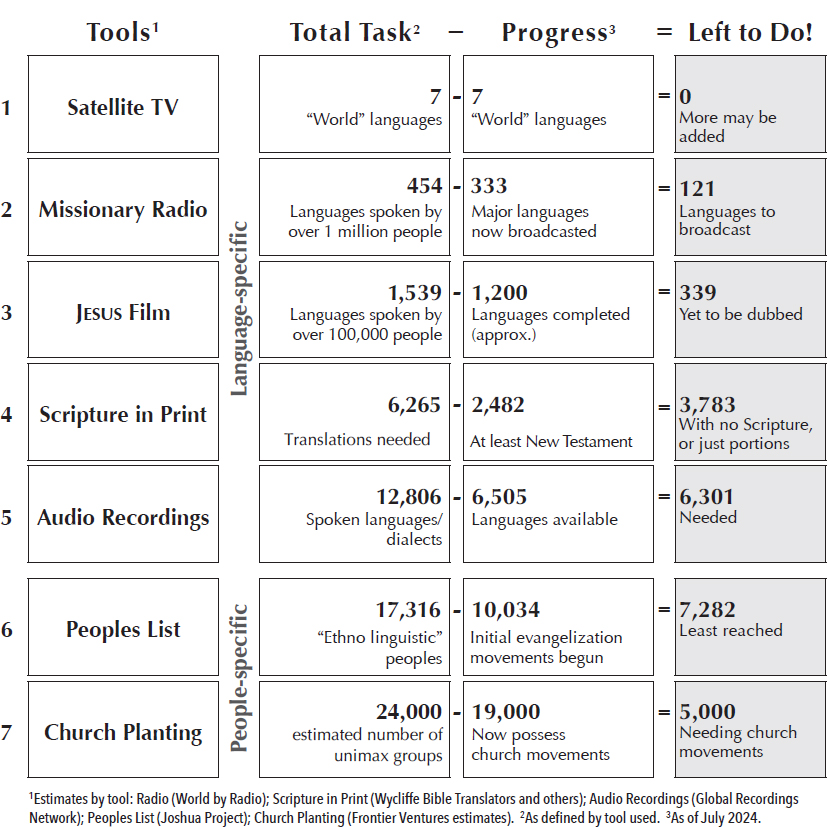
God’s Symphony of Effort to Bring About “A Church for Every People” Bruce A. Koch and Krikor Markarian
This chart is adapted from the one originally conceived by Ralph D. Winter, and it includes further estimates by others. These figures were checked as of July 2024.
Note that all seven rows below are ways of looking at the tasks that are of real value. Nevertheless, it would be a great mistake to assume that any one row is the answer to the unfinished task. None of the numbers in the final column (Left to Do!) are exact; they may be compilations of someone else’s estimates. All numbers are conservative. As one people within a cluster of unreached peoples is reached we often become aware of the existence of the other peoples within that cluster. Therefore, we estimate 5,000 in row 7 (Church Planting) to make sure we do not underestimate what is left to be done. No one communication tool or approach can do the job all by itself. God is orchestrating all these tools and approaches to bring about “A Church for Every People.”
GO TO THE BEGINNING OF LESSON 9: The Task Remaining
Notes
1. “Practicing Christian” refers to Christians of all types and associations, including Roman Catholics, Orthodox, Protestants, Anglicans, Independents, and Marginals, who are not merely nominal.
2. Start at www.joshuaproject.net or search the web for “unreached people profiles.”
3. Gaylyn R. Whalin and W. Terry Whalin, “Cakchiquel Text Material and Linguistic Data in 4 Dialects” (Summer Institute of Linguistics, 1984), www.sil.org/resources/archives/26280.
4. We now possess one of the clearest pictures of the remaining task than ever before in history. The first lists of unreached peoples began to be compiled around fifty years ago, following the initial estimates proposed at Lausanne in 1974 (this was the first time in history that an effort was made to summarize the global unfinished task from a people group perspective). Those early lists were, at best, fragmentary. Since that time, much research has been conducted. In addition to linguistic parameters, mission researchers have begun to document other ethno-cultural and sociological realities that restrict people’s access to the gospel. The gaps in mission data are steadily narrowing.
5. The term “evangelical” refers to Christian groups that emphasize the following: (a) the Lord Jesus Christ as the sole source of salvation, (b) personal faith and conversion through regeneration by the Holy Spirit, (c) recognition of the inspired word of God as the only basis for faith and Christian living, and (d) commitment to biblical witness, evangelism, and mission that seeks to bring others to faith in Christ. This definition is the same as the one used by Operation World.