CHAPTER 85
Global Gateways through Cities
Chris Clayman

Chris Clayman is the executive director of Joshua Project, which highlights peoples and places with the least access to the gospel so that the body of Christ can prioritize its prayer and mission efforts. He has worked in pioneer mission work in West Africa and New York City among Muslim peoples and has initiated and helped develop numerous mobilization and outreach efforts. He is the author of Superplan: a Journey into God’s Story and ethNYcity: The Nations, Tongues, and Faiths of Metropolitan New York.
Not long after hearing about the many unreached people groups in the world with little or no access to the gospel, I moved to Mali, West Africa. I spent time learning the Bambara language from an outdoor butcher who fended off flies with one hand and wielded a machete with the other. I made Malian friends. I drank strong syrupy tea from shot glasses. I asked cultural helpers many questions at baby naming ceremonies. I ate parts of animals I’d never considered food, like goat brains. I even moved into a mud-hut village with no electricity or running water.
I had chosen to live among a people group called the Wassoulou because, at the time, they had no known followers of Jesus. Key leaders from the village expressed interest in the Bible. At one point, the Muslim village chief and elders convened a meeting to discuss my activities. I thought they might kick me out of the village. Instead, they expressed a desire to help “sign people up” to become Christians! Before I could widely share about Jesus, however, I contracted a bad case of malaria that led to other complications. I was medically evacuated to the United States a month later. After a year of recovery and my joyful return to Mali, I was medically evacuated again following more bouts of severe illness. Several years of physical complications ensued. During that time, I married my wife, Nichole, who had planned on spending her life in West Africa, and we began praying about God’s next steps for us.
Because of my physical complications, we were open to moving somewhere else besides West Africa. We heard of a large West African presence in New York City, so we went to explore. We could have met someone from any of the 1,700+ people groups in West Africa,1 but the first West African man we met was a Wassoulou named Musa. Not only was Musa a Wassoulou, but he also declared that he was a follower of Jesus from a Muslim background! Musa was the first Wassoulou follower of Christ we had heard of in the world. He shared his long journey of faith in Christ, which involved Jesus appearing in his dreams, being healed from a terminal disease, reading the Bible cover to cover in a month or two, giving his life to Christ, and enduring multiple decades of his village trying to kill him to blot out the shame. After explaining his extraordinary story, he said, “It’s a miracle you walked into my life today because I’ve always felt called to be an evangelist among my people, but I’ve never known how because it’s just been me.” We moved to New York City shortly after.2
Peoples Are Migrating and Connecting to Cities in Historical Proportions
Nichole and I stumbled into God’s orchestration of people’s migration to cities when we moved to New York, where neighborhoods have names like Little Yemen, Chinatown, Little Bangladesh, and Le Petit Sénégal. Acts 17:26–27 says, “And he made from one man every nation of mankind to live on all the face of the earth, having determined allotted periods and the boundaries of their dwelling place, that they should seek God, and perhaps feel their way toward him and find him” (ESV). God determines the times and places of people’s habitations for a purpose far greater than economic opportunity. Migrants might believe they are only relocating because of whatever pushed them from one country or pulled them to another, but God is using these dispersions for His glory. What may seem like a random scattering of peoples around the world is actually part of a larger story of God gathering all people groups to know and worship Him.
God determines the times and places of people’s habitations for a purpose far greater than economic opportunity.
There are hundreds of millions of international migrants in the world. While this is small in comparison to the world’s total population, the number of international migrants has been doubling every few decades, and these numbers don’t include people’s migration to cities within their own countries. Over half of the world’s population is already urban, and two-thirds of the world’s population is expected to be urban by 2050.3 In 1900, there were only twenty cities with over a million people. Now there are around six hundred cities with over a million people.4 The largest migration of peoples in history is taking place during our time, and God is orchestrating the opportunity.
While missionaries will still need to travel long distances and bridge large linguistic and cultural gaps for the spread of the gospel to all peoples, those distances are becoming smaller due to the diversity of the global Christian population. The cultural, linguistic, and geographical gaps are diminished even more through migration. While retaining their people group ties and identities, immigrants integrate with their host nation through language and cultural acquisition, creating opportunities for host culture Christians to welcome and befriend individuals and families from unreached people groups. Furthermore, most of the world’s migrants are Christians, which creates opportunities for Christian migrants in their new places of residence not only to seek economic advantage but also to participate in spreading God’s glory among unreached peoples to whom they have never previously had proximity.5
Gone are the days when people migrated from their home countries and expected never to see their homes and loved ones again. Advanced communication technology has helped migrants retain bonds and foster new relationships with communities throughout the world. In cities like New York, immigrants are more connected to their global networks than they are with their next-door neighbors. Even my adopted Wassoulou village in Mali, which still doesn’t have running water or electricity, has cell phones powered by car batteries that connect villagers to family members and friends in cities. This development shows that connection to cities is becoming an essential part of life, even in rural areas of developing countries.
Cities Are Conglomerations of Peoples
Some nation-states seek to assimilate immigrants and their children into the host culture by insisting on identity, language, and culture changes. The picture is of a soup in which all ingredients are finely chopped and stirred until no parts are recognizable. Increasingly, however, nation-states value immigrants’ unique identities, languages, and cultures, seeking to integrate them into society. The picture is of a salad, in which all are part of the whole but distinct parts stand on their own. In this way, a city can be viewed as a conglomeration of dozens, or hundreds, of distinct peoples. They form their own neighborhoods, associations, restaurants, rituals, places of worship, and other ways to retain their cultures. Some people can immigrate and function completely in their ethnic communities without learning a new language or relating to people outside their communities. In some cases, global cities offer havens for the preservation of languages and cultures that would have been lost in people’s homelands. In New York City alone, the Endangered Language Alliance has documented over seven hundred languages.6
People groups have social presumptions on who is “our people” and who is acceptable to marry or not. The cosmopolitan nature of cities chips away at rigid people group boundaries, but people group boundaries and identities remain. Individuals from unreached people groups can be geographically proximate to Christian churches for the first time, but these churches can still be so culturally distant that they are barriers to the gospel instead of bridges. One Muslim friend from West Africa asked me about the churches in our neighborhood, “Can you explain something? I see all of these churches around here, but I don’t understand. Women who go into the church do not have much clothing on, and when they go in, they dance and sing. This is not religion. This is discothèque.”
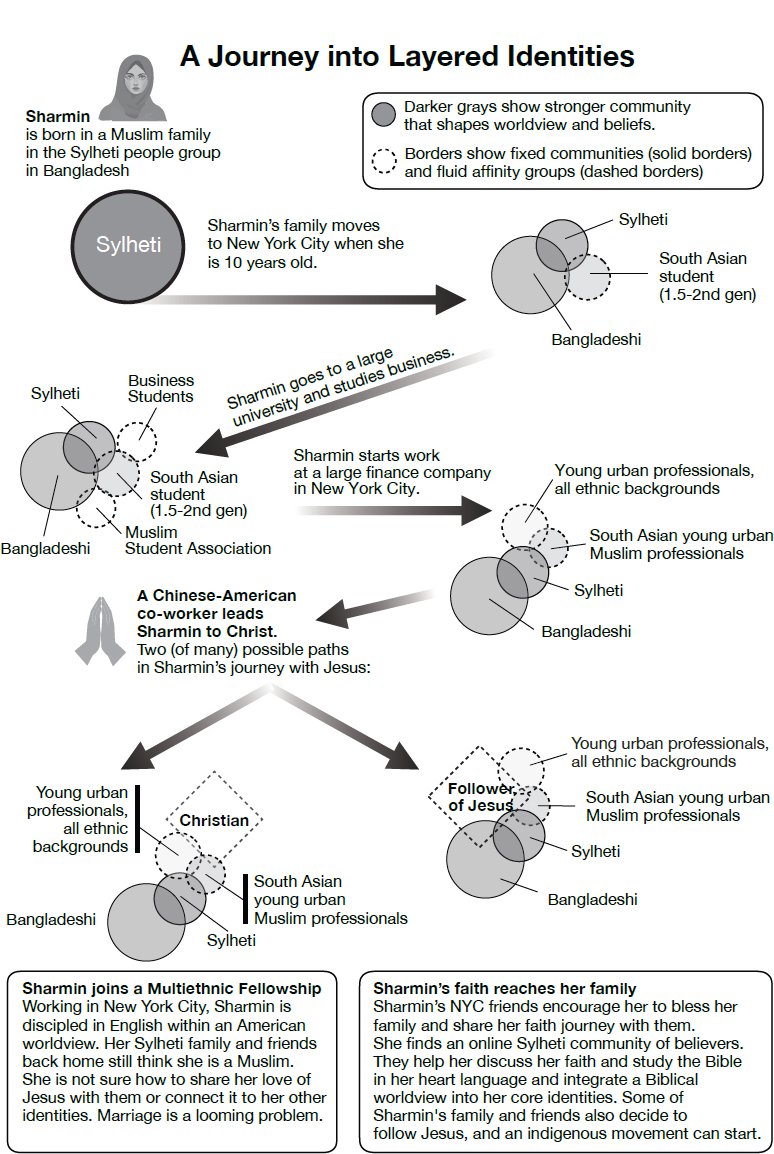
At the same time, multiethnic churches in urban settings can be safe places for members of unreached people groups (UPGs) to explore Christian community. Without the scrutiny of their people watching, members of UPGs may feel a sense of anonymity in attending multiethnic churches and forming relationships with Christians. Donald McGavran, a pioneer in people group thinking, recognized “that if in a conglomerate (mixed member) church, a person is present from a people segment that does not have the gospel, they can become a ‘bridge of God’ to take the Good News to their own people.”7 Multiethnic churches and general city ministries should recognize their unique opportunity to disciple and spread a vision for members of UPGs to reach back as bridges of God to their people.
There are several difficulties in multiethnic church involvement with members of UPGs. Members of UPGs have unique sets of discipleship issues related to persecution, family relations, and spiritual warfare that many churches will not know how to address. As one Muslim-background Christian told me, “I went to a church for ten years, but they never even knew the questions I was asking.” As great and necessary as multiethnic churches are in cities, most are fairly monocultural and disciple people of a particular worldview. It is impossible for one church to adequately disciple people from myriads of cultural, religious, and familial backgrounds. For that reason, ethnic churches are often necessary to effectively evangelize and disciple UPGs.
When a first-generation UPG immigrant is discipled in a multiethnic church, they are rarely discipled in their heart language, and as a result, they struggle to communicate the gospel with their people in a way that can be understood, received, and reproduced. One day I was on the subway speaking Bambara to a Malian Muslim. When the Malian man exited, a gentleman from Côte d’Ivoire approached me and spoke in Jula, a closely related language. I was amazed when the man explained that he was an evangelist and pastor. A Jula-speaking evangelist was a rare find! When we began talking about our faith, however, the man switched to French. When I switched to Bambara, he switched back to French. Finally, he said, “I’m sorry. I wish I could talk about God in my language, but I only know how to talk about God and the Bible in French.” Such a phenomenon is not an anomaly. After becoming a Christ-follower, it took my Fulbe Futa friend over twenty-five years to begin praying, reading the Bible, and sharing her faith in her first language, Pular. She had primarily used French and English. If Christian members of UPGs in multiethnic churches are to be used as bridges of God to their people, they will most likely need to do so in their language.
Cities Are the Most Strategic and Accessible Places to Reach a Diversity of Peoples
In West Africa, I would travel days on rugged roads to encounter an unreached people group, then another couple of days to encounter a different one. In global cities, these groups are living and working together. On one street in New York City where I lived, I could eat at an Afghan Muslim-owned fried chicken restaurant, a Yemeni-owned deli, a Somali-owned restaurant, a Bangladeshi-run fast-food chain, or various West African restaurants with owners from Mali, Senegal, Guinea, or Côte d’Ivoire. On one street I had access to people from some of the least reached peoples and areas of the world, and many of them hailed from countries hostile to missionary activity.
While people group identities and boundaries remain in cities, these dynamics become more complex and layered. Despite their parents’ wishes, a child may marry someone from a different ethnicity or religion, creating new family identities and traditions. People may have hobbies, interests, or vocations in which social groups are formed that transcend ethnicity. Individuals might act and identify one way in their home but act and identify a different way at work for some perceived advantage. Such layered social interactions can contribute to social fragmentation within a people group in cities. As a result, the gospel might not spread as quickly within the people group in an urban setting compared to rural areas. Nevertheless, the porous people group boundaries and broader networks make it easier in cities for the gospel to spread from one people group to another.
Urbanization, Migration, and Technology Are the New Roman Roads for Sharing Jesus
The rapid expansion of the church in the first century was enabled by the extensive Roman road system connecting major cities and towns of the Roman Empire. Jewish Christians began spreading out from Jerusalem following Stephen’s martyrdom, and “those who were scattered went about preaching the word” (Acts 8:4 ESV). We use the term “diaspora” to refer to those who “scatter” or “disperse.”
In today’s world, migrants from unreached peoples disperse from their homelands, where they had little to no interaction with Christians, to countries where it is easy to form relationships with Christians and openly investigate the claims of Christ. Migrants who are Christians also disperse from their homelands, where they had little to no interaction with unreached peoples, to cities where they work the same jobs as immigrants from unreached people groups. Some Christians migrate to countries where the dominant ethnic groups are unreached, such as Filipinos migrating to the Gulf Arab states, giving them easy access to families of the unreached.
For better or worse, key cities influence the rest of the country and a globalized world. When the COVID-19 epidemic first spread throughout the United States, nearly 100 percent of the cases could be traced back to New York City because of its role as an international travel hub. Bad things can spread from cities.
Good things can spread from cities as well. How could Paul write to the Roman church that he no longer had any room for work in the regions of his missionary journeys (Rom 15:23–24)? Paul’s missionary journeys led him to primarily start churches in key cities with regional influence. With many villages and small towns presumably still lacking churches, his declaration only makes sense when understanding that churches in these key cities were well positioned and influential for the spread of the gospel to the entire region.
In our mission work among West Africans in New York City, I quickly realized the influence of the diaspora community on their homeland. Muslim friends and acquaintances would receive gospel resources in their languages and often say, “This message is true. Our people have not understood. I will send this home to my family and fifty people will listen.” The Malian diaspora community was referred to as “big people,” which could better be translated as important “big daddies” and “big mommas.” They were the influencers, shaping African society back home from their cell phones in New York. They were the gatekeepers, determining what information, tools, and resources were acceptable to share with their homeland.
On hearing of my plans to visit Mali, my car-washer friend in the Bronx named Zoumana said he’d take care of me when I arrived. I didn’t know what that meant. Zoumana worked sixty hours a week at minimum-wage jobs. Greeting me at the airport, however, was the secretary general of the largest political party in the country. He drove me in a Mercedes to Zoumana’s home, which was the largest house in a middle-class neighborhood. Gates were opened to his compound where another Mercedes was parked inside. Zoumana had multiple wives, a sign of wealth for Muslims his age. His first wife lived on the first floor. The second wife lived on the second floor, and she was tired because she had returned that day from a business trip to Dubai. The next day we visited Zoumana’s business in the big market of the capital city. He had the largest craft business in the market with dozens of employees. I discovered Zoumana used to be a government influencer in business and owned other buildings he rented out for income. He was my carwasher friend in America, but in Mali he was a big daddy!
The diaspora in cities deeply connects not only with the people in their original homeland but also with other diaspora communities. After a Senegalese woman named Fatou came to Christ in New York City, she led fifteen family members and friends to Christ in her first eighteen months as a believer. They lived in Florida, Canada, Italy, France, and Senegal. Global urban migrants spread news quickly and widely throughout the world.
One Muslim-background Christian friend showed me the power of these networks through technology. He posted a passage from Scripture in a social media app to hundreds of his friends and family and invited discussion. Within a day, Muslims and Christians in the United States, Europe, Africa, and Asia, had posted dozens of exchanges in dialogue about the verse.
Another friend from Bangladesh started a video call group to encourage Muslim-background Christians. Within months of starting the group, around six hundred people were connected, daily meetings were taking place, and Muslims began exploring the Christian community being formed. Around two hundred Muslim-background people were baptized as followers of Christ within the first year of starting the online group.
Migration, urbanization, and technology function today like Roman roads did in the first century for the spread of the gospel. Broad relationships, connectivity, access to information, and speed of communication are resulting in a dispersion of the word of God to the remaining unreached peoples.
The Gospel Returns to Musa’s Village
The first time I returned to Mali after moving to New York City, a Malian Christian visited Musa’s village with Nichole and me. The elders in his village had attempted to kill him for decades for becoming the first Wassoulou Christian in the region. “Death is preferable to shame,” they’d say to justify their actions. But many of these elders had passed away, and Musa chose to lovingly forgive his village. He regularly sent money home to stock the village’s pharmacy. He stayed in contact with family and friends. Furthermore, Musa was now the village’s “big daddy” in New York. As a global urban migrant, his status flipped from shame to honor.
Broad relationships, connectivity, access to information, and speed of communication are resulting in a dispersion of the word of God to the remaining unreached peoples.
Musa recorded a video greeting for us to show his village. He shared his faith in Christ and urged the village to listen to us. Around one hundred people gathered as the Malian Christian and I shared about Jesus and the hope and victory he provides. Musa’s older brother was the first to give his life to Christ. Over forty people have now been baptized in Musa’s village. Musa has returned twice. He tears up when describing what he saw. “All the sacrifice was worth it,” he said, “Because now my village has the opportunity to know Jesus.” Even though missionaries have not been living among the Wassoulou, God used migration, urbanization, and technology to connect people and open doors for the first believers and churches to be started among Musa’s people group. God is using global cities as gathering places and gateways to spread his glory to all peoples. 
RETURN TO LESSON 9: The Task Remaining
Used with permission by Chris Clayman, JoshuaProject.net
GO TO THE BEGINNING OF LESSON 10: How Shall They Hear?
Notes
1. Custom visuals of people group data can be viewed at joshuaproject.net/people_groups/interactive.
2. A fuller version of our story, Musa’s story, and the global opportunities God has provided through cities can be found in my book
Superplan: A Journey into God’s Story (WIGTake, 2018).
3. “Urbanization,” United Nations Population Division, accessed June 29, 2024, www.un.org/development/desa/pd/content/urbanization-0.
4. “World Cities,” World Population Review, accessed June 29, 2024, worldpopulationreview.com/world-cities.
5. “The Religious Composition of the World’s Migrants,” Pew Research Center, August 19, 2024, www.pewresearch.org/religion/2024/08/19/the-religious-composition-of-the-worlds-migrants/. According to Pew’s 2020 Global Religion and Migration Database, 47 percent of international migrants are Christians, and 29 percent are Muslims.
6. “Languages of New York City,” Endangered Language Alliance, accessed June 29, 2024, languagemap.nyc/Info/About.
7. Alan R. Johnson, “Foundations of Frontier Missiology: Core Understandings and Interrelated Concepts,” Evangelical Missions Quarterly 56, no. 4 (2020): 12.