CHAPTER 88
D. G. Wynn

D. G. Wynn is the vice president of global engagement at Gospel Ambition, a leader in faith-based technology. She is also the founder of Chasm Gaming, which brings Great Commission concepts to the masses in a fun way through kingdom-themed card and board games.
Over the past few decades, a new world has appeared, a digital world. As a result, this “digital era” has brought profound and fundamental changes that have shaped personal habits, societies, and cultures. The importance of the digital era became clear to me one day as I was standing in the Great Hall of the Library of Congress—the largest library in the world. On my left lay one of the three remaining complete copies of the Gutenberg Bible. The Gutenberg Bible was the first book ever printed on a printing press, which allowed the Bible to be made widely available to many people for the first time. On my right was a copy of the Wittenberg Bible, which was translated by Martin Luther into German. When the Bible became available in the everyday language of the German people, they no longer had to rely on others to tell them what the Bible said or meant. They could read it for themselves. Both breakthroughs, printing and local language, made it possible for whole new groups of people to know and love Christ.
As I was pondering these two history-making Bibles, I realized that in my pocket was my mobile phone with a Bible app on it, which had the Bible in over 2,500 versions and 1,750 languages. This app is accessible for devices worldwide. All three of these Bibles represent towering innovations that have helped make Christ known more than ever before.
For the sake of the gospel, individuals, churches, mission agencies, training organizations, networks, and more are innovating to make Jesus’s name great among all peoples. In this digital world, individuals who may never have met otherwise can now connect to form friendships and communities with people who are physically distant. To encourage transformational and authentic connections, some digital ministry strategies identify seekers and begin introducing people to Christ, while others provide education and training to deepen growth in Christ. Additional strategies create vital resources like Bible translations or disciple-making resources in different languages. Some provide training for developing new church leaders. The options are endless.
A Change in Culture
The digital world is, in some ways, reshaping culture(s) and creating opportunities where there were none before. For example, nomadic peoples in the Saudi Arabian desert have historically prioritized finding water when choosing where to set up camp. Now, however, a significant factor in where they set up their tents is based on where they can get mobile phone coverage.1
Another example of the significant impact on culture is expressed by the vice president of internet evangelism of the Billy Graham Evangelistic Association, Mark Appleton:
The digital world is, in some ways, reshaping culture(s) and creating opportunities where there were none before.
There are growing sociological similarities between teenagers in Topeka, Kansas, and those in Jakarta, Indonesia. While each group still has their ethnic culture, because of their shared experiences in the global digital space, there are aspects of their lives in which they will relate more to each other than they will to their own parents.2
These changes, and others like them, are significant access points that can connect us with the unreached. In ancient times, the Roman roads were a similar innovation. Creating a network of maintained roads made getting from one place to another faster than ever before. Early missionary teams used those roads to spread the gospel more efficiently, and in our day, we can use the digital world similarly.
An Interconnected World
In addition to cultural shifts, technological access is rapidly increasing and connecting much of the world into a global community. “At this point, two-thirds of the world’s population is digitally connected with internet access. Slightly more than that have mobile phones.”3 The International Telecommunication Union’s graph of internet adoption (see below) illustrates the rapid escalation in access to internetenabled devices.
From the Broadcast Era to the Digital Era
Prior to the 1990s, the main media strategies employed on behalf of the gospel were “broadcast” in nature, meaning that programs were distributed through radio and television. These tools helped millions of people learn about Jesus for the first time.
However, because broadcast media only allows for communication to be one-directional, these ministries need innovations from the digital era (e.g., live chats, instant messaging) to turn their one-way communication strategies into the two-way relationships that seekers and followers of Jesus need in order to thrive.
When the digital era started with the internet and email in the early 1990s, rapid societal changes began to happen globally. Then, the introduction of social media in the mid-2000s fundamentally changed how societies communicated. The world suddenly became both connected to the internet and connected to each other in ways never before experienced. Christians can use this opportunity for connection to establish relationships and form Christ-centered communities across physical divides in entirely new ways.
Community Building in the Digital Era
A group practicing media-to-movement in North Africa launched a website introducing Christ in one of the most intrusive cyber-police states in the world. Over the last half dozen years, they have connected with more than thirty thousand people through their digital media campaigns. An unprecedented number of people in that context decided to follow Christ as a result of the website, related social media campaigns, and the IRL (in-real-life) friendships built through these efforts.4 Some groups are using artificial intelligence and “bots” to help seekers follow Christ. However, “digital opportunity is not just about sharing information . . . it’s about human interaction.”5
Abdul is an example of this online to offline relationship process. He saw Jesus in a dream and searched online to get answers, despite his family’s strong opposition. After we connected him digitally with one of our national pioneers, Abdul was baptized by one of our church partners. On the day of their first physical meeting, Abdul even invited his wife to meet with the pioneer. Abdul now has the courage to share his Christian faith with his family. He is consistently discipled through Zoom meetings.6
As more and more disciples emerge in an area, they can, if appropriate, gather into simple churches and begin to share Jesus throughout their own networks.
Digital Tools for Disciples in the Digital Era
The numerous ministries, churches, and mission agencies globally that are trying to fulfill the Great Commission pursue that goal in a variety of ways. Digital examples of how these groups are engaging range from creating resources and translations to interactive relationships through media. A sample of different digital strategies is provided below, and though it cannot be exhaustive, it is meant to illustrate what exists so that you can find what might be the most useful in your context and dream of the next thing that will help spread the gospel globally.
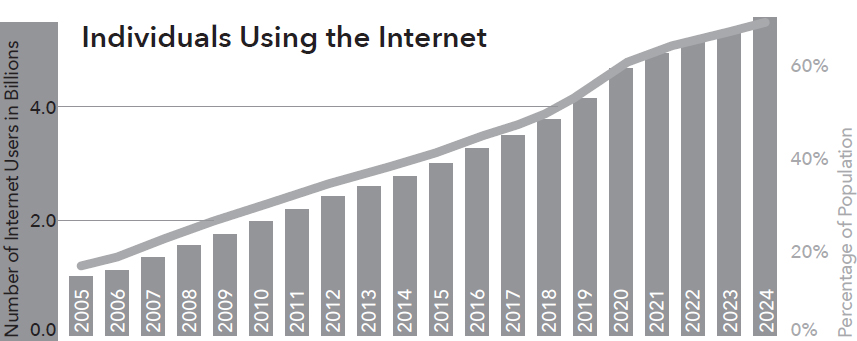
Source: ITC, www.itu.int/en/ITU-D/Statistics/Pages/stat/default.aspx, accessed March 17, 2025.
Bible Access
Many people now read or listen to the Bible using digital devices. This has created unprecedented access to a wide variety of Bible translations, children’s materials, and oral Bibles. No previous generations have had the Bible as easily available to them as those who now live in the digital era. Resources like the YouVersion Bible App and the Bible App for Kids, along with the Digital Bible Society (which also has nearly 1,700 Bible translations), are rapidly expanding access to the Bible globally. For oral cultures, organizations like Faith Comes by Hearing have created audio Bibles in two thousand languages and counting.
Other innovators have created thousands of videos, podcasts, and apps that help people study the Bible. One example is The Bible Project, which has had 620 million views in over two hundred countries, with five million sub-scribers worldwide in less than ten years.
Missiological Education
Advanced opportunities for Christian education have also been greatly expanded in the digital era. Accredited degrees are offered by countless universities and seminaries utilizing online education. Students from across the globe can meet in a virtual space to take classes, build relationships with each other, and discuss various issues. Some of these people will likely never meet in person, but the Christian community formed online will help their personal growth in Christ as they lead local churches.
Disciple-Making Training
Many apps exist that focus on the process of disciple-making and can be used in numerous languages. One particular app’s goal is to guide disciples in how to study the Bible, obey Christ, and share what they are learning with others.7 The ease of the technology makes it possible for anyone to train others, no matter their age or distance, as long as they have access to a device connected to the internet.
Sometimes the least likely people find maximal fruitfulness in the digital era. As a seventy-eight-year-old man who grew up in the pre-digital era, Richard did not seem like the kind of person who would adapt to online platforms. However, when he discovered an online training program8 that challenged him to make disciples, he wondered what he could do with it. Richard had been wheelchair-bound for more than forty years. He couldn’t move across the world to spread the gospel. Instead, he invited all his neighbors and shared with them about the disciple-making training he had just participated in, and then he invited them to join him. Most of those he invited chose to join him in the training.
Another disciple-maker, Barry, using the same training as Richard, connected with new believers in South Sudan via Zoom. After six months, he reported an outbreak of more than five hundred baptisms and another one hundred being cultivated.9
Tech Communities
Some believers are participating in events that deliberately seek to create innovation. These groups host hack-athons, in which hackers, designers, and developers with a heart for missions come together over a weekend to brainstorm and prototype new apps, web tools, digital distribution strategies, reporting solutions, and more.10 Beyond short-term events like hackathons, believers are gathering to create long-term tech communities, sharing code freely and designing solutions that require years of work and the combined effort of many developers. These groups have generated sophisticated software that addresses the needs of church planters who track the generations of churches they are stewarding, which frontline workers used to track using long rolls of paper. These user-friendly software allows for efficient tracking of the generations of churches planted and provides the leaders of these movements with key indicators of the health of the movements.11
Prayer Movements
All research on modern movements toward Jesus indicates that extraordinary prayer is rallied before break-throughs are seen among unreached peoples. Knowing that, a host of organizations are creating digital solutions to rally prayer.
Individual mission agencies are pioneering virtual prayer rooms, which invite participants to pray for specific missionary teams and the people they work among.12 Some organizations are creating 24/7 prayer platforms or ones that rally believers across the planet to pray as the whole body of Christ together.13 Tools like Prayercast and Joshua Project’s Unreached of the Day app provide content rich in information about unreached people groups and how to pray Scripture and hope over them.
The ease of the technology makes it possible for anyone to train others, no matter their age or distance, as long as they have access to a device connected to the internet.
The global church is finding opportunities to pray with each other and for each other like never before. This provides a further sense of community for many and helps those praying to have a greater sense of being joined with other believers in God’s global purposes.
It’s Still a Great Commission in the Digital Era
Jesus relentlessly pursues the fullness of His family from all the peoples of the Earth, and we look with anticipation at how we can spur worship of Christ in the digital era. This is a time when technology has changed, and will change, the way personal relationships are made and communities are formed. With that change comes a time of unprecedented opportunity, challenge, and growth. Much innovation has already begun, but much more opportunity remains to bring glory to Christ in the digital era. 
RETURN TO LESSON 9: The Task Remaining
Notes
1. Keith Williams, “The Little Phone That Could: Mobile-Empowered Ministry,” International Journal of Frontier Missiology 27, no. 3 (2010).
2. Mark Appleton, “We Are All Digital Missionaries,” Mission Frontiers 45, no. 3 (2023).
3. Appleton, “We Are All Digital Missionaries.”
4. Gospel Ambition, “About,” accessed Feb 28, 2024, gospelambition.org/about.
5. Paul Rattray, “Digital Opportunity in Missions Work,” Mission Frontiers 45, no. 3 (2023).
6. Rattray, “Digital Opportunity in Missions Work.”
7. Waha Discovery Bible Study App (available in 20+ languages).
8. Zúme Training (available in 45+ languages)
9. Zúme, “Reports,” accessed Feb 22, 2024, zume.vision/reports.
10. Andrew Feng, “A Hackathon for Global Missions,” Mission Frontiers 45, no. 3 (2023).
11. Disciple.Tools is a movement-tracking software. https://Disciple.Tools.
12. Prayer Room, https://pray.josiahventure.com/.