CHAPTER 66
The Flaw of the Excluded Middle
Paul G. Hiebert

Paul G. Hiebert was the chairman of the Department of Mission and Evangelism and professor of mission and anthropology at Trinity Evangelical Divinity School. He previously taught anthropology and South Asian studies at Fuller Theological Seminary’s School of World Mission. Hiebert served as a missionary in India and he authored ten books with his wife, Frances.
From anthropological reflections on Missiological Issues. Grand Rapids: Baker Book House, 1994. Used by permission.
The disciples of John the Baptist asked Jesus, “Are you he who is to come, or shall we look for another?” (Luke 7:20 RSV). Jesus answered, not with logical proofs but by a demonstration of power in curing the sick and casting out evil spirits. This much is clear. Yet when I once read the passage from my perspective as a missionary in India and sought to apply it to missions in my day, I felt a sense of uneasiness. As a Westerner, I was used to presenting Christ on the basis of rational arguments, not by evidences of His power in the lives of people who were sick, possessed, and destitute. In particular, the confrontation with spirits that appeared so natural a part of Christ’s ministry belonged in my mind to a separate world of the miraculous—far from ordinary everyday experiences.
Another situation, early in my ministry in India, gave me the same uneasiness. One day, while teaching in the Bible school in Shamshabad, I saw Yellayya standing in the door at the back of the class. He looked tired, for he had walked many miles from Muchintala where he was an elder in the church. I assigned the class some reading and went with him to the office. When I asked why he had come, he said that smallpox had come to the village a few weeks earlier and had taken a number of children. Doctors trained in Western medicine had tried to halt the plague but without success. Finally, in desperation the village elders sent for a diviner, who told them that Maisamma, goddess of smallpox, was angry with the village.
To satisfy her and stop the plague, the village would have to perform the water buffalo sacrifice. The village elders went around to each house-hold in the village to raise money to purchase the buffalo. When they came to the Christian homes, the Christians refused to give them anything, saying that it was against their religious beliefs. The leaders were angry, pointing out that the goddess would not be satisfied until every household gave something as a token offering—even one paisa would do.1 When the Christians refused, the elders forbade them to draw water from the village wells, and the merchants refused to sell them food.
In the end some of the Christians had wanted to stop the harassment by giving the paisa, telling God they did not mean it, but Yellayya had refused to let them do so. Now, said Yellayya, one of the Christian girls was sick with smallpox. He wanted me to pray with him for God’s healing. As I knelt, my mind was in turmoil. I had learned to pray as a child, studied prayer in seminary, and preached it as a pastor. But now I was to pray for a sick child as all the village watched to see if the Christian God was able to heal.
Why my uneasiness both in reading the Scriptures and in the Indian village? Was the problem, at least in part, due to my own worldview—to the assumptions I as a Westerner made about the nature of reality and how I viewed the world? But how does one discover these assumptions since they are so taken for granted that we are rarely even aware of them? One way is to look at the worldview of another culture and contrast it with the way we view the world.

Copyright © 2015 International Mission Board. All rights reserved.
Ills and Remedies in an Indian Village
There are many illnesses in an Indian village. According to the Indian worldview, people become sick with “hot” diseases, such as smallpox, and must be treated with “cold” medicines and foods; or they have “cold” diseases like malaria and need “hot” foods and medicines. Some need treatment for boils, cuts, and broken bones, others for mental illnesses. Women may be cursed with barrenness. Individuals or whole families may be plagued by bad luck, by constantly being robbed, or by having their houses burn down. Or they may be seized by bad temper, jealousy, or hatred. They may be possessed by spirits or be injured by planetary forces or black magic.
Like all people, Indian villagers have traditional ways to deal with such diseases. Serious cases, particularly those that are life-threatening or have to do with relationships, they take to the sadhu (saint), a person of god who claims to heal by prayer. Because the god knows everything, including the nature and causes of the illness, the saints ask no questions. Moreover, because they are spiritual, they charge no fees, although those healed are expected to give a generous offering to the god by giving it to the saint.
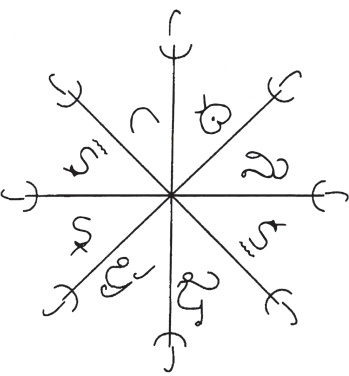
Other cases villagers take to a mantrakar or magician, particularly in cases in which the villagers suspect some evil human or supernatural cause. The magician cures by knowledge and control of supernatural spirits and forces believed to exist on earth. If, for example, one were to venture out on an inauspicious day when the evil forces of the planets are particularly strong, he or she might be bitten by a viper. To cure this the magician would have to say the following mantra (magical chant) seven times—once for each stripe across the viper’s back: om namo bhagavate. sarva peesachi gruhamulu nanu dzuchi paradzuru. hreem, klem, sam phat, svaha. This combines a powerful formula to counter the evil forces with a series of powerful sounds (hreem, klem, sam, phat, svaha) that further empower the formula. Sometimes the magician uses visual symbols (yentras; sample right) or amulets to control spirits and forces in this world. Because they can divine both the nature and the cause of the evil plaguing the patient, they need ask no questions, and like the saints, they receive the offerings of those who have been helped.
A third type of medical practitioner are the vaidyudu (doctors), who cure people by means of scientific knowledge based on the ayyurvedic or unani systems of medicine. Because of their skills in diagnosis, these, too, ask no questions. Villagers report that these vaidyudu feel their wrists, stomachs, and bodies and are able to determine their illnesses. They charge high fees, for this knowledge is powerful, but they give a guarantee: medicines and services are paid for only if the patient is healed.
In addition, there are village quacks who heal people with folk remedies. Their knowledge is limited so they must ask questions about the illness: Where does it hurt and for how long has the pain been felt? Have they been with someone sick? What have they eaten? For the same reason they charge low fees and give no guarantees. People have to pay for the medicines before receiving them. It should not surprise us that Western doctors are often equated at the beginning with the quacks.
What happens to villagers who become Christians? Most of them take problems they formerly took to the saints to the Christian minister or missionary. Christ replaces Krishna or Siva as the healer of spiritual diseases. Many of them in time turn to Western allopathic medicines for many of the illnesses they had taken to the doctor and quack. But what of the plagues that the magician cured? What about spirit possession or curses or witchcraft or black magic? What is the Christian answer to these?
Often the missionary evangelist or doctor has no answer. These do not really exist, they say. But to people for whom these are very real experiences in their lives, there must be another answer. Therefore, many of them return to the magician for cures.
This survival of magic among Christians is not unique to India. In many parts of the world, the picture is the same. In the West, magic and witchcraft persisted well into the seventeenth century, more than a thousand years after the gospel came to these lands.
An Analytical Framework
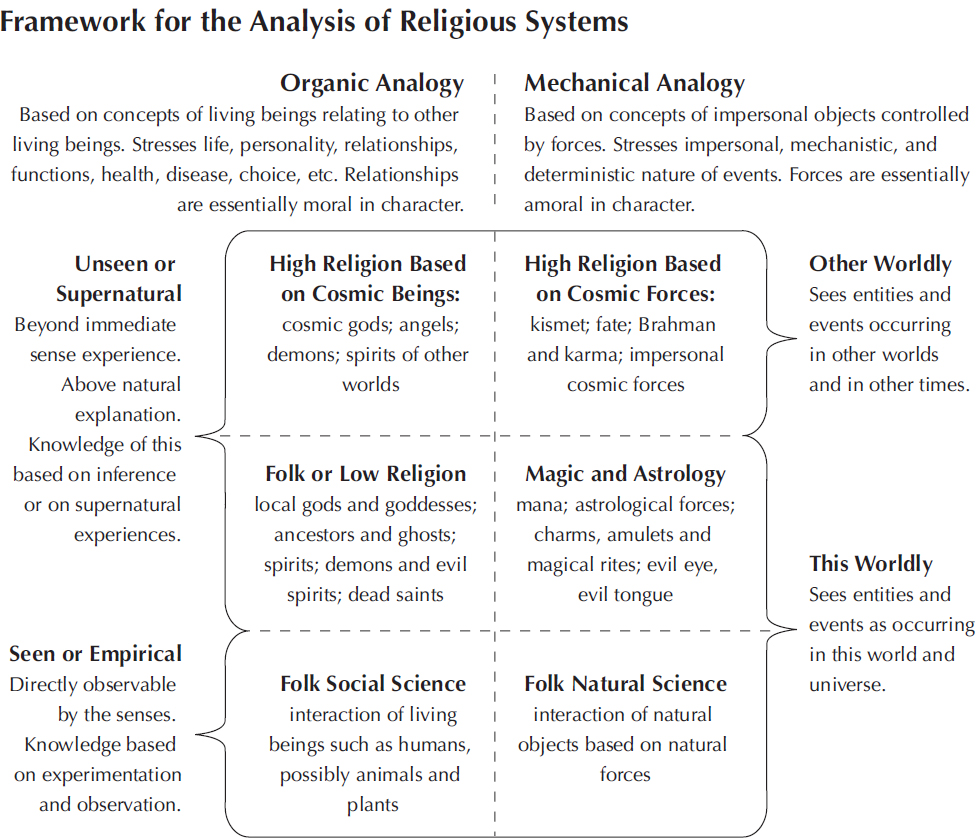
In order to understand the biblical texts, the Indian scene, and the failure of Western missionaries to meet the needs met by magicians, we need an analytical framework. To create this framework, we need two dimensions of analysis (see chart on next page).
The Seen-Unseen Dimension
The first dimension is that of immanencetranscendence. On one end is the empirical world of our senses. All people are aware of this world and develop folk sciences to explain and control it. They develop theories about the natural world around them—how to build a house, plant a crop, or sail a canoe. They also have theories about human relationships—how to raise a child, treat a spouse, and deal with a relative. When a Naga tribal person attributes the death of the deer to an arrow, or a Karen wife explains the cooking of a meal in terms of the fire under the pot, they are using explanations based upon empirical observations and deductions. Western science, in this sense, is not unique. Western science may be more systematic in the exploration of the empirical world, but all people have folk sciences.
Above this level (more remote from the experience of humans) are beings and forces that cannot be directly perceived but are thought to exist on this earth. These include spirits, ghosts, ancestors, demons, and earthly gods and goddesses who live in trees, rivers, hills, and villages. These live, not in some other world or time, but with humans and animals of this world and time. In medieval Europe these beings included trolls, pixies, gnomes, brownies, and fairies, all of which were believed to be real. This level also includes supernatural forces, such as mana, planetary influences, evil eyes, and the powers of magic, sorcery, and witchcraft.
Furthest from the immediate world of human experience are transcendent worlds beyond this one—hells and heavens and other times, such as eternity. In this transcendent realm fit African concepts of a high god and Hindu ideas of Vishnu and Siva. Here is located the Jewish concept of Jehovah, who stands in stark contrast to the baals and ashtaroth of the Canaanites, who were deities of this world, of the middle zone. To be sure, Jehovah entered into the affairs of this earth, but His abode was above it. On this level, too, are the transcendent cosmic forces such as karma and kismet.
The Organic-Mechanical Continuum
Scholars have widely noted that humans use analogies from everyday experience to provide pictures of the nature and operations of the larger world. Two basic analogies are particularly widespread:
1. organic analogy—sees things as living beings in relationship to each other,
2. mechanical analogy—sees things as inanimate objects that act upon one another like parts in a machine.
In the organic analogy, the elements being examined are thought to be alive in some sense, to undergo processes similar to human life, and to relate to each other in ways that are analogous to interpersonal relationships. For example, in seeking to describe human civilizations, philosopher Oswald Spengler and historian Arnold Toynbee speak of them in terms of an organic analogy: Civilizations are born, they mature, and they die. Similarly, traditional religionists see many diseases as caused by evil spirits that are alive, that may be angered, and that can be placated through supplication or the offering of a sacrifice. Christians see their relationship to God in organic terms. God is a person and humans relate to Him in ways analogous to human relationships.
Organic explanations see the world in terms of living beings in relationship to one another. Like humans and animals, objects may initiate actions and respond to the actions of others. They may be thought to have feelings, thoughts, and wills of their own. Often they are seen as social beings who love, marry, have offspring, quarrel, war, sleep, eat, persuade, and coerce one another.
In the mechanical analogy, all things are thought to be inanimate parts of greater mechanical systems. They are controlled by impersonal forces or by impersonal laws of nature. For example, Western sciences see the world as made up of lifeless matter that interacts on the basis of forces. When gravity pulls a rock down to the earth it is not because the earth and rock wish to meet—neither earth nor rock have any thought in the matter. In Western science even living beings often are seen as being caught up in a world ultimately made up of impersonal forces. Just as we have no choice about what happens to us when we fall out of a tree, so it is often thought that we have no control over the forces in early childhood that are believed to have made us what we are today.
Mechanical analogies are essentially deterministic; living beings in a mechanistic system are subject to its impersonal forces. But if they know how these forces operate, they can manipulate or control them for their own advantage. In a sense they exert godlike control over their own destiny.
Mechanistic analogies are basically amoral. Forces are intrinsically neither good nor evil. They can be used for both. Organic analogies, on the other hand, are characterized by ethical considerations. One being’s actions always affect other beings.
Many of the similarities among modern science, magic, and astrology that have been pointed out by anthropologists are due to the fact that all three use mechanistic analogies. Just as scientists know how to control empirical forces to achieve their goals, the magician and astrologer control supernatural forces of this world by means of chants, charms, and rituals to carry out human purposes.
One of the greatest cultural gaps between Western people and many traditional religionists is found along this dimension. The former have bought deeply into a mechanical view of this universe and of the social order.2 To them the basis of the world is lifeless matter controlled by impersonal forces. Many tribal religionists see the world as alive. Not only humans but also animals, plants, and even rocks, sand, and water are thought to have personalities, wills, and life forces. Theirs is a relational, not a deterministic, world.
The Excluded Middle
The reasons for my uneasiness with the biblical and Indian worldviews should be clear: I had excluded the middle level of supernatural this-worldly beings and forces from my own worldview. As a scientist I had been trained to deal with the empirical world in naturalistic terms. As a theologian I was taught to answer ultimate questions in theistic terms. For me the middle zone did not really exist. Unlike Indian villagers, I had given little thought to spirits of this world, to local ancestors and ghosts, or to the souls of animals. For me these belonged to the realm of fairies, trolls, and other mythical beings. Consequently, I had no answers to the questions they raised (see chart on previous page).
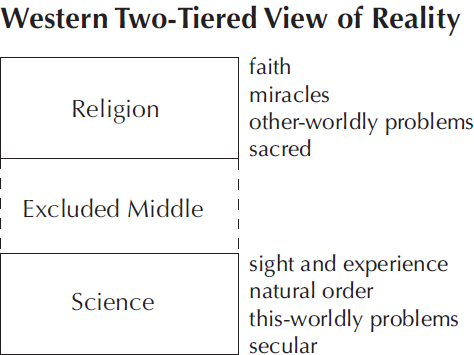
How did this two-tiered worldview emerge in the West? Belief in the middle level began to die in the seventeenth and eighteenth centuries with the growing acceptance of a Platonic dualism and of a science based on materialistic naturalism.3 The result was the secularization of science and the mystification of religion. Science dealt with the empirical world using mechanistic analogies, leaving religion to handle other-worldly matters, often in terms of organic analogies. Science was based on the certitudes of sense experience, experimentation, and proof. Religion was left with faith in visions, dreams, and inner feelings. Science sought order in natural laws. Religion was brought in to deal with miracles and exceptions to the natural order, but these decreased as scientific knowledge expanded.
It should be apparent why many missionaries trained in the West had no answers to the problems of the middle level—they often did not even see it. When tribal people spoke of fear of evil spirits, they denied the existence of the spirits rather than claim the power of Christ over them. The result, Lesslie Newbigin has argued, is that Western Christian missions have been one of the greatest secularizing forces in history.4
What are the questions of the middle level that Westerners find so hard to answer, and how do they differ from questions raised by science and religion? Science as a system of explanation, whether folk or modern, answers questions about the nature of the world that is directly experienced. All people have social theories about how to raise children and organize social activities. All have ideas about the natural world and how to control it for their own benefit.
Religion as a system of explanation deals with the ultimate questions of the origin, purpose, and destiny of an individual, a society, and the universe. In the West the focus is on the individual; in the Old Testament it was on Israel as a society.
What are the questions of the middle level? Here one finds the questions of the uncertainty of the future, the crises of present life, and the unknowns of the past. Despite knowledge of facts such as that seeds once planted will grow and bear fruit, or that travel down this river on a boat will bring one to the neighboring village, the future is not totally predictable. Accidents, misfortunes, the intervention of other persons, and other unknown events can frustrate human planning.
How can one prevent accidents or guarantee success in the future? How can one make sure that a marriage will be fruitful, happy, and enduring? How can one avoid getting on a plane that will crash? In the West these questions are left unanswered. They are accidents, luck, or unforeseeable events, and hence unexplainable. But many people are not content to leave so important a set of questions unanswered, and the answers they give are often stated in terms of ancestors, demons, witches, and local gods, or in terms of magic and astrology.
Similarly, the crises and misfortunes of present life must be handled: sudden disease and plagues, extended droughts, earthquakes, business failures, and the empirically unexplainable loss of health. What does one do when the doctors have done all they can and a child grows sicker, or when one is gambling and the stakes are high? Again, many seek answers in the middle level.
And there are questions one must answer about the past: Why did my child die in the prime of life? Who stole the gold hidden in the house? Here again trans-empirical explanations often provide an answer when empirical ones fail.
Because the Western world no longer provides explanations for questions on the middle level, many Western missionaries have no answers within their Christian world-view. What is a Christian theology of ancestors, of animals and plants, of local spirits and spirit possession, and of principalities, powers, and rulers of the darkness of this world (Eph 6:12)? What does one say when new tribal converts want to know how the Christian God tells them where and when to hunt, whether they should marry this daughter to that young man, or where they can find the lost money? Given no answer, they return to the diviner who gives definite answers, for these are the problems that loom large in their everyday life.
Implications for Missions
The Need for Holistic Theology
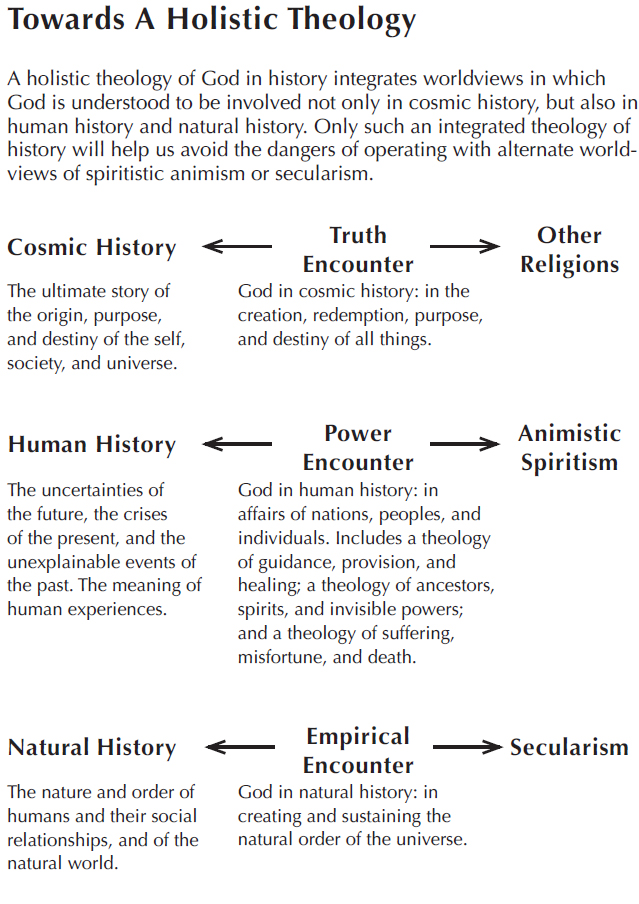
What implications does all of this have for missions? First, it points out the need for missionaries to develop holistic theologies that deal with all areas of life (see diagram on p. 294), that avoid the Platonic dualism of the West, and that take seriously both body and soul.
On the highest level, this includes a theology of God in cosmic history—in the creation, redemption, purpose, and destiny of all things. Only as human history is placed within a cosmic framework does it take on meaning, and only when history has meaning does human biography become meaningful.
On the middle level, a holistic theology includes a theology of God in human history—in the affairs of nations, of peoples, and of individuals. This must include a theology of divine guidance, provision, and healing; a theology of ancestors, spirits, and invisible powers of this world; and a theology of suffering, misfortune, and death.
On this level some sections of the church have turned to doctrines featuring saints as intermediaries between God and humans. Others have turned to doctrines of the Holy Spirit to show God’s active involvement in the events of human history. It is no coincidence that many of the most successful missions have provided some form of Christian answer to middle-level questions.
On the bottom level, a holistic theology includes an awareness of God in natural history—in sustaining the natural order of things. So long as the missionary comes with a two-tiered worldview, with God confined to the supernatural and the natural world operating for all practical purposes according to autonomous scientific laws, Christianity will continue to be a secularizing force in the world. Only as God is brought back into the middle of our scientific understanding of nature will we stem the tide of Western secularism.
Two Dangers in Dealing with the Middle Level
There are two dangers against which we must guard when we formulate a theology that deals with the questions raised at the middle level. These middle-level questions include the meaning of life and death for the living; well-being and the threats of illness, drought, flood, and failure; and guidance in a world of unknowns. The first danger is secularism. This is to deny the reality of the spiritual realm in the events of human life and to reduce the reality of this world to purely materialistic explanations. This is the answer offered by modern science.
A holistic theology includes an awareness of God in natural history—in sustaining the natural order of things.
The second danger is a return to a Christianized form of animism in which spirits and magic are used to explain everything. In spiritism, the spirits dominate reality, and humans must constantly battle or appease them to survive. In magic, humans seek to control supernatural powers through rituals and formulas to achieve their own personal desires. Both spiritism and magic are human and ego-centered; a person can gain what he or she wants by manipulating the spirits and controlling the forces. Both reject a God-centered view of reality, and both reject worship, obedience, and submission as the human response to God’s will. The early church struggled against the animistic world-views around it. Today there is a danger of returning to a Christianized animism in reaction to the secularism of the modern worldview.
Holistic Theology Centered on God
Scripture offers us a third worldview that is neither secular nor animistic. It takes spiritual realities very seriously. In contrast to secular writings, it is full of references to God, angels, Satan, and demons. However, it takes the natural world and humans very seriously. In contrast to the Greek and Roman mythologies, and other great religious texts such as the Avesta and Mahabharata, the Bible does not focus its primary attention on the activities of the spirit world.5 Rather, it is the history of God and of humans and their relationship to each other. Humans are held responsible for their actions. They are tempted, but they choose to sin. God calls them to salvation, and they must respond to His call. The Bible also presents creation as an orderly world, operating according to divinely ordained principles.
In saying this, I do not want to deny the need to deal with the spirit world and related subjects. Yet we need to center our theology on God and His acts and not, as modern secularism and animism do, on human beings and their desires. We need to focus on worship and our relationship to God and not on ways to control God for our own purposes through chants and formulas.
The line between worship and control is subtle, as I learned in the case of Muchintala. A week after our prayer meeting, Yellayya returned to say that the child had died. I felt thoroughly defeated. Who was I to be a missionary if I could not pray for healing and receive a positive answer? A few weeks later he returned with a sense of triumph. “How can you be so happy after the child died?” I asked.
“The village would have acknowledged the power of our God had he healed the child,” Yellayya said, “but they knew in the end she would have to die. When they saw in the funeral our hope of resurrection and reunion in heaven, they saw an even greater victory—over death itself—and they have begun to ask about the Christian way.”
I began to realize in a new way that true answers to prayer are those that bring the greatest glory to God, not those that satisfy my immediate desires. It is all too easy to make Christianity a new magic in which we as gods can make God do our bidding.
Having formulated a theological response to the problems of the middle zone, it is important that we test the beliefs of the people we serve. Some things such as lightning, smallpox, and failure in business, which they may attribute to nature spirits, can better be explained through the order of creation under the superintendence of God. Other things are indeed manifestations of Satan and the other fallen angels. But much of Satan’s work lies hidden from the people, and we must discern and oppose it.
In confronting animistic worldviews, our central message should always focus on the greatness, holiness, and power of God, and His work in human lives. It is He who delivers us from the power of the evil one and gives us the power to live free, victorious Christian lives. 
RETURN TO LESSON 3: Your Kingdom Come
Notes
1. The paisa is the smallest coin in India, now worth about .03 of one penny.
2. Peter L. Berger, Brigitte Berger, and Hansfried Kellner, The Homeless Mind: Modernization and Consciousness (New York: Random House, 1973).
3. Roger K. Bufford, The Human Reflex: Behavioral Psychology in Biblical Perspective (San Francisco: Harper and Row, 1981), 30.
4. Lesslie Newbigin, Honest Religion for Secular Man (Philadelphia: Westminster, 1966).
5. This is reflected in a simple word count in the Bible. In the KJV the word God is used 3,594 times, Jehovah 4 times, Christ 522 times, Jesus 942 times, and Spirit of God 26 times. Many other references to lord and spirit also refer to God. There are 362 references to angels and cherubim, and 158 to Satan, Lucifer, the evil one, and demons. There are 4,324 references to humans.