CHAPTER 65
Culture, Worldview, and Contextualization
Charles H. Kraft

Charles H. Kraft has been professor of anthropology and intercultural communication at Fuller Seminary, School of Intercultural Studies, since 1969. With his wife, Marguerite, he served as a missionary in Nigeria. He teaches and writes in the areas of anthropology, worldview, contextualization, cross-cultural communication, inner healing, and spiritual warfare. Among his numerous books are anthropology for Christian Witness, Two hours to Freedom, and I Give You authority.
A key question for Christians who work cross-culturally is, “What is God’s view of culture?” For example, is Jewish culture created by God and therefore to be imposed on everyone who follows God? Or is there some indication in Scripture that God takes a different position? I believe we have our answer in 1 Corinthians 9:19–22 GNT, where Paul articulates his (and God’s) approach to cultural diversity. Paul says, “While working with the Jews, I live like a Jew,” but “when working with Gentiles, I live like a Gentile.” His approach, then, is to “become all things to all people, that I may save some of them by whatever means are possible.”
The early Christians were Jewish. It was natural for them to believe that the cultural forms in which the gospel came to them were the right ones for everyone. They believed everyone who comes to Jesus must also convert to Jewish culture, but God used the Apostle Paul, himself a Jew, to teach his generation and ours a different approach. In the above text, he articulates God’s approach. Then in Acts 15:2 and following, we find him arguing fiercely against the majority position of the early church for the right of gentiles to follow Jesus within their own sociocultural contexts. God Himself had shown first Peter (Acts 10), then Paul and Barnabas, that this was the right way, by giving the Holy Spirit to gentiles who had not converted to Jewish culture (Acts 13–14).
But the church has continually forgotten the lesson of Acts 15. We have continually reverted to the assumption that becoming Christian means becoming like us culturally. When, after New Testament times, the church required everyone to adopt Roman culture, God raised up Luther to prove that God could accept people who spoke German and worshiped in German ways. Then Anglicanism arose to show that God could use English language and customs, and Wesleyanism arose to let the common people of England know that God accepted them in their culture. So, it has been that there are major cultural issues in the development of every new denomination.
But sadly, the problem persists. Communicators of the gospel continue imposing their culture or denomination on new converts. If then, we take a scriptural approach, we should adapt ourselves and our presentation of God’s message to the culture of the receiving people.
Culture and Worldview Defined
The term culture is the label anthropologists give to the structured customs and underlying worldview assumptions that govern people’s lives. Culture (including worldview) is a people’s way of life, their design for living, and their way of coping with their biological, physical, and social environment. It consists of learned, patterned assumptions (worldview), concepts and behavior, plus the resulting artifacts (material culture).
Worldview, the deep level of culture, is the culturally structured set of assumptions (including values and commitments/allegiances) underlying how a people perceive and respond to reality. Worldview is not separate from culture. It is included in culture as the deepest level of presuppositions upon which people base their lives.
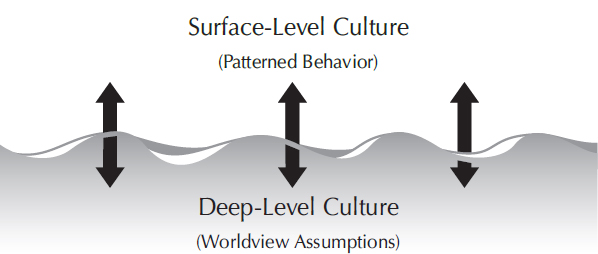
A culture may be likened to a river with a surface level and a deep level. The surface is visible. Most of the river, however, lies beneath the surface and is largely invisible. Anything that happens on the surface of the river is affected by deep-level phenomena such as the current, the cleanness or dirtiness of the river, other objects in the river and so on. What happens on the surface of a river is both a response to external phenomena and a manifestation of the deep-level characteristics of the river.
So it is with culture. What we see on the surface of a culture is patterned human behavior. But this patterned or structured behavior, though impressive, is the lesser part of the culture. In the depths are the assumptions we call worldview, on the basis of which people govern their surface-level behavior. When something affects the surface of a culture it may change that level. The nature and extent of that change, however, will be influenced by the deep-level worldview structuring within the culture.
Culture (including worldview) is a matter of structure or patterns. Culture does not do anything. Culture is like the script an actor follows. The script provides guidelines within which actors ordinarily operate, though they may choose on occasion to modify the script, either because they have forgotten something or because someone else changed things.
There are several levels of culture. The “higher” the level, the more diversity is included in it. For example, we may speak of culture at a multinational level as “Western culture” (or worldview), or “Asian culture,” or “African culture.” Such cultural entities include a large number of quite distinct national cultures. For example, within Western culture there are varieties called German, French, Italian, British, and American. Within Asian culture are varieties called Chinese, Japanese, and Korean. These national cultures, then, can include many subcultures. Within these subcultures we can speak of community cultures, family cultures, and even individual cultures.
In addition, the term “culture” can designate types of strategies (or coping mechanisms) used by people of many different societies. Thus, we can speak of entities such as a culture of poverty, deaf culture, youth culture, culture of factory workers, taxi drivers’ culture, even culture of women. Identifying people in this way is often helpful in working out strategies for their evangelization.
People and Culture
It has been common for both nonspecialists and specialists to refer to culture as if it were a person. We often hear statements such as “Their culture makes them do it,” or “Their worldview determines their view of reality.” Note that the italicized verbs in these statements give the impression that a culture behaves like a person.
The “power” that keeps people following their cultural script is something inside of people—the power of habit. Culture has no power in and of itself. People regularly modify old customs and create new ones, though the habits that result in great conformity are strong. It is important that cross-cultural witnesses recognize both the possibility of change and the place and power of habit.
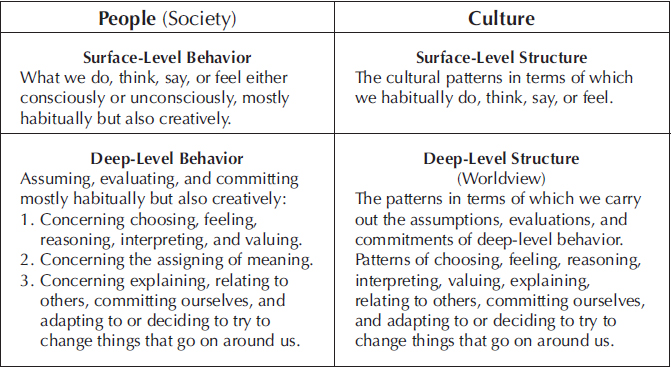
The distinction we are making is embodied in the contrast between the words culture and society. Culture refers to the structure, but society refers to the people themselves. When we feel pressure to conform, it is the pressure of people (i.e., social pressure) that we feel, not the pressure of cultural patterning (the script) itself.
The chart above summarizes the distinction between people’s behavior and the cultural structuring of that behavior.
Cultures and Worldviews Are to Be Respected
Cultural/worldview structuring functions both outside of us and inside of us. We are totally submerged in it, relating to it much as a fish relates to water. And we are usually as unconscious of it as a fish must be of the water or as we usually are of the air we breathe. Indeed, many of us only notice culture when we go into another cultural territory and observe customs different from our own.
Unfortunately, when we see others living according to cultural patterns and with worldview assumptions different from our own, we often feel sorry for them, as if their ways are inferior to ours. We may seek ways to “rescue” them from their customs.
The way of Jesus is, however, to honor a people’s culture and its incorporated worldview, not to wrest them from it. Just as He entered the cultural life of the Jews to communicate with them, so we are to enter the cultural matrix of the people we seek to win. Following Jesus’s example, we note that working from within involves a biblical critique of a people’s culture and worldview assumptions as well as acceptance of them as starting points. If we are to witness effectively, we have to speak and behave in ways that honor the only way of life they have ever known. Likewise, if the church is to be meaningful to receiving peoples, it needs to be as appropriate to their cultural lives as the early church was to the lives of first-century peoples. We call such appropriate churches “dynamic equivalence churches,” “contextualized churches,” or “enculturated churches.”
The Subsystems of Culture
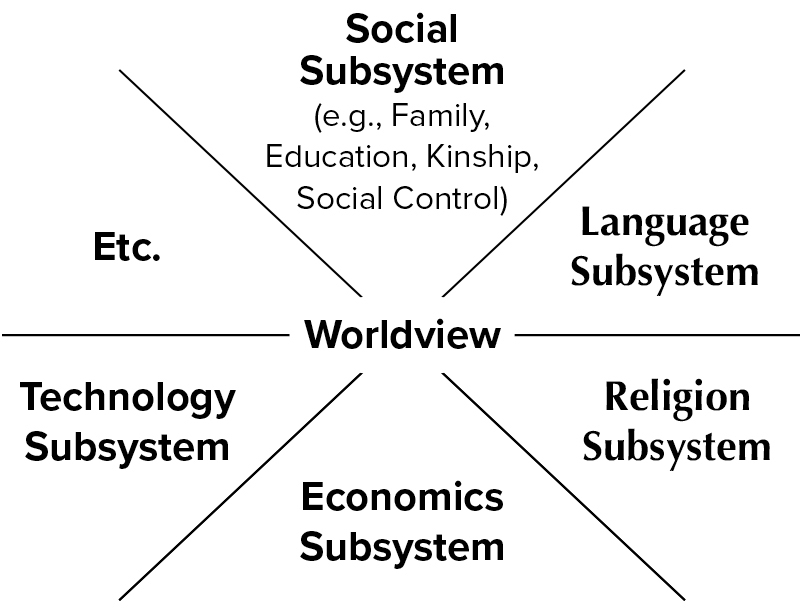
With worldview at the center influencing all of culture, we can divide surface-level culture into subsystems. These sub-systems provide various behavioral expressions of world-view assumptions.
Missionaries may be tempted to replace traditional religion with the religious forms of Western Christianity. Christian witness, however, is to be directed at the world-view of a people so that it influences each of the subsystems from the very core of the culture. There are many cultural subsystems, some of which are diagrammed below. Truly converted people need to manifest biblical Christian attitudes and behavior in all of their cultural life, not just in their religious practices.
If we are to reach people for Christ and to see them gathered into Christ-honoring and culture-affirming churches, we will have to deal with them within their culture and in terms of their worldview. It is hoped that by understanding more of what culture and worldview are all about, we can deal with them more wisely than might otherwise have been the case.
RETURN TO LESSON 10: How Shall They Hear?
Worldview and Culture Change
Just as anything that affects the roots of a tree influences its fruit, so anything that affects a people’s worldview will affect the whole culture and, of course, the people who operate in terms of that culture.
Jesus knew this. When He wanted to get across important points, He aimed at the worldview level. Someone asked, “Who is my neighbor?” so He told them a story and then asked who was being neighborly (Luke 10:29–37 GNT). He was leading them to reconsider and, hopefully, change a basic value deep down in their system. On another occasion Jesus said,
You have heard that it was said, “Love your friends, hate your enemies.” But now I tell you: love your enemies and pray for those who persecute you If anyone slaps you on the right cheek, let him slap your left cheek too. (Matt 5:43–44, 39 GNT)
Again, the seeds were being planted for change at the deep worldview level.
Well-meaning people can cause major worldview problems when they introduce good changes and apply them at the surface level without due attention to the deep-level meanings people attach to them. For example, the missionary requirement that Africans with more than one wife must divorce the “extras” before they can be baptized leads both Christian and non-Christian Africans to certain worldview assumptions concerning the Christian God. Among these are: God is against the real leaders of African society, God is not in favor of women having help and companionship around the home, God wants men to be enslaved to a single wife (like Whites seem to be), and God favors divorce, social irresponsibility, and even prostitution. None of these conclusions is irrational or far-fetched from their point of view. Though we believe God intends that each man have only one wife, this change was forced too quickly, unlike God’s patient approach in the Old Testament where He took many generations to do away with the custom.
Even good changes, if they are introduced in a wrong way, can lead to cultural degradation or even immorality. Among the Ibibio people of southern Nigeria, the message of God’s forgiveness resulted in many people turning to the Christian God because He was seen as more lenient than their traditional god. The converts saw no need to be righteous since they believed God would always forgive them of whatever they did. In aboriginal Australia, among the Yir Yoront people, missionaries introduced steel axes to replace the traditional stone axes. This had a powerful disruptive effect simply because the axes were given to the women and younger men, who traditionally were required to borrow axes from the older men. This change, though providing the people with better technology, challenged their worldview assumptions. It led to the destruction of the authority of the leaders, widespread social disruption, and the near extinction of the people.
RETURN TO LESSON 10: How Shall They Hear?
Contextualized (Appropriate) Christianity
The aim of Christian witness is to see people come to Christ and to be formed into groups we call churches that are both biblically and culturally appropriate. The process by which the church becomes “enculturated” in the life of a people has been called “indigenization,” but now is more frequently referred to as “contextualization.”
The contextualization of Christianity is part and parcel of the New Testament record. This is the process that the apostles were involved in as they took the Christian message that had come to them in the Aramaic language and culture and communicated it to those who spoke Greek. In order to contextualize Christianity for Greek speakers, the apostles expressed Christian truth in the thought patterns of their receptors. Indigenous words and concepts were used (and transformed in their usage) to deal with topics such as God, church, sin, conversion, repentance, initiation, “word” (logos), and most other areas of Christian life and practice. The early Greek churches were in danger of being dominated by Jewish religious practices because those who led them were Jews. God, however, led the Apostle Paul and others to struggle against the Jewish Christians to develop a contextualized Christianity for Greek-speaking gentiles. In order to do this, Paul had to fight a running battle with many of the Jewish church leaders who felt that it was the job of Christian preachers to simply impose Jewish theological concepts on new converts (see Acts 15). These conservative Jews were the heretics against whom Paul fought for the right for Greek-speaking Christians to have the gospel expressed in their language and culture. We conclude from such passages as found in Acts 10 and 15 that it is the intent of God that biblical Christianity be “reincarnated” in every language and culture at every point in history.
Biblically, the contextualization of Christianity is not simply to be the passing on of a product. It is, rather, the imitating of the process that the early apostles went through. To return to our tree analogy, Christianity is not supposed to be like a tree that was nourished and grew in one society and then was transplanted to a new cultural environment, with leaves, branches, and fruit that mark it indelibly as a product of the sending society. The gospel is to be planted as a seed that will sprout within and be nourished by the rain and nutrients in the cultural soil of the receiving peoples. What sprouts from true gospel seed may look quite different above ground from the way it looked in the sending society, but beneath the ground at the worldview level, the roots are to be the same and the life comes from the same source.
In a truly contextualized church, the essential message will be the same and the central doctrines of our faith will be in clear focus since they are based on the same Bible. The formulation of that message and the relative prominence of many of the issues addressed will differ from society to society, though. For instance, what the Bible says about family relationships, fear and evil spirits, and the advocacy of dance and prescribed rituals will be much more apparent in contextualized African Christianity than in America.
Though many non-Western churches today are dominated by Western approaches to doctrine and worship, it is not scriptural that they remain so. There are, of course, similar basic problems (e.g., the problem of sin, the need for a relationship with Christ) that peoples of all societies need to deal with, but those problems need to be approached in different, culturally appropriate ways for each cultural group. Christianity should be perceived as excitingly relevant to the problems people struggle with in their context.
Contextualizing Christianity
Is Very Risky There are great risks involved in attempting to promote a Christianity that is relevant culturally and appropriate biblically. The risk of syncretism is always present. Syncretism is the mixing of Christian assumptions with those worldview assumptions that are incompatible with Christianity so that the result is not biblical Christianity.
Syncretism exists whenever people practice Christian rituals because they consider them magic or use the Bible to cast spells on people or, as in India, consider Jesus just another of many human manifestations of one of their deities, or as in Latin America, practice pagan divination and witchcraft right in the churches, or insist that people convert to a different culture to become Christians. In America it is syncretistic, unbiblical Christianity that sees “the American way of life” as identical with biblical Christianity or assumes that by generating enough faith we can pressure God into giving us whatever we want, or that we should out of love and tolerance regard adultery and homosexual intercourse as acceptable, despite clear biblical condemnations.
The gospel is to be planted as a seed that will sprout within and be nourished by the rain and nutrients in the cultural soil of the receiving peoples.
There are at least two paths to syncretism. One is by importing foreign expressions of the faith and allowing the receiving people to attach their own worldview assumptions to these practices. The result is a kind of “nativistic” Christianity or even, as in Latin America, “Christo-paganism.” Roman Catholic missionaries, especially, have fallen into this trap by assuming that when people practice so-called “Christian” rituals and use “Christian” terminology, those behaviors have the same meanings that the missionaries ascribe to them.
The other way to syncretism is to so dominate a receiving people’s practice of Christianity that the surface-level practices and the deep-level assumptions are imported. The result is a totally foreign, unadapted kind of Christianity that requires people to worship and practice their faith according to foreign patterns. New believers develop a special set of worldview assumptions for church situations that they largely ignore in the rest of their lives. Their traditional worldview remains almost untouched by biblical principles. This is the kind of Christianity some evangelical Protestants have advocated, probably out of a fear of the first kind of syncretism. In many situations, this kind of Christianity attracts some of those who are Westernizing. But masses of traditional people find little or nothing in Christianity that meets their needs, simply because it is presented and practiced in foreign ways to which they cannot connect.
Though we must be cautious concerning syncretism, there is a middle road that involves deep trust in the Holy Spirit’s ability to guide people and the receiving people’s ability to follow that guidance. We, then, are to always point to the Holy Spirit (not ourselves) as the guide while participating with them in discovering His leading. We can assure people that the Holy Spirit will always guide them in accordance with the Scriptures. Practicing this approach, missionary Jacob Loewen chose to never directly answer any questions from the new Christians such as, “What should we do?” Instead, he would ask them, “What is the Holy Spirit showing you?” Only after they had struggled with the answer to that question would he participate with them in seeking guidance, and even then, his approach was to offer them at least three alternative approaches from which they might choose. In response to this approach, they usually developed a fourth alternative that was uniquely their own. If that approach worked, they would continue it. If it did not, they felt free to change it in needed ways, since it was their own and did not come with the prestige that often accompanies the suggestions of respected outsiders.
Though the risk of syncretism is always present when Christians attempt to enculturate Christianity, it is a risk that needs to be taken in order that people experience New Testament Christianity.
Though the risk of syncretism is always present when Christians attempt to enculturate Christianity, it is a risk that needs to be taken in order that people experience New Testament Christianity. Whether in a pioneer situation or after a foreign brand of our faith has been practiced for years, the quest for a vital, dynamic, biblical, contextualized Christianity will require experimenting with new, culturally, and biblically appropriate ways of understanding, presenting, and practicing the “faith which once and for all God has given to his people” (Jude 3 GNT). It will especially require attention to what is going on at the worldview level. To this end the insights of anthropologists into culture and worldview can be harnessed to enable us to advocate a Christianity that is truly contextualized, truly relevant, and truly meaningful.
RETURN TO LESSON 14: Pioneer Church Planting
Understanding Culture Aids Contextualization
Understandings of culture and worldview such as those presented above have helped us greatly in our attempts to understand what biblical and cultural appropriateness means. Among the understandings that have come from such studies are the following:
1. God loves people as they are culturally. The Bible shows us that He is willing to work within everyone’s culture and language without requiring them to convert to another culture.
2. The cultures and languages of the Bible are not special, God-made cultures and languages. They are normal human (indeed pagan) cultures and languages, just like any of the more than seven thousand cultures and languages in our world today. The Bible demonstrates that God can use any pagan culture (even Greek or American) with its language to convey His messages to humans.
3. The Bible shows that God worked with His people in culturally appropriate ways. He took customs already in use and invested them with new meaning, guiding people to use them for His purposes and on the basis of new worldview understandings. Among such customs are circumcision, baptism, worship on mountains, sacrifice, the synagogue, the temple, anointing, and praying. God wants churches today to be culturally appropriate, using most of the customs of a people but attaching new meaning to them by using them for God’s purposes. In this way, people get changed at the worldview level as well as at the surface.
4. God’s work within a culture never leaves that culture unchanged. God changes people first, then through them, the cultural structures. Whatever changes are to take place in the structures are to be made by the people themselves on the basis of their understandings of the Scriptures and God’s workings in their lives, led and empowered by the Holy Spirit, not pressured by an outsider.