CHAPTER 64
Lloyd E. Kwast

Lloyd E. Kwast taught for eight years in a college and theological school in Cameroon, West Africa, under the North American Baptist General Missionary Society. He served as the chairman of the Department of Missions at Talbot Theological Seminary. He was a professor of Biola University School of Intercultural Studies and director of the Doctor of Missiology program there.
What is a culture, anyway? For the student just beginning the study of anthropology, this question is often a first response to a confusing array of descriptions, definitions, comparisons, models, paradigms, etc. There is probably no more comprehensive word in the English language than the word “culture,” or no more complex a field of study than cultural anthropology. Yet, a thorough understanding of the meaning of culture is a prerequisite to any effective communication of God’s good news to a different people group.
The most basic procedure in a study of culture is to become a master of one’s own. Everyone has a culture. No one can ever divorce himself from his culture. While it is true that anyone can grow to appreciate various different cultures, and even to communicate effectively in more than one, one can never rise above his own, or other cultures, to gain a truly supracultural perspective. For this reason, even the study of one’s own culture is a difficult task. And to look objectively at something that is part of oneself so completely is nearly impossible.
One helpful method is to view a culture, visualizing several successive “layers,” or levels of understanding, as one moves into the real heart of the culture. In doing so, the “man from Mars” technique is useful. In this exercise one simply imagines that a man from Mars has recently landed (via spaceship) and looks at things through the eyes of an alien space visitor.

The first thing that the newly arrived visitor would notice is the people’s behavior. This is the outer, and most superficial, layer of what would be observed by an alien. What activities would he observe? What is being done? When walking into a classroom, our visitor may observe several interesting things. People are seen entering an enclosure through one or more openings. They distribute themselves throughout the room seemingly arbitrarily. Another person enters dressed quite differently from the rest, moves quickly to an obviously prearranged position facing the others, and begins to speak. As all this is observed, the question might be asked, “Why are they in an enclosure? Why does the speaker dress differently? Why are many people seated while one stands?” These are questions of meaning. They are generated by the observations of behavior. It might be interesting to ask some of the participants in the situation why they are doing things in a certain way. Some might offer one explanation; others might offer another. But some would probably shrug and say, “It’s the way we do things here.” This last response shows an important function of culture: to provide “the patterned way of doing things,” as one group of missionary anthropologists defines it. You could call culture the “superglue” that binds people together and gives them a sense of identity and continuity that is almost impenetrable. This identity is seen most obviously in the way things are done—behavior.

In observing the inhabitants, our alien begins to realize that many of the behaviors observed are apparently dictated by similar choices that people in the society have made. These choices inevitably reflect the issue of cultural values, the next layer of our view of culture. These issues always concern choices about what is “good,” what is “beneficial,” or what is “best.”
A thorough understanding of the meaning of culture is a prerequisite to any effective communication of God’s good news to a different people group.
If the man from Mars continued to interrogate the people in the enclosure, he might discover that they had numerous alternatives to spending their time there. They might have been working or playing instead of studying. Many of them chose to study because they believed it to be a better choice than play or work. He discovered a number of other choices they had made. Most of them had chosen to arrive at the enclosure in small four-wheel vehicles because they viewed the ability to move about quickly as very beneficial. Furthermore, others were noticed hurrying into the enclosure several moments after the rest had entered and again moving out of the room promptly at the close of the meeting. These people said that using time efficiently was very important to them. Values are “preset” decisions that a culture makes between choices commonly faced. It helps those who live within the culture to know what “should” or “ought” to be done in order to “fit in” or conform to the pattern of life.
Beyond the questions of behavior and values, we face a more fundamental question in the nature of culture. This takes us to a deeper level of understanding, that of cultural beliefs. These beliefs answer for that culture the question: “What is true?”
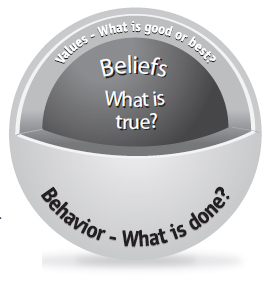
Values in culture are not selected arbitrarily but invariably reflect an underlying system of beliefs. For example, in the classroom situation, one might discover upon further investigation that “education” in the enclosure has particular significance because of their perception of what is true about man, his power to reason, and his ability to solve problems. In that sense culture has been defined as “learned and shared ways of perceiving,” or “shared cognitive orientation.”
Interestingly, our alien interrogator might discover that different people in the enclosure, while exhibiting similar behavior and values, might profess totally different beliefs about them. Further, he might find that the values and behaviors are opposed to the beliefs that supposedly produced them. The problem arises from the confusion within the culture between operating beliefs (beliefs that affect values and behavior) and theoretical beliefs (stated creeds that have little practical impact on values and behavior).
At the very heart of any culture is its worldview, answering the most basic question: “What is real?” This area of culture concerns itself with the great “ultimate” questions of reality, questions which are seldom asked but to which culture provides its most important answers. Few of the people our man from Mars questions have ever thought seriously about the deepest assumptions about life that result in their presence in the classroom. Who are they? Where did they come from? Is there anything or anyone else occupying reality that should be taken into consideration? Is what they see really all there is, or is there something else, or something more? Is right now the only time that is important? Or do events in the past and the future significantly impact their present experience? Every culture assumes specific answers to these questions, and those answers control and integrate every function, aspect, and component of the culture.
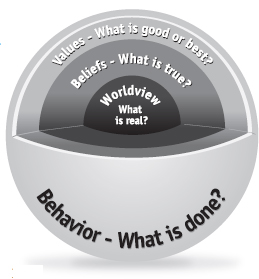
This understanding of worldview as the core of every culture explains the confusion many experience at the level of beliefs. One’s own worldview provides a system of beliefs that are reflected in one’s actual values and behavior. Sometimes a new or competing system of beliefs is introduced, but the worldview remains unchallenged and unchanged, so values and behavior reflect the old belief system. Sometimes people who share the gospel cross-culturally fail to take the problem of worldview into account and are therefore disappointed by the lack of genuine change their efforts produce.
Values are “preset” decisions that a culture makes between choices commonly faced. It helps those who live within the culture to know what “should” or “ought” to be done in order to “fit in” or conform to the pattern of life.
This model of culture is far too simple to explain the multitude of complex components and relationships that exist in every culture. However, it is the very simplicity of the model that commends it as a basic outline for any student of culture. 