CHAPTER 11
George Eldon Ladd

George Eldon Ladd was professor emeritus of New Testament exegesis and theology at Fuller Theological Seminary. Ladd was involved in the Student Volunteer Movement.
Adapted from multiple pages in The Gospel of the Kingdom, 1959. Used by permission of Eerdmans. Slight edits have been made for easier comprehension.
In a day like this, wonderful yet fearful, people are asking questions. What does it all mean? Where are we going? What is the meaning and the goal of human history? Does humanity have a destiny? Or do we jerk across the stage of time like wooden puppets, only for fire to destroy the stage, the actors, and the theatre itself—leaving only a pile of ashes and the smell of smoke?
Ancient Greek poets and philosophers longed for an ideal society and dreamed of a lost golden age in the distant past. But they saw no brightness in the present or hope that such a future would ever happen.
The Hebrew Christian faith expresses its hope in terms of the kingdom of God. This biblical hope is not like the dreams of the Greek poets. Instead, this hope is revealed by God and wrapped up in Him. The biblical idea of the kingdom of God is deeply rooted in the Old Testament. It is grounded in the confidence that there is one eternal, living God who has revealed Himself to people. He has also revealed that He has a purpose for the human race which He has chosen to accomplish through Israel. Thus the prophets announced a day when men will live together in peace. God shall then
judge between the nations, and shall decide for many peoples. And they shall beat their swords into plowshares, and their spears into pruning hooks. Nation shall not lift up sword against nation, neither shall they learn war any more. (Isa 2:4)
Not only shall the problems of human society be solved, but the evils of man’s physical environment shall be no more.
The wolf shall dwell with the lamb; and the leopard shall lie down with the kid; and the calf and the young lion and the fatling together, and a little child shall lead them. (Isa 11:6)
Peace, safety, security—all this was promised for the happy future.
Then came Jesus of Nazareth with the announcement, “Repent, for the kingdom of Heaven is at hand” (Matt 4:17). This theme of the coming of the kingdom of God was central to His mission. His teaching was designed to show people how they might enter the kingdom of God (Matt 5:20; 7:21). His mighty works were intended to prove that the kingdom of God had come upon them (Matt 12:28). His parables illustrated to His disciples the truth about the kingdom of God (Matt 13:11). When He taught His followers to pray, at the heart of their petition were the words, “May Your Kingdom come, Your will be done on earth as it is in heaven” (Matt 6:10). On the eve of His death, He assured His disciples that He would yet share with them the happiness and the fellowship of the kingdom (Luke 22:22–30). He promised that He would appear again on the earth in glory to bring the blessedness of the kingdom to those for whom it was prepared (Matt 25:31, 34).
The Meaning of “Kingdom”
We must ask the most fundamental question: What is the meaning of “kingdom”? When we answer the question based on modern thinking, we lose the key of meaning to this ancient biblical truth. In our Western idiom, a “kingdom” is primarily a realm over which a king exercises his authority. Not many kingdoms remain in our modern world, but a few still remain. The dictionary follows this line of thought, “A state or monarchy, the head of which is a king; dominion; realm.”
The second meaning of a “kingdom” is the people belonging to a given realm. The kingdom of Great Britain may be thought of as the citizens over whom the queen exercises her rule. They are the subjects of her kingdom.
If we want to understand what the Bible means by “kingdom,” we must set aside our modern notions. At this point Webster’s dictionary provides us with a clue when it gives its archaic definition: “The rank, quality, state, or attributes of a king; royal authority; dominion; monarchy; kingship. Archaic.” According to modern language, this definition may be outdated, but it is precisely this ancient meaning that we need in order to understand the ancient biblical teaching. The primary meaning of both the Hebrew word malkuth in the Old Testament and of the Greek word basileia in the New Testament is the rank, authority, and sovereignty exercised by a king. A basileia may indeed be a realm or land over which a ruler exercises his authority. The word kingdom may also refer to the people who belong to that realm—the people whom the king rules. Yet these meanings come from another central meaning. First of all, a kingdom is the authority to rule, the sovereignty of the king.
We see this primary meaning of the word “kingdom” in the Old Testament, where it describes a king’s rule. Ezra speaks of returning from Babylon “in the kingdom” of Artaxerxes, which is to say that the return took place during the reign of Artaxerxes (Ezra 8:1). The establishing of Rehoboam’s “kingdom” speaks of his rule, not the land over which he ruled (2 Chr 12:1). This usage of “kingdom” as a human reign may also be found in passages such as Jeremiah 49:34; 2 Chronicles 11:17; 36:20; Daniel 8:23; Ezra 4:5; and Nehemiah 12:22.
The Meaning of the “Kingdom of God”
When the word “kingdom” refers to God’s kingdom, it always refers to His reign, His rule, and His sovereignty. It does not refer to the realm or the geography over which He reigns. “The LORD has established his throne in the heavens, and his kingdom rules over all” (Ps 103:19). God’s kingdom is His universal rule, His sovereignty over all the earth. “They shall speak of the glory of Your Kingdom and tell of Your power” (Ps 145:11). In the parallelism of Hebrew poetry, the two lines express the same truth. God’s kingdom is His power. “Your Kingdom is an everlasting Kingdom, and Your dominion endures throughout all generations” (Ps 145:13). The realm of God’s rule is heaven and earth, but it is not saying that the realm will last forever. It is God’s rule that is everlasting. “You, O king, the king of kings, to whom the God of heaven has given the kingdom, the power, and the might, and the glory” (Dan 2:37). Notice the synonyms for kingdom: power, might, glory. All are expressions of authority, telling us that the kingdom is the authority that God has given to the king.
One reference in the Gospels makes this meaning very clear. We read in Luke 19:11–12,
As they heard these things, he proceeded to tell a parable, because he was near to Jerusalem, and because they supposed that the Kingdom of God was to appear immediately. He said therefore, “A nobleman went into a far country to receive a basileia and then return.”
The nobleman did not go away to get a realm, an area over which to rule. The territory over which he was to rule was this place he left. The problem was that he was no king. He needed authority, the right to rule. He went off to get a “kingdom,” referring to the authority to exert power as king. The Revised Standard Version has therefore translated the word “kingly power.”
The kingdom of God is His kingship, His rule, His authority. When we realize this, we can see this meaning in passage after passage in the New Testament. We can see that the kingdom of God is not a realm or a people, but it is God’s reign. Jesus said that we must “receive the Kingdom of God” as little children (Mark 10:15). What is received? The church? Heaven? What is received is God’s rule. In order to enter the future realm of the kingdom, people must submit themselves to God’s rule here and now.
When we pray, “Your Kingdom come” (Matt 6:10), are we praying for heaven to come to earth? In a sense we are praying for this, but the reason we yearn for heaven is because God’s reign is more perfectly realized in heaven. Apart from the reign of God, heaven is meaningless. Therefore, we pray, “Your Kingdom come; Your will be done on earth as it is in heaven.” In this prayer we plead for God to reign. We beg Him to display His kingly rule and power. We ask Him to put to flight every enemy of righteousness. We seek His divine rule—that God alone may be King over all the world.
RETURN TO LESSON 3: Your Kingdom Come
The Mystery of the Kingdom
The fourth chapter of Mark and the thirteenth chapter of Matthew contain a group of parables that describe the “mystery of the kingdom of God” (Mark 4:11). A parable is a story drawn from the everyday experience of the people which is designed to illustrate the central truth of our Lord’s message. This central truth is called “the mystery” of the kingdom.
We must first establish the meaning of the term “mystery.” A mystery in the biblical sense is not something mysterious, nor deep, dark, profound, and difficult. We might think of these things when we hear the word today. But when the word was used, it meant something else. In Scripture, “mystery” has a precise meaning which is explained by Paul:
Now to Him who is able to strengthen you according to my gospel and the preaching of Jesus Christ, according to the revelation of the mystery—which was kept secret for long ages, but is now disclosed and through the prophetic writings—is made known to all nations. (Rom 16:25–26)
Here is the biblical idea of mystery: something which has been kept secret in ancient times, but is now disclosed. The mystery is a divine purpose that God designed from eternity past but has kept hidden from people. At last, however, God reveals this purpose and by the Scriptures of the prophets makes it known to everyone. In summary, a mystery is a divine purpose, hidden in God’s mind for long ages, but finally disclosed in a new revelation of God’s redemptive work.
The parables set forth the mystery of the kingdom—a new truth about the kingdom of God that was not revealed in the Old Testament but which is at last disclosed in the earthly ministry of our Lord. What is this mystery?
Old Testament Perspective of the Kingdom
To answer this question, we must go back into the Old Testament to look at a typical prophecy about the coming of God’s kingdom. In the second chapter of Daniel, God gave King Nebuchadnezzar a vision of a great image that had a head of gold, a chest of silver, thighs of bronze, legs of iron, and feet of iron and clay. Then he saw a stone, not cut or shaped by human hands, which struck the image on the feet and ground it to powder. This dust was swept away by the wind “so that not a trace of them could be found.” Then the stone that destroyed the image became a great mountain that filled the whole earth (Dan 2:31–35).
The interpretation is found in verses 44–45. The image represents the series of nations that were to dominate the course of world history. The meaning of the stone is given in these words:
And in the days of those kings, the God of heaven will set up a Kingdom which shall never be destroyed, nor shall its sovereignty be left to another people. It shall break in pieces all these Kingdoms and bring them to an end; and it shall stand forever. Just as you saw that a stone was cut from a mountain by no human hand, and that it broke in pieces the iron, the bronze, the clay, the silver, and the gold. A great God has made known to the king what shall be hereafter.
In the graph below is an Old Testament view of the prophetic future. The Prophets look forward to a glorious day when God’s kingdom will come, when God will set up His reign on the earth.
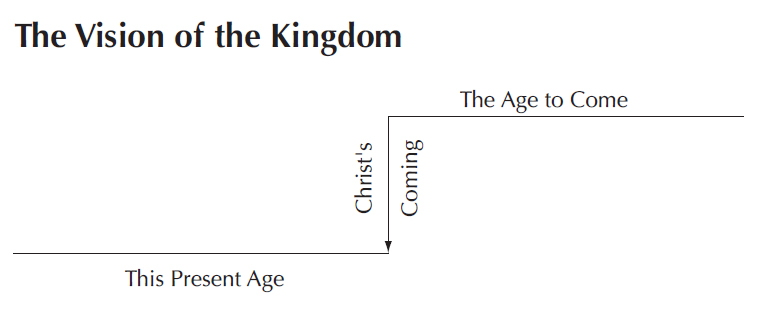
The Messiah Brings God’s Day of Peace and Power
In that day, as the prophets portray it, God’s reign will displace all other reigns, kingdoms, and authorities. He will break the proud sovereignty of evil people that have dominated most of history. God’s reign, His kingdom, will sweep away every opposing rule. God alone will be King in those days.
In the Old Testament view, the coming of God’s kingdom is usually seen as a single great event. The kingdom of God was expected to be a sudden, mighty manifestation of God’s power, sweeping away wicked regimes of human power and filling all the earth with righteousness.
A New Revelation of the Kingdom
We must now turn back to the Gospel of Matthew and bring these ideas together. John the Baptist was announcing that the kingdom of God was coming (Matt 3:2), and he understood this to be the same sudden coming of the kingdom foretold in the Old Testament. The Coming One would bring a twofold baptism: some would be baptized with the Holy Spirit. These would experience the messianic salvation of the kingdom of God. The others would be baptized with the fires of the final judgment (Matt 3:11). John makes his meaning clear in the next verse. He says that the Messiah will sift and separate people in a way similar to a farmer threshing and winnowing his harvest in order to preserve the good grain and discard the chaff. The Messiah will cleanse His threshing floor, gathering the grain into His barn (salvation for the righteous) but sending the wicked into the fiery judgment (v. 12).
From his prison, John sent messengers to Jesus to ask if He really was the Coming One, or if they should continue waiting for God to send someone else as the Messiah. John’s doubt has often been interpreted as a loss of confidence in his own mission and divine call because of his imprisonment. However, Jesus’s praise of John makes this unlikely. John was no reed shaken by the wind (Matt 11:7). John’s problem was created by the fact that Jesus was not acting like the Messiah whom John
“Lord, are you He who is to come, or shall we look for another?” (v. 3). Why did John ask that question? Because the prophecy of Daniel did not seem to be in the process of fulfillment. Herod Antipas ruled in Galilee. Roman legions marched through Jerusalem. Authority rested in the hands of Pilate, a pagan Roman. Idolatrous, polytheistic, immoral Rome ruled the world with an iron hand. Here was John’s problem, and it was the problem of every devout Jew, including Jesus’s closest disciples, in their effort to understand and interpret Jesus’s person and ministry. How could He be the Coming One, who was to bring the kingdom, while sin and sinful institutions remained unpunished?
Jesus replied that He was indeed the bearer of the kingdom and that the signs of the messianic age of prophecy were being manifested. And yet Jesus said, “Blessed is he who takes no offense at me” (Matt 11:6).
What Jesus meant is this: “Yes, the kingdom of God is here. But there is a mystery—a new revelation about the kingdom. The kingdom of God is here, but instead of destroying human sovereignty, it has attacked the ruling power of Satan. The kingdom of God is here; but instead of making changes in the external, political order of things, it is making changes in the spiritual order and in the lives of men and women.”
This is the mystery of the kingdom, the truth that God now discloses for the first time in redemptive history. God’s kingdom is to work among people in two different stages. The kingdom is yet to come in the form prophesied by Daniel when every human sovereignty will be displaced by God’s sovereignty. The world will yet behold the coming of God’s kingdom with power. But the mystery, the new revelation, is that this very kingdom of God has now come to work among people but in an utterly unexpected way. It is not now destroying human rule; it is not now abolishing every sin from the earth; it is not now bringing the baptism of fire that John had announced. It has come quietly, secretly, without drawing attention to itself. It can work among men and never be recognized by the crowds. The kingdom now offers the blessings of God’s rule, delivering people from the power of Satan and sin. The kingdom of God is an offer, a gift that may be accepted or rejected. The kingdom is now here with persuasion rather than with power.
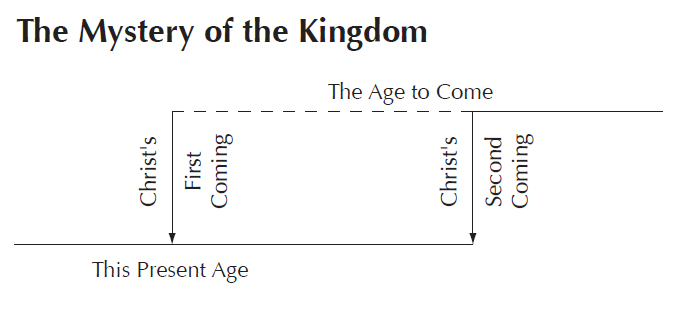
The Messiah Comes Twice
Each of the parables in Matthew 13 illustrates this mystery of the kingdom. The kingdom of God is yet to come in power and great glory. Yet it has now come in an unexpected form. It is actually now present among people in the present evil age, bringing the blessings of the age to come. This is shown in the diagram above.
This is the mystery of the kingdom: before the day of harvest, before the end of the age, God has entered into history in the person of Christ. He has done this in order to bring people the life and blessings of His kingdom. It came humbly, without flash or show. It came to men as a Galilean carpenter went throughout the cities of Palestine. He preached the gospel of the kingdom, delivering men from their bondage to the devil. It came to men as His disciples went throughout Galilean villages with the same message. It comes to men today as disciples of Jesus still take the gospel of the kingdom into all the world. It comes quietly, humbly, without fire from heaven, without a blaze of glory, without a rending of the mountains or a cleaving of the skies. It comes like seed sown in the earth. It can be rejected by hard hearts; it can be choked out; its life may sometimes seem to wither and die, but it is the kingdom of God. It brings the miracle of the divine life among men. It introduces them to the blessings of the divine rule. It is to them the supernatural work of God’s grace. And this same kingdom, this same supernatural power of God, will yet manifest itself at the end of the age. At that time it will not merely appear quietly within the lives of those who have received it. It will show itself in power and great glory, purging all sin and evil from the earth. Such is the gospel of the kingdom.
When Will the Kingdom Come?
If we today have entered into the enjoyment of the blessings of God’s kingdom, our final question is, what are we to do as a result of these blessings? Are we passively enjoying the life of the kingdom while we wait for the Lord to return and complete all things? Yes, we are to wait, but not passively. Perhaps the most important single verse in the word of God for God’s people today is the text for this study: Matthew 24:14. This verse refers to the manifestation of God’s kingdom in power and glory when Jesus returns. There is wide interest among God’s people as to the time of Christ’s return. Will it be soon, or late? Many authors have conducted conferences and offered messages that search Bible prophecy and scan the news to understand the signs of the times. Such searching is done to determine how near the end we may be. Matthew 24:14 gives the clearest statement in God’s word about the time of our Lord’s coming. No verse speaks as concisely and distinctly as this verse about the time when the kingdom will come.
At the start of chapter 24, we find the disciples admiring the magnificent temple. Jesus announced that the temple would be destroyed, which provoked the question, “Tell us, when will this be and what shall be the sign of your coming, and of the close of the age?” (v. 3). The disciples expected this age to end with the return of Christ in glory. The kingdom will come at the same time as the launch of the age to come. Here is their question: “When will this age end? When will you come again and bring the kingdom?”
Jesus answered their question in some detail. He described first of all the course of this age down to the time of the end. This evil age will last until He returns. It will forever be hostile to the gospel and to God’s people. Evil will prevail. Subtle, deceitful influences will seek to turn men away from Christ. False religions and deceptive messiahs will lead many astray. Wars will continue; there will be famines and earthquakes. Persecution and martyrdom will plague the church. Believers will suffer hatred so long as this age lasts. Men will stumble and deliver up one another. False prophets will arise, iniquity will abound and the love of many will grow cold (vv. 4–12).
This is a dark picture, but this is what is to be expected of an age under the rulers of this darkness (Eph 6:12). However, the picture is not one of unrelieved darkness and evil. God has not abandoned this age to darkness. Jewish apocalyptic writings of New Testament times conceived of an age completely under the control of evil. God had withdrawn and was no longer active in the affairs of man. Salvation belonged only to the future when God’s kingdom would come in glory. The present would witness only sorrow and suffering.
Some Christians have reflected a similar gloomy attitude: Satan is the “god of this age”; therefore, God’s people can expect nothing but evil and defeat in this age. The church will completely fall away; civilization will become utterly corrupt. Christians must fight a losing battle until Christ comes.
The word of God does indeed teach that evil will become more intense at the end of the age—for Satan remains the god of this age. However, we stress that God has not abandoned this age to the evil one. In fact, the kingdom of God has entered into this evil age; Satan has been defeated. The kingdom of God, in Christ, has created the church, and the kingdom of God works in the world through the church to accomplish the divine purposes of extending His kingdom in the world. We are caught up in a great struggle—the conflict of the ages. God’s kingdom works in this world through the power of the gospel.
And this gospel of the Kingdom will be preached throughout the whole world, as a testimony to all nations; and then the end will come. (Matt 24:14)
In this text I find three things. There is a message, there is a mission, and there is a motive.
CONTINUE READING Sidebar: D-Day before V-E Day
1. The Message of the Kingdom
The message is the gospel of the kingdom; this good news is about the kingdom of God. Some have said that the gospel of the kingdom is not the gospel of salvation. They have claimed that the gospel of the kingdom is a special announcement of the return of Christ that will be preached in the tribulation by a Jewish remnant after the church is gone. We cannot deal at length with that problem, but we can discover that the gospel of the kingdom is the gospel that was proclaimed by the apostles in the early church.
We must first, however, notice a close connection between Matthew 24:14 and the Great Commission. When the Lord ascended, He commissioned His disciples:
Go therefore and make disciples of all nations, baptizing them in the name of the Father and of the Son and of the Holy Spirit, teaching them to observe all that I have commanded you; and lo, I am with you always, to the close of the age. (Matt 28:19–20)
When one compares these verses, they speak for themselves. “What shall be the sign of Your coming, and of the close of the age?” “This gospel of the Kingdom will be preached throughout the whole world, as a testimony to all nations; and then the end will come.” “Go therefore and make disciples of all nations . . . and lo, I am with you always, to the close of the age.” Both verses speak about the same mission: worldwide evangelization until the end of the age. This fact ties together Matthew 24:14 and 28:19.
The book of Acts shows that the apostles set out to fulfill this mission. In Acts 8:12, Philip went down to Samaria and preached the gospel. The Revised Standard Version accurately describes his mission in these words: “he preached good news about the kingdom of God.” Literally translated, the words are, “‘gospeling’ concerning the kingdom of God.” New Testament Greek has the same root for the noun, “gospel,” and the verb, “to gospel” or “to preach the gospel.” Unfortunately, we do not have the same idiom in English; it would help us understand this truth. Matthew 24:14 speaks of the “gospel of the kingdom,” and Acts 8:12 speaks of “gospeling about the kingdom.” This gospel of the kingdom must be preached in all the world. Philip went into Samaria, gospeling concerning the kingdom of God, i.e., preaching the gospel of the kingdom. We have in Acts 8:12 the same phrases as in Matthew 24:14, except that we have a verb instead of the noun with the preposition “about” inserted in the phrase.
When Paul came to Rome he gathered together the Jews, for he always preached the gospel “to the Jew first.” What was his message? “When they had appointed a day for him, they came to him at his lodging in great numbers. And he expounded the matter, from morning till evening, testifying to the kingdom of God and trying to convince them about Jesus” (Acts 28:23). The testimony about the kingdom of God, the gospel of the kingdom, was the message Paul proclaimed to the Jews at Rome.
However, Paul met the same reaction as had our Lord when He appeared in Israel announcing the kingdom of God (Matt 4:17). Some believed, but the majority of the Jews rejected his message. Paul then announced God’s purpose for the gentiles since Israel refused to believe: “Let it be known to you then that this salvation of God has been sent to the gentiles; they will listen” (Acts 28:28). Paul preached to the Jews the kingdom of God; they rejected it. Therefore, “this salvation of God” was then offered to the gentiles. The fact that the gospel of the kingdom of God is the same as the message of salvation is further proven by the following verses: “And he lived there two whole years at his own expense, and welcomed all who came to him, preaching the kingdom of God and teaching about the Lord Jesus Christ” (vv. 30–31). The kingdom was preached to the Jews; when they rejected it, the same kingdom was proclaimed to the gentiles. The good news about the kingdom of God was Paul’s message for both Jews and gentiles.
Victory over Death
We now turn again to the Scripture which most clearly and simply describes what this gospel of the kingdom is. In 1 Corinthians 15:24–26, Paul outlines the stages of our Lord’s redemptive work. He describes Christ’s victorious reign with the words, “Then comes the end, when He delivers the kingdom to God the Father after destroying every rule and every authority and power. For He must reign”—He must reign as King and He must reign in His kingdom—”until He has put all His enemies under His feet. The last enemy to be destroyed is death.”
This is how the Bible describes the reign of Christ and its purpose. God reigns in the person of His Son, Jesus Christ. He reigns in order to put His enemies under His feet. Then, “the last enemy to be abolished is death.” This is the mission of God’s kingdom: to abolish death. God’s kingdom must also destroy every other enemy, including sin and Satan, for death is the wages of sin (Rom 6:23) and it is Satan who has the power over death (Heb 2:14). Only when death, sin, and Satan are destroyed will redeemed men know the perfect blessings of God’s reign.
The gospel of the kingdom announces Christ’s conquest over death. The final victory will be in the future when death will be finally cast into the lake of fire (Rev 20:14). Nevertheless, Christ has already defeated death. Paul says that God’s grace has now been “manifested through the appearing of our Savior Christ Jesus, who abolished death and brought life and immortality to light through the gospel” (2 Tim 1:10). The word translated “abolish” does not mean to do away with; it means to defeat, to break the power, to put out of action. The same Greek word is used in 1 Corinthians 15:26, “The last enemy to be destroyed is death.” This word appears also in 1 Corinthians 15:24, “Then comes the end, when He delivers the kingdom to God the Father after destroying every rule and every authority and power.”
There are therefore two stages in the destruction: the abolition and the defeat of death. Its final destruction awaits the second coming of Christ, but by His death and resurrection, Christ has already destroyed death. He has broken its power. Death is still an enemy, but it is a defeated enemy. We are certain of the future victory because of the victory which has already been accomplished. We have an accomplished victory to proclaim.
This is good news about the kingdom of God. How men need this gospel! Everywhere one goes he finds the gaping grave swallowing up the dying. Tears of loss, of separation, of final departure stain every face. Every table sooner or later has an empty chair, every fireside its vacant place. Death is the great leveler. Wealth or poverty, fame or oblivion, power or futility, success or failure, race, creed or culture—all our human distinctions mean nothing before the ultimate irresistible sweep of the scythe of death that cuts us all down. The gravesite may be a fabulous Taj Mahal, or a massive pyramid, or an unmarked forgotten spot of ragged grass, or the unplotted depths of the sea. Still one fact stands: death reigns.
Apart from the gospel of the kingdom, death is the mighty conqueror before whom we are all helpless. We can only beat our fists against the tomb without effect. It does not yield; it does not respond. But the good news is this: death has been defeated; our conqueror has been conquered. God displayed His kingdom’s power through Christ’s victory over the cross. In the face of God’s kingdom, death was helpless. It could not hold Him; death has been defeated; life and immortality have been brought to light. An empty tomb in Jerusalem is proof of it. This is the gospel of the kingdom.
Victory over Satan
The enemy of God’s kingdom is Satan; Christ must rule until He has put Satan under His feet. This victory also awaits the coming of Christ. During the Millennium, Satan is to be bound in a bottomless pit. Only at the end of the Millennium is he to be cast into the lake of fire.
But we have discovered that Christ has already defeated Satan. The victory of God’s kingdom is not only future, but a great initial victory has taken place. Christ partook of flesh and blood—He became incarnate—”that through death he might destroy him who has the power of death, that is, the devil, and deliver all those who through fear of death were subject to lifelong bondage” (Heb 2:14–15). The word translated as “destroy” is the same word found in 1 Corinthians 15:24–26 and 2 Timothy 1:10. Christ has nullified the power of death; He has also nullified the power of Satan. Satan still goes about like a roaring lion bringing persecution upon God’s people (1 Pet 5:8); he insinuates himself like an angel of light into religious circles (2 Cor 11:14). But he is a defeated enemy. His power, his domination has been broken. His doom is sure. A decisive, the decisive, victory has been won. Christ cast out demons, delivering men from satanic bondage, proving that God’s kingdom delivers men from their enslavement to Satan. It brings them out of darkness into the saving and healing light of the gospel. This is the good news about the kingdom of God. Satan is defeated, and we may be released from demonic fear and from satanic evil and know the glorious liberty of the sons of God.
Victory over Sin
Sin is an enemy of God’s kingdom. Has Christ done anything about sin, or has He merely promised to deliver us sometime in the future when He brings the kingdom in glory? We must admit that sin, like death, is still abroad in the world. Every newspaper bears an eloquent testimony of the working of sin. Yet sin has been defeated, like death and Satan, have been defeated. Christ has already appeared to put away sin by the sacrifice of Himself (Heb 9:26). The power of sin has been broken. “We know this, that our old self was crucified with him so that the body of sin might be destroyed, and we might no longer be enslaved to sin” (Rom 6:6). Here a third time is the word “to destroy” or “abolish.” Christ’s reign as king has the objective of “abolishing” every enemy (1 Cor 15:24–26). This work is indeed future, but it is also past. Our Lord will finish the work at His second coming, but He has already begun it by His death and resurrection. “Death” has been abolished and destroyed (2 Tim 1:10), Satan has been destroyed (Heb 2:14), and the “body of sin” has been abolished and destroyed (Rom 6:6). The same word of victory, of the destruction of Christ’s enemies, is used three times of this threefold victory: over Satan, over death and sin.
Therefore, we are to be no longer in bondage to sin (Rom 6:6). The day of slavery to sin is past. Sin is in the world, but its power is not the same. Men are no longer helpless before it, for its dominion has been broken. The power of the kingdom of God has invaded this age, a power that can set men free from their bondage to sin.
The gospel of the kingdom is the announcement of what God has done and will do. It is His victory over His enemies. It is the good news that Christ is coming again to destroy forever His enemies. It is a gospel of hope. It is also the good news of what God has already done. He has already broken the power of death, defeated Satan, and overthrown the rule of sin. The gospel is one of promise but also of experience, and the promise is grounded in experience. What Christ has done guarantees what He will do. This is the gospel that we must take into all the world.
2. The Mission of the Kingdom
We find in Matthew 24:14 a mission as well as a message. This gospel of the kingdom—this good news of Christ’s victory over God’s enemies—must be preached in all the world. There must be a witness to all nations. This is our mission. This verse is one of the most important in all the word of God. By it we know the meaning and the purpose of human history.
The Meaning of History
In our day people are seeking to grasp the meaning of history with great urgency. We do not need to be reminded that our generation faces potential destruction of such total proportions that few of us try to envisage the awful reality. In the face of such a catastrophe, people ask even more: “What is history all about? Why are people on this earth? Can we detect some pattern that will show us meaning, purpose, or destiny? Will history bring humankind to some intended goal?”
In former generations, the philosophy of progress was widely accepted. Some thinkers charted the meaning of history by a single straight line that gradually inclined upwards. They think society improved step by step, starting from primitive and savage, moving upward to a high level of culture and civilization. The philosophy of progress taught that it is in the nature of humankind to improve continually. Our destiny will one day attain a perfect society, free from all evil, war, poverty, and conflict. This view has been shattered upon the anvil of history. Current events have made the concept of inevitable progress absurdly unrealistic.
Another view interprets history as a series of cycles like a great spiral. There is movement both up and down. There are high points and low points on the spiral, but each ascent is a little higher than the last and each descent is not as low as the preceding. Even though we have our “ups and downs,” the movement of the spiral as a whole is upward. This is a modification of the doctrine of progress.
Other interpretations have been utterly pessimistic. Someone has suggested that the most accurate chart of the meaning of history is the set of tracks made by a drunken fly, feet wet with ink, staggering across a piece of white paper. The steps lead nowhere and reflect no pattern of meaning.
It is the author’s conviction that the ultimate meaning of history must be found in the action of God in history as recorded and interpreted in inspired Scripture. Here, Christian faith must speak. If there is no God, humanity is lost in a maze of confusing experiences. There is no pattern in life and no meaning to provide guidance. If God has not acted in history, the events of the centuries are merely the ebb and flow of the tides. They wash back and forth aimlessly between the sands of eternity. But the basic fact in the word of God is this: God has spoken. God has been at work in history to redeem. And He will yet bring history to a divinely destined goal.
The Divine Purpose and the Chosen People
The Bible has an answer to the question of the meaning of history. The central theme of the entire Bible is God’s redemptive work throughout history. Long ago, God chose a small and despised people, Israel. God was not interested in this people for its own sake; God’s purpose included all humankind. God in His sovereign design selected this one insignificant people for a purpose. Through them He intended to work out His redemptive purpose, and eventually it would include the entire human race. The ultimate meaning of Egypt, of the Assyrians, of the Chaldeans, and of the other nations of the ancient Near East is found in their relationship to this one tiny nation—Israel. God set up rulers and cast them down so that He might bring forth Israel. He raised up this people and preserved them. He had a plan, and He was working out this plan in history.
Then “in the fullness of time” (Gal 4:4), the day came when the Lord Jesus Christ appeared on earth. It is significant that He was a Jew, a physical son of Abraham. In Jesus, God grandly fulfilled His purpose for Israel. This does not mean that God is finished with Israel, but it does mean that when Christ appeared, God reached the first goal in His purpose to redeem the nations through Israel. Up until that time, the nation of Israel was the clue to meaning in history. When Christ had accomplished His redemptive work of death and resurrection, the divine purpose in history moved from Israel, who rejected the gospel, to the church—the fellowship of both Jews and gentiles who accepted the gospel. This is proven by our Lord’s saying in Matthew 21:43, which is addressed to the nation Israel: “The Kingdom of God will be taken away from you and given to a nation producing the fruits of it.” The church is “a chosen race, a royal priesthood, a holy nation” (1 Pet 2:9). It is in the present mission of the church, as it carries the good news of the kingdom of God unto all the world, that the redemptive purpose of God in history is being worked out.
Consider the staggering fact that God has entrusted to people like us, redeemed sinners, the responsibility of carrying out His purpose in history. Why has God done it in this way? Is He not taking a great risk that His purpose will fail? It is now over nineteen hundred years later, and the goal is not yet achieved. Why did God not do it Himself? Why did He not send hosts of angels whom He could trust to complete the task at once? Why has He committed it to us? We do not try to answer the question except to say that such is God’s will. Here are the facts: God has entrusted this mission to us, and unless we do it, it will not get done.
Let Matthew 24:14 burn in our hearts. God has said this about no other group of people. This good news of the kingdom of God must be preached, if you please, by the church in all the world for a witness to all nations. This is God’s program. This means that for the ultimate meaning of modern civilization and the destiny of human history, you and I are more important than the United Nations. From the perspective of eternity, the mission of the church is more important than the march of armies. It is more important than the actions of the world’s capitals. As we fulfill this mission, the divine purpose for human history will be accomplished.
3. The Motive of the Kingdom
Finally, our text contains a mighty motive: “Then the end will come.” The subject of this section is, when will the kingdom come? I am not setting any dates. I do not know when the end will come. And yet I do know this: When the church has finished its task of evangelizing the world, Christ will come again.
What a sobering realization this is! It is so staggering that some people say, “I cannot believe it! It simply cannot be true that God has committed such responsibility to people.” When William Carey wanted to go to India to take the gospel to that country a century and a half ago, he was told, “Sit down, young man; when God wants to evangelize the heathen, He will do it without your help.” But Carey had the vision and the knowledge of God’s word not to sit down. He rose up and went to India. He initiated modernday worldwide missions.
Our Responsibility: To Complete the Task
God has entrusted to us the continuation and the consummation of that task. Here is the thing that thrills me. We have come far closer to the finishing of this mission than any previous generation. We have done more in the last century and a half in worldwide evangelization than all the preceding centuries since the time of the apostles. Our modern technology has provided printing, automobiles, airplanes, and radios. These and many other methods have allowed us to speed up our task of carrying the gospel into all the world. Previously unknown languages are being recorded in writing. The word of God has now been rendered at least partially into over two thousand languages or dialects, and that number is growing yearly. Here is the challenging fact. If a relatively small minority of God’s people took this text seriously and responded to its challenge, we could finish the task of worldwide evangelization in our own generation. We would then witness the Lord’s return.
Someone will say, “This is impossible. Many lands today are not open to the gospel. We cannot get into China; the doors into India are closing. If the Lord’s return waits until the church gives the gospel to the world, then Christ cannot possibly return in our lifetime. So many lands are closed to the gospel that it is impossible to finish the task today.”
Such an attitude fails to reckon with God. It is true that many doors are closed at the moment, but God is able to open closed doors overnight, and God is able to work behind closed doors. My concern is not with closed doors; my concern is with the open doors that we do not enter. If God’s people were really faithful and were doing everything possible to finish the task, God would see to it that the doors were opened. Our responsibility is the many doors standing wide open which we are not entering. We are a disobedient people. We argue about the definition of worldwide evangelization. We debate the details of the end times. Yet we neglect the command of the word of God to evangelize the world.
Someone else will say, “How can we know when the mission is fulfilled? How close are we to completing the task? Which countries have the good news and which do not? How close are we to the end? Does this not lead to date-setting?”
I answer, “I do not know.” God alone knows the definition of terms. I cannot precisely define who “all the nations” are. Only God knows the exact meaning of “evangelize.” He alone knows, who has told us that this gospel of the kingdom shall be preached in the whole world for a testimony unto all the nations. He alone will know when that goal is fulfilled. But I do not need to know. I know only one thing: Christ has not yet returned; therefore, the task is not yet done. When it is done, Christ will come. Our responsibility is not to insist on defining the terms; our responsibility is to complete the task. So long as Christ does not return, our work is undone. Let us get busy and complete our mission.
Becoming Biblical Realists
Our responsibility is not to save the world. We are not required to transform this age. Matthew 24 tells us that until the very end of the age there will be wars and troubles; people will be attacked and killed for their faith. I am glad these words are in the Bible. They give me stability. They provide sanity. They keep me from an optimism detached from reality. We are not to be discouraged when evil times come.
However, we have a message of power to take to the world. It is the gospel of the kingdom. Throughout the course of this age, two forces are at work: the power of evil and the kingdom of God. The world is the scene of a conflict. The forces of the evil one are assaulting the people of God, but the gospel of the kingdom is assaulting the kingdom of Satan. This conflict will last until the end of the age, for the final victory will be achieved only by the return of Christ.
There is no room for unqualified optimism. Our Lord’s sermon on the Mount of Olives shows that until the very end, evil will characterize this age. False prophets and false messiahs will arise and lead many astray. Iniquity and evil will abound so that the love of many will grow cold. God’s people will be called upon to endure hardship. “In the world you have tribulation” (John 16:33). Our Lord Himself said, “He who endures to the end will be saved” (Matt 24:13). As we carry the gospel into all the world, we are not to expect unqualified success. We are to be prepared for opposition, resistance, even persecution and martyrdom. This age remains evil and hostile to the gospel of the kingdom. There is, however, no room for unrelieved pessimism. In some prophetic studies, we receive the impression that the end of the age, the last days, is to be characterized by total evil. Undue emphasis is sometimes laid upon the perilous character of the last days (2 Tim 3:1). The visible church, we are told, is to be completely leavened by evil doctrine. Apostasy will so thoroughly pervade the church that only a small remnant will be found faithful to God’s word. Evil will appear to reign supreme.
Our responsibility is not to insist on defining the terms; our responsibility is to complete the task.
We cannot deny that the Scriptures emphasize how evil the last days are to be. The evil that characterizes this age will become even more intense at the very end as it opposes and hates the kingdom of God. Yet, this does not mean that we are to lapse into pessimism and abandon this age and the world to evil and Satan. The kingdom of God has invaded This present evil age. The powers of the age to come have attacked this age. The gospel of the kingdom will indeed be proclaimed throughout the world.
The last days will indeed be evil days, but “in these last days [God] has spoken to us by a Son” (Heb 1:2). God has given us a gospel of salvation for the last days, a gospel embodied in one person—the Son of God. Furthermore, God declares, “In the last days it shall be that I will pour out my Spirit upon all flesh” (Acts 2:17). God has spoken for the last days; God has poured out His Spirit in the last days to empower His people to proclaim the kingdom as a testimony to all the nations. This must be the spirit of our mission in this evil age. We are not rosy optimists, expecting the gospel to conquer the world and establish the kingdom of God. Neither are we to be despairing pessimists who feel that our task is hopeless in the face of the evil of this age. We are realists—biblical realists. While we recognize the terrible power of evil, we also continue in the mission of worldwide evangelization. As we continue that mission, we should expect to see victories revealing God’s kingdom. But when Christ returns in glory, he will accomplish the last and greatest victory.
Here is the motive of our mission: the final victory awaits the completion of our task. “And then the end will come.” There is no other verse in the word of God which says, “And then the end will come.” When will this age end? When the world has been evangelized. “What will be the sign of your coming and of the close of the age?” (Matt 24:3). “This gospel of the kingdom will be preached throughout the whole world as a testimony to all nations; and then, and then, the end will come.”
“Go Ye Therefore”
Do you love the Lord’s appearing? Then you will bend every effort to take the gospel into all the world. It troubles me in the light of the clear teaching of God’s word and in the light of our Lord’s explicit definition of our task in the Great Commission (Matt 28:18–20) that we take it so lightly. “All authority in heaven and on earth has been given to me.” This is the good news of the kingdom. Christ has wrested authority from Satan. The kingdom of God has attacked the kingdom of Satan. This evil age has been assaulted by the age to come in the person of Christ. All authority is now His. He will not display this authority in its final glorious victory until He comes again, but the authority is now His. Satan is defeated and his power restrained; death is conquered; sin is broken. All authority has been given to Him. Because of that authority, he says, “Go, therefore.” His is the kingdom; He reigns in heaven, and He is now manifesting His reign on earth in and through His church. He now works with us to accomplish our mission until “the end of the age” (Matt 28:20). He will then return and establish His kingdom in glory. To us it is given not only to wait for but also to hasten the coming of the day of God (2 Pet 3:12). This is the mission of the gospel of the kingdom, and this is our mission.
RETURN TO LESSON 3: Your Kingdom Come
D-Day before V-E Day Ken Blue
Ken Blue has served for more than 40 years as a pastor, church planter, and a missionary to Eastern Europe. Through Good News to the Poor, he has brought the gospel to many developing countries. He has written several books, including Welcome home: Good News to prodigals and elder Brothers and The Gospel Uncensored: how Only Grace Leads to Freedom.
Taken from authority to heal by Ken Blue. Copyright © 1979 by Ken Blue. Used by permission of InterVarsity Press, www.ivpress.com.
Through His authentic life, perfect sacrifice, and victorious resurrection, Jesus effected a transfer of sovereignty from Satan’s pseudokingdom to God’s kingdom. Now Jesus claims to possess all authority in heaven and earth (Matt 28:18). God always had this authority, but through the incarnation it is established in history. And the implications of Jesus’s “all authority” are now manifest through the church in history.
Satan is bound and his pseudo-kingdom is breaking up, yet God has left him room to maneuver. What power and freedom he still possesses and precisely when he is able to exercise these is not entirely clear from Scripture. What is clear from Scripture and increasingly confirmed in our experience is that the kingdom of God has already absorbed the full wrath of Satan’s might and survived it. The kingdom of God has already gone through its darkest night. The most dismal evil in all history found its absolute limits at Calvary. After evil had choked on its own venom, it became forever subject to Christ and to us in His name. There is no absolute dualism between God and Satan. The victor at the end of the battle is already crowned. Yet there are still many sick and some demonized people among us who are subjected to the unsanctioned and illegal power of Satan. How are we to understand this ambiguity?
A helpful illustration of how a war already won could continue to be fought comes from the history of World War II. On “D-Day” the Allied troops landed successfully at Normandy beach in order to establish a secure beachhead on the European mainland. It was understood by military experts at the time that this operation secured ultimate victory for the Allies. There would be, however, many more bloody battles fought before the day on which ultimate victory would be realized: “V-E Day” (Victory in Europe Day).
In God’s war with evil, “D-Day” occurred with the death and resurrection of Christ. Ultimate victory is now assured; yet the fight rages on until “V-E Day,” the glorious return of Christ. Between these times, the church presses the battle against the evil which remains in the world. Blood is still shed in these battles, and some of the blood will be ours, but we are assured that the ultimate victory of the past will be fully realized in the future.