CHAPTER 10
David J. Bosch

David J. Bosch was a South African missiologist born near Kuruman, South Africa. He served as a Dutch Reformed missionary in the Transkei. He founded the Southern African Missiological Society (SAMS) in 1968 and was the first editor of its journal, Missionalia. Bosch became professor of missiology at the University of South Africa in 1971. He was known for his gracious pastoral and spiritual sensitivities and for his books, a Spirituality of the road, Witness to the World, and Transforming Mission.
From Witness to the World, 1980. Used by permission of Wipf and Stock Publishers, www.wipfandstock.com.
A careful reading of both Old and New Testaments reveals that God Himself is the subject of mission. We have here to do with missio Dei, God’s mission. One of the ways in which the Old Testament in particular has given expression to the conviction that God is the author of mission is by laying much emphasis on what God rather than man does, almost to the extent of suggesting that man is inactive. That this is not the intention will hopefully become clear.
The “Servant of the Lord”
It has for a long time been customary to refer to the “Servant of the Lord” in Isaiah 40–55 as the missionary par excellence. This interpretation flows from the centrality of the concept “witness” in those chapters. The “servant” is, however, not an active missionary sent out to the nations. The verb “yôṣî” in Isaiah 42:1 is not to be translated as “carry out,” “bring . . . to,” but rather as “cause to become visible.” The NEB translation of this verse is therefore preferable: “My servant . . . will make justice shine on the nations.” It is not the servant’s own activities which are emphasized, but the fact that God works in and through him. He is, we are told, brought into the courtroom to witness in the case between God and the nations. He is, however, a very remarkable and, according to our standards, useless witness, for he can neither see nor speak (Isa 42:18–20; 43:8–13). The purpose of this metaphor is, once again, not to say that the witness is indeed blind, deaf, and mute, but that, in the final analysis, Yahweh Himself is the Witness.
The “servant” of the Lord in Isaiah 40–55 is a paradigm of Israel. Israel’s election and existence has no goal in itself, but through Israel God is busy with the nations. Her election is a prolepsis, an anticipation. In and through her God stretches His hand out to the world. His salvific activities in Israel are a sign and signal to the nations. She is called to be “a light to all peoples” (Isa 42:6). God intends to do more than merely restore the tribes of Judah and bring back the descendants of Israel: “I will make you a light to the nations, that My salvation may reach to earth’s farthest bounds” (Isa 49:6 NEB).
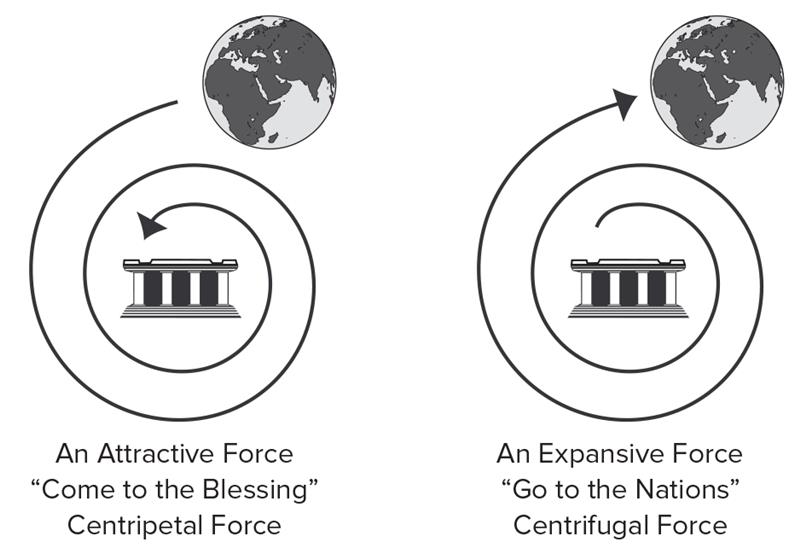
For many years it has been customary to argue that the Old Testament views mission centripetally—the nations coming towards Israel—whereas the New Testament understanding of mission is centrifugal—from the center, Israel or the church, missionaries move outward into the world. It is true that the Old Testament views mission predominantly in centripetal categories, but not exclusively so. The metaphor of light in Isaiah 42:6, 49:6 and elsewhere, is particularly appropriate to give expression to both a centripetal and a centrifugal movement. A light shining in the darkness draws people towards it, centripetally, yet at the same time it goes outward, crossing frontiers and allowing God’s salvation to reach “to earth’s farthest bounds” (Isa 49:6 NEB).
In the Old Testament, Israel’s missionary significance lies, however, predominantly within the framework of centripetal categories. This explains the centrality of Jerusalem or Zion in the Old Testament’s universalistic passages. The centripetal category is employed to give expression to the conviction that God, not Israel, is the author of mission.
God intends to do more than merely restore the tribes of Judah and bring back the descendants of Israel
Zechariah 8 gives classical expression to this. It is Yahweh who, after the exile, gathers His scattered people from the nations (vv. 7–8) and instructs them (vv. 9–19). The nations observe this and spontaneously express the desire also to go to Jerusalem. As many as ten men “from nations of every language” will pluck the robe of a Jew and say: “We will go with you because we have heard that God is with you” (v. 23 NEB). It is not Israel’s faith, example and witness that act as a magnet here; it is God’s faithfulness to Israel that causes the nations to come. And yet, not for a single moment does this suggest that Israel’s faith, example, and witness are dispensable. Far from it. Once again, Israel herself is fully involved in God’s mission to the nations. She was a pagan whom God elected to salvation; but she retains her new and special position as “non-pagan” only insofar as she accepts and lives up to her responsibility in the world. Primarily this means remaining true to Yahweh, but then this implies remaining true to the world, in letting her light shine forth and being an example to the world. Israel is to witness by word and deed.
God and His People as Competitors?
It would, however, be wrong to find the real difference between Old and New Testaments in the centripetal-centrifugal distinction. At least three observations can be made to establish that that distinction is a relative one.
First, the centripetal missionary dimension is by no means confined to the Old Testament. It is characteristic of the New Testament also. Astrologers came from the East to Jerusalem to look for the Savior of the world (Matt 2). Simeon refers to the deliverance which God has prepared “in full view of all the nations: a light that will be a revelation to the heathen” (Luke 2:31–32 NEB). Quoting Isaiah 56:7, Jesus referred to the temple as “a house of prayer for all the nations” (Mark 11:17 NEB). The cleansing of the temple moreover, suggests that the restoration of Israel should precede the pilgrimage of the nations to Jerusalem. The Roman army officer coming to Jesus (Matt 8:5) and the Greeks traveling to Jerusalem to see Jesus (John 12:20) give expression to the same idea: Salvation is to be found in Israel and the nations who wish to partake of it should go there. After all, “it is from the Jews that salvation comes” (John 4:22 NEB). The world’s salvation can be consummated at one place only—in Jerusalem; this explains the prominence of this city in all four Gospels, especially that of Luke (the non-Jew!).
Second, we have to point out that the centripetal-centrifugal distinction may easily lead to “true” mission being understood as only centrifugal, as this suggests the crossing of geographical boundaries and proclamation to pagans by word of mouth. However, the crossing of geographical boundaries constitutes only one element of what the Bible understands by “mission.” Mission is more than preaching to pagans.
Third, there is a tendency to understand mission in the Old Testament as entirely and exclusively “God’s work.” Some of Jesus’s contemporaries indeed believed that God’s work, by definition, excluded any human involvement. This understanding implies that New Testament centrifugal mission, in which people are ostensibly more actively involved, might then be labeled “man’s work.” With this, however, we enter a very slippery area where God’s activity excludes the work of people and vice versa. Then God and His people become competitors.
We want to put it, categorically, that this is a false conception that can only be detrimental to the church. The Bible speaks with a disarming candor here. The disciples are seed (Matt 13:38) and at the same time laborers bringing in the harvest (Matt 9:37–38); they are members of the flock (Matt 10:16; Luke 12:32; John 10:1–16) but also shepherds (Matt 10:6; John 21:15–17); they are in need of absolution (Matt 18:23–27) but can also give absolution to others (Matt 16:19; 18:18; John 20:23). God has revealed to them the “secrets of the kingdom” (Matt 13:11), yet they have to seek the kingdom (Matt 5:20; 6:33; Luke 13:24). They are God’s children (John 1:12), yet they have to become that by loving their enemies (Matt 5:44–45). They have received eternal life (John 3:16–17; 11:25–26) yet still have to go through the gate that leads to life (Matt 7:14). Because they have done what Jesus expected of the rich young ruler, they are “perfect” (Matt 19:21; cf. Mark 10:28), yet they have to keep watch and pray so that they will not fall into temptation (Matt 26:41). The believers must work out their own salvation in fear and trembling, for(!) it is God who works in them (Phil 2:12–13). Therefore Paul can, quite unselfconsciously, call them “God’s fellow-workers” (1 Cor 3:9). The key to these apparently complete paradoxes lies in the New Testament expression “in Christ.”
By God’s grace I am what I am, nor has His grace been given to me in vain; on the contrary, in my labors I have outdone them all—not I, indeed, but the grace of God working with me. (1 Cor 15:10 NEB)
If, however, we regard God and His people as competitors and put God’s work against the efforts of people, we soon land ourselves in one of two untenable positions. If we emphasize only the one side, our faith adopts the blind, unbending characteristics of fate; if we emphasize only the other side, we become fanatics and arrogant zealots.
There is, as the examples quoted from Scripture indicate, a creative tension between God’s work and the work of people, and any attempt to explain it by means of a balanced formula or to codify it precisely in a dogma, risks destroying its tender mystery. To recognize this is of the utmost importance for the biblical foundation of mission.
In Christ
Many scholars have underlined the remarkable fact that the so-called “Great Commission” (Matt 28:18–20 and parallels) seems to play no role in the New Testament church herself, because it is never repeated nor referred to. Two reasons may perhaps explain this silence.
First, the Great Commission is not a commission in the ordinary sense of the word. It is, rather, a creative statement in the manner of Genesis 1:3 and elsewhere: “Let there be . . .” Or, as Lesslie Newbigin puts it, with reference to Acts 1:8: “The word, ‘You shall be my witnesses,’ is not a command to be obeyed but a promise to be trusted.”1 It was a promise, however, that could only be perceived in the act of obeying, as Peter discovered when he visited Cornelius and said in amazement, “I now see how true it is that God has no favorites” (Acts 10:34 NEB). Paul referred to it as a “mystery,” a “secret” only now revealed to him in the act of preaching the gospel to all people, “that through the gospel the gentiles are joint heirs with the Jews, part of the same body, sharers together in the promise made in Christ Jesus” (Eph 3:6 NEB).
A second reason for the silence about the Great Commission in the early church lies in the fact that a mission to the gentiles was never at issue in the early church—despite the views of scholars such as Ferdinand Hahn, Ernst Käsemann, and others. Opinions differed only on the way in which gentiles were to be brought into the church, especially on the question of circumcision. In these circumstances, a reference to a “missionary command” would have been irrelevant.
Both these considerations demonstrate that mission in the New Testament is more than a matter of obeying a command. It is, rather, the result of an encounter with Christ. To meet Christ means to become caught up in a mission to the world.
Mission is a privilege in which to participate. Thus Paul introduces himself to the church in Rome as somebody who, through Christ, has “received the privilege of a commission in His name to lead to faith and obedience men in all nations” (Rom 1:5 NEB). Mission, for Paul, is the logical consequence of his encounter with the risen Christ on the Damascus road.
Similarly, in the so-called “christological hymn” (Phil 2:6–11), there is no reference to a missionary command. And yet, the worldwide mission falls clearly within the purview of the hymn: “That at the name of Jesus every knee should bow . . . and every tongue confess, ‘Jesus is Lord’” (vv. 10–11 NEB). Mission is therefore, according to the New Testament, derived from Christology. This is how it appears in another early Christian hymn:
He who was manifested in the body, vindicated in the spirit, seen by angels; who was proclaimed among the nations, believed in throughout the world, glorified in high heaven. (1 Tim 3:16 NEB)
Similarly, in 2 Corinthians 5:18–20 (NEB) and Ephesians 2:14–18 (NEB), mission is christologically founded as the message of the reconciliation of the world with God; the “service of reconciliation,” entrusted to the church, proceeds from the fact that Jesus, with regard to Jews and gentiles, has broken down, “in His own body of flesh, the enmity which stood like a dividing wall between them,” thus creating “out of the two a single new humanity in Himself.”
The church, therefore, is involved in mission because Jesus was given a name above all names (Phil 2:9), and declared Son of God by a mighty act in that He rose from the dead (Rom 1:4), because God was in Christ reconciling the world to Himself (2 Cor 5:19) and Jews and gentiles to one another in a single body to Himself through the cross (Eph 2:16).
Mission in the New Testament is more than a matter of obeying a command. It is, rather, the result of an encounter with Christ.
If the church is “in Christ,” she is involved in mission. Her whole existence then has a missionary character. Her conduct as well as her words will convince the unbelievers (1 Pet 2:12) and put their ignorance and stupidity to silence (1 Pet 2:15). “God’s scattered people,” to whom 1 Peter is addressed (cf. 1:1), are a chosen race, a royal priesthood, a dedicated nation, and a people claimed by God for His own. This new status in Christ has a clear purpose: to proclaim the triumphs of Him who has called them out of darkness into His marvelous light (cf. 1 Pet 2:9). Because of this new life in Christ, mission “happens,” so to speak, for we read about unbelievers calling upon the Christians for an explanation of the hope that is in them (1 Pet 3:15). This hope was so conspicuous, that the unbelievers became both curious and jealous. To put it in Pauline language: this was the way in which God spread abroad the fragrance of the knowledge of Himself (2 Cor 2:14). Wherever the apostle lived, spoke, and acted as “Christ’s fragrance,” something happened to the surrounding people.
RETURN TO LESSON 2: The Story of His Glory
Two Forces Jonathan Lewis
In the story of Israel fulfilling her role in God’s mission, two forces were at work. The first was an attractive force, symbolized by the tabernacle and then by the temple in Jerusalem. These buildings were the places that God had established to be worshiped and known. They were holy places, the heart of Israel’s worship. Yet they were not intended just to serve Israel. When Solomon dedicated the temple, he made it clear that the temple had a wider, global purpose.
The Bible records other foreigners who were attracted to Israel because of the evidence of God’s blessing, including the Queen of Sheba; Ruth, a Moabite woman; and Naaman the Syrian. Thousands of Israelites would travel long distances to worship at the major festivals. On the day of Pente-cost, for example, there were people from “every nation under heaven” (Acts 2:5 ESV) visiting in Jerusalem. The record says that there were some “Greeks” among those who had come “to worship at the feast” of Passover (John 12:20 ESV). God’s plan to reach the nations, however, includes much more than the dynamic of attraction.
A second force in operation was an active, expansive force which operated to send God’s message beyond the borders of Israel. Some examples of Israelites God used to proclaim His message to other nations include captives such as Joseph or exiles such as Daniel and Esther. Or consider the prophet Jonah, who was specifically told to preach to the city of Nineveh.
Jeremiah was appointed as a “prophet to the nations” (Jer 1:5 ESV). It’s speculated that he or other messengers may have traveled widely in delivering his many oracles. In contrast to called prophets, God used a little Israelite slave girl to announce His healing power to Naaman, the mighty, but leprous, captain of the Syrian army. Some might argue that these cases are exceptions and would point out that many of these people were captives or were serving against their will. God showed that He is able to use His people to spread His message, whether they are willing agents or not. Israel’s tragic history could have been considerably different if she had been a willing instrument of God’s redemptive plan. She was not. God used captivity and exile both to judge Israel’s disobedience and to extend her witness beyond her borders.
These two dynamic forces are also present today. On a global scale, many are attracted to so-called “Christian” countries because of the evidence of God’s blessing through material wealth and stability. Churches where God’s power and grace are evident can also draw people. On a personal level, godly character may attract those who want to possess those same qualities. Yet the attractive force is not enough to spread the gospel to all peoples. There are too many social, cultural, and geographic barriers that need to be crossed for this to happen. God’s people must be willing to go to the nations with the good news if they hope to fulfill their part in God’s plan.
RETURN TO LESSON 2: The Story of His Glory
Notes
1. L. Newbigin, “The Church as Witness,” Reformed Review 35, no. 1 (1978): 9.