Distant Thunder Brian Hogan
Mongols Follow the Khan of Khans
Brian Hogan and his family worked on a YWAM (Youth With A Mission) church-planting team and launched a Disciple Making Movement in Mongolia. He is currently a DMM trainer and director of Disciple Making Mentors. Brian and Louise, both Perspectives instructors, make their home in the Arkansas Ozarks. Brian is the author of There’s a Sheep in My Bathtub: Birth of a Mongolian Church planting Movement.
In the thirteenth century, the Mongol tribes, united under Genghis Khan, thundered across the steppes of Central Asia and terrorized the known world. In a short time, these fierce horsemen had carved out an empire dwarfing those of Cyrus and Caesar combined.
The Mongol Empire was not to endure for long. The Mongols embraced Tibetan Buddhism and became a back-ward hinterland ruled by a succession of Chinese dynasties. In 1921, a Communist revolution turned Mongolia into the first “independent” Soviet satellite. All missionaries were expelled before any church had been planted, and the darkness of Communism settled over this “closed” country. Mongolia was one of the very few countries on earth with no church and no known national believers.
Doors Begin to Open
After seventy years of being sealed off from the outside world, Mongolia gained freedom and independence along with other Soviet Bloc nations in early 1990, and Satan’s defenses against the gospel came crashing down. Creative strategies sparked the beginnings. A team of Native American believers entered Mongolia as tourists in 1990. Their visit generated a great deal of interest among Mongols and even hit the national press. By the end of their second visit in 1991, they had publicly baptized thirty-six new Mongol believers. The spiritual landscape of Mongolia would never be the same.
A young Swedish couple, Magnus and Maria, came to Mongolia intending to plant churches. As they began to learn the language in the capital, Ulaan Baatar, friendships developed with the new and very young Mongolian believers in that city’s growing churches.
Maria and Magnus made several forays up to Erdenet, Mongolia’s third largest city, with short-term Mongolian evangelism teams from a church in the capital city of Ulaan Baatar. These trips bore fruit in the form of fourteen teenage girls who responded to the teaching on faith and repentance. Magnus baptized these first disciples in January 1993, the beginnings of the church in Erdenet.
Fourteen young girls—not a very auspicious beginning. The new fellowship needed on-site help if it was to grow into anything more. In February, the young couple moved up to Erdenet accompanied by one of the best students in their English classes, a nineteen-year-old female Mongolian believer named Bayaraa. As Magnus and Maria ministered with and discipled Bayaraa, their relationship served as an effective bicultural bridge. Magnus and Maria gained important insights into Mongolian culture that guided their ministry. Bayaraa was a natural evangelist. What she learned about Jesus and the Bible from Magnus and Maria, she put to immediate use leading many to the Lord.
The disciples were quickly organized into three groups that met in homes. They gathered for prayer, fellowship, and teaching in an atmosphere of support and accountability. From the very beginning, they were taught to obey the simple commands of the Lord Jesus Christ. They learned to love God and each other, pray, give generously, repent and believe, baptize, celebrate the Lord’s Supper, and teach others to love and obey Jesus. As the girls led their friends to Christ, the groups multiplied. Magnus couldn’t lead the expanding number of groups, so active and faithful believers were equipped and released into leadership. After some time, they began a larger gathering, the “Celebration Service,” on a monthly basis to bring the house groups together for corporate worship and fellowship. After one year, the number of baptized Christ followers had grown to 120—almost all teenage girls! This was not the multigenerational church of entire families the church planters were dreaming of—it was half a youth group.
After a year of language study in Ulaan Baatar, my wife Louise, our three daughters, and I moved to Erdenet joining Magnus, Maria, and Bayaraa. A year later, others from Russia, America, and Sweden joined our team’s ranks. Apart from three members of the Peace Corps, our team was Erdenet’s sole foreign presence—we were utterly different. We tried to work from behind the scenes so the movement would have visible Mongolian leadership.
Breakthrough into the Mainstream
We realized that teenage girls were not the best foundation for starting a church movement. At that time, however, youth were the only ones responding anywhere in Mongolia. So we worked with the fruit the Lord provided and prayed for a breakthrough to begin reaching whole families. We established “provisional elders” (starting with two younger men and Bayaraa) in order to begin the process of allowing a Mongolian style of church leadership to develop.
We worked with the fruit the Lord provided and prayed for a breakthrough to begin reaching whole families.
Breakthrough of Relevance
There was a great divide between our youthful urban circle of friends and the family-oriented heart of traditional Mongolian society. The three cities of Mongolia were a relatively recent and imposed urban social structure over-laid by Communism upon a nomadic tribal society—and nomadic social structure was seen by all as the more legitimate and authentic of the two. Even our early converts had the impression the gospel wasn’t relevant for “real Mongols.” Even though Mongolia had become a 50 percent urbanized society, to the Mongol understanding, “real Mongols” are horse-riding pastoralists and gher (traditional round felt tents) dwellers. An urban teen growing up in an apartment building who has never even sat on a horse is not an authentic Mongolian. The gospel would be seen as just a foreign import, like Coca-Cola, if it were only embraced by city dwellers. If Jesus were going to “become a Mongolian,” He would need to enter into the lives of nomadic herders.
A visiting short-term team began to pray for the sick in some of the traditional gher suburbs on the outskirts of town. God answered prayer dramatically. A lame person, a deaf person, a mute person, and a blind person were all healed, and several demons were cast out. These healings provided a seal of authenticity recognized by the older Mongols. The news spread like wildfire and the fellowship was flooded with growth from every age group and segment of the city. The urbanized youth were especially surprised that “real Mongols” were coming to faith. Soon two older traditional Mongol men joined the ranks of our provisional elders. When these men, who were respected heads of households, began leading house churches and ministries, it made a huge difference in gaining credibility for the movement in the larger culture.
RETURN TO LESSON 11: Building Bridges of Love
Breakthrough of Understanding
The second factor in the sudden acceptability of the good news by the traditional Mongols was the decision by our team and the “elders-in-training” to begin using the Mongolian term Borkhan to refer to the God of the Bible. Many centuries before, when Tibetan Buddhist missionaries arrived in Mongolia, they adopted Borkhan, the generic Mongolian term for “god,” for their purposes. In the early ‘90s, nearly all the believers in Mongolia used another term for God, Yertontsin Ezen, which was a brand-new term composed by a translator in an attempt to avoid any potential confusion or syncretism with the beliefs of Buddhism. But the new term, which can be translated as “Master of the Universe,” sounded unfamiliar and unreal to Mongolian ears. It had no intrinsic meaning for them and was essentially a foreign word made up of Mongolian elements. Although the Erdenet elders-in-training were used to using the term Yertontsin Ezen, they decided that the traditional term Borkhan would be more appropriate and acceptable and was capable of being filled with biblical meaning. This change came just in time for the suddenly open crowds who witnessed healings and deliverances. The God who was working these wonders had a name that didn’t sound like science fiction.
The solutions these Mongol leaders crafted were both biblically and culturally correct—much better than solutions we missionaries might have crafted.
RETURN TO LESSON 10: How Shall They Hear?
Developing Indigenous Leadership
During this period of explosive growth our team was careful to stay “behind the scenes,” giving on-the-job training for the emerging leaders. Care was taken to do everything in ways that could easily be imitated—baptisms were in bathtubs, worship songs were not imported, etc.
The team recalled what we had learned from veteran missionary George Patterson before coming to Mongolia. He got to the heart of discipleship, saying, “People are saved to obey the Lord Jesus Christ in love.” We made sure Jesus’s basic commands were taught in such a way that disciples could immediately respond in obedience. The house churches enabled, supported, and encouraged these practical responses to the teaching from God’s word. Believers helped one another to do the word and not just hear it, often finding corporate ways to obey together.
Yet there were serious problems from our point of view where the cultural norms of Mongolian society conflicted with some of the moral teaching of the Scriptures. The elders-in-training were encouraged to search the Scriptures to find solutions for sin problems in the emerging church. Cultural blind spots in the areas of sexual purity and courtship were dealt with by defining principles, then teaching and enforcing them. The solutions these Mongol leaders crafted were both biblically and culturally correct—much better than solutions we missionaries might have crafted.
The emerging Mongolian church looked far different from any of our team’s home churches in Sweden, Russia, or America. Dramas and testimonies quickly became prominent features of the large celebration meetings (which went from once to twice a month and eventually weekly). The “drama team” wrote and produced their own skits, plays, and dramatic dances from Bible stories and everyday Mongolian life. This became a powerful teaching and evangelistic tool. Time was always set aside for testimonies from “real Mongols”—often new believers in their sixties just come from the steppes. These long and, to Western ears, rambling stories of salvation gripped the fellowship in a state of rapt wonder and awe. God was on the move among their people—dressed in the most traditional of Mongolian clothing. Worship rose from their hearts as they sang new songs written by their own people in their own language and unique musical style. This was no foreign fad or import!
Our team of expatriates concentrated our efforts on discipling, equipping, and releasing Mongols to take the lead in building up the church and reaching the lost. A school of discipleship was formed and by the third class was entirely Mongol led. With the emphasis upon “learning by doing,” new leaders were trained locally in the ministry rather than being sent away. The leadership of the home gatherings had been placed into their hands almost immediately, and soon the Mongol believers also carried the majority of the responsibility for the weekly services.
Overcoming
All of this progress and growth was not overlooked by the enemy. Beginning in November of 1994, our team and the fledgling church endured two solid months of unrelenting spiritual attacks: three cult groups targeted our city, the church was almost split, leaders fell into sin, and some were demonized. Our team came close to despairing and pulling out.
Finally, two sudden and unexplainable deaths rocked the missionary team and the church. My only son, Jedidiah, had been born on November 2nd. On the morning of Christmas Eve our apartment rang with screams when Louise discovered Jedidiah’s cold and lifeless body—dead of Sudden Infant Death Syndrome at two months. We buried our boy and a piece of our hearts in the frozen soil on a cold windswept hillside outside of town. The next day a young girl in the church died from an unknown cause.
In response, the believers and our team came together for twenty-four hours of prayer and fasting. At three in the morning, a breakthrough occurred and everyone knew it. The church has never been overwhelmed by an onslaught of spiritual warfare like that since.
Explosive Growth
One of the beauties of meeting in homes was, while other churches in Mongolia were sorely hindered by government harassment, usually taking the form of evictions from Sunday meeting locations, the church in Erdenet was largely unaffected by such moves—since worship typically took place in living rooms all over town! Growth was taking place in the house groups, and even going months without “celebration services” didn’t slow things down. When the numerous house churches did gather, united in God’s presence, the believers were encouraged, as they saw their numbers continue to grow.
The Beginnings of a Church-Planting Movement
As encouraging as this start in Erdenet was, it still fell short of the vision God had given to our team. We knew the planting of a single church in one city would not be the breakthrough to reaching an entire nation and beyond. We were aiming for a movement of indigenous and spontaneously multiplying churches within the Mongolian peoples, and the Mongolian believers themselves needed to share this goal.
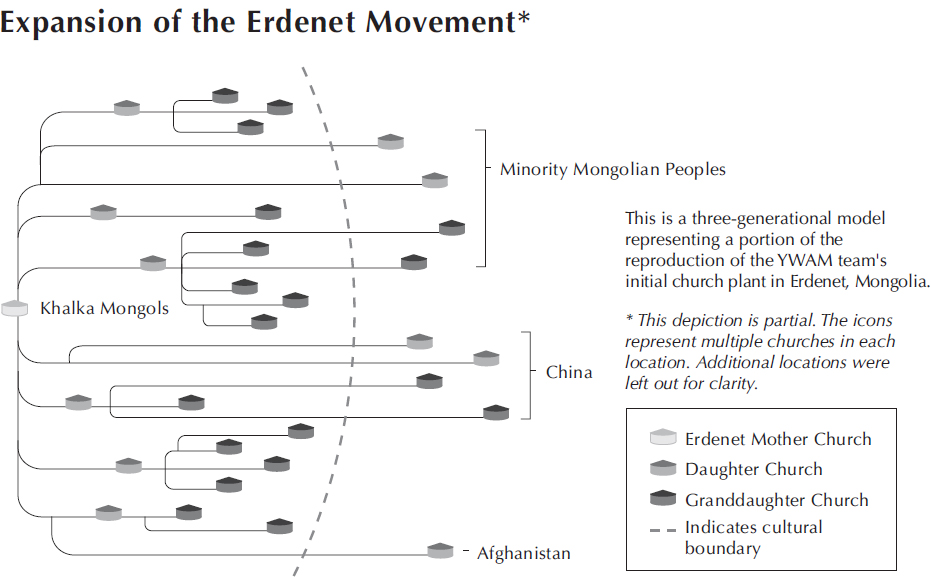
At the very first baptism, Magnus shared this vision with the newly born body of Christ: to reach all the families of Erdenet with the gospel, to plant a daughter church in the neighboring province, and to reach other unreached peoples of the world. The young believers, blissfully clueless, responded very enthusiastically. We trained all of the disciples to view the church as a living organism rather than an organization—a healthy “mother church” that would reproduce into daughter and granddaughter churches. The leaders we trained kept the vision—”God wants to plant new churches through our church”—before the members.
About a year and a half into the church’s development, the Mongol “provisional elders” decided to politely decline further funds from supporting churches abroad. The funds had been used to provide some of the Erdenet church workers’ salaries for about a year. Their own people, having been taught to obey Jesus’s command to give generously, were now meeting all of the church’s needs with local giving. When a foreign church insisted on sending funds, they decided to use them to establish new “daughter” churches with the understanding that this too was only temporary.
During the church’s second year, the elders sent out teams and planted a daughter church in a town sixty kilometers away. Because they were of the same people group, planting another congregation was easy for the Mongolians. The leaders the Lord raised up for this daughter church soon began sending teams out to plant granddaughter churches in other towns even farther from Erdenet.
The End of the Beginning
After just three years of work by our team in Erdenet, we realized that our efforts had borne good fruit and we had “worked ourselves out of a job.” In the beginning of 1996, we had successfully modeled and passed on every ministry and function in the church movement to Mongolian disciples. The Mongols were doing everything and we were just watching. The bittersweet moment that had been our goal all along had come. It was time to say goodbye.
The Easter service was packed—standing room only. Nearly eight hundred filled the largest hall in Erdenet with many more turned away by the authorities, who closed the doors when they saw the crowds. Those who managed to get in gathered to worship Jesus and to witness the ceremony marking the passing of authority from our foreign church-planting team to the local elders. We explained and acted out the analogy of a relay race to portray graphically what was taking place. A baton was handed from our family and Magnus, representing the church planters, to a group of Mongolian leaders in full national dress. They were so ready! The baton was passed. For the first time in history, a fully indigenous Mongolian church was in Mongolian hands—and they in turn were firmly in the nail-scarred hands of Jesus.
Our family left Mongolia that very day, and the rest of the team left in June when their English teaching commitments ended. In our absence, the Mongolian churches continued to grow and multiply. They started a number of mercy ministries as well. They began to feed and clothe street children, care for single mothers, prevent abortions, and even plant a church among dump dwellers. All of these initiatives were completely from and by the Mongolian believers.
The movement continues. By 2008, the church in Erdenet had given birth to fifteen daughter churches in towns scattered across the country. Some of their daughter churches have themselves reproduced from one to six granddaughter churches. A very satisfying report—considering we started with only teenage girls!
This movement has also been hard at work cross-culturally. Teams of Mongol church planters have been sent to Muslim peoples in two other countries, to an animistic forest tribal people, as well as already having launched church-planting movements among several other Mongolian tribes. Five of the daughter churches and four granddaughter churches are missionary church plants among distinct ethnic groups. A missionary training school in Erdenet trains the Mongolian church’s emerging mission force.
God seems to have made the spiritual soil of Mongolia especially fertile for church planting. The gospel continues to do its life-giving and community-changing work. Churches continue to grow and reproduce. Conservative estimates state that the number of believers grew from just two in 1990 to over seventy thousand believers today. Mongolia has changed from a mission field to being a powerful mission force—sending out more missionaries per believer than any other nation on Earth. As in a previous age, Mongols again thunder off to the nations beyond their barren hills—this time under the leadership of the “Khan of Khans”—King Jesus!
RETURN TO LESSON 13: Organic Multiplication of Churches
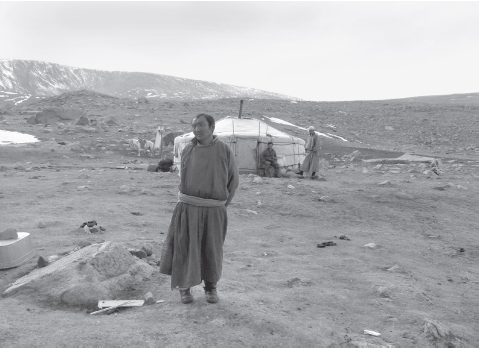
Photo courtesy of Rory Clark, Pasadena, CA.