A Pioneer Team in Zambia, Africa Phillip Elkins
Phillip Elkins served in Zambia for five years and in Liberia for four years. He is executive director of the Language and Culture Institute, which provides hands-on, experience-based training in ethnic communities in the US and overseas. He served as a member of the faculty and founder of the intercultural studies program at Fuller Theological Seminary.
This church-planting case study differs from some in that it describes a team of missionaries who banded together prior to entering a field. Most efforts are put together by a sending agency and they bring together several people who may meet for the first time on the field. This team came together in 1967 out of a common concern to reach an unreached or “hidden” people whom God had already prepared to be receptive to His redemptive message.
The team took as its model the “Apostolic Band” of the first century. This multitalented, multi-gifted group had varying degrees of field experience. Stan Shewmaker had already worked in Zambia, Africa, for five years; Frank Alexander in Malawi, Africa, for four years; Phillip and Norma Elkins had visited and researched missions in seventy-one countries; two other couples had been on short-term assignments in Africa. Ages of members ranged from 25 to 33. The five men in the group had degrees in biblical studies and had completed master’s degrees in missiology just prior to leaving for the field.
Because of this experience and training, the team felt it could function as its own agency in the same sense that the Paul-Timothy-Luke-Silas “band” of the New Testament did. The group was sent by an “Antioch” congregation in San Fernando, California. This church body recognized that the true “sending” agent was the Holy Spirit (Acts 13:4, “so being sent by the Holy Spirit”) and thus did not consider itself the governing or “decision-making” organization. Responsibility for field decisions was left to the team, directed by the Holy Spirit, in partnership with the national Christian leadership on the field.
Early Decisions and Convictions
As the team searched for an unreached people (two years), they concluded that the Holy Spirit was leading them to a segment of the Tonga tribe (one of the largest in Zambia, numbering over three hundred thousand) called the Toka-Leya. Ninety-five percent of these people were adherents of an ethnic, or localized, folk-religion (some would use the term animistic). Within a twelve-mile radius of where the team settled (the primary target area) were one hundred villages with four small congregations that had not grown for several years (a total of seventy-five Christians).
The team spent most of the first two years (1970–71) learning the language and culture, without engaging in overt evangelistic activities. By the end of 1973, there were four times as many churches (16) and six times the membership (450). Beyond this immediate twelve-mile area, completely new movements were started. For example, in the Moomba chieftaincy, seventy miles to the north, newly trained national Christians planted six churches with 240 members within a few months. This was done in 1973 and involved the chief, a third of all the village headmen and both court judges deciding to follow Jesus.
I mention this early rapid response to show that we were indeed led to a “ripe pocket” in God’s mosaic of peoples. We knew that the national church, motivated and trained, had to be the vehicle to gather the harvest. By 1974, we felt most of the American team could pull out. By 1979, the last two “foreign” families felt they could responsibly move on to another new people to begin the process again. Today a national church continues the process of evangelizing and discipling “to the fringes.”
“Methods,” “approaches,” and “strategy” may be “unspiritual” words in some Christians’ vocabulary. I feel in the context of this effort there was validity in the strategy and specific methods followed by the team. In addition to what has been described, I think the first two years in which we were involved as in-depth “learners” of the Tonga world-view (language, lifestyle, values, politics, social structure, beliefs, educational systems, and other aspects of culture) were essential to our efforts as church planters. My wife and I lived in a village of 175 people and followed a lifestyle closely identified with that of other Toka-Leya families. We learned to “hurt” where they hurt and “feel” what they felt. We identified, not so much to be “accepted,” though that is important, but to understand and appreciate their culture for its finest and best dimensions. We had to know what parts were already functioning positively within the will and purpose of God. We needed to know what had to be confronted and changed to fit the demands of the kingdom of God.
Perhaps most critical was the need to learn where people had “felt needs” through which God’s message of redemption could be accepted as good news. The message proclaimed as “gospel” by earlier Christian efforts was in fact perceived as “Bad News.” The “gospel” was perceived as God calling men to have one wife and not to drink beer. Though Christians were saying many other things, this was perceived as the “banner” of the message. Because missionaries showed a major interest in setting up schools for children, the adult population found the message all right for children but almost unthinkable for adults.
Understanding the Tonga Worldview
During our two years of “incarnational identification,” the Tongas’ perception of reality (worldview) became increasingly clear to us. It was to this perception of reality that we had to address our lives and message. Graphically, it might be described to a Westerner as follows:
Tongas believed that one can affect the fetus in another person’s body. For example, if a pregnant woman’s family had brought death to members of your family, you could enlist the aid of a medicine man to cause the death of the fetus (without having physical contact with the pregnant woman).
Perhaps most critical was the need to learn where people had “felt needs” through which God’s message of redemption could be accepted as good news.
The category of living living corresponds to our concept of living people with their finite physical limitations. But after physical death this person continues as the living dead. The personality, personal enemies, prejudice, taste preferences, and so forth continue intact. Therefore, one can go to the grave of the living dead person and request assistance based on a knowledge of that person’s personality and the obligations of relationship. Similarly, the exalted living dead are to be supplicated based on the status they attained while in the living living existence.
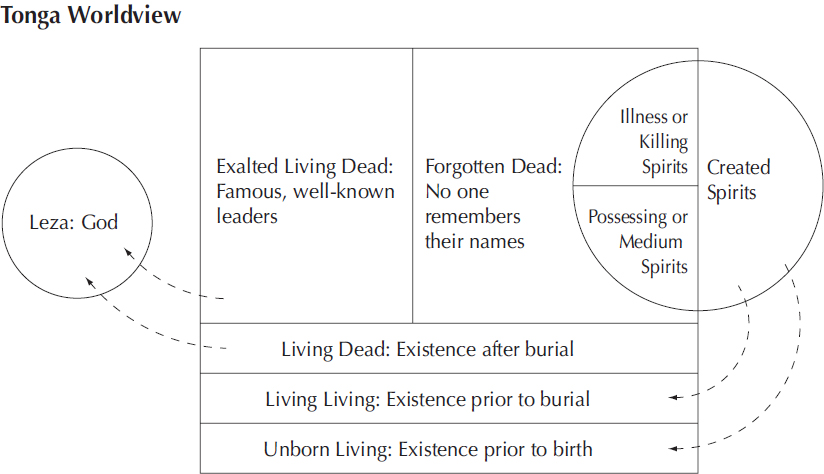
The forgotten dead are those persons whose names and personalities have passed from living memory. Therefore, no one can now appeal to them, placate them, or appease them. This group represents a dimension of reality which strikes at the heart of the fears, apprehensions, and frustrations of the Tonga.
Within this framework of “reality” I will describe how our team of Christians found an opening to speak to felt needs. The Tonga believed that God (Leza) created humans and, for a while, lived together with them. But as people became abusive in their relationship with Him (in one story a woman strikes God), God left them, and all direct communication became impossible. The only remaining way to speak to God then, is through the living dead or exalted living dead. But the inability to “hear back” from God, to know His personality, to understand whether their needs were adequately communicated, represented an area of felt need.
Forgotten ancestors are commonly believed to be the spirits which enter people to kill them. A violent illness is associated with such spirits, and unless the person can get this spirit expelled, death will result. Other spirits represent alien forgotten dead (they come from another tribe) which frequently are associated with a long-term, frustrating, but not fatal illness. These spirits also frequently possess the person and use the person as a medium to communicate with the community. The community responds to this possession by special gatherings to dance and sing to the spirit. The purpose of these gatherings is to appease, control, and hopefully rid the person of the spirit.
Finally, there are spirits which humans play a role in creating. These particular spirits were the most feared and frustrating for the people with whom I lived. None of the literature I studied on spirits in Africa dealt with this particular spirit, though humanly created spirits do exist in other African tribes.
Our understanding came in this way. A very sick boy was brought to me one day. The child was near death and I felt it was beyond my own limited medical skills to help. I took the parents and child to a hospital, but as I watched, the child died. From a Western medical perspective, the child died from complications of malaria and anemia. A year later, I attended a village court case where a man was accused of killing this very child. The man finally admitted, after weeks of trial procedures, that he was guilty. The reason was that the man felt he had been wronged by the father of the child and he wanted to create his personal isaku spirit. No one during the trial was willing to explain to me what an isaku spirit was. People who were normally generous with information would deny knowing anything about these spirits. During this time, my wife and I visited a village one evening where none of the women around a fire had their children on their backs. This was very unusual. I asked them why and they explained that it was because there were many isaku spirits in their village and they were afraid for the safety of their children. They said that their other children were in huts where they could be watched. When they discovered that I did not know what an isaku spirit was, they explained only that it was an evil spirit. Since all spirits were considered evil, that was not much help.
As the weeks went by, I finally persuaded a medicine man, who occasionally visited our area, to explain isaku. This spirit could be created by people who wanted a being to steal, kill, or otherwise serve their own interests. To create an isaku, one would first have to dig up and decapitate a freshly buried body. The head would be removed in the middle of the night to an isolated area where two paths cross. A fire would be built and certain medicines would be added to it. The ensuing smoke would engulf the head to which portions of certain animals had been attached (snake skin, bird feathers, feet of a rabbit, etc.). This ceremony, if correctly done, would result in a living spirit called isaku. The physical part of this spirit was to be kept, fed, and hidden. If one properly cared for isaku, the person would have his wishes granted. If not properly cared for, isaku would kill the person or a member of his family. When a person who owns an isaku dies, the relative who inherits the dead person’s name also inherits their isaku. Normally, no one would reveal that they had an isaku. Thus, if a relative who was asked to receive a name was suspicious that an isaku was associated with it, that person might refuse to receive the name.
If anyone inherits a name, and unknowingly should have received an isaku, they learn of the mistake very painfully. They may arrive home one day to learn that a child has died suddenly.
As our knowledge grew of isaku spirits, many gaps in our understanding of the Tonga were eliminated. We grew increasingly conscious of how powerless the people felt to adequately deal with isaku spirits and those who would create them. This, coupled with the realization that the Tonga felt every death was the result of someone’s overt effort to cause it, helped us to understand the extent of much of the animosity and anger between individuals and families.
Responding to Felt Needs
From all of the above insights, a picture of felt needs emerged to which God could speak meaningfully. The first good news from God for the Tonga was that He had given to us a Holy Spirit. The Tongas knew nothing of a good spirit, much less a Holy Spirit from God Himself as a gift. We shared that we were not afraid, as they were, of isaku spirits because we had residing in us continually a Spirit that would not tolerate other spirits. The Spirit in us was more powerful than any other spirit. This explained the joy, the confidence, the hope, and the lack of fear they had seen in our lives.
The second part of our good news was that God, who they already knew by name, had not abandoned them. The Tonga had left God, but He was willing to live among them again. He had already proved His willingness by sending a Son who lived as a human and showed humans how to really live. We explained that they could now talk directly to God about their needs and that this Son also serves as a person’s special advocate before God. God’s Son was so concerned to remove the sin and guilt for all of the offensive ways that we live that He Himself accepted the punishment on our behalf.
The Tongas began to realize the verification and proof of what we said was the Holy Spirit who lived in us. Lest I be misunderstood by a reader of this, I am not talking about a special gift of speaking in tongues. I am speaking of that which every Christian receives at his new birth.
Part of our good news was that God, who they already knew by name, had not abandoned them.
We also spoke of the verification that would come from knowing the Bible. This had little immediate impact, as most of the people could not read. However, the Word is not confined to the printed page. The Word was communicated daily by a God who was willing to reveal Himself in their lives. He revealed Himself one day as we went to a village where we were stopped by a drunken woman who forbade us to come into her village. She said they followed Satan and not God. But that night she died and the next day hundreds of people came wanting to know more of God’s will for their lives.
The major political leader of our area had been leading the people to the graves of their ancestors annually to solicit rain. When he accepted the good news, he demonstrated his faith by leading his people in a new way. When the first drought occurred, he called the people together to spend a day calling to God to give them rain. This was a bold move which exceeded the faith of some of the missionaries. But God honored the boldness, and before the sun set, the earth was drenched in rain.
In the village where we made our home, almost half of the adult population accepted baptism. At their initiative, we all spent a night in prayer before going out as a group to share our faith with another village.
As our team of American missionaries saw more and more churches planted, we began to modify our role as leaders in evangelism and church planting. I believe it was a good strategy for us to identify with the Tongas physically and to provide a physical and spiritual model for evangelism. I know this is a concept that is considered “past” in many circles, but I feel it should still be an emphasis in pioneer mission efforts.
To train indigenous leadership we set up sixteen extension centers for training every Christian in the basics of the Christian faith and instituted a special course for those who emerged as church leaders. This was done with the new Christians bearing the cost of the courses. We followed the practice of not subsidizing the construction of buildings or providing funding for those who entered the preaching ministry.
Prepared for Battle
I cannot close this story without admitting that we, like the team that Paul worked with, experienced some interpersonal conflict and setbacks in our ministry goals, including betrayals by believers and reversions by some of those we had the greatest hopes for. But we accept that as normal in the battle “against the principalities, against the powers, against the world-rulers of this darkness, the spiritual hosts of wickedness in the heavenly places” (Eph 6:12 ASV).
I think it is important for one to know the Bible well enough to be able to know where the battle is. I think we invite defeat when we do not make the effort to learn the local language well enough to teach effectively in it. I think it is essential that we participate in a real way in the life-style and struggles of the people we are sent to. When we do not ground our proclamation on an understanding of a people’s hurts and felt needs, and when we allow our own cultural understanding of the Christian message to blind us to what God wants said in a radically different setting and culture, we invite failure.
I heartily commend the team approach for pioneer mission efforts. During the five years I was in Zambia, one of our original families left, but others came and were incorporated. In addition, from the very beginning, we tried hard to expand the team leadership to include Tonga Christians. This kind of team approach is not the only way to approach the task, but it was part of what made our five years in Zambia a productive and happy experience.