CHAPTER 103
Retaining Identity and Preserving Community
R. W. Lewis

R. W. Lewis worked with her father, Ralph Winter, to develop graphics about the least reached peoples. She took the first Perspectives course (the Summer Institute for International Studies) in 1974 and then helped run Student Conferences on World Evangelization at Caltech, graduating in 1977. She has spent the last 50 years on overseas teams and in leadership focused on the frontier peoples.
Adapted from “Promoting Movements to Christ within Natural Communities,” International Journal of Frontier Missiology 24, no. 2 (2007). Used with permission.
Insider movements can be defined as movements to obedient faith in Christ that remain integrated with or inside their natural community. In any insider movement there are two essential dynamics:
1. Continued community. The gospel takes root within preexisting communities or social networks in such a way that no new social structures are needed, invented, or introduced. Believers are not gathered from diverse social networks to create a “church.” Instead, believers in the preexisting community become the main expression of “church” in that context.
2. Retained identity. Believers retain their identity as members of their socioreligious community while living under the lordship of Jesus Christ and the authority of the Bible.1
Take a closer look at these two dynamics.
1. Preexisting Communities Become the “Church”
How can the gospel take root within preexisting communities in such a way that the community or network becomes the main expression of “church” in that context? To understand why this factor is important in insider movements, let’s contrast planting a church with implanting the gospel.2
Planting Churches
Typically, when people “plant a church” they work to create a new social group. Individual believers, often strangers to one another, are gathered together into new fellowship groups. Church planters try to help these individual believers become like a family or a community. This pattern of “aggregate church” planting can work well enough in individualistic Western societies. However, in communitybased societies, when believers are taken out of their families into new social structures the affected families usually perceive the new group as having “stolen” their family member. The spread of the gospel is then understandably opposed.
“Implanting” the Gospel
In contrast to how churches are planted, insider movements can be considered to be “implanted” when the gospel takes root within a preexisting community. Like yeast, the gospel spreads within the community. No longer does a newly formed church group try to become like a family. Instead, believers within their preexisting family or community network gradually learn how to provide spiritual fellowship for each other. This network of believers within their family and community forms the core of an implanted church. The strong relational bonds already exist; what is new is their commitment to Jesus Christ. Implanted movements are not necessarily more “contextualized” than planted churches. Even if the new church is very close to the culture, the creation of a new structure often unnecessarily distances believers from their families.3
Continuing Communities: Is It Biblical?
Households such as those of Cornelius, Lydia, and the Philippian jailer became the relational core of many of the churches that we see in the New Testament. These and other examples feature families and larger social communities following Christ together.
Some have seen the redemption of preexisting communities as fulfillment of God’s promise to Abraham that in his descendants all the families would be blessed (Gen 12:3; 28:14). When entire families and clans are not broken apart, but instead transformed and fulfilled by Christ, the larger society in which these movements flourish can be blessed and transformed in significant ways. The gospel is not seen as a threat and thus it flows more easily into neighboring relational networks.
2. Believers Retain Their Socioreligious Identity
In many countries today, it is almost impossible for a new follower of Christ to remain in a vital relationship with their community without also retaining their socioreligious identity. In these places, the word “Christian” is not understood as referring to sincere believers in Jesus Christ. Instead, the term “Christian” calls to mind a socioreligious-political category. One’s religious identity (Muslim, Christian, Hindu, etc.) is often written on one’s identity card at birth. Changing one’s identity from “Muslim” or “Hindu” to “Christian” is usually seen as a great betrayal of one’s family and friends. Making such a change is often illegal or impossible, or at best, thought to be quite scandalous.
Nevertheless, the gospel can spread freely in such places through insider movements. Insider believers have a new spiritual identity, living under the lordship of Jesus Christ and the authority of the Bible, but they retain their socio-religious identity.
Retaining Identity: Is It Biblical?
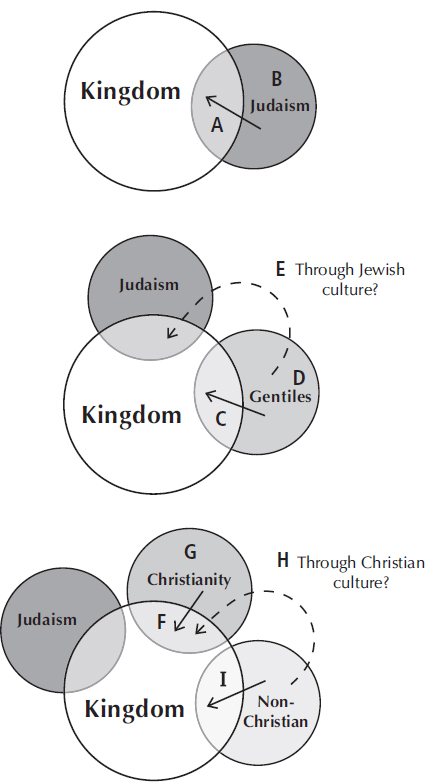
Does one have to go through Christianity to enter God’s family? The New Testament addresses a nearly identical question: “Do all believers in Jesus Christ have to go through Judaism in order to enter God’s family?” It is important to realize that for both questions, the nature of the gospel itself is at stake. The “Kingdom Circles” sidebar illustrates the issue.
The woman at the well at first refused Jesus’s offer of eternal life because as a Samaritan, she could not go to the temple in Jerusalem or become a Jew. But Jesus distinguished true faith from religious affiliation, saying God was seeking “true worshipers who worship the Father in spirit and truth” (John 4:19–24). Realizing that Jesus was “the Savior of the world” (v. 42) and not just of the Jews, many Samaritans in her town believed. Based on what Jesus had told the woman at the well, it is very likely that these new followers retained their Samaritan community and identity.
Kingdom Circles R. W. Lewis
A simple diagram can help distinguish between socioreligious identity and the altogether essential spiritual identity of believing in and following Jesus Christ.
If the kingdom of God can be represented as a circle of those who are obedient, believing followers of Jesus Christ, we can portray the idea that only some of those who were participants in Judaism in New Testament times were Jewish people following Christ as Lord and therefore had entered the kingdom of God (A). Not everyone who was Jewish in that day became part of the kingdom of God (B).
Many gentiles of that day followed Jesus Christ as Lord and entered the kingdom of God (C). It’s important to note that many gentiles did not follow Christ or enter the kingdom (D). But one way to portray the issue facing church leaders in Acts 15 was this: Is it necessary for gentiles to “go through” Judaism in order to enter the kingdom of God (E)?
If we ask the same question today, we will have to begin by recognizing that while many people who adhere to Christian culture and family traditions have obediently believed in Christ and have entered the kingdom of God (F), many others are Christians in name only and have not entered the kingdom of God, even though they may be members in good standing of Christian churches (G). This raises a similar question: Is it necessary for people with a non-Christian identity to “go through” Christian identity and culture in order to become part of the kingdom of God (H)? How this question is answered helps us recognize that many people with a non-Christian socioreligious identity may be entering the kingdom of God by becoming wholly devoted, obedient believing followers of Jesus Christ while retaining their socioreligious identity and community relationships (I).
RETURN TO LESSON 14: Pioneer Church Planting
Later, the Holy Spirit revealed to the apostles that the gentile believers did not have to go through Judaism in order to enter God’s family. In Antioch, Jewish believers were telling gentile believers they must comply with Jewish culture and traditions to be fully acceptable to God. Disagreeing, Paul brought this issue to the lead apostles in Jerusalem. The issue was hotly debated because the Jews had believed for centuries that conversion to the Jewish religion was required to be part of the people of God. But the Holy Spirit showed the apostles they should not “burden” gentile followers of Christ with Jewish religious traditions (Acts 15).
To make this decision, the apostles used two criteria: the giving of the Holy Spirit to the gentiles coming to Christ and the guidance of Scripture. First, they heard that the Holy Spirit had descended on gentile believers who were not practicing the Jewish religion. Second, they realized the Scriptures had predicted that this would happen. These two criteria were sufficient for the apostles to conclude that
God was behind this new movement of believers who were retaining their gentile cultural identity. Therefore, they did not oppose it or add on demands for religious conversion. If we use the same two criteria today, insider movements affirm that people do not have to go through the religion of Christianity. Instead, they only need to go through Jesus Christ to enter God’s family.
Paul wanted people to understand that this truth has been part of the gospel from the beginning. He pointed out that God promised Abraham that all people groups would receive the Spirit through faith in Jesus Christ alone (Gal 3:8–26). As a result, when Peter and Barnabas consented to the demand of traditionalists that gentiles be required to follow their Jewish religious customs, Paul publicly rebuked them for “not acting in line with the truth of the gospel” (Gal 2:14–21). Paul warned that adding religious conversion to following Christ would nullify the gospel. He also affirmed that not through any religion, but “through the gospel the gentiles are made heirs together in the promise of Christ Jesus” (Eph 3:6). Therefore, a person can gain a new spiritual identity without leaving one’s birth identity, without taking on a “Christian” label, and without affiliating with the traditions and institutions of Christianity.
Let the nations be glad that they too have direct access to God through Jesus Christ! This is the power of the gospel! 
CONTINUE READING Sidebar: Kingdom Circles
Notes
1. Rebecca Lewis, “Promoting Movements to Christ within Natural Communities,” International Journal of Frontier Missiology 24, no. 2 (2007): 75.
2. In both cases, the assumption is being made that “a church” is not a building, institution, or meeting, but a functional local community of mutually supportive believers under the lordship of Jesus Christ.
3. Some people equate C5 churches with insider movements. However, not all C5 communities result in insider movements. For an insider movement to occur, C5 believers must remain genuine members of their family and community networks, not creating odd or competing religious institutions or events.
Three Types of Christward Movements Rick Brown and Steven C. Hawthorne
Rick Brown is a Bible scholar and missiologist. He has been involved in outreach in Africa and Asia since 1977. He currently teaches with Perspectives.
Steven C. Hawthorne leads a mission and prayer mobilization ministry called WayMakers. After co-editing the Perspectives course and book in 1981, he launched a series of research expeditions among unreached peoples in Asia and the Middle East.
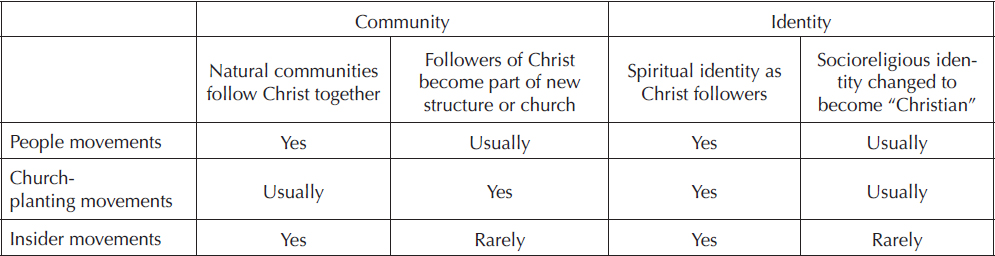
Three distinct types of movements to Christ have been described in the last century: “people movements,” “church-planting movements,” and “insider movements.”
Insider Movements
Rebecca Lewis defines insider movements as having two essential dynamics: continuing community and retained socioreligious identity. Her definition helps us see what is similar and different in the three different kinds of movements.
All three types of movements rightly claim to describe the flourishing of the gospel within preexisting social networks or natural communities. All three celebrate the hallmark of new spiritual identity as members of the kingdom of God and disciples of Jesus Christ. But there are differences when we look closely at how the two dynamics of community and identity are seen to work. Let’s consider each of the three kinds of movements with these two dynamics in mind.
People Movements
People movements were identified and studied by J. Waskom Pickett in the 1930s in India, although he called them “mass movements.” They were later analyzed and popularized by Donald McGavran in the 1950s. The basic phenomenon observed was the decision by many, or most of a community to become Christians together. Although the focus was Christ—McGavran often referred to them as “Christward movements.” Large parts of intact social networks left behind their former socioreligious affiliation and took on a traditional Christian social identity. People movements are still occurring, although they are rarely publicized.
With respect to community, people movements are famous for encouraging entire families, clans, tribes, and caste communities to become Christians together. With respect to religious affiliation and identity, they are expected to make a clear break. McGavran often spoke of the need to “Christianize” whole peoples.
Church-Planting Movements
Church-planting movements were noticed and described in the 1990s. The most prominent feature of these movements is ongoing multiplication, enhanced by a radically simple church structure and empowered by natural leaders of the community, who sustain and extend the movements of disciples making more disciples. For most practitioners, the term disciple-making movements (DMM) is interchangeable with the designation church-planting movements (CPM).
Within “reached peoples” in which there is a respected Christian identity, church-planting movements have been documented to bring millions of people to vibrant faith. They have also exploded among many unreached people settings in which they usually create new church structures. Even though the churches are usually simple house groups with nonprofessional “lay” leadership, they are often viewed by the local community as totally new social structures within the larger community. According to David Garrison, believers “make a clean break with their former religion and redefine themselves with a distinctly Christian identity.”1
RETURN TO LESSON 14: Pioneer Church Planting
Notes
1. David Garrison, “Church Planting Movements vs. Insider Movements,” International Journal of Frontier Missiology 21, no. 4 (2004): 154.