CHAPTER 102
Types of Fellowships Muslims Join or Form When They Follow Jesus
John J. Travis

John J. Travis (pseudonym) has lived and worked for more than 25 years in Muslim communities in South and Southeast Asia. He currently teaches parttime as an affiliate assistant professor at Fuller Theological Seminary. Jay and his wife Ann frequently teach, train, and coach in numerous countries on contextualization, healing prayer and sharing the good news of Jesus with Muslims. Jay is co-editor of Understanding Insider Movements: Disciples of Jesus in Diverse religious Communities.
During His life and ministry, Jesus made it clear that He came to bring salvation to the world, to be followed by all peoples.
Jesus went first to His own people, the Jewish people. They were the first to follow Him in Galilee, meeting informally in homes. After the risen Jesus ascended to heaven, His followers formed Christ-centered fellowships in Jerusalem (Acts 2:46–47; 4:32–33). They continued to observe Jewish cultural forms and holidays. They continued to meet in homes and to pray in the Jewish temple courts. Early in Jesus’s work, He approached people of a similar, but different religious community, the Samaritans. Many of them became believers in Jesus after meeting with Him in their homes for two days. The Samaritans said: “We know that this One is indeed the Savior of the world” (John 4:41–42).
Not long after, groups of gentiles began to hear about Jesus and follow Him. They were baptized, but they did not follow Jewish customs, particularly the practice of circumcision. Some of the Jewish followers of Jesus objected and demanded that followers of Jesus from gentile backgrounds must be circumcised and obey all of the law of Moses to be part of God’s people. Acts 15:1–29 tells the story of how early church leaders resolved this conflict. They came to recognize that there were different ways to follow Jesus faithfully.
Different Expressions of Faith
Since that time there have been many different expressions of following Jesus. In recent decades, one expression of faith in Christ has arisen among people with Jewish family heritage. They declare themselves to be followers of Yeshua (Jesus in Hebrew) as the Messiah. These Jesus-following Jews still observe Jewish holidays and religious forms, yet have not, for a number of reasons, taken on the religious identity of “Christian.” They do, however, see themselves as part of the global body of Christ, even though they realize that officially Judaism denies that Jesus rose from the dead and that He is the Messiah.
In our day, many Muslims worldwide are following Jesus and the kingdom that Jesus proclaimed. Many of those following Jesus, retain their Muslim identity, continuing to honor family traditions and observe Muslim holidays. Many openly share their faith in Jesus with family and friends. Other Muslims deciding to follow Jesus are joining existing Christian fellowships. Yet still other Jesus-following Muslims meet with other followers in secret, either underground or using virtual means. Still other Jesus followers with Muslim heritage are pioneering new types of fellowships that use contextual songs, dress, artwork, and musical instruments.
One factor that affects these new expressions of faith among Muslims are the common assumptions that many Muslims have about the religious identity “Christian.” Unfortunately, in many Muslim societies, “Christian” lifestyles are thought to include drinking alcohol, eating pork, dressing immodestly, being anti-Islamic, etc. For a Muslim to “become Christian” implies a rejection of family and birth community. Most Muslims turning to Christ, avoid this kind of Western lifestyle, but since that surrounding Muslim culture has these assumptions, most of them avoid using the term “Christian” to identify themselves.
One factor that affects these new expressions of faith among Muslims are the common assumptions that many Muslims have about the religious identity “Christian.”
Purpose of the C-Spectrum
The C1–C6 Spectrum (henceforth “C-Spectrum”) describes six types of Christ-centered fellowships that Muslims either join or form at the time that they choose to follow Jesus. The “C” in the C-Spectrum stands for “Christ-centered fellowships,” meaning that all of these Muslims have put their faith in Jesus Christ and are committed to following Him and obeying the Bible. Further, “Christ-centered fellowship,” represents the biblical term ecclesia, a Greek word that in biblical use means a gathering, an assembly, a congregation, or the people in a church, but never the building in which they meet.
The purpose of the C-Spectrum is to help Christian followers of Christ better recognize the various forms of worship that Christ-centered Muslims sometimes choose, as well as how they choose to identify themselves with their Muslim community of origin.
C-Spectrum Dynamics: Language, Culture, Religious Forms and Religious Labels
Fellowship types along the C-Spectrum use different languages, cultures, holidays, and ways of expressing religious identity.
The strength of social ties and family relations in many Muslim societies means most Muslims will feel lost and rootless if they lose connection with their family and community. This is why Muslims who begin to follow Jesus, pray long and hard about how to openly express their new faith in Jesus with others. The following are common questions that Muslims turning to Jesus ask:
Language? In our gatherings, will we continue to use our mother tongue? Is there a translation of the Injil (New Testament) in our own language? Will we use the same religious terms for God, Jesus, and prophets that our families have always used?
Muslims who begin to follow Jesus, pray long and hard about how to openly express their new faith in Jesus with others.
Culture? Now that we are following Christ, what aspects of our beliefs, daily customs, and traditions will we continue to practice? Will we change and why?
Muslim practices and holidays? Will we change our Muslim names, dress, diet, forms of prayer, and ways of fasting? Will we now celebrate new or different holidays, or continue to celebrate holidays with our families as we have always done?
Religious identity? With what religious identity or words will we describe ourselves? Will we take on the identity of being a Christian, or continue to refer to ourselves as “Muslims,” or create a new designation for ourselves?
The Six Different Expressions Described by the C-Spectrum
Each of the types of fellowships described here exists in Muslim-majority areas of the world. I have known followers of Jesus in all six types of fellowships. In some areas of the world, only one or two types are known to exist. In other places, sometimes in the same city, all six exist. The designations C1, C2, etc., make it easy to refer to a particular type of fellowship without lengthy explanations. The word “traditional” indicates similarity with existing Christian fellowships elsewhere. The word “contextual” indicates the use of forms and expressions closer to Muslim contexts and culture. Fellowship types on the right end of the C-spectrum are culturally closer to the Muslim community than fellowship types on the left end.
“Traditional Church” (C1): Christ-Centered Fellowship Using a Language Different from the Daily Language of Local Muslim Community
Thousands of traditional Christian fellowships or churches are found in certain Muslim-majority parts of the Middle East, Asia, and Africa. These may be Orthodox, Catholic, Protestant, or another denomination. Some of these fellowships predate Islam, such as Egyptian Coptic churches. The distinguishing features of C1 fellowships are that they use traditional Christian forms (e.g., music, liturgy, architecture, holidays), and instead of using the language spoken daily by the surrounding Muslim community, they use another language (e.g., French, English, or another trade language). Some Muslims who come to faith in Jesus and understand the language of worship being used join these traditional churches.
“Traditional Local-Language Church” (C2): Traditional Christ-Centered Fellowship Using the Language of Local Muslim Community
These fellowships are similar in form to C1, except they use the daily language of the surrounding Muslim population. Examples would be fellowships using Arabic, Turkish, Swahili, or Javanese. However, even though they use the daily language of the local Muslim population, C2 fellowships, with some notable exceptions, seldom use the same religious vocabulary as local Muslims (e.g., they do not use Isa al-Masih for Jesus Christ). In terms of religious identity, members of C1 and C2 fellowships refer to themselves as Christians or use the name of their denomination or church (e.g., Orthodox, Protestant, Catholic, Pentecostal).
“Contextual Fellowship” (C3): Contextual Christ-Centered Fellowship Using the Local Language and Non-Muslim Cultural Forms
Unlike the traditional Christian forms that characterize C1 and C2 fellowships, C3 fellowships strive to incorporate local ethnic and cultural forms in their music, dress, place of worship, and artwork. C3 groups aim to develop new and beautiful indigenous expressions of faith in Jesus. What distinguishes C3 groups from C4 is that C3 groups intentionally avoid practices that appear “Islamic” (e.g., prayer postures, Muslim terminology). As with C1 and C2 communities, C3 groups usually refer to themselves as Christians.
“Contextual Muslim-Friendly Fellowship” (C4): Contextual Christ-Centered Fellowship Using Local Language and Muslim Religious Forms
Whereas C1–C3 groups seek to avoid Islamic forms (e.g., religious terminology, holidays, diet, dress, prayer postures), C4 groups often retain them. They carefully fill these Muslim forms with biblical meanings. They do not refer to themselves as Muslims nor do they call themselves “Christians” due to unfortunate cultural implications that the term carries. C4 groups therefore refer to themselves as “followers of Jesus” or other similar terms that focus on Jesus and allegiance to Him.
“Muslim Followers of Jesus” (C5): Contextual Christ-Centered Fellowship Remaining Culturally, Socially, and Legally Part of the Local Muslim Community
C5 is quite similar in lifestyle and form to C4. The difference is that C5 fellowships, unlike C1–C4, have not intentionally removed themselves from or been forced to leave the Muslim community. Instead, they have found ways to reinterpret, marginalize, or reject certain Muslim teachings and practices, while remaining part of the Muslim religious community. This requires great tact and wisdom. God is helping many of these C5 fellowships to spiritually thrive while giving clear witness to Jesus among family and friends. Jesus followers in C5 fellowships label themselves simply as “Muslims” or “Muslims who follow Jesus” (or a similar designation).
“Catacomb Believers” (C6): Isolated Groups of Disciples of Jesus Meeting Underground or Online
C6 refers to groups of Jesus followers who are restricted in their ability to meet openly. Their circumstances may limit their ability to speak publicly about faith in Jesus. Yet many find creative ways to connect with other Jesus followers and also to share the gospel discreetly as God’s Spirit leads. Similar to C5, these Jesus followers refer to themselves as Muslims in society at large but may identify themselves in other ways when they meet in secret or online with other underground believers in Jesus.
Frequently Asked Questions About the C-Spectrum
Is there a preferred Christ-centered fellowship type along the C-Spectrum?
No. There is no preferred fellowship type along the C-spectrum. Any fellowship from C1 to C6 follows Christ just as faithfully as any other. It all depends on how seriously Scripture is studied and applied. Again, given the great variance from one Muslim family or community to another, even in the same geographical area or people group, no single type of Christ-centered fellowship is ideal for all.
Spectrum of Six Types of Christ-Centered Fellowships
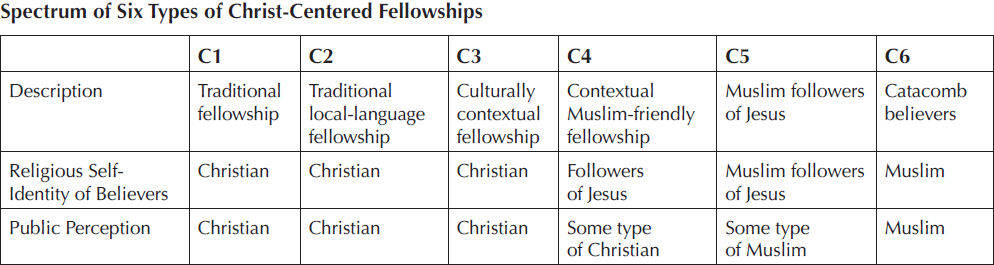
Chart adapted by the editors from Massey, “God’s Amazing Diversity in Drawing Muslims to Christ,” International Journal of Frontier Mission 17, no. 1 (2000). Used by permission.
Why are types of Christ-centered fellowships presented along a spectrum?
Presenting these different forms of fellowships together helps to compare and contrast the different types. Each type of fellowship shares some similarities with those fellowships placed closest to it along the spectrum. Even though there are six types of fellowships identified in the C-Spectrum, these should not be seen as rigid categories. In reality, it is more like a continuum with significant overlap between different types.
Is the C-Spectrum intended to be primarily prescriptive or descriptive?
The C-Spectrum is intended to be primarily descriptive. When I first designed the C-Spectrum in the 1990s, the six types of fellowships already existed. It is not intended to promote or condemn any particular form of following Jesus.
How can C5 groups remain biblical when they are still viewed as part of the Muslim community? What happens when they encounter Muslim teachings or practices that are not compatible with the Bible?
This is a frequent and important question. The answer is that as they grow in their relationship with Jesus, striving to “find out what pleases the Lord” (Eph 5:10), they are by necessity having to reject certain Muslim teachings and practices and reinterpret or marginalize others. This process is never easy and requires Holy Spirit–inspired tact, patience, winsomeness, and wisdom.
One leader of several C5 groups that my wife and I know well is a Muslim woman I will call Fatima. She is a radically committed follower of Jesus who has told us countless times that God has called her to remain in deep relationships with her family and loved ones to be a witness to Jesus among her people. As she grapples with how to obey the Lord and remain connected to family and community, she has told us that the Lord often wakes her up in the middle of the night and speaks to her, reminding her of certain passages of Scripture that she finds helpful.
With her family and friends, she openly rejects some common Muslim teachings that Jesus did not die on the cross, or that the Bible has been corrupted. In a bold yet winsome manner, she speaks with fellow Muslims, telling them that the Bible is valid, that Jesus did die and rise again, and that she has personally experienced the life transformation of new birth through Jesus. She has also rejected what are often called folk Islamic practices, such as the wearing of charms and seeking help from occult practitioners. Instead, she speaks of her confidence that Jesus is all that is needed for life’s problems. Many of her friends who have listened have come to faith in Jesus.
Many C5 groups find fresh and different interpretations of Islamic practices. For example, some C5 followers observe the thirty-day Ramadan fast, but they reinterpret the purpose and meaning of it. Instead of keeping the fast to gain spiritual merit or the forgiveness of sins, they fast in order to intercede for family, draw near to God, and as an act of community solidarity.
Finally, some beliefs are marginalized. For example, I do not hear people in C5 groups speaking ill about Muhammad or the Qur’an. To do this would likely result in their being forced out of the Muslim community. Rather they marginalize Muhammad and the Qur’an as respectfully as they can, choosing instead to tactfully turn the focus of the conversation to Jesus and the New Testament.
This process of rejecting some teachings and practices and reinterpreting or marginalizing others helps many stay free from former incorrect beliefs. But by focusing on the Bible and obeying the leading of the Spirit, they also live out the admonition for ongoing spiritual transformation as expressed in these words from Ephesians.
You were taught, with regard to your former way of life, to put off your old self, which is being corrupted by its deceitful desires; to be made new in the attitude of your minds; and to put on the new self, created to be like God in true righteousness and holiness. (Eph 4:22–24)
A Hope for the Future
As the gospel spreads more deeply and broadly among Muslims, we will see a greater number of every C-Spectrum type taking root in Muslim societies all across the world. It is my hope that Jesus followers would honor, speak well of, and pray for each other, whether they were born Muslim, or have been called to work among Muslims. May our Lord be glorified by our words and our love for one another. 