CHAPTER 97
The Spontaneous Multiplication of Churches
George Patterson

George Patterson taught in the Division of Intercultural Studies at Western Seminary in Portland, Oregon. He coached and trained missionaries to multiply churches in many areas of the world. He worked for 21 years in northern Honduras through an extension program of Theological Education and Evangelism.
Our Lord sends us to disciple every “nation” (people group) by training them to obey all His commands (Matt 28:18–20). This means that we disciple a “nation” only when it is permeated by obedient disciples who also disciple other unevangelized peoples. So we don’t fulfill the mandate by simply starting one church amidst a people. We, or those we send, must start the kind of church that grows and reproduces spontaneously as churches will, in daughter churches, granddaughter churches, great-granddaughter churches and so on. Spontaneous reproduction of churches means the Holy Spirit moves a church to reproduce daughter churches on its own without outsiders pushing the process.
I began training pastors in Honduras in a traditional theological institution and had the traditional problems for the traditional reasons. Our plan was for them to return to their hometowns as pastors, but the graduates found the gold lettering on their diplomas did not go well with the whitewashed adobe walls back home.
My supervisor had the gall to blame us teachers. He told us, “Close the school; start discipling the people.”
“Then I will be a teacher without a classroom!” I complained.
“So,” my supervisor retorted, “teach by extension.”
“What’s that?”
After a few weeks of riding a donkey from home to home to train leaders in their villages, I announced, “Hey, I can do this Theological Education by Extension (TEE) stuff. It’s great.”
My supervisor warned me, “Then your students had better rise up and pastor their own churches or we’ll close down this TEE, too.”
I initially took the pastoral training to family men (biblical “elder” types) in the povertyridden villages, mountains, and cities. Unlike their single young sons, they had crops, jobs or family responsibilities that kept them from going off to our resident Bible school. They also lacked the education to absorb its intensive teaching. But these older men, with roots in their villages and barrios, could begin pastoring with the respect of their people much easier than the single young people could. As will be the case in many of today’s remaining unreached fields, we began to see growth not through any one church growing big or fast, but through the slow, steady reproduction of many small churches.
We conscientiously applied New Testament discipling principles, and found this enabled many churches to reproduce new churches in Honduras and many other fields. Our field testing of programs based on these principles have consistently given good results in Latin America and Asia, including hostile fields where evangelism is illegal.
We learned to distinguish these general principles from culture-specific applications. Biblical principles themselves, if applied with culturally relevant methods, should enable churches to reproduce wherever there is plenty of “good soil.” Theologically speaking, the good soil needed for the gospel seed to take root and multiply is bad people, and lots of them (Matt 13:18–23; Eph 2:1–10).
Missionary or not, one can multiply disciples by doing these four simple things:
1. Know and love the people you disciple.
2. Help disciples to make other disciples.
3. Teach and practice obedience to Christ.
4. Help churches build up and multiply other churches.
1. Know and Love the People You Disciple
We must know and love a people before we can disciple them. When Jesus told His disciples to “look at the fields,” they were finding it hard to love the Samaritans around them. They could not see them receiving God’s grace.
Limit Your Area of Responsibility to One People or Community
We must focus on one people group, the one God has given us. Paul knew his area of responsibility before God (2 Cor 10:12–16; Acts 16:6–10; Gal 2:8). He knew what kind of churches to plant and where. For a movement of church reproduction, a church-planting team needs a clear focus from God. My area was the Spanish-speaking people of the Aguan Valley and surrounding mountains. It helps to be exact.
Choosing your people in a new field needs study and prayer. Confer with other missionaries, local leaders, and God Himself for guidance.
Knowing a people means touching the heart of individuals. Laughing with those who laugh. Weeping with those who weep. Playing marbles with two-year-old Chimbo and checkers with his grandpa (or whatever they play in the town square). It may help if you let him beat you. This applies to arguing religion, too. It’s dangerous always to be “right” when you’re the new kid on the block. Learn to appreciate the people and their ways, even the toothless old men. Listen and learn until you have discovered those things in their folk religion or culture that help communicate the gospel.
Let the Church Be of the Culture
I hope it takes you less time than it took me to learn that formal pulpit preaching is ineffective (and often illegal) in many of today’s remaining unreached places. You can preach God’s word with power in many other ways if you know your people. We used dramatic Bible reading, songs with music and lyrics composed by nationals, poems, symbols, and storytelling. They sang with more enthusiasm when they composed songs in the local style.
Know exactly what you are aiming at within the community: a well-defined body of obedient disciples of Jesus Christ. Then, you can help the new church to embrace its identity. There must be a majority from the community itself, especially at the first baptism or worship meetings, or the church is not born as a distinct entity within the community. Otherwise new followers will feel that they have simply been added to some new organization run by the outsiders. I initially robbed the new followers of the thrill of looking at each other and saying, “We are now the church here!” They must see the new church being born as a part of their community.
What Will You Do to Reproduce Disciples?
Let’s assume you research all the factors well: race, culture, logistics, urban versus rural backgrounds, language similarities, education, and economic levels, etc. You learn the language. Then you go to your new field with a team of church planters, as similar to the local people as possible in every aspect. Some or all of the church planters may be from another culturally or economically similar culture. You are happy because they do not have to make that long cultural leap that delays church planting by years. You finally arrive, unpack your toothbrush, take a deep breath, pray, step out the door and find fifty thousand people living around you who have all sorts of misconceptions about Jesus. Now what?
What you do first often determines the direction of your work, for good or bad, for years to come. Will it lead to reproducing churches? Each place will vary, but the best first steps will always include teaching the new followers to obey Jesus’s commands (Matt 28:18–20). Take the shortest route possible to start a real church: a group of believers in Christ, dedicated to obeying His commands. In a new field, it can start small, perhaps with only three or four members. It will grow if you disciple the people as Jesus said.
At this early stage, avoid institutions (such as community development programs unrelated to church planting, schools, clinics, etc.) if possible. It’s best to let these come later. In Honduras we established community development work, but it grew out of the churches, not vice versa. We taught obedience to the great commandment of loving our neighbor in a practical way. A poverty program can aid church planting if the two are integrated by the Holy Spirit. But churches dependent on charitable institutions are almost always dominated by the foreign missionary and seldom reproduce.
To start a church that will multiply in the normal way in a new untouched place with no experienced pastors nor organized churches, these are the normal steps (change them where local circumstances require it):
1. Present the gospel message first to male heads of house-holds in a way that they can easily imitate. We often told them Bible stories they could pass on immediately to their own family and friends, even before they made a commitment to following Christ. We went with them to show them how. Why male heads of families? We worked in a macho culture (right where the word macho came from, where men carried sharpened machetes and used them readily). Female leadership, right or wrong, limited the outreach of brand-new works in our area.
2. Baptize all repentant believers without delay (entire families when possible). At first I was reluctant to baptize new followers. I delayed baptism in a misplaced desire to make sure that they were “safe” and would not fall away. I soon saw, though, that the very reason many fell away was my distrust. That’s the funny thing about God’s grace; He wants us to let it spill over on the unworthy (Rom 5:20–21).
3. Encourage a style of worship that new elders-in-training can lead and teach to others. Don’t invite the public until local leaders can lead the gatherings. Celebrate the Lord’s Supper regularly as the center of worship, especially until local leaders are mature enough to present messages in an edifying, humble way.
4. Organize a provisional group of elders as soon as mature people come to faith. Mentor these leaders in how to pastor their own people right away. Remember, this is for pioneer fields with neither experienced pastors nor well-organized churches. We, like Paul, must use the best people God gives as the churches multiply, or the new disciples have no leadership at all (Acts 14:23).
5. Enroll these new elders-in-training as pastors on the job. Don’t remove them from their people for training. Meet with them every two or three weeks (more often if possible) until they are fully able to mentor and equip their members to serve others and make disciples.
2. Encourage Disciples to Build Up Other Disciples
Mobilize your disciples immediately to encourage and encourage and nurture those they are discipling. To build up the church as a living, reproducing body, Paul instructs pastors and teachers to train the members of the church for the ministry, to edify the body of Christ (Eph 4:11–12).
Build Loving Relationships with the Leaders You Disciple
Like most new missionaries, I took myself too seriously. I worried about what my disciples were doing. It took me years to learn to sit back, laugh at my own goofs, and trust the Holy Spirit to do His work in my students. How can we enable the leaders we train to edify each other and their people through personal, loving relationships?
Paul left his disciple Timothy behind to work with the elders in newly planted churches with these instructions: “The things which you have heard from me . . . entrust these to faithful people who will be able to teach others also” (2 Tim 2:2 NASB). How dynamic and reproductive is this loving “Paul-Timothy” relationship between teacher and student! If you have not yet tried to teach the way Jesus and His apostles did, you are in for a blessing. If it frightens you, start with just one or two potential leaders. Train them on the job; make sure they have what they need to be effective in ministry. Personal discipling does not mean “one-on-one” (Jesus taught twelve), nor is it just to deal with personal needs. (Jesus spent most of His time personally discipling the top-level leaders of the church, the very apostles.)
In Honduras I usually taught from one to three students in a way they could imitate and pass on to others immediately. I helped each one have an effective ministry. I taught and modeled what he would pass on to his own people and his own pastoral trainees in the daughter or granddaughter churches. These taught other elders who taught still others as Paul instructed Timothy. The chain grew to over a hundred pastors in training, all elders of churches. As soon as a new church was born, the outside worker enrolled a local leader, normally an elder highly respected by his people, and began passing on to him the same doctrine and materials as he was receiving himself. This new “Timothy” taught the rest of the new elders in his young church. It kept multiplying as long as each discipler did everything in a way his students could imitate immediately. I stopped teaching and preaching in the professional way in which I was used to (they admired it but could not imitate it). I stopped using electronic equipment including movies and anything else that was not available to all our workers. That’s hard on a technology-oriented Westerner used to gadgets and conditioned to using the very latest technology.
Once we developed loving, Paul-Timothy discipling relationships, we seldom had to discuss church planting. The Holy Spirit channeled the word of God through these relationships to mobilize the people like Timothy and church reproduction took care of itself. At first I failed to trust the Holy Spirit and pushed the men myself. I dictated rules and prerequisites to keep the doctrine and the church pure and to make sure the men did their job. It stifled the work; one bitter failure followed another. I prayed, “Lord, I don’t want a big ministry of my own; just let me help the Hondurans have a good ministry.” God answered this prayer. I also learned through disappointments to let the people themselves decide on their own leaders, using 1 Timothy 3:1–7.
We learned not to plant the churches first then train the leaders for them; nor did we train the leaders first then tell them to raise up their churches. We married the two efforts to form one ministry.
Before I learned to imitate the way Christ and His apostles discipled, I was satisfied if my student answered test questions correctly and preached good sermons in the classroom. I neither saw nor cared what he did in his church with what he was learning. I slowly learned to see beyond my student to his work with his people. I responded to the needs of his church by listening at the beginning of each session to the reports of my students. Then I often set aside what I had prepared and instead taught what each student’s people needed at that time.
It was hard at first to let the developing churches’ needs and opportunities dictate the order of a functional curriculum. In time much of my discipling, like the teaching of the Epistles, became problem solving. Yes, if we start reproductive churches, then we will have problems. The apostles did, too. If you want to avoid problems, don’t have children and don’t try planting churches.
Encourage Edifying Teaching Relationships between Leaders and Their Disciples
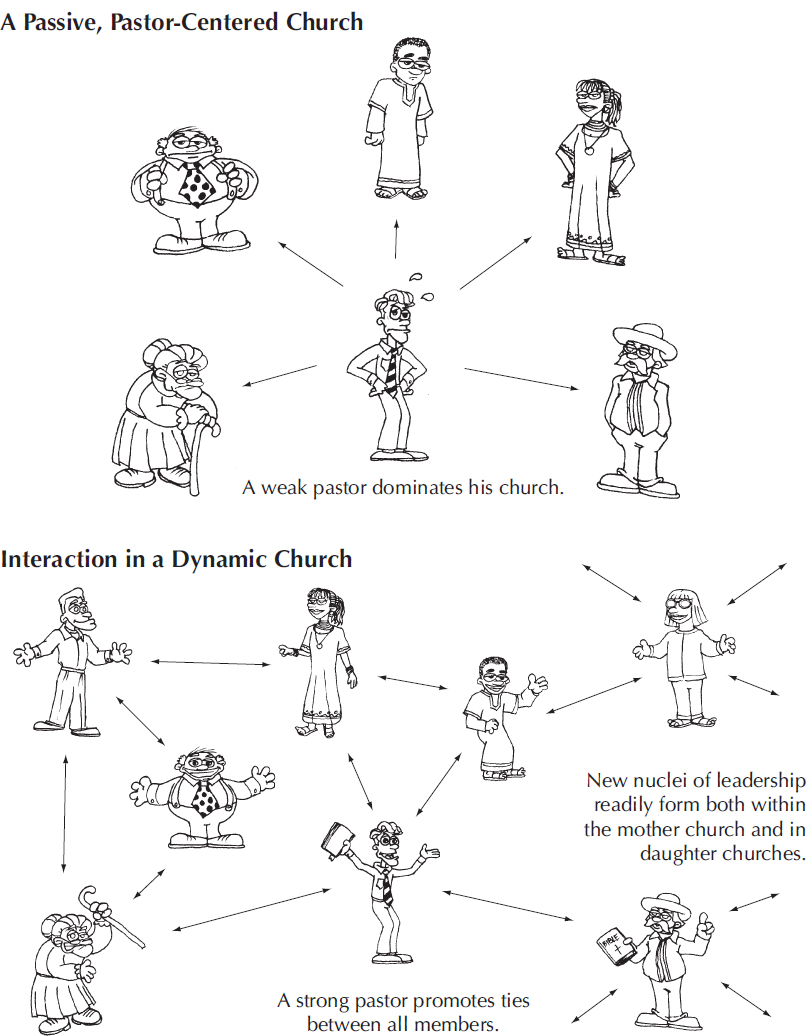
The pastor or leading elder sets the example for all the leaders. They in turn enable all the members of an infant congregation to minister to each other in love. A weak pastor dominates his congregation. He tries to do everything or delegates it in a demanding way. This is like herding sheep rather than leading people (both Jesus and Peter prohibit herding in a demanding way: Matt 20:25–28; 1 Pet 5:1–4). Where do you suppose pastors on the mission field pick up the bad practice of herding others? It’s not all cultural; they learned it from us missionaries. I furnished the only model the new pastors had in our pioneer field. Because of my superior education and resources, I made the decisions for my less educated colleagues. At the same time, like most new missionaries, I felt insecure and over-protected the first churches. A strong missionary, like a strong pastor, does not fear to give authority and responsibility to others. He does not force gifted, willing workers into existing slots in his organization, but rather builds ministries around them.
3. Teach Obedience to Christ
Above and before all else, teach and practice obedience to Jesus’s commands in love. After affirming His deity and total authority on earth, Jesus commissioned His church to make disciples who obey all His commands (Matt 28:18–20). His commands take priority over all other institutional rules. This obedience is always motivated by love for Christ. If we obey God for any other reason, it becomes sheer legalism. God hates that.
Start Right Out with Loving Obedience to Jesus’s Basic Commands
To plant churches in a pioneer field, aim for each community to have a group of believers in Christ committed to obeying His commands. This definition of a church might get a D minus where you studied theology, but the more you add to it, the harder it will be for the churches you start to reproduce. We asked our converts to memorize this list of Christ’s basic commands:
1. Repent and believe (Mark 1:15)
2. Be baptized and continue in the new life it initiates (Acts 2:38; Rom 6:1–11)
3. Love God and neighbor in a practical way (Matt 22:37–40)
4. Celebrate the Lord’s Supper (Luke 22:17–20)
5. Pray (Matt 6:5–15)
6. Give (Matt 6:19–21; Luke 6:38)
7. Disciple others (Matt 28:18–20)
Memorize them. You can neither be nor make obedient disciples unless they are basic to your Christian experience. They are the ABCs of both discipling and church planting.
Define Evangelism and Theological Education Objectives in Terms of Obedience
Make obedient disciples. Only disciples who obey Christ produce a church that multiplies within a culture. Consider the two commands: “Repent and believe” and “Be baptized.” In Western culture a person stands alone before his God and “decides” for Christ, but in other cultures, sincere conversion needs interaction with family and friends. Faith, repentance, and immediate baptism of the entire family or group—no invitation to make a decision—is the norm (Acts 2:36–41; 8:12; 10:44–48; 16:13–15, 29–34; 18:8). Repentance goes deeper than a decision; it is a permanent change wrought by God’s Spirit. We are born all over again. Few purely intellectual decisions in any culture lead to permanent, obedient discipleship.
Only disciples who obey Christ produce a church that multiplies within a culture.
We found that when we baptized repentant believers reasonably soon, without first requiring a lengthy doctrinal course, the great majority then responded to our training with obedient discipleship. The detailed doctrine came later. Teaching heavy theology before one learns loving, childlike obedience is dangerous. It leaves a person assuming that Christianity is having scripturally correct doctrine and they leave it at that. They become a passive learner of the word rather than an active disciple.
We taught our pastors to orient all church activity to New Testament commands. As they taught the word of God, they accustomed their people to discern three levels of authority: New Testament commands, apostolic practices, and human traditions. With New Testament commands uppermost, including the commands given by Jesus’s apostles, there is always an emphasis on serving Christ. The second level of authority, apostolic practices, provides helpful examples and patterns. We have liberty to follow them, but we do not prohibit them. Human traditions are evaluated and valued for what they are.
Three Levels of Biblical Authority George Patterson
To help obedience-oriented churches multiply, it is very useful to distinguish and prioritize three different levels of authority:
1. New Testament Commands: These carry all the authority of heaven. They include the commands of Jesus that are expressed by the apostles in the New Testament. We don’t vote on them or argue about doing them. They always take precedence over any human organization’s rules.
2. Apostolic Practices (not commanded): We cannot enforce these as laws because Christ alone has authority to make laws for His own church, His body. Nor can we prohibit their practice because they have apostolic precedent. Examples include: holding possessions in common, laying hands on converts, celebrating the Lord’s Supper frequently in homes using one cup, and baptizing on the same day of conversion.
3. Human Customs: Practices not mentioned in the New Testament have only the authority of a group’s voluntary agreement. If it involves discipline, the agreement is recognized in heaven (but only for that congregation; we do not judge another congregation by the customs of our own: Matt 18:15–20). The sequence in which you select items on the training menu should be based primarily on what you hear. Everything depends on the readiness of the teacher to listen to what the present needs and growth struggles are.
Nearly all church divisions and quarrels originate when a power-hungry person seeking followers puts mere apostolic practices or human customs (levels 2 or 3 of authority) at the top level as law.
We created a simple pastoral training curriculum guide in which the student’s expressed needs determined the order in which topics were studied. The sequence in which the mentor selects items on the training menu should be based primarily on what the mentor hears in the reports of the person being trained. Everything depends on the readiness of the teacher to listen to the present needs and growth struggles of the students.
Based on the seven general commands of Christ (listed earlier), we had a menu of ministries that included subjects like evangelism, prayer, giving, pastoral care, teaching, loving neighbors, building character, counseling, worship, reproducing daughter churches and mission. For each subject, the teaching included all major areas of Bible, doctrine, and church history wherever they best helped the church at the time. By keeping theological education linked to points of obedience to Christ, we avoided merely teaching topics. In this way, our theological training was always focused on training them to obey Christ within areas of the student’s felt need.
4. Help Churches Build Up and Multiply Other Churches
Healthy daughter churches need loving, encouraging discipling relationships within their own church and with the mother church (Acts 11:19–30; 14:21–28; 15:1–2, 28–31). If your church, church-planting, or training organization is already established but did not include mentoring relationships, add this personal discipling to it. However, don’t insist on abruptly changing all of your current ways of operating overnight.
Help Each New Church to Reproduce
Each church should send workers to reproduce daughter churches. In Ephesians 4:1–12 God has promised to give “apostles” to every church (by apostles let’s assume that it means “sent ones” in a general sense). These “apostles” are the ones God places in every church that have itchy feet for carrying the church’s DNA to new areas. The longer you wait to mobilize a church for multiplication, the harder it is to reprogram its thinking. Teach your people the joy of leaving their own people, to extend Christ’s kingdom into pioneer fields. After prayer and perhaps fasting, hold a formal separation service with laying on of hands, as the Antioch church did. Remember, it is not the individuals that reproduce, but congregations that pray and are moved by the Holy Spirit. Let each new church be a link in the chain.
Ask the new church leaders to develop their own plans. They must take the initiative. Don’t push your plans on them; simply teach them what the Bible says about their task and let them respond. For example, we asked our pastors to draw a large map with arrows to the villages that they planned for their church to reach directly or through their daughter or granddaughter churches. Their church workers then signed their names by those towns or neighborhoods for which they would pray and plan.
Show Each New Believer How to Witness to Friends and Relatives
The Holy Spirit flows readily through the bonds that exist between family members and close friends (Acts 10:24, 44). Keep new Christ followers in a loving relationship with them (don’t pull them out of their circle to put them in a safe Christian environment, or those very bonds which aid the spread of the gospel become barriers).
We prepared simple gospel studies (mostly Bible stories) that even people who could not read could use at once to share their new faith. We accompanied them to demonstrate it, modeling it all in a way they could immediately imitate.
Build Loving Interchurch Discipling Relationships
At first I applied church “body life” only to local congregations. Then I learned to build interchurch discipling relationships with accountability. Elders in one church sacrificially discipled less experienced pastors in the daughter or granddaughter churches.
Sometimes travel was difficult for an older elder, and the main worker from the daughter church rode his horse to the mother church every two weeks or so. Where the churches were one or two days’ walk apart, the teacher and student took turns slogging through the muddy trails.
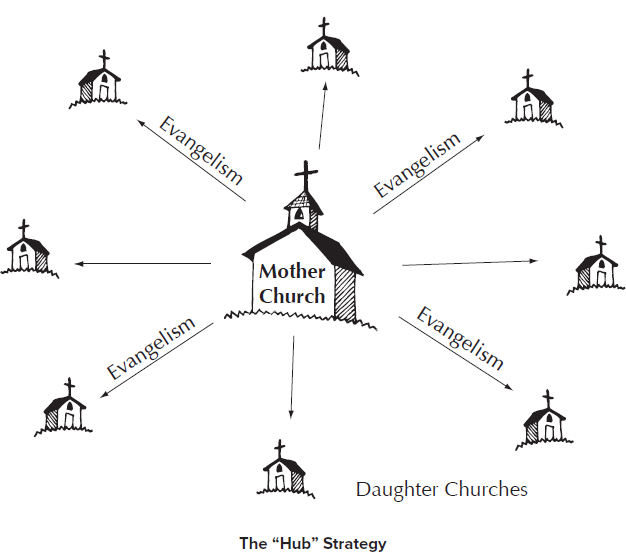
Beware of the bad strategy of a mother church sending workers to several daughter churches at once, as though she were the only church with God’s reproductive power.
The “hub” strategy (see diagram) wears out the workers and discourages the mother church. God’s power, inherent in all churches in which His Spirit dwells, enables a mother church to start a daughter church and train its new elders to help it develop and reproduce in granddaughter churches. Just disciple the disciplers and watch it happen!
The chain was not a hierarchy to control, like a military chart of a chain of command. Volunteer teachers simply worked with volunteer students. It took sweat and guts to build these loving ties between churches, helping people to know, love and train each other for immediate pastoral ministry. In the process some volunteer ministers were shot, put to death by machete, weakened by disease, and almost drowned. It was worth it.
The modern missionary’s most common sin is controlling the national churches. I had to learn to keep out of the way and let the Spirit’s power inherent in the churches produce the ministries by which the churches were edified and reproduced. I guided, encouraged, taught God’s word, and counseled, but I no longer pushed. Then we saw the chain reaction: one of the extension networks produced five generations and over twenty churches.
We met occasionally to reaffirm our plans and decide which church would reach certain villages or communities. We divided our entire area of responsibility into nine regions and planned the steps to start a daughter church that would reproduce in each region. The pastoral students of the Honduras Extension Bible Institute have for many years been starting an average of five new churches a year, each of which has from one to three new pastors in training. After turning the leadership of this program over to Hondurans, it has continued to reproduce in spite of other missionaries’ pressure to revert to traditional pastoral training methods.
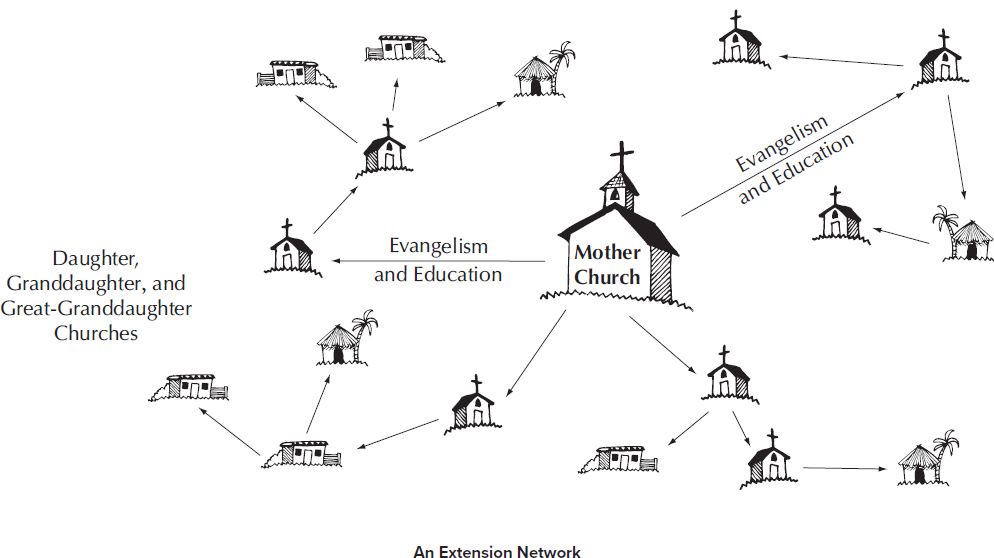
Extension networks help daughter churches reproduce granddaughter churches.
When a chain gets too long for good communication, simply reorganize the teaching relationships. Don’t assume that doctrine will get watered down the longer the chain. Each Spirit-filled teacher in the chain has the same love for the word and will rejuvenate the flow. I discovered that the strongest churches were usually one or two links removed from me, the foreign missionary. The key to maintaining the chains is to have loving communication in both directions. Accurate student reports from each daughter church are essential for the teacher to respond, applying God’s word accurately to its life, needs, and opportunities.
Pray for protection from traditions that hamper this spontaneous reproduction. We have mentioned teaching that neglects discipleship and failure to help newly repentant converts to obey, beginning with baptism. Another almost universal impediment to reproduction is a missionary subsidy that stifles nationals’ own giving and builds a dependent spirit. Don’t rob poor believers of the blessing of sacrificial giving! God multiplies their offering by special celestial mathematics that will prosper them now and for eternity. Paying national pastors with outside funds nearly always stifles spontaneous reproduction and eventually leads to deep resentment when the source no longer equals the demand.
Pray for Reproduction Power
Like a grain of wheat, each new church in a chain has the same potential to start the reproduction all over again. Christ’s parables in Matthew 13, Mark 4, and John 15 compare the growth and reproduction of His churches to that of plants. Like all other living creatures God has created, the church has its own seed in itself to reproduce after its own kind. Every time we eat, we eat the fruit of God’s tremendous reproduction power given to plants and animals. Look around out of doors; it’s everywhere—grass, trees, birds, bees, babies, and flowers. All creation is shouting it! This is the way God works! Reproduction is His style. Pray for it! (God in His infinite wisdom acts a bit lazy when we don’t ask Him to move; He limits His absolute power to our weak faith!) We ourselves don’t make the church grow or reproduce any more than pulling on a stalk of corn would make it grow. Paul plants, Apollos waters, God gives the growth (1 Cor 3:6). We sow, water, weed, fertilize, and fence the crop, but rely on the church’s own God-given potential to reproduce. An obedient, Spirit-filled church has to reproduce at home or abroad. It’s the church’s very nature as the body of the risen, life-giving Son of God. 
CONTINUE READING Sidebar: Three Levels of Biblical Authority