CHAPTER 96
Plain Talk about a Difficult Subject
Donald A. McGavran

Donald A. McGavran was born in India of missionary parents and later returned there as a third-generation missionary in 1923, serving as a director of religious education and translating the Gospels in the Chhattisgarhi dialect of Hindi. He founded the School of World Mission at Fuller Theological Seminary and was formerly dean emeritus. McGavran was the author of several influential books, including The Bridges of God, how Churches Grow, and Understanding Church Growth.
The goal of Christian mission should be to preach the gospel and, by God’s grace, to plant in every unchurched segment of humankind a cluster of growing churches. The goal is not one small sealed-off conglomerate congregation in every people. Rather, the long-range goal (to be held constantly in view in the years or decades when it is not yet achieved) should be, “a cluster of growing congregations in every segment.”
The Conglomerate Church Approach
As we consider the question of how to plant clusters of growing churches, we should remember that it is usually easy to start one single congregation in an unchurched people group. The missionary arrives. He and his family worship on Sunday without local people. They are the first members of that congregation. He learns the language and preaches the gospel. He lives like a Christian. He tells people about Christ and helps them in their troubles. He sells tracts and gospels or gives them away. Through the years a few individual converts have been won from this group and that. Sometimes they may come for very sound and spiritual reasons; sometimes from mixed motives. But here and there a woman, a man, a boy, a girl do decide to follow Jesus.
One single congregation arising in the way just described is almost always a conglomerate church—made up of members of several different segments of society. Some are old, some young, orphans, rescued persons, helpers, and ardent seekers. All seekers are carefully screened to make sure they really intend to receive Christ. In due time, a church building is erected, and lo, a church in that people. It is a conglomerate church. It is sealed off from most people groups of that region. No segment of the population says, “That group of worshipers is us.” They are quite right. It is not. It is ethnically quite a different social unit.
Slow to Grow
This very common way of beginning the process of evangelization is a slow way to disciple the peoples of earth—note the plural: “the peoples of earth.” Let us observe closely what really happens as this congregation is gathered. Each new follower, as they become a Christian, is seen by their kin as one who leaves “us” and joins “them.” They leave our gods to worship their gods. Consequently, their own relations force them out. Sometimes they are severely ostracized, thrown out of house and home; their life is threatened. Hundreds of followers have been poisoned or killed. Sometimes the ostracism is mild and consists merely of severe disapproval. Their people consider them traitors. A church that results from this process looks to the peoples of the region like an assemblage of traitors. It is a conglomerate congregation. It is made up of individuals, who, one by one, have come out of several different societies, castes, or tribes.
Now if anyone, in becoming a Christian, is forced out of, or comes out of, a tightly structured segment of society, the Christian cause wins the individual but loses the family. The family, the new believer’s people, and the neighbors of that tribe are often fiercely angry at him or her. They are the very men and women to whom he or she cannot talk. “You are not of us,” they say to them; “You have abandoned us. You like them more than you like us. You now worship their gods, not our gods.” As a result, conglomerate congregations, made up of converts won in this fashion, grow very slowly. Indeed, one might truly affirm that where congregations grow in this fashion, the conversion of the ethnic units (people groups) from which they come is made doubly difficult. “The Christians misled one of our people,” the rest of the group will say. “We’re going to make quite sure that they do not mislead any more of us.”
Easy for Missionaries
“One by one” is relatively easy to accomplish. Perhaps ninety out of every hundred missionaries who intend church planting get only conglomerate congregations. I want to emphasize that. Perhaps ninety out of every hundred missionaries who intend church planting get only conglomerate congregations. Such missionaries preach the gospel, tell of Jesus, sell tracts and gospels, and evangelize in many other ways. They welcome inquirers, but whom do they get? They get a man here, a woman there, a boy here, a girl there, who for various reasons is willing to become Christian and patiently endure the mild or severe disapproval of their people.
Ineffective in Unreached Peoples
If we are to understand how churches grow or do not grow amidst unreached peoples, we must note that the process I have just described seems unreal to most missionaries. “What,” they will exclaim, “could be a better way of entry into all the unreached peoples of that region than to win a few individuals from among them? Instead of resulting in the sealed-off church you describe, the process really gives us points of entry into every society from which a convert has come. That seems to us to be the real situation.”
Those who reason in this fashion usually have known church growth in a largely Christian land, where men and women who follow Christ are not ostracized or regarded as traitors, but rather, as those who have done the right thing. In that kind of society, every convert usually can become a channel through which the Christian faith flows to his relatives and friends.
The People Movement Approach
Let us now consider another way that God is using to disciple the peoples of planet Earth. My account is not theory, but a sober recital of observable facts. As you look around the world, you see that while most missionaries succeed in planting only conglomerate churches by the “one by one out of the social group” method, here and there clusters of growing churches arise by the people movement method. They arise by tribe- or caste-wise movements to Christ. This is in many ways a better approach. To use it effectively, missionaries should operate on seven principles.
1. Aim for a Cluster of Growing Congregations
They should be clear about the goal. The goal is not one single conglomerate church in a city or a region. They may get only that, but that must never be their goal. The goal must be a cluster of growing, indigenous congregations, every member of which remains in close contact with their kindred. This cluster grows best if it is in one people, one caste, one tribe, or one segment of society. For example, if you were evangelizing the taxi drivers of Taipei, then your goal would not be to win some taxi drivers, some university professors, some farmers, and some fishermen, but rather to establish churches made up largely of taxi drivers, their wives and children, and their assistants and mechanics. As you win disciples in that particular community, the congregation has a natural, built-in social cohesion. Everybody feels at home.
2. Concentrate on One People
The principle is that the national leader or the missionary should concentrate on one people. If you are going to establish a cluster of growing congregations amongst, let us say, the Nair people of Kerala, which is the southwest tip of India, then you would need to place most of your missionaries and evangelists so they can work among the Nairs. They should proclaim the gospel to Nairs, saying quite openly to them, “We are hoping that within your great caste there soon will be thousands of followers of Jesus Christ who also remain solidly in the Nair community.” They will, of course, not worship the old Nair gods, but then plenty of Nairs don’t worship their old gods. Plenty of Nairs are Communists and ridicule their old gods.
The Nair people whom God calls, who choose to believe in Christ, will love their neighbors more than they did before and will walk in the light. They will be saved and beautiful people. They will remain Nairs, while at the same time becoming Christians. To repeat, concentrate on one people group. If you have three missionaries, don’t have one evangelizing this group, another that, and a third two hundred miles away evangelizing still another. That is a sure way to guarantee that any churches started will be small, non-growing, one-by-one churches. The social dynamics of those sections of society will work solidly against the eruption of any great growing people movement to Christ.
3. Encourage Christ-Followers to Remain with Their People
The principle is to encourage Christ-followers to remain thoroughly one with their own people in most matters. They should continue to eat what their people eat. They should not say, “My people are vegetarians, but now that I have become a Christian, I’m going to eat meat.” After they become Christians they should be more rigidly vegetarian than they were before. In the matter of clothing, they should continue to look precisely like their kinsfolk. In the matter of marriage, most peoples are endogamous, insisting that “our people marry only our people.” They look with very great disfavor on “our people marrying other people.” And yet when Christians come in one by one, they cannot marry their own people, because none of them have become Christian. In a place where only a few of a given people become Christians, they have to take husbands or wives from other segments of the population when it comes time for them or their children to marry. So their own kin look at them and say, “When you become a Christian you mongrelize your children. You have left us and have joined them.”
All Christ-followers should be encouraged to bear cheerfully the exclusion, the oppression, and the persecution that they are likely to encounter from their people. When anyone becomes a follower of a new way of life, they are likely to meet some disfavor from their loved ones. Maybe it’s mild; maybe it’s severe. They should bear such disfavor patiently. They should say on all occasions:
I am a better son/daughter than I was before; I am a better father/mother than I was before; I am a better husband/wife than I was before; and I love you more than I used to do. You can hate me, but I will not hate you. You can exclude me, but I will include you. You can force me out of our ancestral house, but I will live on its veranda. Or I will get a house just across the street. I am still one of you; I am more one of you than I ever was before.
Encourage Christ-followers to remain thoroughly one with their people in most matters. Please note the word “most.” They cannot remain one with their people in idolatry or drunkenness or obvious sin. If they belong to a segment of the society that earns its living by stealing, they must “steal no more.” But, in most matters (how they talk, how they dress, how they eat, where they go, what kind of houses they live in), they can look very much like their people and ought to make every effort to do so.
4. Encourage Group Decisions for Christ
The principle is to try to get group decisions for Christ. If only one person decides to follow Jesus, do not baptize them immediately. Say to them, “You and I will work together to lead another five, or ten, or God willing, fifty of your people to accept Jesus Christ as Savior so that when you are baptized, you will be baptized with them.” Ostracism is very effective against one lone person. But ostracism is weak indeed when exercised against a group of a dozen. And when exercised against two hundred it has practically no force at all.
5. Aim for a Constant Stream of New Christ-Followers
The principle is this: Aim for scores of groups of that people to become Christians in an ever-flowing stream across the years. One of the common mistakes made by missionaries, Eastern as well as Western, all around the world is that when a few become Christians, perhaps one hundred, two hundred, or even one thousand, the missionaries spend all their time teaching them. They say to themselves, “If these people become good Christians, then the gospel will spread.” So for years, they concentrate on a few congregations. By the time they begin evangelizing outside that group, ten to twenty years, the rest of the people no longer want to become Christians. That has happened again and again. This principle requires that, from the very beginning, the missionary keeps on reaching out to new groups. “But,” you say, “is not this a sure way to get poor Christians who don’t know the Bible? If we follow that principle, we shall soon have a lot of ‘raw’ Christians. Soon we shall have a community of perhaps five thousand people who are very sketchily Christian.”
Yes, that is certainly a danger. At this point, we must lean heavily upon the New Testament, remembering the brief weeks or months of instruction Paul gave to his new churches. We must trust the Holy Spirit and believe that God has called those people out of darkness into His wonderful light. Between the two evils of giving them too little Christian teaching or allowing them to become a sealed-off community that cannot reach its own people, the latter is much the greater danger. We must not allow new Christ-followers to become sealed off. We must continue to make sure that a constant stream of new Christ-followers comes into the ever-growing cluster of congregations.
6. Help Christ-Followers Exemplify the Highest Hopes of Their People
The point is this: The disciples, whether five or five thousand, ought to say, or at least feel:
We Christians are the advance guard of our people, of our segment of society. We are showing our relatives and neighbors a better way of life. The way we are pioneering is good for us who have become Christians and will be very good for you thousands who have yet to believe. Please look on us not as traitors in any sense. We are better sons, brothers, and wives, better tribesmen and caste fellows, better members of our labor union than we ever were before. We are showing ways in which, while remaining thoroughly of our own segment of society, we all can have a better life. Please look on us as the pioneers of our own people entering a wonderful promised land.
7. Emphasize Brotherhood
The principle I stress is this: constantly emphasize brotherhood. In Christ, there is no Jew, no Greek, no bond, no free, no barbarian, no Scythian. We are all one in Christ Jesus. But at the same time, let us remember that Paul did not attack all imperfect social institutions.
Paul also said in that famous passage emphasizing unity, “There is no male or female” (Gal 3:28). In Christ, there is no sex distinction. Boys and girls are equally precious in God’s sight. People from this tribe, and from that, are equally precious in God’s sight. We are all equally sinners, equally saved by grace. These things are true, but at the same time, there are certain social niceties that Christians at this time may observe.
As we continue to stress brotherhood, let us be sure that the most effective way to achieve brotherhood is to lead ever-increasing numbers of men and women from every ethnos, every tribe, every segment of society into an obedient relationship to Christ. As we multiply Christians in every segment of society, the possibility of genuine brotherhood, justice, goodness, and righteousness will be enormously increased. Indeed, the best way to get justice—possibly the only way to get justice—is to have very large numbers in every segment of society become committed Christians.
As we work for Christward movements in every people, let us not make the mistake of believing that “one by one out of the society and into the church” is a bad way. One precious soul willing to endure severe ostracism in order to become a follower of Jesus, one precious soul coming all by himself, is a way that God has blessed and is blessing to the salvation of humankind. But it is a slow way. And it is a way that frequently seals off the converts’ own people from any further hearing of the gospel.
Sometimes one by one is the only possible method. When it is, let us praise God for it, and live with its limitations. Let us urge all those wonderful new Christians who suffer persecution and oppression, to pray for people dear to them and to work constantly so that more of their own people may believe and be saved.
One by one is one way that God is blessing the increase of His church. The people movement is another way. The greatest advances of the church on new ground out of non-Christian religions have always come by people movements, never one by one. It is equally true that “one by one out of the people” is a very common beginning way. In the book Bridges of God, which God used to launch the church growth movement, I have used an illustration. I say that missions start out proclaiming Christ on a desertlike plain. There, life is hard; the number of Christians remains small. A large missionary presence is required. But, here and there, the missionaries or the Christ-followers find ways to break out of that arid plain and proceed up into the verdant mountains. There, large numbers of people live; there, great churches can be founded; there, the Church grows strong; that is people movement land.
The greatest advances of the church on new ground out of non-Christian religions have always come by people movements, never one by one.
I commend this picture to you. Let us accept what God gives. If it is one by one, let us accept that and lead those who believe in Jesus to trust in Him completely. But let us always pray that, after that beginning, we may proceed to higher ground, to more verdant pasture, to more fertile lands where great groups of men and women, all of the same segment of society, become Christians and thus open the way for Christward movements in each people on earth. Our goal should be Christward movements within each segment. There the dynamics of social cohesion will advance the gospel and lead multitudes out of darkness into His wonderful life. We are calling people after people from death to life. Let us make sure that we do it by the most effective methods. 
RETURN TO LESSON 14: Pioneer Church Planting
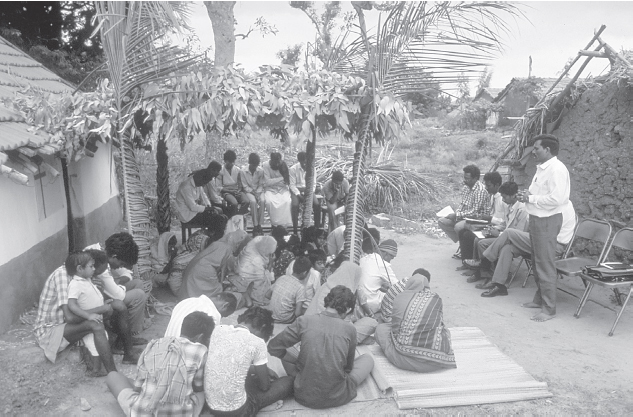
Photo courtesy of the International Mission Board, Richmond, VA.