CHAPTER 74
Finding a Place and Serving Movements within Society
Paul G. Hiebert

Paul G. Hiebert was chairman of the Department of Mission and Evangelism and professor of mission and anthropology at Trinity Evangelical Divinity School. He previously taught anthropology and South Asian studies at Fuller Theological Seminary’s School of World Mission. Hiebert served as a missionary in India and authored ten books with his wife, Frances.
Adapted from Incarnational Ministry: planting Churches in Band, Tribal, peasant, and Urban Societies. Grand Rapids: Baker Book House, 1995. Used by permission.
People are social beings, born, raised, married, and usually buried in the company of their fellow humans. They form groups, institutions, and societies. Social structure is the way in which they organize their relationships with one another and build societies.
Societies can be studied on two levels: that of interpersonal relationships and that of society as a whole. A study of missions at each of these levels can help us a great deal in understanding how churches grow.
Finding a Place in Society
When missionaries settle down in another culture, whatever their specific task, they are involved in relationships with a great many people. What are the characteristics of these various relationships?
Forming a Bicultural Bridge
One of the most important relationships is that between the missionary and a few members of the local community who connect with him or her more significantly than others, whether as friends or coworkers. This has sometimes been called a “bicultural bridge.” In this relational juncture, both sides become increasingly acquainted with the other culture. The local people who serve as part of this bridge interpret language, customs, and new cultural expressions to the missionary. They also help their own community understand and accept foreigners. Since both parties become bicultural to some extent, it opens the way for the missionary to learn the culture and to find a place in the new society.
But a bicultural bridge is more than a conduit for communication. It is itself a new culture. Missionaries will set up housing, institutions, and ways of doing things that reflect features of their home culture, and, in part, are adapted to the culture in which they find themselves. The bridging phenomenon works both ways. Those of the host community who form a bicultural bridge also learn aspects of the missionaries’ culture. Perhaps the largest single issue that arises is identifying and functioning in culturally understood roles.
Perception of Roles
“Who are you?” This question is repeatedly asked of a person who moves to a new culture. What the people really want to know is, “What are you?” They want to know how to relate to the newcomer—what status and roles he or she occupies. If the missionary answers, “I am a missionary,” he/ she is naming a status with its associated roles that are clear to him or her. But in many contexts around the world, the word “missionary” has either no meaning or a very negative meaning to the local people.
One of the most important relationships is that between the missionary and a few members of the local community who connect with him or her more significantly than others, whether as friends or coworkers.
Just as languages differ, so also the roles found in one culture differ from those found in another. When missionaries show up in a new culture, the people may have to observe them to try to deduce from their behavior which of their roles they fit. They then conclude what kind of person they are and expect them to behave accordingly. We would do the same thing if a foreign man were to arrive and announce that he is a “sannyasin.” From his looks we might conclude he is a hippie, when, in his mind and culture, he is a Hindu saint.
In India male missionaries were called dora. Dora is the word used for rich farmers and small-time kings. These petty rulers bought large pieces of land, put up compound walls, built bungalows, and had servants. They also erected separate bungalows for their second and third wives. When the missionary men came, they bought large pieces of land, put up compound walls, built bungalows, and had servants. They, too, erected separate bungalows, but for the single missionary ladies stationed on the same compound.
Missionary wives were called dorasani. The term is used not for the wife of a dora for she should be kept in isolation away from the public eye, but for his mistress whom he often took with him in his cart or car.
The problem here is one of cross-cultural misunderstanding. The missionary thought of himself as a “missionary,” not realizing that there was no such thing in the traditional Indian society. In order to relate to him, the people had to find him a role within their own set of roles, and they did so. Unfortunately, the missionaries were not aware of how the people perceived them.
A second role into which the people often put the missionary men in the past was “colonial ruler.” He was usually White like the colonial rulers, and he sometimes took advantage of this. He could get railroad tickets without waiting in line with the local people, and he could influence the officials. To be sure, he often used these privileges to help the poor or oppressed, but by exercising them, he became identified with the colonial rulers.
The problem is that neither of the roles, rich landlord or colonial ruler, permitted the close personal communication or friendship that would have been most effective in sharing the gospel. Their roles often kept the missionaries distant from the people.
But what roles could the missionaries have taken? There is no simple answer to this, for the roles must be chosen in each case from the roles in the culture to which they go. At the outset they can go as students and request that the people teach them their ways. As they learn the roles of their society, they can choose one that allows them to communicate the gospel effectively. But when they choose a role, they must remember that the people will judge them according to how well they fulfill their expectations of that role.
Roles and Relationships with Local Christians
As missionaries interact with local Christians, these relationships can both simplify and complicate the bicultural bridging. As fellow Christians, there is a body of belief and understanding that is shared in common, which makes communication easier. However, the expectations of the local believers may include vertical relationships such as parent/child, teacher/student, or benefactor/recipient. These are role pairs in which the missionary is expected to be in charge. Often the most difficult aspect of this is that missionaries may work hard to find a servant role but find themselves frustrated by the expectations of their host people.
From a structural perspective, vertical roles in which communication proceeds from the top down are not the best for effective communication. There is little feedback from the bottom up. People below comply with the orders from above but often do not internalize the message and make it their own. From a Christian perspective, this role does not fit the example of Christ. On the contrary, it can lead to an exploitation of others for our own personal gain.
What roles can the missionary take? And what place will he or she have in the social structure? Here we can turn to a biblical model—that of a servant. We must stress our equality with our national brothers and sisters. There is no separation into two kinds of people, “we” and “they.” Among believers we trust the locals just as we trust our fellow missionaries, and we are willing to accept them as colleagues and as administrators over us.
Missionaries may work hard to find a servant role, but find themselves frustrated by the expectations of their host people.
There is leadership in the church, just as there must be in any human institution if it is to function. Leadership assignments are not based on culture, race, or even financial power. They are made according to God-given gifts and abilities. The biblical concept of leadership is characterized by servanthood. Leaders are those who seek the welfare of others and not of themselves (Matt 20:26–28). They are dispensable, and in this sense the missionaries are the most dispensable of all, for their task is to plant the church and to move on when their presence begins to hinder its growth.
RETURN TO LESSON 11: Building Bridges of Love
Social Structure and Church Movements
Cross-cultural servants need to be aware of the structures, groups, and institutions within a given society. How are societies put together and how do social groupings relate to one another as the gospel begins to flourish and bring about changes in society? Here, again, two or three illustrations can show best the application and usefulness of the concept.
Tribal Societies
In many tribes, social groups play an important role in the life of an individual, more so than they do in Western society with its strong emphasis on individualism and freedom. In a tribe, a person is born and raised within a large kinship group or lineage made up of all the male descendants of some remote ancestor, plus all the families of these males.
To get something of a feel for this type of society, imagine living together with all of your relatives who share your last name. All the men one generation older than you would be your “fathers,” responsible for disciplining you when you deviate from the family rules and customs. All the women of that generation would be your “mothers” who care for you. All in your lineage of your own age would be “brothers” and “sisters,” and all the children of all your “brothers” would be your “sons” and “daughters.”
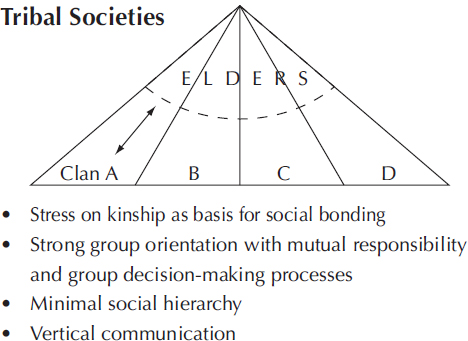
Strong kinship groups in a tribe provide the individual with a great deal of security. They provide for you when you are sick or without food, support you when you go away to school, contribute to your purchasing a field or acquiring a bride, and fight for you when you are attacked. In turn, the group makes many demands on you. Your lands and your time are not strictly your own. You are expected to share them with those in your lineage who need them.
Important decisions in these tribes are generally made by the elders—the older men who have had a great deal of experience with life. This is particularly true of one of the most important decisions of life, namely, marriage. Unlike in our society where young people are all too ready to get married when they “fall in love” without carefully testing the other person’s social, economic, mental, and spiritual qualifications, in most tribes, weddings are arranged by the parents. From long experience they know the dangers and pitfalls of marriage. They are less swayed by the passing emotional attachments of the present. The parents make the match only after a long and careful examination of all the prospective partners. Love grows in these marriages as in any marriage by each partner learning to live with and to love the other.
Lineage and tribal decisions are also made by the elders. Family heads have their say, but they must comply with the decisions of the leaders if they want to remain a part of the tribe.
This type of social organization raises serious questions for Christian evangelism. Take, for example, Lin Barney’s experience. Lin was in Borneo when he was invited to present the gospel to a village tribe high in the mountains. After a difficult trek he arrived at the village and was asked to speak to the men assembled in the longhouse. He shared the message of the “Jesus Way” well into the night and, finally, the elders announced that they would make a decision about this new way. Lineage members gathered in small groups to discuss the matter and then the lineage leaders gathered to make a final decision. In the end they decided to become Christians, all of them. The decision was by general consensus.
What should the missionaries do now? Do they send them all back and make them arrive at the decision individually? We must remember that in these societies no one would think of making so important a decision as marriage apart from the elders. Is it realistic, then, to expect them to make an even more important decision regarding their religion on their own? Should the missionaries accept all of them as born again? After all, some may not have wanted to become Christian and will continue to worship the gods of their past.
Group decisions do not mean that all of the members of the group have become Christians, but it does mean that the group is open to further biblical instruction. The task of the missionary is not finished—it has only begun—for he or she must now teach them the whole of the Scriptures.
Such people movements are not uncommon. In fact, much of the growth of the church in the past has occurred through them, including many of the first Christian ancestors of most of the readers of this book.
Peasant Societies
In peasant societies, we often see social classes, groups, and castes as a more prominent feature of social organization and interaction than extended kinship ties. Power is often concentrated in the hands of an elite that is removed from those who are considered commoners.
Peasant societies are made up of different groups of people, often with different classes, cultures, and languages (heterogeneous, comprised of different groups), while most tribes are homogeneous (comprised of one group).
The presence of several groups in the same village has significant implications for church planting. Important issues arise. First is the issue of church unity. If we plant a church in one group, people from other groups may not be willing or permitted to attend. Social distances are as important as geographic ones. People may live a few yards from each other but socially be a hundred miles apart.
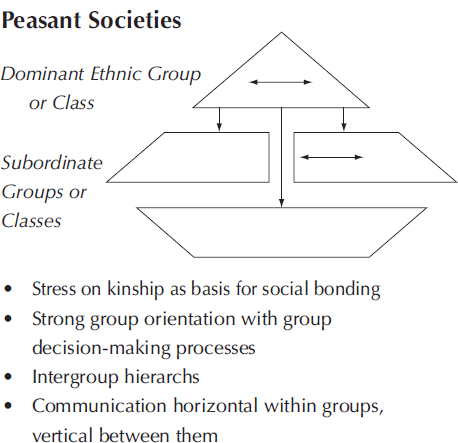
We can turn to India for an illustration of this. Villages are divided into a great many jatis or castes. Many of these, such as the Priests, Carpenters, Ironsmiths, Barbers, Washermen, Potters, and Weavers, are associated with certain job monopolies.
Castes are also grouped into the clean castes and the untouchables. The latter are ritually polluting and their touch, in the past, polluted clean-caste folk who had to take a purification bath to restore their purity. Consequently, the untouchables had to live in hamlets apart from the main villages and were forbidden to enter the Hindu temples.
When the gospel came, it tended to move in one group of castes or the other but not in both. When the gospel came, it tended to touch either the clean castes or untouchables but not both. They did not want to associate with the untouchables. The missionaries continued to accept all who came and required that they all join the same church. Consequently, many of the clean-caste people reverted back to Hinduism.
The problem here is not simply a theological one. Many of the high-caste converts sincerely believed the gospel, and even today many are secret believers. It is a social problem. People are socially very diverse, and they find it hard to associate closely and intermarry with people markedly different from themselves. Can we expect people to change their deep-seated social ways at the moment of their conversion—in other words, should we expect them to join the same church? Is changing our social customs a part of Christian growth—or should we allow them to form different churches with the hope that with further teaching they will become one?
There have been some in India who have held that the peoples’ salvation is not tied to their joining a single church, and they have therefore started different churches for the clean castes and the untouchables. They have had much greater success in winning people from the clean castes, but they have also faced a great deal of criticism. Others argue that this is contrary to the will of God. They ask if we should divide churches on the basis of fallen human social structures such as class and caste. Where is the unity of the church and the oneness of the gospel and Holy Spirit? They contend that if bridges of fellowship are not built between groups from the beginning, the church will be captive to social systems and will contribute to the segregation and oppression that characterizes these systems.
Going to the Top or the Bottom?
There is a second dilemma that we face when dealing with societies made up of groups ranked in a hierarchy of prestige and power. To whom should we go first: the dominant elite, the middle-class commoners, or the untouchables, serfs, poor, and other marginal peoples at the bottom of society?
Many missionaries have argued that we must go first to the dominant group. If the community leaders become Christian, they argue, the others will follow because the elite serves as their example. This strategy, however, has met with limited success in peasant societies. First, peasant elites have been more resistant to the gospel than the lower classes and castes. And further, even if people in the dominant group become Christians, they are rarely willing to associate with and evangelize the lower classes. Other missionaries have gone first to the poor and oppressed. This has frequently occurred not because of conscious planning but because of the widespread response of the downtrodden, for whom the gospel has a special attraction.
Many peasant societies do not have middle classes, at least not in the contemporary sense of the term. With the spread of modernity, however, educated and relatively independent middle-class people have begun to appear in many rural communities. In recent years, evangelicals have increasingly gone to them to plant churches because they are open to change.
RETURN TO LESSON 11: Building Bridges of Love
Urban Societies
The sheer size and complexity of modern cities make it difficult for us to understand them. We need to use both macro and micro approaches—both helicopter and street-level views—to help us grasp this great, complex, and confusing thing we call a city.
The Macro View
Cities vary greatly, depending on their histories, cultures, and location. They also vary in their reason for existence, whether as governmental centers (Washington DC), religious centers (Mecca), business and trade centers (Mumbai), or tourism centers (Acapulco). However, despite the great variation, some generalizations can be made that apply to most, if not all, cities.
To understand cities, we must look at the effect of size on human organization. It is impossible for ten or twenty million people to live together without very complex social, economic, and political systems to make their common life possible. People belong to families, associations, and neighborhoods, which relate to city government structures that, in turn, are part of the larger state and national structures.
Cities are centers of power, wealth, knowledge, and expertise. They both dominate and depend upon the rural and tribal communities surrounding them that supply them with food and other raw materials. As centers they attract both rich and poor. Masses of people attract more people.
The sheer size and complexity of cities and their centralization of power give rise to internal hierarchy. The distance between the rich and the poor, the powerful and powerless, those of high status and low, is almost incomprehensible. Heads of modern corporations can earn more playing a game of golf with other executives than their lowest-paid workers earn in two or three years of hard work!
Another important characteristic of cities is diversity. They attract different kinds of people who form their own cultural communities. People tend to relate closely to those in their own groups and only superficially to others in the city.
Culture Shock: Starting Over Paul G. Hiebert
Adapted from Crucial Dimensions in World evangelization by Arthur F. Glasser et al., William Carey Publishing, 1976.
Being sent off as a missionary was exciting. You were center stage at the big farewell at your home church. There was the thrilling, sorrowful parting at the airport, and then the long flight. Friends meeting you diminished the uneasiness of suddenly being in a strange country. But within hours, things began to go wrong. You couldn’t read the menu at the restaurant, so you took your chances on something you didn’t recognize. You recognized half the food on the plate. The other half looked inedible. Was it roasted insects or goat’s entrails? Later, you went to the market to buy oranges, but the woman couldn’t understand a word you said. You had to pay her, but all you could do was hold out a handful of the strange coins for her to take what she wanted. You were sure you were cheated. You got on a bus to go across town and got lost. You imagined yourself spending the next ten years riding the bus trying to get home. You got sick, and you were sure the local doctor didn’t know how to treat American diseases. Now you are sitting on your bed, wanting to go back where you came from. How did you get yourself into this anyway, and what do you say to your church after a few weeks of “missions” abroad? “The job is done”? “I can’t take it”?
Your reaction is perfectly normal. Everyone experiences culture stress when they enter a new culture. Tourists do not really experience culture shock because they return to their American-style hotels after sightseeing. Culture shock is not a reaction to poverty or to the lack of sanitation. For foreigners coming to America, the experience is the same. Culture shock is the disorientation of discovering that all the cultural patterns we have learned are now meaningless. We know less about living here than the children. We must begin all over again to learn the elementary things of life—how to speak, eat, market, travel, and a thousand other things. Culture shock really sets in when we realize that this now is going to be our life and home.
CONTINUE READING Sidebar: Closing the Gap
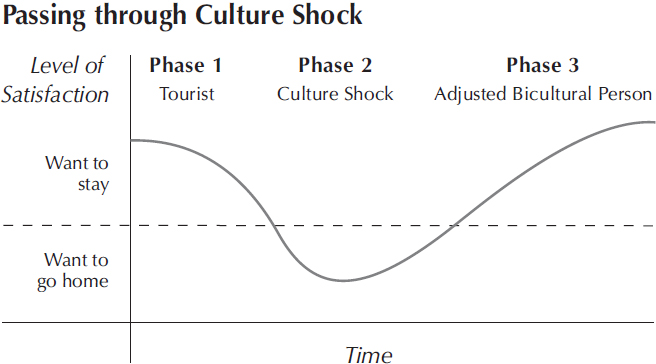
Culture shock is a sense of cultural disorientation in a different society.
The Micro View
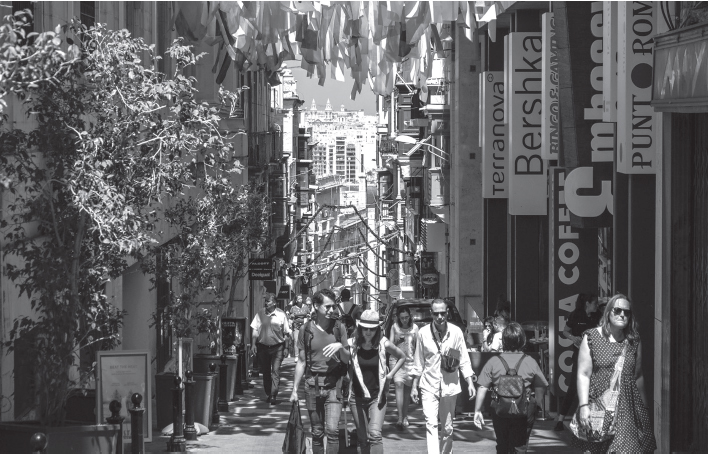
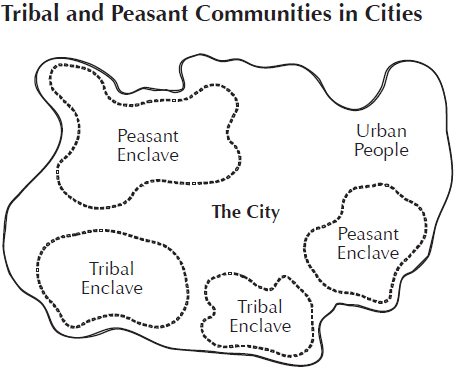
This leads us to the micro or street-level view of cities. Distinct communities rise based on ethnic, class, cultural, and residential differences, many of which maintain their own languages and cultures. Los Angeles has more than seventy-five distinct ethnic communities and teaches classes in public schools in more than seventy languages.
Classes emerge in peasant villages, but in the city they explode into a great many different lifestyle enclaves made up of people who share similar cultural practices, values, and interests. In addition to economic variables, there are subcultures that arise around jobs, religions, or special interests such as cars, the arts, sports, etc. Classes differ from ethnic groups in one significant way: their boundaries are porous. It is possible to move to a higher or lower class.
Copyright © 2018 International Mission Board. All rights reserved.
Not all city folk have an urban mentality. Many are peasants who visit or move to the city but keep their rural attitudes. They form small village enclaves in the city where they try to maintain life as they knew it in the countryside. In time such people become true city folk, but it may take generations.
Urban Social Organization
Having looked at some of the general characteristics of urban societies, we need to examine in more detail some of the dimensions of their social organization.
roles
Most relationships in peasant societies are multiplex in nature. Those in urban settings are simplex.
Multiplex relationships exist where people meet each other on many different occasions and in many different roles. The strength of multiplex relationships is that people learn to know each other intimately, as whole persons. Relationships tend to be more enduring. They lead to a strong sense of community.
When people relate to each other in simplex relationships, they see each other primarily in terms of the one role in which they meet, whether it be as a coworker, family member, doctor, neighbor, etc. These relationships are less enduring, more superficial and functional, and leave people with a sense of alienation.
Families
In general, there is a tendency for the nuclear family rather than the extended family to be emphasized in cities. Urban mobility, individualism, and freedom erode family stability. Divorce and remarriage are more common than in most peasant societies. The result is single-parent families and blended families. Nevertheless, families continue to play the dominant role in the private sector of city life.
Networks
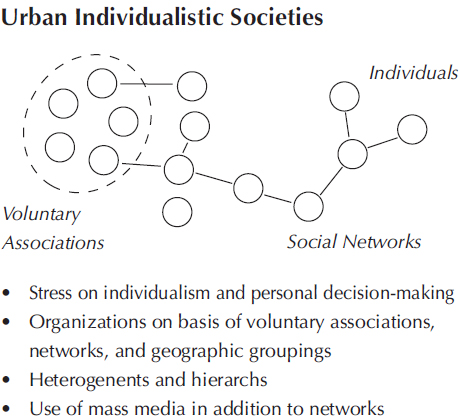
Networks are a major form of middle-level social organization in cities. News may spread rapidly through networks. Most city folk develop core networks made up of people with whom they like to associate, discuss personal problems, and share in social recreation. Whereas in peasant communities this similarity is based on kinship, in urban settings people tend to associate with nonkin who share similar occupations, interests, class, and ethnic group.
Associations and Institutions
The dominant social structures of public life in cities are associations and institutions. They are flexible and able to organize large numbers of diverse people, which makes them much more functional than kinship groups in a complex society.
Associations are groups of people who organize themselves informally around a common interest or cause. They may be based on friendships, gender, age, common interest, a task or goal, prestige, etc. Voluntary associations create symbols to express their identity and reinforce their members’ sense of belonging. They coordinate tasks and formulate roles (like president, treasurer). They develop their own cultures and norms that they enforce through varying degrees of social pressure.
Informal associations may evolve into formal institutions, which become the major form of social organization in the public sector of most cities. These include governments, banks, schools, churches, businesses, hospitals, etc. Within institutions, members find language, roles, networks, social hierarchies, power structures, economic resources, belief systems, symbols, and worldviews. In short, each operates like a subcultural community.
Churches in the City
We cannot explore exhaustively the methods for planting churches in urban settings. Our purpose here is to make us aware of the need to study and understand the specific urban setting in which we minister and to be sensitive to the way the social and cultural contexts of people influence the ways in which they hear and believe the gospel.
Churches and Diversity
In the city, a great many congregations are needed to reach diverse groups. Because of the rapid growth of cities, it is easy for whole people groups and communities in a city to have no church. Existing churches tend to serve their own kind of people, but someone has to look at the city as a whole to identify where new churches are urgently needed.
Planting churches must begin with careful research. Otherwise, we will be blind to many of the social and cultural forces that can help or hinder our work. Demographic studies of the city will lead us to choose a specific location and community. Ethnographic research should be done on the selected community. Part of the research and preparation process is an examination of our own preconceptions about people and the work. Our deepest attitudes are often the greatest barriers to effective church planting in the city.
One of the great obstacles to effective church planting in the city is our own preconceptions of what constitutes a church. We often believe that it must have characteristics of the rural and suburban churches with which we are familiar. Too often we are peasants seeking to plant rural churches in urban settings. We need to break from our stereotypes of the church if we want to be effective in the city.
No one form of church serves as the model for all others. The church will take different shapes in different communities. Megachurches appeal largely to middle- and upper-class people seeking multiple ministries. Storefronts and missions reach out to the poor and street dwellers; small churches and house fellowships to those seeking a strong sense of community.
Many urban churches are discovering the need to incorporate diversity into the local church itself. Examples include different ethnic groups that form congregations that work together and use the same facilities or multiethnic urban churches that have several intersecting congregations. Each group needs a place and say in the life of the church, and each group needs to be nurtured and fed in its own gathering.
Church Movements among the Poor
Today churches among the poor are planting other churches. Local leaders are essential to such movements. The most effective leaders are those who emerge in the context of everyday life and have the vision, zeal, and gifts for organizing and guiding people. Most of them must earn their own living and minister out of their passion for Christ. They need Bible training but can get it only through personal discipling, night courses, or ongoing seminars.
Many church movements among poor people have been accompanied by an emphasis on God’s miracles. People look for visible demonstrations of God’s transforming power. We need to demonstrate the power of prayer and of God’s extraordinary healing and provision. All healings are God’s healings and are miraculous. Some seem more ordinary than others, but we must expect and affirm them all.
Building Community
The city is a place of alienation. City dwellers meet many people but they feel less and less a part of intimate communities. Churches can provide a sense of community in the midst of the depersonalizing system of the city.
But churches in the city are in danger of becoming religious clubs, and large urban churches often take the shape of a corporation. Is it possible for local churches to truly be covenant communities in an urban setting? The early church was and it drew the lonely and lost into its fold. If the church today loses its battle against being a religious club or a corporation, it will be or it is in danger of becoming just another human organization captive to its times. If the church wants to reach the city, it must first be the church in the biblical sense of that term—a place where Christ is in the midst and the Holy Spirit is present in holiness and power. 
RETURN TO LESSON 11: Building Bridges of Love
Closing the Gap Donald N. Larson
Donald N. Larson was senior consultant for cross-cultural living and learning at Link Care Center. He was also professor of anthropology and linguistics at Bethel College, St. Paul, Minnesota, and he previously served the Toronto Institute of Linguistics as director for 25 years.
From Missiology: an International review, Arthur F. Glasser, ed., April 1978. Used by permission.
There is often a wide gap in the missionary’s conception of his or her role and how it is viewed by those of his or her adopted community. Closing the gap between missionary and local community members means rede-signing old roles and designing new ones. Missionaries may have to learn to be foreigners for the first time in their lives. They may have to find new, culturally appropriate ways to be a friend or a neighbor. To close this gap means that missionaries must measure their effectiveness by the standards of their hosts, not their own.
Some years ago, at a language and culture learning workshop in East Africa, a missionary asked me if I knew anything about elephants. When I replied that I did not, she asked more specifically if I knew what happens when a herd of elephants approaches a water hole that is surrounded by another herd. I replied that I did not know what would happen. She explained that the lead elephant of the second group turns around and backs down toward the water hole. As soon as his backside bumps two of the elephants gathered around the water hole, they step aside and make room for him. This is then the signal to the other elephants that the first herd is ready to make room for them around the hole. When I asked what point she was trying to make, she stated simply and powerfully, “We must back in.” Missionaries today must learn to “back in” to their host communities.
The first task of the missionary is to identify those roles that are most appropriate and effective.
What does it mean to “back in” as a missionary? From the position of an outsider, the missionary must find a way to be recognized as acceptable within the society. Some roles help the missionary to make this move. Others will not. The first task of the missionary is to identify those roles that are most appropriate and effective. Local residents must feel good about the presence of the missionary in their community.
To be acceptable, local community members must first find missionaries teachable. The role of learner is an especially useful entry role. The learner’s dependence and vulnerability convey in some small way the messages of identification and reconciliation that are explicit in the gospel. Entering a new community as a sincere learner of language and culture, missionaries approach the local community with humility, offering dignity to the people from whom they learn. A learner is one who “backs in.”