CHAPTER 75
Communication and Social Structure
Eugene A. Nida

Eugene A. Nida, a linguist, anthropologist, and biblical scholar, began his association with the American Bible Society in 1943. He was the Translations Research Coordinator for the United Bible Societies from 1970 to 1980. He continued his work as a consultant with the Bible Societies and continued researching and lecturing in Europe and Asia. He wrote 22 books on translation and missions.
From Message and Mission, rev. ed. by Eugene A. Nida. Pasadena: William Carey Library, 1990.
Communication never takes place in a social vacuum but always between individuals who are part of a total social context. These participants in the communicative event stand in a definite relationship to each other—for example, as boss to employee, son to father, policeman to offender, and child to babysitter. Moreover, in every society there are definite rules about what types of people say what kinds of things to certain classes of persons. What is quite proper for one class to say may be unbecoming for another, and even the same remarks from different persons may be quite differently interpreted. The same behavior interpreted as offensive arrogance in an underling may be considered charming insouciance on the part of the boss, and what is squirming subservience in the lower middle class may be interpreted as lovable modesty in the upper class.1 Whatever different classes of people say is inevitably influenced by their respective positions in society. For man is more than an individual: he is a member of a very large “family,” whether clan, tribe, or nation, and there are always important, though usually unformulated, rules that apply to all interpersonal communication.
This aspect of communication within the social structure is particularly important from the religious point of view. Wherever there are tribal or national gods, these deities inevitably occupy special positions of importance in the social structure, either as mythical ancestors or as guardians of the social patterns and mores of the people. For this reason religion is often in opposition to any breach with the past, any breaking away of individuals from the “faith” and any presumed undermining of the prestige of traditional leadership. More often than not, a new convert to Christianity in a predominantly pagan society will feel very much like one Hopi Indian who returned to his own village after having been away at school, where he had been baptized a Christian. On the first day of his return, all the villagers went off to a dance and left him sitting in the shadow of the mission wall. He felt, as he described it later, “like a man without a country.”
Unfortunately, some missionary approaches to non-Christians have involved the creation of a Christian caste or subculture. Before India’s independence, some well-meaning missionaries almost unconsciously felt that for new Indian converts to become truly Christian and remain faithful to their new stand, they needed full identification with the missionaries and the foreign community. The result in some instances was the development of a wholly artificial “hothouse” environment, where Christian converts might be protected but could never really grow. In a sense they were being taught to be square pegs in round holes.
Well-intentioned missionary work has sometimes failed to communicate the gospel because the source adopted a role completely incompatible with any effective identification with those to be reached. In one mission to Indians in South America, the role of the communicators is that of a rich landowner. Such a person can accomplish a good deal on the basis of this prestige. He cannot, however, effectively relate the good news to the people he seeks to reach because the roles of the participants in communication block effective understanding. Given the roles of landowner and peon, there is never a two-way traffic of meaningful communication about the real issues of life, and without two-way communication there can be no identification.
Well-intentioned missionary work has sometimes failed to communicate the gospel because the source adopted a role completely incompatible with any effective identification with those to be reached.
Social Structures and Interpersonal Communication
Social structures, together with the networks of communication they represent, are very diverse. We shall attempt neither a detailed analysis of all the various types of social structures nor a discussion of the many factors that give rise to different patterns of social life. Here we are concerned only with a particular aspect of social structure—namely, that which is significant in terms of interpersonal communication. For this purpose two primary types of distinctions, intersecting on various levels, may be distinguished. First, we must distinguish between the urban (or so-called “metropolitan” society) and the rural (or “face-to-face” society) types of structures. Second, we must analyze these types of structures in terms of their homogeneous or heterogeneous character. The urban society is characteristic of the typical city dweller in large urban centers, whether in New York, London, or Calcutta, and the rural society is characteristic of the peasant community, whether it is an Indian village near Mexico City or a mountain hamlet in northern Thailand.
By a homogeneous society, we mean one in which most or all of the people participate in the common life in more or less the same way. Such groups may have class differences and distinctions of leadership and positions of authority, but the society is nevertheless an integrated whole, sharing much the same system of values. It is not merely an aggregate of subcultures which operate along quite different lines. Sweden, for example, may be regarded as a more or less homogeneous society, in contrast to the United States with its large, heterogeneous population in varying degrees of “assimilation.” It may be contrasted also with a country like Peru, which maintains an Ibero-American culture in its cities but has a distinctly different culture in the villages of the altiplano and the eastern jungle.
Models of Social Structure
In order to understand more clearly certain of the essential features of social structure, it is convenient to diagram such social patterns, using as a general base an “inverted” diamond jewel shape.
In this generalized and schematic diagram, we indicate not only the relative positions and sizes of the different classes—upper, middle, and lower—but also something of the total configuration. This configuration suggests that the upper class tapers off into a relatively limited number of top leaders and that the lower class (which might be called the indigent section of the population) are generally fewer in number at the very bottom than those who are somewhat higher in the social structure.
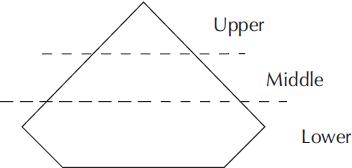
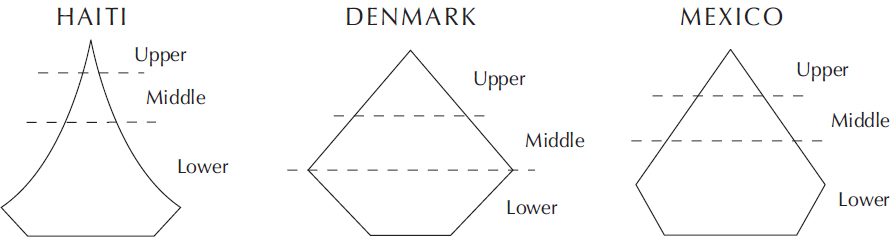
We have arbitrarily chosen to represent social structure in three classes. In some societies, however, one must recognize four, five, six, or even more classes. In such a case it is customary to speak of such distinctions as upper upper, lower upper, upper middle, lower middle, upper lower, and lower lower class. The forms of these diagrams are not based upon statistical data, for such data are not available in terms of class criteria. They are obviously impressionistic but very useful.
It should be noted, for example, that in Haitian society the upper class constitutes a very narrow, stratified group, while the society almost bulges at the base. In the diagram of Denmark, the upper class does not tower proportionately so much above the rest of the structure, the middle class is rather large, and the lower tapers off to a very restricted indigent base. Mexico, on the other hand, represents a somewhat more “typical” structure with a growing middle class, a somewhat attenuated upper class, and the bulk of the society in the lower class, though not with the proportionately heavy concentration at the bottom that characterizes Haiti.
Communication within Social Structures
The significance of social structure for communication can be summarized in two basic principles: (1) people communicate more with people of their own class; that is, interpersonal communication of a reciprocal nature is essentially horizontal; and (2) prestigious communication descends from the upper classes to the lower classes, and this vertical communication is primarily in one direction and tends to be principally between adjacent groups.
1. Interpersonal Communication is Horizontal and Reciprocal
Truly effective communication, however, is not unidirectional. There must be reciprocity in communication (which we may call “social feedback”), or the results may be unsatisfactory. In war, for example, the general must know not only how to give orders to the troops; he must also know precisely how the troops are faring, or his orders are likely to result in bungling tragedies, as in the collapse of France in World War II. As a general must know where the men are and the type of resistance they are meeting, in all organizational communication with a centralized source of communication, orders must go out, but information must be fed back continuously.
2. Prestigious Communication is Vertical and Unidirectional
When, for example, an African insists on wearing a heavy, cumbersome overcoat on a hot day simply to demonstrate that he has received such a coat from a White official and thereby has gained some measure of local status, it should be evident to the observer that what comes down from the top carries a tremendous amount of prestige. Both in ministry and in missionary work, it is usual for the religious professional to do most of the talking. He has gone forth to tell people the truth, not to listen to other people’s ideas about the truth. If this attitude is pushed to an extreme, the message inevitably will become irrelevant.
Communicative Approach in a Face-to-Face Society
To the structure of urban societies, the rural, peasant, and primitive face-to-face societies present certain striking contrasts. There are, of course, many important differences between, for example, a small rural community in the hills of Kentucky and a village in the northern part of Zaire. Nevertheless, certain significant features are particularly relevant to the problems of communication.
In general, there are two main types of face-to-face societies: (1) folk and (2) primitive. The first is a dependent type of society that looks toward the urban center, derives considerable benefits from it, and also contributes much to it, especially by way of raw materials. The primitive society, on the other hand, is also a strictly face-to-face grouping that may be loosely or tightly organized, but its economy and orientation are almost completely independent of out-side influences. Such a group with its own laws is quite homogeneous, with little division of labor, except between sexes. Actually, strictly primitive groups—in this sense of the term—are now few and are rapidly becoming dependent, though at present they may be in a transitional state. In contrast to the inverted diamond structure with horizontal class cleavage which is typical of urban cultures, folk societies and, to a considerable extent, primitive societies may be diagrammatically described as broad-based, pyramidal forms with roughly parallel rather than crosssectional divisions:

The pyramid in this instance is quite broad-based, for in general the distinctions between those who lead and those who are led are not great. At the same time, there are no simple higher, middle, and lower classes or elaborations of these distinctions. Rather, the structure of the society breaks down essentially into family groups related by birth or marriage, depending upon the particular form which any particular social structure may take.
The apex of the diagram indicates the leadership of a small group, the elders of the society. These leaders form an oligarchical control but also individually represent their family affiliations, as suggested by the dotted lines. Such a society has a strong sense of cohesion and presents a more or less uniform front against intrusion. It must be conservative in orientation in order to preserve itself. By and large it makes collective decisions, not by any formal parliamentary techniques but by the kind of informal discussion and interchange of opinions that characterize most types of “family decisions.” The effective spread of information in such a society is not describable as along either horizontal or vertical axes (as in our previous diagrams) but rather primarily along family and clan lines. McGavran makes a point of the necessity of using these effective channels of communication as the “bridges of God.”2
Communicative Approach in a Heterogeneous or Urban Society
Heterogenous societies are primarily of two types: (1) urban societies that contain urbanstructured minority groups and (2) urban societies that include face-to-face subsocieties.
In the first type one must recognize three factors: (1) the basic differences which mean that one cannot, for all his idealism, use identically the same approaches to the various groups; (2) the immense prestige differential, which means that the people in the less prestigious groups try to follow, or think that they are following, the norms of the higher group; and (3) the priority of intragroup communication if effective communication is to be obtained.
In the second principal type of heterogeneous society, the dominant urban structure includes a minority group having a face-to-face type of society. When a single social structure involves not only a dominant group but an included face-to-face constituency, it is essential to recognize not only their differences of structure but also their interrelations. One of the most serious mistakes in missionary work has been to imagine that certain indigenous groups should be reached as a separate constituency and developed as an isolated community when all the time they are highly dependent in relation to the urban center. It is just as possible, however, that missionary effort fails to recognize the need of devising different approaches to the urban and folk societies but lumps them together without regard to their different structures. In a heterogeneous society with an included folk culture, there is always the acute problem of dealing with people in a state of transition. Are they to be ministered to in terms of their rural circumstances or in their city setting? In a sense, it all depends on where they are and how they view themselves. The people themselves are living a dual role.
If a missionary is to be successful in communicating, he must recognize the distinctions that exist between various classes of people and make his message applicable to their circumstances and transmittable by means of their traditional networks of communication.
If a missionary is to be successful in communicating, he must recognize the distinctions that exist between various classes of people and make his message applicable to their circumstances and transmittable by means of their traditional networks of communication. Each class or subculture must be reached within the context of its own life.
Communicative Approach to Any Society
Once we have recognized the fundamental structure of a society, we can see that the approaches that have proved to be most successful in them are the ones that make optimum use of the natural flow of communication. The basic principles in such an approach are four: (1) effective communication must be based upon personal friendship; (2) the initial approach should be to those who can effectively pass on communication within their family grouping; (3) time must be allowed for the internal diffusion of new ideas; and (4) the challenge for any change of belief or action must be addressed to the persons or groups socially capable of making such decisions.
We must not leave the impression that only such persons as have been described as helpful are indispensable to evangelistic endeavors. But when we analyze developments throughout the whole range of work, it becomes evident that the social and personal qualities of those initially won to the new faith are of high significance in assessing the probable effectiveness of the communication and its extension to others. The fact that effective communication within any social context must inevitably follow the social structure seems quite evident. People are such an integral part of the social structure in which they live that only in and through this structure can they be reached and live out their faith.
RETURN TO LESSON 11: Building Bridges of Love
Notes
1. David Riesman, Individualism Reconsidered (Garden City, NY: Doubleday, 1954), 46.
2. Donald A. McGavran, The Bridges of God (London: World Dominion Press, 1955), 120.