CHAPTER 63
From Western Christendom to Global Christianity
Todd Johnson and Sandra S. K. Lee

Todd Johnson is co-director of the Center for the Study of Global Christianity at Gordon-Conwell Theological Seminary. He is co-author of the second and third editions of the World Christian encyclopedia and the atlas of Global Christianity. He is also the editor of the World Christian Database online.
Sandra S. K. Lee is an ordained pastor and a regional administrator of the Evangelical Covenant Church. She is managing editor of the atlas of Global Christianity and previously served as research associate at the Center for the Study of Global Christianity and research assistant to the Executive Chair of the Lausanne Committee for World Evangelization.
Christians can be found today in every country in the world. Although Christianity has been gradually expanding since its earliest days, its ubiquitous presence around the world is recent in human history. Kenneth Scott Latourette opened his book The Emergence of a World Christian Community (1949) with the words, “One of the most striking facts of our time is the global extension of Christianity.”1 John J. Considine took this further with his statement “Christianity is not true Christianity unless it embraces all mankind—unless it is World Christianity” (italics his).2
The Spread of Christianity
The global Christian movement began with Christ and His disciples in Jerusalem, in what many today are referring to as the “Global South” (Africa, Asia, and Latin America). From there, Christianity spread in several directions. It traveled to the East along the Silk Road through Persia into India and eventually to China. It spread south through Egypt to the Horn of Africa and west across North Africa.
But through the centuries, the faith took hold in increasing proportions in the Northern Hemisphere, particularly in Europe. At the same time, it decreased in Asia and Africa, partly due to the rise of Islam. By 1500, 92 percent of all Christians were European.
Then as Europeans discovered the rest of the world, Christianity began a sustained move back towards the Southern Hemisphere. By 1900, because of vibrant mission activity and indigenous evangelism in the preceding centuries, global Christianity suddenly began a sharp southward trend. The church in the Global South began to expand rapidly and continued to grow throughout the twentieth century. The most vigorous growth was in Africa, exploding from 10 million Christians in AD 1900 to 667 million in AD 2020.
However, the trend also continued westward, as North America had more Christians than any other region of the world by 1970. This year marks a sharp transition. After 1970, the fastest-growing portion of the global church was in Asia, which began to pull the center of global Christianity toward the East for the first time in over 1,300 years.
Sometime after 1980, Christians from the Southern Hemisphere outnumbered Northern Christians for the first time since the tenth century. There is no indication that the vigorous growth in the Global South will slow down during the twentieth century, as the church continues to see tremendous growth in Latin America, Africa, Asia, and Oceania. Christianity has become a global movement, expressing itself in the languages and cultures of nine thousand of the approximately thirteen thousand people groups in the world.
The graph on the following page illustrates the steady growth of the percentage of Christians in the Global North from the time of Christ. Note that Christians from the Global South represented over fifty percent of all Christians for the first nine hundred years. The dramatic rise of the percentage of world Christians in the Global South and the corresponding decline in the North occurred in the twentieth century.
From the West to the Rest
Over the course of many centuries and especially with the rise of European Christendom (and later with its world empires), Christianity increasingly became identified with and enmeshed with the political and economic agenda of the West. David Smith comments, “It is simply impossible to overlook the fact that the ‘great era’ of Christian missions occurred as people of European origin extended their political and economic control until it encompassed 84 percent of the land surface of the globe.”3 This European colonial world system and its global preeminence gave rise to the myth of the Christian faith as being exclusively Western—even though significant non-Western Christian movements were already present in the sixteenth century.
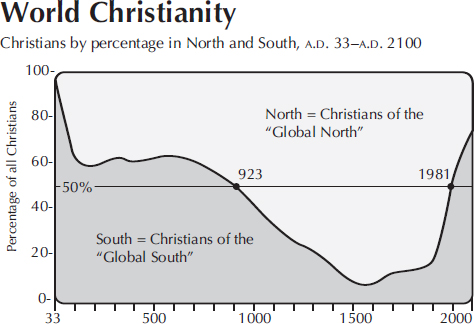
Graph 1 illustrates the steady growth of the percentage of Christians in the Global North from the time of Christ. Note that Christians from the Global South represented over 50% of all Christians for the first 900 years. The dramatic rise of the percentage of Christians in the Global South and the corresponding decline in the North occurred in the 20th century.
Only in the late twentieth century did Christianity around the world begin to disentangle itself from its Western colonial character. Andrew Walls writes, “The full-grown humanity of Christ requires all the Christian generations, just as it embodies all the cultural variety that six continents can bring.”4 No longer is the picture of the average Christian a White Westerner (who, in 1980, were ceasing to be practicing Christians at a rate of 7,600 per day).5 Rather, we have witnessed the coming of age of the younger churches within the context of decolonization and rising nationalism. Contrary to destroying indigenous societies, Christianity—especially with its emphasis on the translation of the Scriptures into the vernacular—allowed for the preservation of indigenous languages and cultures.6 Churches persisted and grew in the face of opposition because of the strength the Christian faith provided people in sociopolitical, economic, and cultural upheaval.7 In moving southward, Christianity is “in some ways returning to its roots . . . ‘the renewal of a non-Western religion.’”8
Implications for the Future of Christianity
What does this continuing move south and east mean for the future of Christianity? Five areas can be briefly mentioned here. (1) Southern Christians will interpret and critique Northern Christianity’s recent one thousand years of dominance in theology and ecclesiology by producing their own reflections and by looking back to the earliest Christian centuries when they were in the majority. (2) The languages of Christianity are shifting south. Already by 1980, Spanish was the leading language of church membership in the world.9 Today, Chinese, Hindi, Swahili, and other major Southern languages are carrying the Christian message. (3) The majority of Southern Christians are poorer than their Western counterparts and must daily face the realities of poverty and the inequities that accompany it. (4) Christians are in close contact with Muslims, Hindus, and Buddhists. This will potentially intensify both conflict and dialogue. (5) The potential of new Christ-following movements among cultures not yet reached with the gospel means that new cultural forms of Christianity are likely to emerge. In all five areas, the central question remains, “How well will global Christianity navigate its increasingly diverse composition?”
In moving southward, Christianity is “in some ways returning to its roots . . . ‘the renewal of a non-Western religion.’”
1. Theology Moves South
Until now, the dominant theologies of Christianity have been written by Western scholars, but the massive movements of Southern Christianity will likely chart the future of Christian theology. Kwame Bediako outlines the enormous challenges this project holds for African Christians.10 Hwa Yung poses that as the Asian church grows rapidly, it needs to “self-theologize, developing a theology for itself that is rooted in [its] culture, history and context.”11 The Northern church would do well to take on the posture of learning, as David Smith advises:
We are witnesses to the emergence of new centers of spiritual and theological vitality as Christians from the southern continents add their insights to the church’s total knowledge of the incomparable Christ. In the present transitional stage we are moving from a Christendom shaped by the culture of the Western world, to a world Christianity which will develop new spiritual and theological insights as the biblical revelation is allowed to interact with the many cultures in which Christ is now confessed as Lord.12
The changing nature of theology has further implications for theological education and leadership training. Centers of theological education need to be established and developed in the South as there is a “great need for non-Western exegetical studies which will help us understand the Bible better, and which will complement the work that is being done by Western writers.”13 If the churches of the North are to participate in the life of the global church, their theological seminaries need a diverse curriculum of studies that include non-Western church histories and theologies, thereby reversing the assumption that “Western Christianity possesses the spiritual, theological and material resources needed by the rest of the world.”14
2. Speaking More Languages
The rapid growth of Christianity in non-Western, non-English-speaking countries also implies that the languages of Christians are changing. As observed earlier, Spanish was the leading language of church membership in the world by 1980, but Christians in Africa, Asia, and Latin America worship in numerous other languages. Thus, the translation of the gospel into indigenous languages and cultures has become increasingly important. Lamin Sanneh writes that “Christianity could avoid translation only like water avoiding being wet.”15 He contrasts this with Islam, where true followers of any language or culture must worship in Arabic. In Christianity, all languages and cultures are validated by the translation of the Scriptures. For many people groups where there is no written language, Bible translators not only provide Scriptures in the mother tongue but also encourage wider literacy and other forms of education.
Western scholars will also have to recognize and seriously consider writings in non-English and non-European languages. There is a great need for Christian scholarship in these languages to be translated into Northern languages such as English, French, German, or Spanish. Apart from the shift away from Northern languages as the dominant languages of Christianity, there is also a need for a change in the perception of missions as a Northern phenomenon. For the past several hundred years, Christians in Europe and the United States have been “the church” and the rest of the world has been “the mission field.” With the shift of Christianity’s center of gravity from Europe to the Southern Hemisphere, Africa, Asia, and Latin America can no longer be seen as the periphery. Instead, “Christian mission to all parts of the globe will require resources from both the North and the South to be successful.”16
3. Including More of the Poor
Another daily reality for Southern Christians is poverty. Much of the Global South deals with serious issues of poverty and a lack of access to proper health care. Countries that have been hardest hit by AIDS, such as Botswana, Zimbabwe, and Swaziland, are also countries where Christianity is flourishing. Without access to medical care, accounts of healing and exorcism found in the Bible are taken more seriously. The work of the Holy Spirit exhibited in miracles of healing and deliverance from demonic powers has exploded in the ministry of Pentecostal/charismatic churches in the Global South. David Smith describes these churches as “overwhelmingly charismatic and conservative in character, reading the New Testament in ways that seem puzzlingly literal to their friends in the North,” and as “largely made up of poor people who in many cases live on the very edge of existence.”17 Thus the growth of Christianity in poorer regions implies not only an alternative reading of the Bible but also a different experience of the Bible. For the poorer Christian communities in the South, meeting the social needs of people is integral to Christian witness, theology, and ministry. For the Western church and missionaries, poverty and AIDS in the South cannot be ignored. Nor can assistance be granted from a position of power, but only with humility and in acknowledgment of a crisis within the church.
4. Conflict and Dialogue
Christianity’s shift to the South brings to the forefront the potential conflict between Christians and non-Christians. How will Muslim-Christian tensions in countries like Nigeria, Sudan, Indonesia, and the Philippines be resolved? What is the future of the Christian church in Hindu India? How will Buddhists and Christians coexist in Southeast Asia? Furthermore, although these religions are found primarily in Asia, there are increasing numbers of Muslims, Hindus, and Buddhists living in North America and Europe. Some see this as a sign of inevitable conflict while others are more hopeful.18 Christians around the globe have an opportunity to show hospitality to non-Christian neighbors and to take a genuine interest in their religions and cultures.
For some time now, most Christians in the North have experienced religious freedom and comfort.19 The spread of Christianity to the South, where it often clashes with other religions, implies the reality of persecution and martyrdom experienced by the church in the past. In places like Nigeria, Sudan, India, and China, Christians live with the risk of losing their lives. Robust Christian discipleship, often defined by suffering and persecution in the New Testament, is taking on greater significance for the global church.
5. Southern “Christianities” Yet to Emerge
Finally, it is important to remember that there are at least four thousand cultures (out of thirteen thousand) that have not yet been reached with the gospel.20 In terms of the gospel command to “make disciples of all nations,” this means that four thousand new cultural forms of Christianity have yet to emerge. Most of these, as pointed out earlier, are Muslim, Hindu and Buddhist. Who from the South or North will be presenting the gospel to these peoples? What cultural expectations are likely to be made for those who choose to follow Christ? Perhaps surprisingly for many Northerners (and perhaps for some Southerners as well), there are encouraging signs that people from these great religious systems may not have to entirely leave their traditions to become followers of Christ.21 Nonetheless, the frontier mission task still remains unfinished despite global Christianity’s vast resources.
Ever-Increasing Diversity
All of these factors point toward a future for global Christianity that represents both opportunity and peril. What is certain is that in either case Christianity will not be drawing on a dominant Northern or Southern cultural, linguistic, or political framework for the answers. Global Christianity is a phenomenon, not of uniformity but of ever-increasing diversity. Paul-Gordon Chandler writes, “It is like the canvas of a beautiful painting with contrasting and complementary colors. The foundation for our unity as Christians throughout the world is not our likeness but our diversity.”22 The unanswered question for Christians from both the North and South is how well we will work, minister, and grow together in the context of this astonishing diversity. 
RETURN TO LESSON 7: Eras of Protestant Mission History
The Next Christendom Philip Jenkins
The Coming of Global Christianity
Philip Jenkins has a joint appointment as the Edwin Erle Sparks Professor of the Humanities in history and religious studies at Penn State University and as distinguished senior fellow at the Institute for Studies of Religion at Baylor University. He has published twenty books, including The New Faces of Christianity: Believing the Bible in the Global South and God’s Continent: Christianity, Islam and europe’s religious Crisis.
From The Next Christendom: The Coming of Global Christianity, 2002. Used by permission of Oxford University Press, USA. Figures updated as of 2024.
We are currently living through one of the transforming moments in the history of religion worldwide. Over the past five centuries or so, the story of Christianity has been inextricably bound up with that of Europe and European-derived civilizations overseas, above all in North America. Until recently, the overwhelming majority of Christians have lived in White nations, allowing theorists to speak smugly, arrogantly, of “European Christian” civilization. Conversely, radical writers have seen Christianity as an ideological arm of Western imperialism. Many of us share the stereotype of Christianity as the religion of the “West” or, to use another popular metaphor, the Global North.
Over the past century, however, the center of gravity in the Christian world has shifted inexorably southward, to Africa, Asia, and Latin America. Already today, the largest Christian communities on the planet are to be found in Africa and Latin America. If we want to visualize a “typical” contemporary Christian, we should think of a woman living in a village in Nigeria or in a Brazilian slum (favela).
Many of the fastest-growing countries in the world are either predominantly Christian or else have very sizable Christian minorities. Even if Christians just maintain their present share of the population in countries like Nigeria and Kenya, Mexico and Ethiopia, Brazil and the Philippines, there are soon going to be several hundred million more Christians from those nations alone. Moreover, conversions will swell the Christian share of world population. Meanwhile, historically low birth rates in the traditionally Christian states of Europe mean these populations are declining or stagnant. In 1950, a list of the world’s leading Christian countries would have included Britain, France, Spain, and Italy, but none of these names would be represented in a corresponding list for 2050.
Christianity should enjoy a world-wide boom in the coming decades, but the vast majority of believers will be neither White nor European nor Euro-American. According to the respected Center for the Study of Global Christianity: some 2.5 billion Christians are alive in 2024, about one-third of the planetary total. Europe, with 550 million Christians has fallen from first to third in terms of Christians by continent in the last decade. The largest single bloc, some 730 million people, is in Africa. Latin America is close behind with 615 million and 415 million Asians profess Christianity. North America has 270 million believers. Both Europe and North America are in decline. If we extrapolate these figures to the year 2050, and assume no great gains or losses through conversion, then there would be around 3.2 billion Christians, of whom 1.3 billion would live in Africa, 679 million in Latin America, and 585 million in Asia. Europe, with 489 million, would have slipped to fourth place. Africa and Latin America would be in competition for the title of most Christian continent. About this date, too, another significant milestone should occur, namely that these two continents will together account for two-thirds of the Christians on the planet. By 2050, only about one-fifth of the world’s 3.2 billion Christians will be non-Hispanic Whites.
If demographic change just meant that Christianity would continue to be practiced in more or less its present form, but by people of a different ethnic background, that would of itself be a fact of some historical moment. But the changes of the coming decades promise to be much more sweeping than that. The types of Christianity that have thrived most successfully in the Global South have been very different from what many Europeans and North Americans consider mainstream. These models have been far more enthusiastic, much more centrally concerned with the immediate workings of the supernatural, through prophecy, visions, ecstatic utterances, and healing.
If in fact the bulk of the Christian population is going to be living in Africa, Asia, or Latin America, then practices that now prevail in those areas will become ever more common across the globe. This is especially likely when those distinctive religious patterns are transplanted northward, either by migration or by actual missions to the old imperial powers, to what were once the core nations of world Christianity. If we are to live in a world where only one Christian in five is a non-Hispanic White, then the views of that small minority are ever less likely to claim mainstream status, however desperately the Old World Order clings to its hegemony over the control of information and opinion. When we look at the Pentecostal enthusiasm of present-day Brazil or the indigenous churches of Africa, then quite possibly, we are getting a foretaste of the Christianity of the next generation.
CONTINUE READING: From Western Christendom to Global Christianity
Notes
1. Kenneth Scott. Latourette, The Emergence of a World Christian Community (New Haven: Yale University Press, 1949), 1.
2. John Joseph Considine, World Christianity (Milwaukee, WI: Bruce Publishing Company, 1945), ii.
3. David Smith, Mission after Christendom (London: Darton, Longman, & Todd, 2003), 90.
4. Andrew. F. Walls, The Missionary Movement in Christian History: Studies in the Transmission of Faith (Maryknoll, NY: Orbis Books, 1996), xvii.
5. David B. Barrett, George Thomas Kurian, and Todd M. Johnson, eds., World Christian Encyclopedia (New York: Oxford University Press, 1982), 7.
6. Lamin Sanneh, Whose Religion Is Christianity? The Gospel beyond the West (Grand Rapids: Eerdmans, 2003), 99.
7. Dana L. Robert, “Shifting Southward: Global Christianity since 1945,” International Bulletin of Missionary Research 24, no. 2 (2000): 53.
8. Kwame Bediako as cited in Philip Jenkins, The Next Christendom: The Coming of Global Christianity (Oxford: Oxford University Press, 2002), 15.
9. See Global Table 7, “Affiliated Christians (Church Members) Ranked by 96 Languages each with over a Million Native Speakers, AD 1980,” in Barrett, Kurian, and Johnson, World Christian Encyclopedia, 10.
10. Kwame Bediako, Christianity in Africa: The Renewal of a Non-Western Religion, Studies in World Christianity (Maryknoll, NY: Orbis, 1995).
11. Hwa Yung, “Theological Issues Facing the Asian Church” (paper presented at ALCOE V, August 2002, Seoul), 2. See also his more detailed proposal in Mangoes or Bananas? The Quest for an Authentic Asian Christian Theology (Oxford: Regnum Books International, 1997).
12. Smith, Mission after Christendom, 61.
13. Yung, “Theological Issues,” 2.
14. Smith, Mission after Christendom, 97.
15. Sanneh, Whose Religion Is Christianity? 99.
16. Samuel Escobar, The New Global Mission: The Gospel from Everywhere to Everyone (Downers Grove, IL: InterVarsity Press, 2003), 18.
17. Smith, Mission after Christendom, 131.
18. Hopeful includes Thomas W. Simmons Jr., Islam in a Globalizing World (Stanford, CA: Stanford University Press, 2003).
19. One exception (among many) is the Russian and Eastern European churches that suffered greatly under Communist rule.
20. These are listed in Part 8, “Ethnosphere,” in David B. Barrett, George Thomas Kurian, and Todd M. Johnson, eds., World Christian Encyclopedia, vol. 2, 2nd ed. (Oxford: Oxford University Press, 2001), 30–241. Note that the four thousand least-evangelized peoples are identified as World A in column 34. These peoples receive the least attention from Northern or Southern Christians (Scripture translation, radio broadcasting, missionaries, etc.).
21. See especially Herbert E. Hoefer’s observations of Hindus in Madras who were following Jesus Christ from within the Hindu context in Churchless Christianity (Pasadena, CA: William Carey Library, 2001).
22. Paul-Gordon Chandler, God’s Global Mosaic: What We Can Learn from Christians around the World (Downers Grove, IL: InterVarsity Press, 2000), 15.