CHAPTER 56
Overlooked Pioneers History Almost Forgot
Linda P. Saunders

Linda P. Saunders, PhD, is passionate about missions, education, and training. Linda, her husband, and their children lived in Venezuela for nearly 15 years, serving as career missionaries. Linda serves on the leadership team for the Evangelical Missiological Society as the National Vice President for Membership and is part of the advisory council for the National African American Mission Council. She is a Subject Matter Expert and adjunct professor at Liberty University.
Many accounts of the modern Protestant mission movement have overlooked the missionary labors of key Black leaders from the Americas who went to minority peoples who otherwise would not have had access to the gospel. For example, early missionary leaders like Rebekka Protten, George Liele (also spelled Lisle), and John Stewart are lesser-known figures in missions history who took the gospel to places where Christ was not preached. Their lives and missionary work were early models of innovation in missions, as they each pioneered methods of sharing the gospel that would allow all people to have access to news about Christ in ways appropriate to their cultural context.
Protten, Liele, and Stewart all began their work before formal mission structures or training existed. They were Blacks living in the Americas at a time when most Blacks were enslaved. They were minorities within their home cultures and realized that a separate and distinct work of out-reach and evangelization would be needed to reach other minorities like themselves. They understood that the existing church and leadership structures would not be able or willing to train others like themselves. At much personal cost and without outside support, each of them created new methods for training disciples and making leaders among people who were otherwise not included in church structures of the time.
Each of these early missions leaders went to a previously unevangelized people, learned new cultures and languages, and formed new congregations of Christ followers under local leadership that were adapted to local environments. Protten left her home in the Caribbean and eventually went as far as Europe and Africa. She established the first churches for Black people in the Americas. Liele went from the United States to Jamaica, where he established many churches. Liele eventually traveled as far as England, where he participated in the creation of some of the first missionary-sending structures in the modern period. Stewart left his home in the southern part of the United States to share the gospel among the Wyandots, a native people group in the northern part of the United States. As a result of his labors, many Wyandots began to believe in Christ.
Rebekka Protten
Rebekka Protten was born on a Caribbean island around 1718. Her father was Danish and her mother was African. She was about five or six years old when she was abducted into slavery and taken to a different island, where she was purchased and raised as an enslaved domestic servant. In her master’s home, she was introduced to Christianity, and as a young teen, Rebekka became a believer.
Even though slaves were not usually taught how to read and write, Rebekka’s owners educated her. Rebekka’s opportunity for education created a thirst within her to educate others, and she began by teaching others enslaved in her master’s household. During this era, a custom in the American islands was for White European fathers of “mixed race” children to secure their child’s emancipation (freedom) documents. In keeping with this custom, when her owner died, Rebekka was freed.
When some Moravian Brethren missionaries from Germany arrived on her island, Rebekka had already begun to teach the Bible to other enslaved people, usually their only access to such knowledge. She had already led many souls to Christ. Recognizing the value of her work, the new missionaries from Germany joined Rebekka in her work.
When Rebekka realized that the enslaved people could not come to regular church meetings due to their work schedules, she began to take church to them, walking for many miles. As a traveling teacher, she walked almost constantly to places where enslaved people lived. In turn, those that she trained emulated her pattern and also began to walk to remote places to share Jesus, train leaders, and establish worshiping communities.
The Moravians felt it would be good for Rebekka to marry and arranged for her to marry Matthäus Freundlich, a Moravian missionary from Germany. With mutual consent, Rebekka and Matthäus were married.
In 1740 Count Zinzendorf, the founder of the Moravian missionary movement and a wealthy European nobleman, visited the island where Rebekka lived. Upon Zinzendorf’s arrival, he discovered that Rebekka, her husband, and another missionary had been given life sentences in prison for sharing their faith. Zinzendorf had to exert his influence to secure their freedom. On this visit, Zinzendorf experienced Rebekka’s missionary work firsthand. Zinzendorf recorded his amazement in his diary saying it was a “greater wonder” than what he had witnessed at home in Germany.1
When Rebekka’s first husband died, she then married Christian Protten. The Moravians then ordained Rebekka and sent her to Germany, where all Moravian missionaries were trained. Eventually, she was sent to Africa as a Moravian missionary.
Rebekka could speak English, Dutch, Dutch-Creole (the language of many enslaved on the island), and German. Later missionaries would discover principles of missions that Rebekka had already implemented. For example, Rebekka did not place the churches she planted under the control of missionaries. Instead, she trained local leaders to lead in each local church. She also knew the importance of training disciples and leaders by going from home to home.
Later missionaries would discover principles of missions that Rebekka had already implemented.
This way, they could continue to work and care for their families and did not need to leave for schooling or training. She also adapted the gospel message to local contexts. Each of these ideas, in a later period, would be “rediscovered” as key principles of effective global evangelism.
George Liele
George Liele was born in the southern United States into slavery around 1750. Liele attended church with his master, Henry Sharp. Liele accepted Jesus and soon began preaching to others who were also enslaved. The mostly White congregation in which he became a believer recognized Liele’s gift for preaching and ordained him. Liele’s ordination allowed him to become an itinerant preacher and preach in local churches, both White and Black.
Recognizing that Blacks in America had a distinct culture and way of life from Whites at the time, Liele and one of his disciples planted a church—The First African Baptist Church—near Savannah, Georgia, in 1778. This church recognized the need for congregations that were adapted to local minority culture and were led by their own leaders.
The trajectory of Liele’s work changed during the American Revolutionary War, fought between the British and their American colonies. When the British army arrived in that area of America, Liele was recruited to join the British army to fight against the American colonies. During the war, the British used the lure of freedom as a potential reward to enslaved men who joined the British Army. As a result, many enslaved people joined the British cause in hopes of gaining their freedom. After the war ended, Liele was discharged from the British Army. To seek safety for his family, Liele wanted to leave America, but he could not afford to do so. He found a way to go into debt by entering a formal agreement to become a servant to the man who loaned him money for boat passage to Jamaica. In this way, he and his family were able to escape to Jamaica.
However, upon his arrival in Jamaica, Liele worked to pay off the debt for the family’s voyage, which in reality, reenslaved him. After some number of years, Liele was able to pay off what he owed and once again became a free man. Recognizing that there were no churches or schools for enslaved people in Jamaica at that time, he began to plant many churches throughout Jamaica, many of which are still active today. He began a school for Blacks, but the schools founded by Liele not only taught basic reading and writing. They also provided theological and missionary training. In this way, many of Liele’s disciples became leaders, made disciples, and planted churches.
Liele did not receive funds for his missionary work initially. He experimented with the idea of establishing a business to raise funds for ministry, so he began a farm. However, the farm was never lucrative enough to support Liele and his family, so he drove a wagon as a kind of taxi service to earn more income. This taxi service also gave him a reason to itinerate throughout Jamaica, sharing the gospel.
Like Protten, Liele realized that to reach enslaved people for Christ, he would have to travel to their homes. He also understood that enslaved people would need their own church structures in which they could learn and lead when they were not serving their masters. Traditional church meeting times and places simply were not compatible with enslaved people’s work schedules or the societal divisions and prejudices between Blacks and Whites at the time.
Liele truly desired to reach as many Jamaicans as possible to live for Christ. The churches among the enslaved peoples struggled financially, but they still had a desire to share Christ globally. The enslaved people had already sent out local evangelists around Jamaica and even some missionaries to other countries—despite a lack of money, freedom, and training. However, Liele knew they needed to connect to other global-minded Christians for the churches to continue to grow.
Given Liele’s desire for the church in Jamaica to grow, it might at first seem counterintuitive that he went to London and lived there for several years. However, Liele’s time in London was a proving ground for him and providential for the ministry in Jamaica. Liele met influential missions leaders in London, such as John Rippon and John Ryland. Ryland and Rippon had initially inspired a young William Carey to write his groundbreaking book An Enquiry. Ryland then supported Carey’s mission work in India, and a new wave of missionary sending was launched. After Liele’s time in London, Ryland also supported Liele and the missionary work amid and from the enslaved Jamaicans. Thus, Carey and Liele were both supported by the same group of British leaders from that time onward.
In one sense, Carey and Liele were worlds apart geo-graphically and culturally. However, Carey and Liele were contemporaries and colaborers in the gospel. They both reached out to a people group whose customs and culture were vastly different from their own.
Thousands came to Christ under Liele’s ministry. Liele was a theologian, educator, businessman, and missionary to the people of Jamaica. He began his missionary work without a formal sending structure. However, as new sending structures were formed, he realized their importance. Although the people he was working with were enslaved and sending missionaries seemed impossible, Liele and the Jamaican churches found ways to send their own missionaries. Liele’s legacy is one that championed literacy, education, and, more importantly, reaching people for Christ.
John Stewart
In 1786, John Stewart was born as a free Black in the United States at a time when most Blacks were enslaved. Although his parents taught him about Jesus from a young age, Stewart lived a life of self-gratification. When one of his friends died, Stewart was profoundly grief-stricken. As a result, Stewart returned to God and joined a local church.
Soon after giving his life to God, Stewart heard a voice that said, “Thou shalt declare my counsel faithfully.” He knew that the voice meant for him to go north. However, he decided to go south instead. While going south and running from God’s call on his life, Stewart nearly died due to illness. Thereafter, he obeyed God and moved north to live among the Wyandots, a Native American people group. At that time, the Wyandots had no churches and did not seem interested in Christ. Previous missionaries had left the area and given up. Stewart, however, was not deterred by this.
The Wyandots had nearly been exterminated by another group of Native Americans in a two-year war. To escape the violence, some of the Wyandots had found a haven in the Sandusky, Ohio region, where Stewart went to live. Because the Wyandots were suspicious of outsiders, Stewart was not initially welcomed by them. In addition, Whites were also suspicious of Stewart, thinking he had run away from slavery or was preaching some false gospel. They would sometimes try to disrupt his work. Nevertheless, Stewart stayed with the Wyandots and continued in his work in spite of opposition from both Whites and Native Americans.
The churches among the enslaved peoples struggled financially, but they still had a desire to share Christ globally.
When Stewart realized that the Wyandots were fond of music, he began to minister through song. It was his singing that first drew many of the Wyandots to attend church gatherings. By sharing Christ through singing, Stewart had adapted the presentation of the gospel into a cultural form more acceptable to the Wyandots. Stewart’s missionary work also included house calls to members of the tribe. For three months, he preached through an interpreter when he realized that many Wyandots did not speak English. A few Wyandots accepted Christ, but it was not until the tribal leaders began to follow Jesus that the number of followers of Christ increased.
After a few years, a new group of missionaries arrived in the Wyandots’ area. They discovered Stewart’s flourishing work and invited him to join them. Some of them discovered that Wyandots who had previously heard the gospel through Stewart quickly believed. These new missionaries saw the value of Stewart’s work. That work inspired them to establish a new missionary society to ensure that the work would continue. As a result, others were also inspired to start new missionary societies to begin work in other places.
Stewart’s last words were “Be faithful,” and he was. From 1816 until his death in 1823, Stewart trained and discipled local Wyandot to be church leaders. When he got too old and weak to travel, he stayed home and trained Wyandot children to love and obey Christ right up until his last hours of life.
Today, many consider Stewart’s missionary work to be the founding of Methodist missions in America. Stewart discovered the value of sharing the gospel through song and in the local language. He learned to live in local communities and to train people from home to home. In addition to establishing local churches, his work demonstrated the value of having new missionary-sending structures in the United States. He opened the way for new missionaries to come and build on the work he had already pioneered.
Conclusion
These brief snapshots are merely a sampling of pioneers whose contributions to the missionary movement have often been overlooked. The missionary strategies Protten used are still being utilized today. Liele showed how to live for the glory of God, even during difficult circumstances. Churches he started still exist in Jamaica and the United States. Stewart’s ability to adapt to the Wyandots demonstrates his cultural intelligence and willingness to adjust to other people’s ways of life. They each helped ignite the mission movement of our time.
Remembering these leaders can encourage us to notice those in the world who are not being reached by current missionary efforts. They can inspire us to innovate and be willing to adapt evangelism methods and church structures so that all can hear the good news of Christ. Although they were nearly forgotten by history, these stories are now rightly being placed into the story of how God has worked through His people in all times and all places. 
RETURN TO LESSON 8: Pioneers of the World Christian Movement
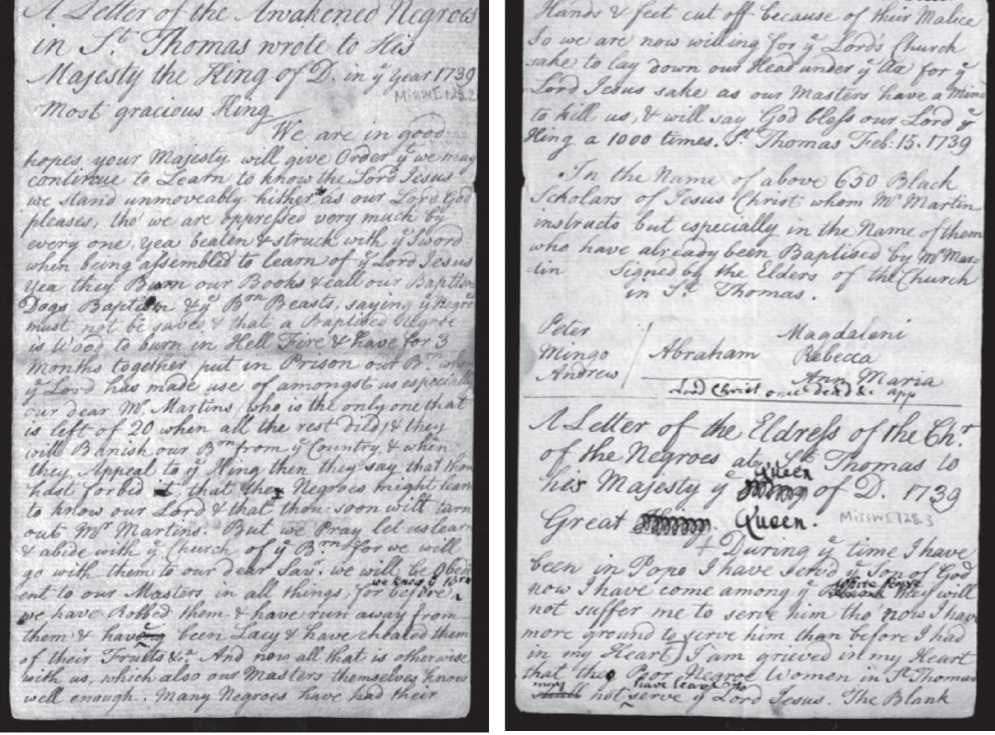
In 1739, a letter was sent to the King of Denmark on behalf of 650 enslaved Christians in St. Thomas. Signed by the church elders, including Rebekka Protten, the letter appealed for their rights and sought support for their spiritual and social well-being.
Notes
1. J. Taylor Hamilton and Kenneth G. Hamilton, A History of the Church Known as the Moravian Church, or the Unitas Fratrum, or the Unity of the Brethren, During the Eighteenth and Nineteenth Centuries (Bethlehem, PA: Times Publishing Company, Printers, 1900), 49–50.