CHAPTER 24
Rebelling against the Status Quo
David Wells

David Wells is distinguished senior research professor at Gordon-Conwell Theological Seminary. He has taught at Trinity Evangelical Divinity School and has served as the academic dean at Gordon-Conwell Theological Seminary’s Charlotte, North Carolina campus. He is the author of several books including The person of Christ: a Biblical and historical analysis of the Incarnation and The Gospel in the Modern World.
Adapted from “Prayer: Rebelling against the Status Quo,” Christianity Today 17, no. 6 (November 2, 1979). Used by permission.
Why don’t we pray? The answer is that we don’t believe prayer will make any difference. We accept, however despairingly, that the situation is unchangeable, that what is will always be.
You will be appalled by the story I am about to relate to you. Appalled, that is, if you have any kind of social conscience.
A poor Black woman living on Chicago’s South Side sought to have her apartment properly heated during the frigid winter months. Despite city law on the matter, her unscrupulous landlord refused. The woman was a widow, desperately poor and ignorant of the legal system, but she took the case to court on her own behalf. Justice, she declared, ought to be done. It was her ill fortune, however, to appear repeatedly before the same judge who, as it turned out, was an atheist and a racist. He abided by the principle that “Blacks should be kept in their place.” The possibility of a ruling in her favor was bleak. It became even bleaker because she lacked the indispensable ingredient necessary for a favorable ruling—namely, a satisfactory bribe. Nevertheless, she persisted.
At first, the judge did not so much as look up from reading the novel on his lap before dismissing her. But then he began to notice her. “Just another Black,” he thought, “ignorant enough to think she could get justice.” Her persistence, though, made him selfconscious. This turned to guilt and anger. Finally, embarrassed and raging, he granted her petition and enforced the law. Here was a massive victory over “the system”—at least as it functioned in this corrupt courtroom.
In putting the matter like this I have not, of course, been quite honest. For this never really happened in Chicago (as far as I know), nor is it even my “story.” My fictitious story is based on a parable told by Jesus (Luke 18:1–8) to illustrate the nature of petitionary prayer. Jesus was obviously not likening God to the corrupt judge but rather drawing a parallel between the widow and the petitioner. There are two aspects to this parallel: First, the widow refused to accept her unjust situation, just as we Christians should refuse to resign ourselves to the corruption of this world. Second, despite the discouragements, the widow persisted with her case, as should we. The first aspect relates to the nature of prayer, and the second aspect relates to the practice of prayer.
Our Problem: Not Failing to Practice Prayer, but Misunderstanding Prayer
My argument is this: too often, our petitionary prayers are feeble and irregular because they are addressed in the wrong way. We beat ourselves up for our weak wills, our insipid desires, our ineffective techniques, and our wandering minds. We keep thinking that somehow our practice is awry, and we rack our brains to see if we can discover why. I suggest that the problem lies in a misunderstanding of the nature of petitionary prayer. Our practice of prayer will never have the persistence of that widow until our out-look has her clarity.
Prayer as Rebellion
What, then, is the nature of petitionary prayer? In essence, it is rebellion—rebellion against the status quo, the state of the world in its sin and fallenness. It is the absolute and undying refusal to accept as normal what is completely abnormal. It is the rejection of every agenda, every scheme, every opinion that clashes with the norms that God originally established. Our petitionary prayers are an expression of the unbridgeable chasm that separates good from evil, a declaration that evil is not a variation on good but its very opposite.
Resignation as Surrender
To put it another way, accepting the status quo or “life as it is” (i.e., accepting the inevitability of the way things are in life) is to surrender a biblical view of God. This resignation to what is abnormal contains a hidden, unrecognized assumption that God’s power to change the world, to over-come evil with good, will not be actualized.
Nothing destroys petitionary prayer (along with a biblical view of God) as quickly as resignation. “At all times,” Jesus declared, “we should pray and not lose heart” (Luke 18:1).
Other Worldviews Accept Things as They Are
The diminishing of petitionary prayer due to resignation has an interesting historical connection to other religions. Religions that stress quiet acceptance of the status quo always disparage petitionary prayer. For example, the Stoics claimed that such prayer showed an unwillingness to accept the existing world as an expression of God’s will; trying to escape from this world by asking God to change things was bad, according to them. Buddhists also hold a similar viewpoint. Though our secular culture today uses a different pathway of logic, it arrives at the same basic position.
Secularism holds the view that life is an end in itself. In secular thinking, life is disconnected from a relationship to God. Consequently, the only norm or “given” in life (be it norms for meaning or norms for morality) is the world as it is. Secularists believe we must come to terms with life, accepting things as they are; seeking some other reference point around which to structure our lives is futile and escapist. It is not only that God (the object of our petitions) has become irrelevant, but His relationship to the world is viewed in a new way—a way that does not violate secular assumption. God may be “present and active” in the world, but it is not a presence and activity that changes anything.
In contrast, I believe that petitionary prayer flourishes only if we believe two things: First, that God’s name is hallowed too irregularly, His kingdom has come too little, and His will is done too infrequently. Second, that God Himself can change this situation. Therefore, petitionary prayer expresses the hope that life as we encounter it can and should be different.
Jesus’s Example: Contending with the Status Quo in Prayer
That, I believe, is the real significance of petitionary prayer in our Lord’s life. Much of His prayer life is left unexplained by the Gospel writers (e.g., Mark 1:35; Luke 5:16; 9:18; 11:1), but we can detect a pattern in the circumstances that led Jesus to pray.
First, Jesus prayed before making major decisions (e.g., choosing His disciples, Luke 6:12). Indeed, the only thing that could explain why He chose that ragtag bunch of non-entities—boastful, ignorant, slow to comprehend—was that He had prayed before choosing them. Second, He prayed when pressed beyond measure, when His day was unusually busy with many competing demands on His energies and attention (e.g., Matt 14:23). Third, He prayed in the great crises and turning points of His life, such as His baptism, transfiguration and crucifixion (Luke 3:21; 9:28–29). Finally, He prayed before and during unusual trials and temptations, the most vivid being Gethsemane (Matt 26:36–45). As the “hour of evil” descended, the way Jesus met it contrasted greatly with the way His disciples met it. He persevered in prayer while they slept in faintness of heart.
Accepting the status quo or “life as it is” (i.e., accepting the inevitability of the way things are in life) is to surrender a biblical view of God.
Each of these turning point events presented Jesus with the opportunity to take on an agenda, perspective, or course of action other than God’s. His rejection of the alternatives was each time accompanied by His petitionary prayer. It was His means of refusing to live in this world or to do His Father’s business on any other terms than His Father’s. In short, His petitionary prayer was a rebellion against the world in its perverse and fallen abnormality. Similarly, it would be impossible for us to live in God’s world on His terms, doing His work in a way that is consistent with who He is, without engaging in regular prayer.
Rejecting Despair: God Himself Contending with Evil
To pray is to declare that God and this world are at cross-purposes. To “sleep” or “faint” or “lose heart” is to act as if they were not. Why then do we pray so little for our local church? Is it really that our technique is bad, our wills weak or our minds distracted? I don’t believe so. There is plenty of passionate and lively discussion in the church today—whether justified or not—about the mediocrity of the preaching, the emptiness of the worship, the superficiality of the fellowship, and the ineffectiveness of the evangelism. So, why, then, don’t we pray as much as we talk? The answer, quite simply, is that we don’t believe prayer will make any difference. We accept, however despairingly, that the situation is unchangeable, that what is will always be. This is not a problem about the practice of prayer but rather about its nature. Or more precisely, it is a problem with how we view the nature of God and His relationship to this world.
Unlike the widow in the parable, we too easily accept the unjust and fallen world around us—even when it intrudes into Christian institutions. It is not always that we are unaware of what is happening, but simply that we feel completely powerless to change anything. That sense of impotence leads us, however unwillingly, to strike a truce with what is wrong.
In other words, we have lost our anger, both as witnesses in society as well as before God in prayer. Fortunately, God has not lost His anger. The wrath of God is His opposition to what is wrong, the means by which truth is put on the throne and error is sent to the gallows. Without God’s wrath, there would be no reason to live morally in the world and every reason not to live morally. The wrath of God is thus intimately connected with petitionary prayer that also seeks the triumph of truth and the banishment of evil.
The framework Jesus gave us for thinking about this is the kingdom of God. The kingdom is that sphere where the king’s sovereignty or authority to rule is recognized. And because of the nature of our King, His sovereignty is exercised supernaturally. In Jesus, the long-awaited “age to come” arrived. He is the Messiah who has invaded the world. Being a Christian, then, is not a matter of simply having the right religious experience. Rather, it means belonging to and serving Jesus as King. Evangelism is successful not because our technique is “right” but because “this age” breaks into the lives of sinful people. God’s “age”—the era of His crucified Son—is dawning in the whole world. Our praying, therefore, should look beyond our private concerns to the wide horizon of all human life in which God is concerned. If the gospel is universal, we cannot restrict prayer to the local.
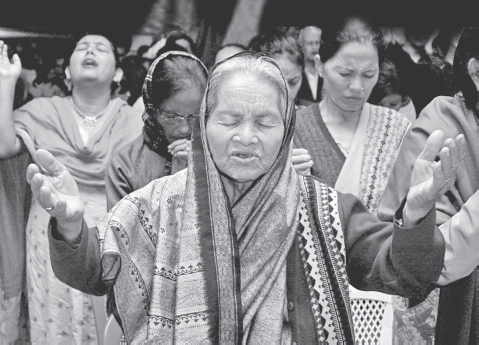
Photo courtesy of Ghania Zaman.
If the gospel is universal, we cannot restrict prayer to the local.
Keep Making Your Case: The World as Courtroom
It is not beside the point, therefore, to view the world as a courtroom in which a “case” is being made against what is wrong and for what is right. Our feebleness in prayer happens because we have lost sight of this, and until we regain this viewpoint we will not persist in our role as advocates and litigants before God. There is every reason why we should regain our vision and utilize our opportunity, for the judge before whom we appear is neither corrupt nor ungodly. Our judge is the glorious God and Father of our Lord Jesus Christ. Do you really think He would fail to bring about justice for His chosen ones who cry to Him night and day? Will He keep putting them off? “I tell you,” our Lord declares, “He will see that they get justice, and quickly” (Luke 18:7–8).