CHAPTER 79
Phil Parshall

Phil Parshall has served as a missionary with SIM (Serving in Mission) for 44 years in Bangladesh and the Philippines. He is the author of nine books on Islam, including The Cross and the Crescent: Understanding the Muslim heart and Mind, Bridges to Islam: a Christian perspective on Folk Islam, and Muslim evangelism: Contemporary approaches to Contextualization.
Gary, an outstanding young missionary in a South Asian country, was thrilled to have a significant part in leading three middle-aged men to Christ. These hard working, low-income farmers from a Muslim background delighted in their opportunity to spend time each week drinking sweet tea and discussing their new-found faith with Gary. What a wonderful affirmation of Gary’s calling it was to have fellowship with these first three believers in a district of several million Muslims.
One overcast January afternoon, the men arrived at Gary’s small, rented home with an urgent request. They complained of the bitterly cold winds that were relentlessly blowing through the cracks in their thatched huts. Though Gary had purposely adopted a simple lifestyle, it was still obvious to the believers that his two young daughters were comfortably wrapped in warm clothes. The spokesman for the group asked if Gary might share some blankets and cast-off garments to help their children fight off the frigid winds that blew through their homes each evening.
How would you respond to these seemingly legitimate requests? What are the issues that complicate a response? Later in this article you will find Gary’s reply to the men.
Biblical Perspectives
Ponder these exhortations:
- Luke 6:30 (NIV): “Give to everyone who asks you, and if anyone takes what belongs to you, do not demand it back.”
- Luke 12:33 (NIV): “Sell your possessions and give to the poor.”
- 1 John 3:17 (NIV): “If anyone has material possessions and sees his brother in need, but has no pity on him, how can the love of God be in that person?”
- James 2:15–17 (NIV), more specifically to Gary’s dilemma: “Suppose a brother or sister is without clothes and daily food. If one of you says to him, ‘Go in peace; keep warm and well fed,’ but does nothing about their physical needs, what good is it? In the same way, faith by itself, if it is not accompanied by action, is dead.”
These Scriptures are sometimes difficult to know how to put into practice.
One rather well-off missionary residing in a destitute Asian country sought to be a literalist. Each morning a huge crowd of unruly, poorly clothed beggars waited impatiently at his gate for their daily allocation of rupees. Even then, the money given would only purchase a basic meal, certainly not enough to buy warm clothes for their shivering bodies. And then, one day the beggars arrived to find an empty home. The missionary had called it quits and returned to his homeland where he would no longer have to face such a hermeneutical dilemma. As for the beggars, their emotional reaction to sudden deprivation was more anger than appreciation for the assistance they had received over the past years.
Money builds and money destroys. On the positive side, Western funding has assisted innumerable evangelism and social projects throughout history. The poor have profited physically and spiritually from such tangible acts of compassion. However, the downside is the insidious slide toward dependency on the part of the receiver. I have yet to see such a dependent relationship that I feel good about. For many years in Bangladesh, I was the “boss” of ten clerical workers in our large correspondence school office in the capital city, Dhaka. I was also involved in several relief outreaches that assisted literally thousands of poor people in our beleaguered country. The end result of this interaction with those in some way subservient to me was that I was called “Boro Sahib,” the English equivalent being a “VIP.”
To me this was an uncomfortable designation signifying dominance as well as relational distance. To the Bengalis, this was indicative of the fact that I was a power person from whom many good things could be obtained. After some years, my wife and I went to live in a rented house in a small town far from Dhaka. From the day we arrived until we left, I was only referred to as “Bhai” or “brother.” With no employees and no trappings of ostentation, this “power person” had left behind all vestiges of prestige. I was now much more at one with the people I had come to be incarnate among. I had been welcomed into the neighborhood as a brother. How good it felt!
Possible Solutions
There is no way I can hope to postulate definitive answers to this massive problem in the next few paragraphs. What I can hope to achieve is to make a few suggestions that might possibly be helpful to some.
Lifestyle Issues
This is a problem that refuses to go away. Even the most dedicated outsider finds it extremely difficult to match his or her standard of living to that of the locals when residing among a poor community. Those who sincerely try to do so often find the emotional and physical test too much to bear. At that point, they either transfer to a large city with its offered amenities or return to their home country.
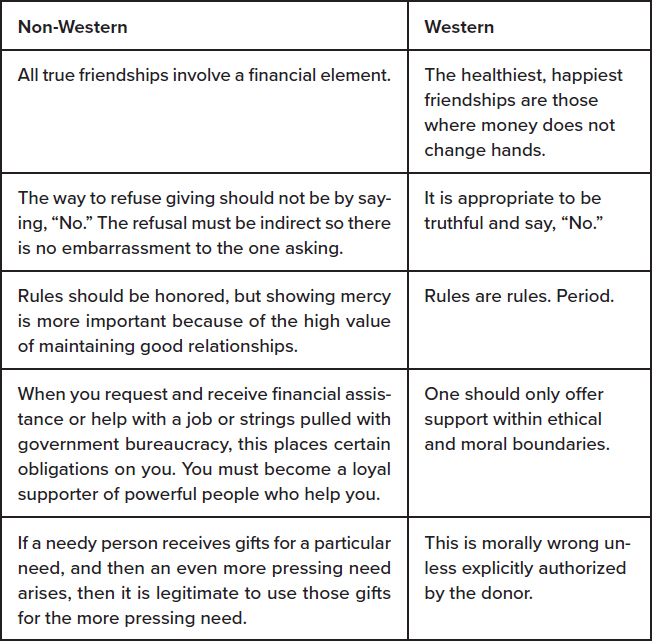
Different Views concerning Relationships and Money Joseph Cumming
From an article by Joseph Cumming of Yale University, inspired by David Maranz’s book African Friends and Money Matters. Cumming lived 15 years in a Muslim country.
Non-Western and Western views on money can be very different.
CONTINUE READING Sidebar: The Role of the Righteous Rich
For some, a mission compound left over from colonial days offers a sequestered alternative. Comfortable, secure housing arrangements are an oasis in the desert (sometimes literally). But I have never felt comfortable with such a solution. We are called to be light in the community. The paradox of this can at times be seen in the generator-lit homes of the foreigners while the local people sit in semidarkness gathered around a small kerosene lamp. Even if it is financially expedient to occupy such compound housing, I feel it is time to redeploy our people and move into housing within the local community. It has been my family’s privilege to have never lived in a cloistered Christian community during our missionary career.
Even the most dedicated outsider finds it extremely difficult to match his or her standard of living to that of the locals when residing among a poor community.
We must always be aware of whom we are serving. If it is the wealthy, then lifestyle compatibility with them is not usually difficult for Western missionaries. But a ministry to the poor exacerbates the complexity of the identification process. It seems prudent to me to enter one’s ministry area at as low a financial profile as possible. Then, as necessary, increase one’s standard of living. Those who come in at a higher level seldom move downward. But emotional stability and physical well-being are of utmost importance for missionaries and their families. I have known missionaries who have held tenaciously to extreme simplicity only to be forced to return home shattered in mind and body. Such a scenario benefits no one.
Support of Local Ministers
Westerners are often result-oriented people. They argue that so much more can be accomplished in church-planting ministry by putting local people on salary. They are the ones who know their people, are experts at their language, can live simply, and are agreeable to perform the tasks assigned to them by their financial patrons. More for less. What could be better?
Well . . . several things could be better. Dependency (for as long as the money lasts) is the biggest problem. I can give many illustrations of angry nationals who have cursed the foreigner when they closed the valve on foreign funding. Then there is the perception of the minister on the part of the local non-Christian population, i.e., the people they came to serve. They undervalue the propagator of a “foreign religion” who is only a paid vender, doing the bidding of an expat with lots of money.
The problems are daunting. In my own mission experience, my team found several ways to address this issue. One way forward for our team was to request the assistance of a Muslim-background believer (MBB). This quality evangelizer knew Islam and he knew his people, including their folklore. He and his family lived very simply, as we Westerners also sought to do. And best of all, we were colleagues in ministry. A missions agency provided the family with a stipend, thus being a more indirect source of funding. Because of his competence, we never heard Muslims assign him the “vendor” designation. In that geographical area there had never been a Muslim come to Christ. Today there are hundreds more MBBs. This national believer was the sparkplug to all that happened.
In the Philippines, we were privileged to work with churches willing to be involved in church planting among those resistant to the gospel. It was exciting to see Filipino Christians involved, not only in going but also in supporting Christian workers. It was particularly thrilling to see the Chinese Filipino church taking on financial responsibility for non-Chinese evangelists.
Other Issues
But what about the unrelenting requests for loans in certain very poor countries? For years, I capitulated to those entreaties. Unfortunately, I lost both money and “friends.” In the end, I decided to close down the loan business and only give grants. The amounts were decided on the basis of need, advice from others, and last but not least, by prayer. As much as possible, I tried to keep in sync with what the surrounding community was giving . . . plus a bit extra as I am, after all, the rich foreigner!
And finally, back to Gary. As he faced the new believers, he realized his gift of clothes would do three things: (1) keep their children warm; (2) signal to the onlooking Muslims that these three men had betrayed religion and society for material benefit; (3) activate a dependency syndrome that would not only stunt these men’s spiritual lives but would also hinder, if not curtail, a future movement to Christ in the area.
All of the above was humbly communicated to the hopeful men who stood before Gary. They were assured of the ability of a prayer-answering God to meet their needs. Without a great deal of enthusiasm, they returned to their village some three miles distant.
Gary prayed much over the next week. When the men came again, they joyfully told how the Lord had met their needs and that now all was well. In the ensuing decades these three men became the foundation of a group that now exceeds five hundred baptized believers. In that area, dependency on foreign funds has been minimal.
There is no standard solution. Every situation calls for experimentation and adaptation. I am convinced that missions and money should be an important topic in our missiological discussions. 
CONTINUE READING Sidebar: Different Views concerning Relationships and Money
The Role of the Righteous Rich Jonathan J. Bonk
Jonathan J. Bonk is mission research professor at Boston University’s School of Theology. He is founder and director emeritus for the Dictionary of African Christian Biography.
From “Missions and Money: Affluence as a Western Missionary Problem . . . Revisited,” International Bulletin of Missionary research 31, no. 4 (2007), published by Overseas Ministries Study Center, New Haven, CT. Used by permission.
How should missionaries live as Christians in contexts of poverty? as they try to establish a role in their host community, missionaries often find themselves in the status of the wealthy—a position for which they have little or no preparation. Jonathan J. Bonk, in his book Missions and Money: Affluence as a Western Missionary Problem, summarizes this dilemma.
His own sojourn in ethiopia led him to understand why the rich do not dare to “risk living in close social or physical proximity to the poor, and why, when circumstances oblige them to do so, they must protect themselves and their possessions with walls, gates, bars, dogs, or armed guards.”
Inevitably, and unbeknownst to them, newcomers to a society will behave in ways that mark them as belonging to a given status. When missionaries fulfill only a part of expected behavior associated with their status and its accompanying roles, people can feel deeply betrayed or angry. For example, many missionaries, in an effort to help people economically, have unwittingly assumed the role of patron or benefactor. If they then refuse to fulfill the obligations associated with that role, the understandable result is confusion, frustration, and even anger. The sincerity and honesty of such missionaries are questioned.
It is my modest proposal that Western Christians generally, including missionaries—whenever they either anticipate or discover that their way of life and its entitlements make them rich by the standards of those around them—embrace the status of “righteous rich” and learn to act accordingly its associated roles in ways that are both culturally appropriate and biblically disciplined. Expectations will vary from culture to culture, but people normally make a clear distinction between rich people who are good and rich people who are bad. Missionaries should aspire to be on the good end of the culturally delineated continuum. In turn, these culturally defined ideal statuses and their accompanying roles need to be informed biblically to ensure that the missionary’s life measures up to his or her teaching.
GO TO THE BEGINNING OF LESSON 13: Organic Multiplication of Churches