CHAPTER 77
Identification in the Missionary Task
William D. Reyburn

William D. Reyburn served the United Bible Societies as a translation consultant in South and Central America, West Africa, Europe, and the Middle East. He served as World Translations Coordinator based in London, England from 1968 to 1972.
Adapted from readings in Missionary anthropology II, ed. William A. Smalley. Pasadena: William Carey Publishing, 1978.
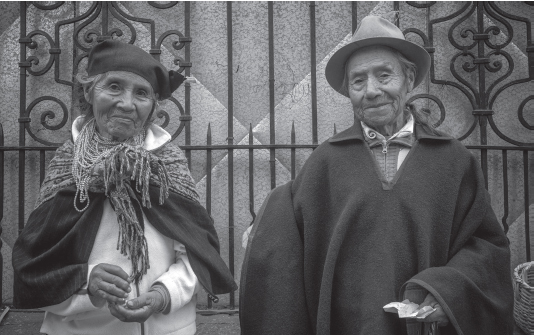
A steady downpour of rain had been falling from late afternoon until long after dark. A small donkey followed by a pair of men slowly made its way down the slippery sides of the muddy descent which wound into the sleepy town of Baños, high in the Ecuadorean Andes.
No one appeared to pay any attention as the two dark figures halted their burro before a shabby Indian hostel. The taller of the two men stepped inside the doorway where a group of men sat at a small table drinking chicha by candlelight. No sooner had the stranger entered the room than a voice from behind the bar called out, “Buenas noches, meester.”
The man in the rain-soaked poncho turned quickly to see a fat-faced woman standing half-concealed behind the counter. “Buenas noches, señora,” he replied, lifting his hat slightly. Following a short exchange of conversation, the man and barmaid reappeared outside and led the donkey through a small gate to a mud stable. The two men removed their load and carried it to a stall-like room beside the stable where they were to spend the night.
I sat down on the straw on the floor and began pulling off my wet clothes. I kept hearing the word meester which I had come to dislike intensely. Why had that funny little woman there in the semidarkness of the room addressed me as meester? I looked at my clothes. My hat was that of the poorest cholo in Ecuador. My pants were nothing more than a mass of patches held together by still more patches. On my dirty mudstained feet I wore a pair of rubber tire alpargatas the same as any Indian or cholo wore. My red poncho was not from the high-class Otavalo weavers. It was a poor man’s poncho made in Salcedo. It had no fancy tassels and in true cholo fashion there were bits of straw dangling from its lower edge, showing that I was a man who slept with his burro on the road. But why then did she call me meester, a term reserved for Americans and Europeans? At least she could have addressed me as señor, but no, it had to be meester.
I felt as though my carefully devised disguise had been stripped from me with the mention of that word. I kept hashing it over and over in my mind. It wasn’t because she detected a foreign accent, because I had not as yet opened my mouth. I turned to my Quechua Indian companion, old Carlos Bawa of Lake Colta. “Carlos, the lady knew I am a meester. How do you think she knew, Carlitos?”
My friend sat huddled in the corner of the room with his legs and arms tucked under his two ponchos. “I don’t know, patroncito.” Looking up quickly at Carlos I said, “Carlos, for three days I have been asking you not to call me patroncito. If you call me that people will know I am not a cholo.” Carlos flicked a finger out from under the collar of his woolen poncho and touching his hat brim submissively replied, “I keep forgetting, meestercito.”
Disgusted and aching in my rain-soaked skin I felt like the fool I must have appeared. I sat quietly watching the candle flicker as Carlos dozed off to sleep in his corner. I kept seeing the faces of people along the road we had walked for the past three days. Then I would see the face of this woman in Baños who had robbed me of what seemed like a perfect disguise. I wondered then if perhaps I hadn’t been taken for a European even earlier. I was hurt, disappointed, disillusioned, and to make things worse I was dreadfully hungry. Reaching into our packsack, I pulled out the bag of machica flour my wife had prepared for us, poured in some water, stirred the brown sugar and barley mixture with my finger, and gulped it down. The rain was letting up now, and from a hole in the upper corner of the room, I could see the clouds drifting across the sky in the light of the moon. A guitar was strumming softly out in the street and in the stall next to us a half dozen Indians had just returned from the stable and were discussing the events of their day’s journey.
Blowing out the candle, I leaned up against the rough plank wall and listened to their conversation, then eventually fell asleep. It was some hours later when I was startled awake by the noise of our door creaking open. I got to my feet quickly and jumped behind the opening door, waiting to see what was going to happen. The door quietly closed and I heard old Carlos groan as he settled down onto his mat to sleep. Carlos was returning, having gone out to relieve himself. My companion had been warning me for several days that Indians often rob each other and I should always sleep lightly. It was quiet now, deathly silent. I had no idea what time it may have been, as a watch was not suitable for my cholo garb. I lay on the floor thinking about the meaning of identification. I asked myself again and again what it meant to be identified with this old Quechua Indian who was so far removed from the real world in which I lived.
I was traveling the Indian markets of the Ecuadorean Andes in order to know what really lay hidden in the hearts of these Quechua Indians and Spanish-speaking cholos. What was the real longing in their hearts that could be touched? I wanted to know what it was that drunkenness seemed to satisfy. Was the Quechua Indian really the sullen withdrawn personality that he appeared to be before his patrón? Was he so adjustable to life conditions that his attitude could incorporate almost any conflict without upsetting him seriously? Was he really a good Catholic, a pagan, or what kind of a combination? Why underneath was he so opposed to outward change? What was he talking about and worrying over when he settled down at night in the security of his own little group? I was seeking to get beyond outward appearance to their roots deep within, the hidden things of the heart that Christ wanted to claim for his own.
A major aspect of the missionary task is the search for what in German is called der Anknüpfungspunkt, connection or point of contact. The proclamation of the gospel aside from such a contact point is a proclamation that skirts missionary responsibility. This is simply the process in which the one who proclaims the good news must make every effort to get in touch with his listener. Man’s heart is not a clean slate that the gospel comes and writes upon for the first time. It is a complex tablet that has been scrawled upon and deeply engraved from birth to death. The making of a believer always begins with an unbeliever. Clearly this is the job of the Holy Spirit. However, this does not remove man from his position of responsibility. It is man in his rational hearing and understanding that is awakened to belief. It is the conquering of man’s basic deceit that allows the Holy Spirit to lay claim to him and to make him a new creature. A man must be aware that he stands in defiance of God’s call before he can be apprehended by God’s love. Before an enemy can be taken captive, he must stand in the position of an enemy.
The Forms of Identification
Missionary identification may take on many different forms. It may be romantic or it may be dull. It may be convincing or it may appear as a sham. The central point is that identification is not an end in itself. It is the road to the task of gospel proclamation. Likewise, the heart of the controversial matter of missionary identification is not how far one can go but rather what one does with the fruits of identification.
Some so-called identification is misoriented and tends to create the impression that living in a small village or learning the local tongue is automatically the “open sesame” to the heart of a person. It is not the sheer quantity of identification that counts; it is rather the purposeful quality that comprehends humanity as a responsible being, seeking to be in touch with his reality. The practical obstacles to missionary identification are many. In the pages that follow we shall attempt to outline some of these as we have lived in them and to evaluate the effects of the lack of missionary identification and participation.
Strength of Unconscious Habit
Without doubt the nature of the obstacle to identification is the fact that one has so well learned one’s own way of life that one practices it for the most part without conscious reflection. In the case described above, the old Quechua Indian, Carlos Bawa, the donkey, and I had been traveling across the plateau of the Andes spending the days in the markets and the nights cramped into tiny quarters available to itinerant Indians and cholos for approximately 10 cents U.S. We had made our way from Riobamba to Baños, a three-day trek by road, and no one except an occasional dog appeared to see that all was not quite normal. It was not until stepping into the candlelit room of the inn at Baños that I was taken for a foreigner (at least it so appeared). I suspect that it bothered me a great deal because I had created the illusion for a few days that I was finally on the inside of the Indian-cholo world looking around and not in the least conspicuous about it. When the innkeeper addressed me as meester, I had the shock of being rudely dumped outside the little world where I thought I had at last gained a firm entrance. The following morning I went to the lady innkeeper and sat down at the bar. “Now, tell me, señora,” I began, “how did you know I was a meester and not a local señor or a cholo from Riobamba?” The fat little lady’s eyes sparkled as she laughed an embarrassed giggle. “I don’t know for sure,” she replied. I insisted she try to give me the answer, for I was thoroughly confused over it all. I went on. “Now suppose you were a detective, señora, and you were told to catch a European man dressed like a poor cholo merchant. How would you recognize him if he came into your inn?” She scratched her head and leaned forward over the counter. “Walk outside and come back in like you did last night.” I picked up my old hat, pulled it low on my head, and made for the door. Before I reached the street she called out, “Wait, señor, I know now what it is.” I stopped and turned around. “It’s the way you walk.” She broke into a hearty laugh at this point and said, “I never saw anyone around here who walks like that. You Europeans swing your arms like you never carried a load on your back.” I thanked the good lady for her lesson in posture and went out in the street to study how the local people walked. Sure enough, the steps were short and choppy, the trunk leaning forward slightly from the hips and the arms scarcely moving under their huge ponchos.
Identification is not an end in itself. It is the road to the task of gospel proclamation.
Limits of Identification
Perhaps the most outstanding example in which I was reminded of the limitations of identification occurred while we were living in a mud-and-thatch hut near Tabacundo, Ecuador. We had moved into a small scattered farming settlement near the Pisque River about a kilometer from the United Andean Mission for whom we were making a study. My wife and I had agreed that if we were to accomplish anything at the UAM we would have to settle among the people and somehow get them to accept us or reject us. We were accepted eventually but always with reservations. We wore nothing but Indian clothes and ate nothing but Indian food. We had no furniture except a bed made of century plant stalks covered with a woven mat exactly as in all the Indian houses. In fact, because we had no agricultural equipment, weaving loom, or granary, our one-room house was by far the most empty in the vicinity. In spite of this material reduction to the zero point, the men addressed me as patroncito. When I objected that I was not a patrón because I owned no land, they reminded me that I wore leather shoes. I quickly exchanged these for a pair of locally made alpargatas, which have a hemp fiber sole and a woven cotton upper. After a time had passed, I noticed that merely changing my footwear had not in the least gotten rid of the appellation of patroncito. When I asked again, the men replied that I associated with the Spanish townspeople from Tabacundo. In so doing, I was obviously identifying myself with the patrón class. I made every effort for a period to avoid the townspeople but the term patroncito seemed to be as permanently fixed as it was the day we moved into the community.
The men had been required by the local commissioner to repair an impassable road connecting the community and Tabacundo. I joined in this work with the Indians until it was completed two months later. My hands had become hard and calloused. One day I proudly showed my calloused hands to a group of men while they were finishing the last of a jar of fermented chicha. “Now, you can’t say I don’t work with you. Why do you still call me patroncito?” This time the truth was near the surface, forced there by uninhibited alcoholic replies. Vicente Cuzco, a leader in the group, stepped up, put his arm around my shoulder, and whispered to me. “We call you patroncito because you weren’t born of an Indian mother.” I needed no further explanation.
Ownership of a Gun
Living in an African village caused us to become aware of the effect of other formative attitudes in our backgrounds. One of these in particular is the idea of personal ownership. While living in the south Cameroon village of Aloum among the Bulu in order to learn the language, we had been received from the first day with intense reception and hospitality. We were given Bulu family names; the village danced for several nights, and we were loaded with gifts of a goat and all kinds of tropical foods.
We had been invited to live in Aloum and we were not fully prepared psychologically to understand how such an adoption was conceived within Bulu thinking. Slowly we came to learn that our possessions were no longer private property but were to be available for the collective use of the subclan where we had been adopted. We were able to adjust to this way of doing because we had about the same material status as the others in the village. Their demands upon our things were not as great as their generous hospitality with which they provided nearly all of our food.
Then one night I caught a new vision of the implication of our relation to the people of Aloum. A stranger had appeared in the village, and we learned that Aloum was the home of his mother’s brother. It was the case of the nephew in the town of his maternal uncle, a most interesting social relationship in the patrilineal societies in Africa. After dark when the leading men in the village had gathered in the men’s clubhouse, I drifted over and sat down among them to listen to their conversations. The fires on the floor threw shadows that appeared to dance up and down on the mud walls.
Slowly we came to learn that our possessions were no longer private property but were to be available for the collective use of the subclan where we had been adopted.
Finally silence fell over their conversations and the chief of the village arose and began to speak in very hushed tones. Several young men arose from their positions by the fires and moved outside to take up a listening post to make sure that no uninvited persons would overhear the development of these important events. The chief spoke of the welcome of his nephew into his village and guaranteed him a safe sojourn while he was there. After these introductory formalities were finished the chief began to extol his nephew as a great elephant hunter. I was still totally ignorant of how all this affected me.
I listened as he eulogized his nephew’s virtue as a skilled hunter. After the chief finished, another elder arose and continued to cite cases in the nephew’s life in which he had displayed great bravery in the face of the dangers of the jungles. One after another repeated these stories until the chief again stood to his feet. I could see the whites of his eyes which were aimed at me. The fire caused little shadows to run back and forth on his dark face and body. “Obam Nna,” he addressed me. A broad smile exposed a gleaming set of teeth. “We are going to present our gun to my nephew now. Go get it.”
I hesitated a brief moment but then arose and crossed the moonlit courtyard to our thatch-covered house where Marie and some village women sat talking. I kept hearing in my ears: “We are going to present our gun . . . our gun . . .” almost as if it were a broken record stuck on the plural possessive pronoun. It kept repeating in my ears, “ngale jangan . . . ngale jangan . . .” Before I reached the house I had thought of half a dozen very good reasons why I should say no. However I got the gun and some shells and started back to the clubhouse. As I reentered the room I caught again the sense of the world of Obam Nna. If I were to be Obam Nna, I should have to cease being William Reyburn. In order to be Obam Nna I had to crucify William Reyburn nearly every day. In the world of Obam Nna I no longer owned the gun as in the world of William Reyburn. I handed the gun to the chief and, although he didn’t know it, along with it went the surrender of a very stingy idea of private ownership.
Copyright © 2008 International Mission Board. All rights reserved.
Symbolic Value of Food
Another problem in village participation is the matter of food and water. I had gone into the village of Lolo to carry out some studies relative to the translation of the book of Acts and had taken no European food, determined to find what the effects of an all-Kaka diet would be. I found that the simple mixture of cassava flour and hot water to form a mush was an excellent sustaining diet. On one occasion over a period of six weeks on this diet, I lost no weight, had no diarrhea, and suffered no other ill effects. All of this food was prepared by village women, and I usually ate on the ground with the men wherever I happened to be when a woman would serve food. On several occasions when I was not in the right place at the right time it meant going to bed with an empty stomach. I carefully avoided asking any woman to prepare food especially for me, as this had a sexual connotation that I did not care to provoke.
Once I had been talking most of the afternoon with a group of Kaka men and boys about foods people eat the world over. One of the young men got his Bulu Bible and read from chapter 10 of Acts the vision of Peter who was instructed to kill and eat “all manner of four-footed beasts of the earth, and wild beasts, and creeping things, and fowls of the air.” This young Kaka who had been a short while at a mission school said, “The Hausa people don’t believe this because they won’t eat pigs. Missionaries, we think, don’t believe this because they don’t eat some of our foods either.” I quite confidently assured him that a missionary would eat anything he does.
That evening I was called to the young man’s father’s doorway, where the old man sat on the ground in the dirt. In front of him were two clean white enamel pans covered by lids. He looked up at me and motioned for me to sit. His wife brought a gourd of water which she poured as we washed our hands. Then flicking wet fingers in the air to dry them a bit, the old man lifted the lid from the one pan. Steam arose from a neatly rounded mass of cassava mush. Then he lifted the lid from the other pan. I caught a glimpse of its contents. Then my eyes lifted and met the unsmiling stare of the young man who had read about the vision of Peter earlier in the afternoon. The pan was filled with singed caterpillars. I swallowed hard, thinking that now I either swallowed these caterpillars or I swallowed my words and thereby proved again that Europeans have merely adapted Christianity to fit their own selfish way of life. I waited as my host scooped his shovel-like fingers deep into the mush, then with a ball of the stuff he pressed it gently into the caterpillar pan. As he lifted it to his open mouth, I saw the burned and fuzzy creatures, some smashed into the mush and others dangling loose, enter between his teeth.
My host had proven the safety of his food by taking the first portion. This was the guarantee that he was not feeding me poison. I plunged my fingers into the mush but my eyes were fixed on the caterpillars. I wondered what the sensation in the mouth was going to be. I quickly scooped up some of the creeping things and plopped the mass into my mouth. As I bit down the soft insides burst open and to my surprise I tasted a salty meat-like flavor which seemed to give the insipid cassava mush the ingredient that was missing.
We sat silently eating. There is no time for conversation at the Kaka “table” for as soon as the owner has had his first bite male hands appear from every direction and the contents are gone. As we sat eating quickly the old man’s three wives with their daughters came and stood watching us from their kitchen door-ways. They held their hands up and whispered busily back and forth, “White man Kaka is eating caterpillars. He really has a black heart.” The pans were emptied. Each one took a mouthful of water, rinsed his mouth, spat the water to one side, belched loudly, said “Thank you, Ndjambie” (God), and arose and departed into the rays of the brilliant setting sun. My notes on that night contain this one line: “An emptied pan of caterpillars is more convincing than all the empty metaphors of love which missionaries are prone to expend on the heathen.”
Ideological Insulation
There are other obstacles to missionary participation in the life of the local community which arise from background as well as local Christian tradition. It does not take local people long to size up the distance that separates themselves from the missionary. In some cases this distance is negligible, but in others, it is the separation between different worlds. Missionaries with pietistic backgrounds are prepared to suspect that everything the local people do is bad and that therefore, in order to save them, they must pull them out and set up another kind of life as opposed to the original one. This process seldom if ever works, and when it does the result is the creation of a society that consists of converted souls but no converted life.
Freedom to Witness
The Christian church sealed off from the world becomes unintelligible to the world it attempts to reach. It is like the father who can never remember how to be a child and therefore is looked upon as a foreigner by his children. Missionary participation and identification are not produced by a study of anthropology but by being freed through the Spirit of the Lord to witness to the truth of the gospel in the world.
My caterpillar experience illustrates the importance of identification. But identification is not an end in itself. It is the road to gospel proclamation.
Christianity calls men into a brotherhood in Christ, but at the same time Christians often negate that call by separating mechanisms that run the gamut from food taboos to fear of other groups. The Christian gospel is foreign enough to the self-centeredness of man’s view of the universe. However, before this misconception of the self can be corrected, there is a barrier that must be penetrated. In Christian terminology it is the cross that leads man from his walled-up self out into the freedom for which he was intended.
The missionary task is that of sacrifice. Not the sacrifice of leaving friends and comfortable situations at home, but the sacrifice of reexamining one’s own cultural assumptions.
There is yet another foreignness that must be over-come through the sacrifice of one’s own way of thinking and doing things. Christianity cannot be committed to one expression of civilization or culture. The missionary task is that of sacrifice. Not the sacrifice of leaving friends and comfortable situations at home, but the sacrifice of reexamining one’s own cultural assumptions and becoming intelligible to a world where one must not assume that intelligibility is given.
Fruitful missionary practice asks this question: “What place in this person’s heart is the Holy Spirit touching?” The missionary task is to ferret out this point of contact through identification with him. The basis of missionary identification is not to make the local feel more at home around a foreigner nor to ease the materialistic conscience of the missionary, but to create a communication and a communion where together they seek out what Paul in 2 Corinthians 10:5 (RSV) calls the “arguments and obstacles”—”We destroy arguments and every proud obstacle to the knowledge of God, and take every thought captive to obey Christ.” This obedience is the goal of the missionary task. 