CHAPTER 73
Three Encounters in Christian Witness
Charles H. Kraft

Charles H. Kraft has been professor of anthropology and intercultural communication at Fuller Seminary, School of Intercultural Studies, since 1969. With his wife, Marguerite, he served as a missionary in Nigeria. He teaches and writes in the areas of anthropology, worldview, contextualization, cross-cultural communication, inner healing, and spiritual warfare. Among his numerous books are anthropology for Christian Witness, Two hours to Freedom, and I Give You authority.
Revised from “What Kind of Encounters Do We Need in Our Christian Witness?” evangelical Missions Quarterly 27, no. 3 (July 1991), published by Missio Nexus. Used by permission.
The term “power encounter” comes from missionary anthropologist Alan Tippett. In his 1971 book, People Movements in Southern Polynesia, Tippett observed that in the South Pacific the early acceptance of the gospel usually occurred when there was an “encounter” demonstrating that the power of God is greater than that of the local pagan deity.1 This was usually accompanied by a desecration of the symbol(s) of the traditional deity by its priest or priestess, who then declared that he or she rejected the deity’s power, pledged allegiance to the true God, and vowed to depend on God alone for protection and spiritual power.
These confrontations, along with those classic biblical power encounters (e.g., Moses vs. Pharaoh, Exodus 7–12, and Elijah vs. the prophets of Baal, 1 Kings 18) formed Tippett’s view of power encounter.
More recently, the term has been used more broadly to include healings, deliverances, or any other “visible, practical demonstration that Jesus Christ is more powerful than the spirits, powers, or false gods worshiped or feared by the members of a given people group.”2 The concept of “taking territory” from the enemy for God’s kingdom is seen as basic to such encounters.
According to this view, Jesus’s entire ministry was a massive power confrontation between God and the enemy. The ministry of the apostles and the church in succeeding generations is seen as the continuing exercise of the “authority and power over all demons and all diseases” given by Jesus to His followers (Luke 9:1). Contemporary stories about such encounters come from nearly everywhere where the church is growing rapidly.
Tippett observed that most of the world’s peoples are power-oriented and respond to Christ most readily through power demonstrations.3 Gospel messages about faith, love, forgiveness, and the other facts of Christianity are not likely to have nearly the same impact on such people as the demonstrations of spiritual power. My own experience confirms Tippett’s thesis. Therefore, cross-cultural workers ought to learn as much as possible about the place of power encounter in Jesus’s ministry and ours.
Jesus Christ Confronts Satan
Of course, missionaries face several questions about power encounters. One of the basic ones is how to relate power concerns and approaches to our traditional emphases on truth and salvation. Let me suggest that we need to use a three-pronged approach to our witness.
Jesus battled Satan on a broader front than simply power encounters. If we are to be biblically fair and balanced, we must give two other encounters equal attention: allegiance encounters and truth encounters. We need to focus on the close relationship in the New Testament between these three encounters. Here’s an outline that will help:
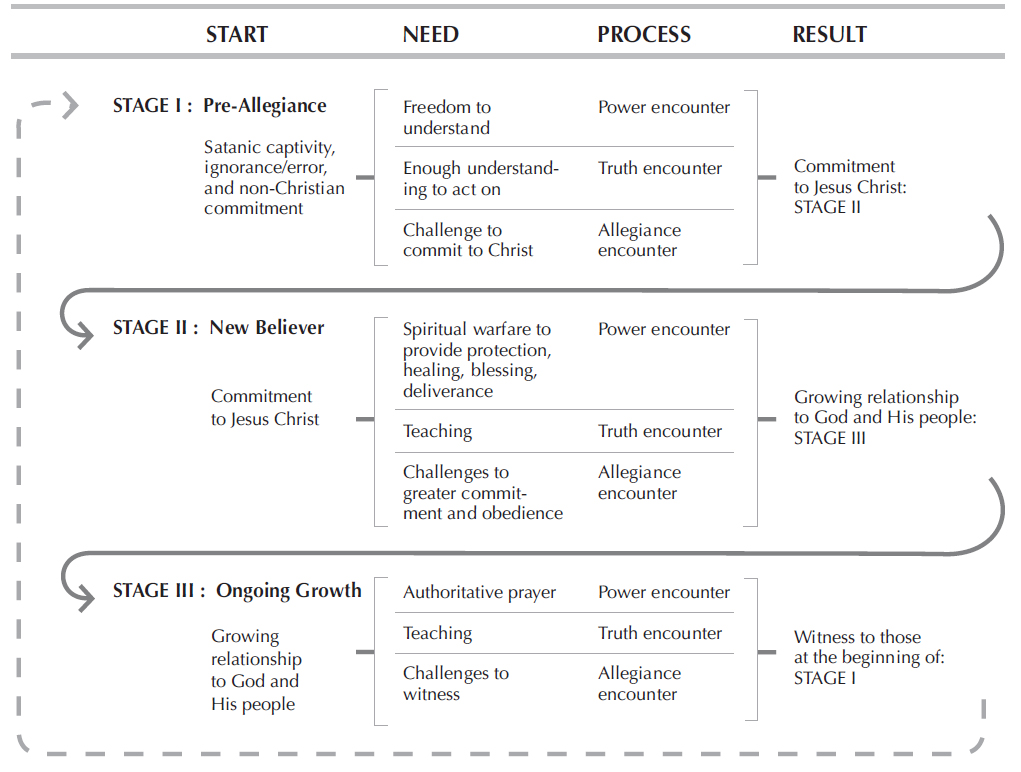
1. Jesus confronts Satan concerning power. This results in power encounters to release people from satanic captivity and bring them into freedom in Jesus Christ.
2. Jesus confronts Satan concerning allegiance. This results in allegiance or commitment encounters to rescue people from wrong and bring them into relationship with Jesus Christ.
3. Jesus confronts Satan concerning truth. This results in truth encounters to counter ignorance or error and to bring people to correct understandings about Jesus Christ.
Throughout the world many Christians have committed themselves to Jesus Christ and embraced much Christian truth, but they have not given up their pre-Christian commitment to and practice of what we call their traditional spiritual power. The powers of darkness that they formerly followed have not been confronted and defeated by the power of Jesus. So, they live with a “dual allegiance” and a syncretistic understanding of truth.
Therefore, some mistakenly assume that if they confront people with healing and deliverance campaigns to show them Christ’s power, they will turn to Him in droves. They assume that those who experience God’s healing power will automatically commit themselves to the source of that power.
However, I know of several such campaigns that have produced few, if any, lasting conversions. Why not? Because little attention was paid to leading the people from an experience of Jesus’s power to a commitment to Him.
I believe Jesus expects power demonstrations to be as crucial to our ministries as they were to His (Luke 9:1–2). However, any approach that advocates power encounter without giving adequate attention to the other two encounters—allegiance and truth—is not biblically balanced. Many people who saw or experienced power events during Jesus’s ministry did not turn to Him in faith. This should alert us to the inadequacy of power demonstrations alone as a total evangelistic strategy.
A Balance of Encounters
We can see the three kinds of encounters outlined above in Jesus’s ministry. Typically, He started by teaching, followed by a power demonstration, then a return to teaching, at least for the disciples (e.g., Luke 4:31–44; 5:1–16; 5:17–6:5; 6:6–16, 17–26, etc.). Jesus seems to have used power demonstrations more when interacting with people who had not yet become His followers, focusing more on the teaching of truth with those already committed to Him.
His appeal for allegiance to at least the first five apostles (Peter, Andrew, James, John—Luke 5:1–11, and Levi—Luke 5:27–28) occurred after significant power demonstrations. Once His followers had successfully negotiated their allegiance encounter, their subsequent growth was primarily a matter of learning and practicing more truth.
First-century Jews, like most people today, were very concerned about spiritual power. Paul said they sought power signs (1 Cor 1:22). Jesus’s usual practice of healing and deliverance from demons soon after entering a new area (e.g., Luke 4:33–35, 39; 5:13–15; 6:6–10, 18–19, etc.) may be seen as His way of approaching them at the point of their concern. When He sent out His followers to the surrounding towns to prepare the way for Him, He commanded them to use the same approach (Luke 9:1–6; 10:19).
Jesus’s reluctance to do miraculous works merely to satisfy those who wanted Him to prove Himself (Matt 12:38–42; 16:1–4) would, however, seem to indicate His power demonstrations were intended to point to something beyond the mere demonstration of God’s power.
Second, Jesus sought to lead people into the most important encounter, the allegiance encounter. This is clear from His challenge to the Pharisees when they demanded a miracle, that the people of Nineveh who repented would accuse the people of Jesus’s day who did not do likewise (Matt 12:41). Experiencing God’s power may be both pleasant and impressive, but only allegiance to God through Christ really saves.
Experiencing God’s power may be both pleasant and impressive, but only allegiance to God through Christ really saves.
The Nature and Aims of the Three Encounters
The three encounters—truth, allegiance, and power—are not the same, but they are each intended to initiate a process crucial to the Christian experience aimed at a specific goal.
1. The concern of the truth encounter is understanding. The vehicle of that encounter is teaching.
2. The concern of the allegiance encounter is relationship. The vehicle of that encounter is witness.
3. The concern of the power encounter is freedom. Its vehicle is spiritual warfare.
Truth and understanding have a lot to do with the mind; allegiance and relationship rest primarily in the will; and freedom is largely experienced emotionally.
1. Truth Encounters
Truth encounters in which the mind is engaged and the will is challenged seem to provide the context within which the other encounters take place and can be interpreted. Jesus constantly taught truth to bring His hearers to ever greater understandings about the person and plan of God. To teach truth, He increased their knowledge. However, in Scripture, knowledge is grounded in relationship and experience; it is not simply philosophical and academic. The truth encounter, like the other two, is personal and experiential, not merely a matter of words and head knowledge.
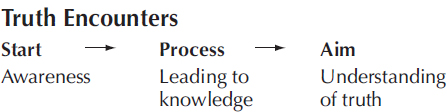
When we focus on knowledge and truth, we enable people to gain enough understanding to be able to accurately interpret the other two encounters. For example, a power demonstration has little, or wrong, significance unless it is related to truth. Knowledge of the source and the reason for the power are essential for proper interpretation of a power event.
2. Allegiance Encounters
Allegiance encounters, involving the exercise of the will in commitment and obedience to the Lord, are the most important of the encounters. For without commitment and obedience to Jesus, there is no spiritual life.
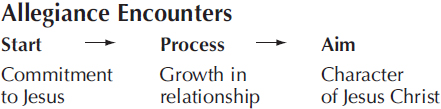
The initial allegiance encounter leads a person into a relationship with God. Through successive encounters between our will and God’s, we grow in intimacy with and likeness to Him, as we submit to His will and practice intimate association with Him.
Implied in the allegiance encounter is the cultivation of the fruits of the Holy Spirit, especially love toward God and man. We are to turn from love of (or commitment to) the world that is under the control of the evil one (1 John 5:19) to God who loved the world and gave Himself for it. As we grow in our relationship with Him, we become more like Him, conforming to the image of Christ (Rom 8:29).
3. Power Encounters
Power encounters contribute a different dimension to Christian experience. They focus on freedom from the enemy’s captivity. Satan is the blinder (2 Cor 4:4), restrictor, hinderer, crippler—the enemy who attempts to keep people from allegiance to God and truth. Though he works on all human faculties, the enemy seems particularly interested in crippling people emotionally. If people are to move into commitment to Christ, they need emotional freedom.
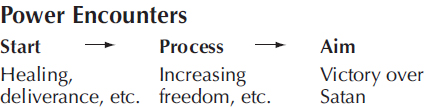
For the one who is healed, delivered, blessed, or otherwise freed from the enemy’s grip, the major payoff is freedom. However, for an observer the impact is likely to be quite different. If properly interpreted, the encounter communicates basic truths about God’s power and love. The observer sees that God is worthy of his trust because He is willing and able to free people from Satan’s destructive hold.
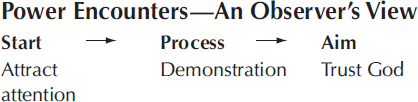
Although we do not call them power encounters, our demonstrations of love, acceptance, forgiveness, and peace in troubled times—plus a number of other Christian virtues—play the same role of attracting attention and leading people to trust God. These all witness to the presence of a loving God willing to give abundant life and bring release from the enemy.
The Encounters Work Together
Our missionary witness needs to use all three encounters together, not separately, as seen in this threepart circle:
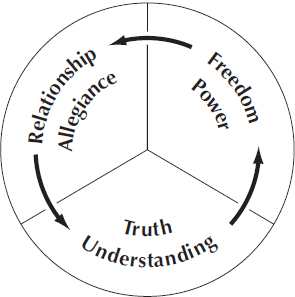
People need freedom from the enemy to (1) open their minds to receive and understand truth (2 Cor 4:4) and (2) to release their wills so they can commit themselves to God. However, they can’t understand and apply Christian truth, nor can they exercise power, without a continuing commitment to God. Nor can they maintain the truth and their allegiance without freedom from the enemy won through continual power encounters. We constantly need each of these dimensions in our lives.
Some Guidelines for Evangelicals
Because Satan is a master at deceit and counterfeiting, we must encounter or confront him rather than simply ignore him. And we know, as we confront him, that greater is He who is in us than he who is in the world (1 John 4:4), and we thank God that Jesus has “stripped the spiritual rulers and authorities of their power” (Col 2:15). But we are still at war, and we are commanded to put on armor and fight against the “wicked spiritual forces in the heavenly world” (Eph 6:11–12). So, although we know how this war will end, many battles remain, and we need to know our enemy and how to fight him.
As we survey the world’s mission fields, we find many places where Christians still have dual allegiances. Many believers, including pastors, still go to shamans, priests, and other spirit mediums.
Many evangelicals have grown up with a knowledge-truth brand of Christianity that pays little if any attention to power encounters. But we go out to witness and evangelize among people who have grown up in spirit-oriented societies and often find that solid, lasting conversions to Christ are hard to achieve with our knowledge-truth approach alone.
Satan counterfeits truth, instills damning allegiances, and provides power. He has, as it were, three arrows in his quiver. However, generally, evangelical missionaries have only two, so their work often flounders on the rocks of dual allegiance and nominalism.
We encounter allegiance to other gods and spirits with the challenge to commitment to Jesus Christ. But when the people need healing or seek fertility, or when there isn’t enough rain or there are floods, too often our answer is the hospital, the school, and modern agriculture. We provide secular answers to what to them (and the Bible) are basically spiritual issues.
We have encountered Satan’s counterfeit “truths” with the exciting truths of Christianity, but often in such an abstract way that our hearers have seen little verification of that truth in our lives. In most cases, both missionaries and the local Christians are more impressed with scientific truth than with biblical truth.
The missing element for them and for us is the “third arrow,” genuine New Testament power, the continual experience of the presence of God, who every day does things the world calls miracles. We must confront Satan’s counterfeit power with God’s power. Truth and commitment alone won’t do. We need all three kinds of biblical encounters if we are to succeed in our world mission. 
RETURN TO LESSON 10: How Shall They Hear?
Notes
1. Alan Tippett, People Movements in Southern Polynesia (Chicago: Moody Press, 1971), 206.
2. C. Peter Wagner, How to Have a Healing Ministry (Ventura, CA: Regal Books, 1988), 150. See also John Wimber, Power Evangelism (New York: Harper & Row, 1985), 29–32, and Charles Kraft, Christianity with Power (Ann Arbor: Servant, 1989).
3. Tippett, People Movements, 81.