CHAPTER 71
Why Communicate the Gospel through Stories?
Tom A. Steffen

Tom A. Steffen is professor emeritus of intercultural studies at the Cook School of Intercultural Studies, Biola University, La Mirada, California. He served 20 years with New Tribes Mission, 15 of which were in the Philippines.
From reconnecting God’s Story to Ministry: Cross-Cultural Storytelling at home and abroad by Tom A. Steffen. Copyright © 2005. Used by permission of InterVarsity Press, P.O. Box 1400, Downers Grove, IL 60516. www.ivpress.com.
While living in the Philippines, I thought that I had finally learned enough of the Ifugao language and culture to allow me to do some public evangelism. I developed some Bible lessons that followed the topical outline we received in pre-field training: the Bible, God, Satan, humanity, sin, judgment, and Jesus Christ. I began by first introducing my Ifugao listeners to the authority base of the Bible. Then I quickly moved on to the second part of the outline about God, and so forth, culminating with Jesus Christ. I presented the lessons in a topical, systematic format. My goal was not only to communicate the gospel but to communicate it in such a way that the Ifugao could effectively articulate it to others.
But as I taught, I soon realized that the Ifugao found it difficult to follow the topical presentations and found it even harder to explain the content to others. I was perplexed.
Something needed to change, so I added a number of stories from the Old Testament to illustrate the abstract concepts in the lessons through concrete things like pictures and locally available objects. I told stories about creation, the fall, Cain and Abel, the flood, the escape from Egypt, the giving of the Ten Commandments, the tabernacle, Elijah, and Baal, all of which would provide a foundation for Jesus’s story. Their response was phenomenal. Not only did the evangelistic sessions come alive, but the recipients also became instant evangelists, telling the stories to friends enthusiastically and effectively. From then on I integrated stories in all my evangelistic efforts.
Back to the Power of Story
After the Ifugao reintroduced me to the power of story, I began to research the topic.1 I soon discovered that many disciplines, including management, mental and physical health, apologetics, theology, and anthropology rely heavily on telling stories.
Sadly, though, storytelling has become a lost art for many Christian workers in relation to evangelism.
Sadly, though, storytelling has become a lost art for many Christian workers in relation to evangelism. Few present the gospel using Old Testament stories to lay a solid foundation for understanding the life of Christ, or connect these stories of hope to the target audience’s story of hopelessness. Rather, many prefer to outline four or five spiritual laws and prove the validity of each through finely honed arguments.
A number of hollow myths bias this preference against storytelling in evangelism: (1) stories are for children; (2) stories are for entertainment; (3) adults prefer sophisticated, objective, propositional thinking; (4) character derives from dogmas, creeds, and theology; (5) storytelling is a waste of time in that it fails to get to the meatier issues. As a result of these and other related myths, many Christian workers have set aside storytelling. To help reconnect God’s story to evangelism-discipleship, I will highlight seven reasons why storytelling should become a skill practiced by all who communicate the gospel.
1. Storytelling Is a Universal Form of Communication
No matter where you travel in this world, you will find that people love to tell and listen to stories. Young children, teenagers, and seniors all love to enter the life experiences of others through stories.
Whatever the topic discussed, stories become an integral part of the dialogue. Stories are used to argue a point, interject humor, illustrate a key insight, comfort a despondent friend, challenge the champion, or simply pass the time of day. No matter what its use, a story has a unique way of finding its way into a conversation.
Stories are heard anywhere. They are appropriate in churches and prison, in the courthouse, and around a campfire.
Not only do all people tell stories, they have a need to do so. This leads us to the second reason for storytelling.
2. More than Half of the World’s Population Prefer the Concrete Mode of Learning
Illiterate and semiliterate people in the world probably outnumber people who can read.2 People with such backgrounds tend to express themselves more through concrete forms (story and symbol) than abstract concepts (propositional thinking and philosophy).
A growing number of Americans prefer the concrete mode of communication. This is due, at least in part, to a major shift in communication preference. One of the reasons behind this shift (and the dropping literacy rate) is the television. With the average TV sound bite now around thirteen seconds, and the average image length less than three seconds (often without any linear logic), it is no wonder that those under its daily influence have little time or desire for reading. Consequently, newspaper businesses continue to dwindle while video production companies proliferate. If Christian workers rely too heavily on abstract, literary foundations for evangelism and teaching, two-thirds of the world may turn its attention elsewhere.3
3. Stories Connect with Our Imagination and Emotions
Effective communication touches not only the mind, it also reaches the seat of emotions—the heart. Unlike principles, precepts, and propositions, stories take us on an openended journey that touches the whole person.
While stories provide dates, times, places, names, and chronologies, they simultaneously provoke tears, cheers, fear, anger, confidence, conviction, sarcasm, despair, and hope. Stories draw listeners into the lives of the characters. Listeners (participants) not only hear what happened to such characters; through the imagination they vicariously enter the experience. Herbert Schneidau eloquently captures this point when he states: “Stories have a way of tapping those feelings that we habitually anesthetize.”4
People appreciate stories because they mirror their own lives, weaving together fact and feeling. Stories unleash the imagination, making learning an exciting, life-changing experience.
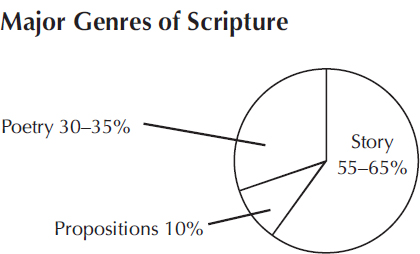
4. Approximately 55–65 Percent of the Bible Is Story
Three basic styles of literature dominate the landscape of the Scriptures—story, poetry, and thought-organized format—but story is predominant (see figure above).
Over the centuries, the writers of the Bible documented a host of characters: from kings to slaves, from those who followed God to those who lived for personal gain. Such stories serve as mirrors to reflect our own perspective of life, and more importantly, God’s perspective. Charles Koller astutely points out:
The Bible was not given to reveal the lives of Abraham, Isaac, and Jacob, but to reveal the hand of God in the lives of Abraham, Isaac, and Jacob; not as a revelation of Mary and Martha and Lazarus, but as a revelation of the Savior of Mary and Martha and Lazarus.5
Poetry covers approximately 30–35 percent of the Bible. Songs, lamentations, and proverbs provide readers and listeners with a variety of avenues to express and experience deep emotions. These portions of Scripture demonstrate the feeling side of people and illuminate the feelings of God as well.
The remaining 10 percent is composed in a thought-or-ganized format. The Apostle Paul’s Greek-influenced writings fall under this category, where logical, linear thinking tends to dominate. Many Westerners schooled in the tradition of the Greeks, myself included, prefer to spend the majority of time in the Scripture’s smallest literary style. Yet if God communicated the majority of His message to the world through story, what does this suggest to Christian workers?
5. Every Major Religion Uses Stories to Socialize Its Young, Convert Potential Followers, and Train Members
Buddhism, Islam, Hinduism, Judaism, Christianity—all use stories to expand (and limit) membership and assure ongoing generational adherence. They use stories to differentiate true members from false, acceptable behavior from unacceptable. Stories create committed communities.
Whether Paul was evangelizing Jews or gentiles, the audience heard relevant stories. Unbelieving Jews heard about cultural heroes such as Abraham, Moses, and David (Acts 13:13–43). Unbelieving gentiles heard about the powerful God behind the creation story (Acts 14:8–18; 17:16–34). Maturing believers heard the same stories with a different emphasis.
Could one of the reasons for this be that stories provide an inoffensive, nonthreatening way of challenging one’s basic beliefs and behavior?
6. Stories Create Instant Evangelists
People find it easy to repeat a good story. Whether the story centers around juicy gossip or the gospel of Jesus Christ, something within each of us wants to hear and tell such stories. Suppressing a good story is like resisting a jar full of your favorite cookies. Sooner or later, the urge is too strong and the cookie gets eaten; the story gets told. Told stories get retold.
Because my Ifugao friends could relate well to the life experiences of Bible characters, they not only applied the stories to their lives, but they immediately retold them to family and friends, even before they switched faith allegiance to Jesus Christ. Stories create storytellers.
7. Jesus Taught Theology through Stories
Jesus never wrote a book on systematic theology, yet He taught theology wherever He went. As a holistic thinker, Jesus often used parabolic stories to tease audiences into reflecting on new ways of thinking about life.
As Jesus’s listeners wrestled with new concepts introduced through parables, they were challenged to examine traditions, form new images of God, and transform their behavior. Stories pushed the people to encounter God and change. It wasn’t comfortable to rise to the challenge of Jesus’s stories: to step out of the boat, turn from family members, extend mercy to others, search for hidden objects, and donate material goods and wealth to the poor—none of it was inviting. But the stories had thrown open possibilities that made it difficult to remain content with life as it had been. Whichever direction the listeners took, they found no middle ground. They had met God. Jesus’s stories, packed with theology, caused reason, imagination, and emotions to collide, demanding a change of allegiance.
Conclusion
The Bible begins with the story of creation and ends with a vision of God’s recreation. Peppered generously between alpha and omega are a host of other stories. While stories dominate Scripture, they rarely enter the Christian worker’s strategies. Leland Ryken cogently asks:
Why does the Bible contain so many stories? Is it possible that stories reveal some truths and experiences in a way that no other literary form does—and if so, what are those ways? What is the difference in our picture of God when we read stories in which God acts, as compared with theological statements about the nature of God? What does the Bible communicate through our imagination that it does not communicate through our reason? If the Bible uses the imagination as one way of communicating truth, should we not show an identical confidence in the power of the imagination to convey religious truth? If so, would a good starting point be to respect the story quality of the Bible in our exposition of it?6
Stories pushed the people to encounter God and change.
Is it not time for today’s Christian workers to revitalize one of the world’s oldest, most universal and powerful art forms—storytelling? I believe so. I also believe that Christian workers, with training and practice, can effectively communicate the finished story of Jesus Christ and connect it to the target audience’s unfinished story. Presenting an overview of Old and New Testament stories that unveils the history of redemption will highlight for the listeners the Storyline (Jesus Christ) of the sacred Storybook (Bible). Should this happen, the gospel will be much more easily understood and more frequently communicated to family and friends. 
RETURN TO LESSON 10: How Shall They Hear?
Transforming Worldviews through the Biblical Story Bruce Graham
Bruce Graham is former general director and current India facilitator of the Frontier Mission Fellowship and has worked at the U.S. Center for World Mission/Frontier Mission for 30 years. He and his wife, Christy, worked in India for 12 years, equipping Indians for cross-cultural ministry. He attended and later gave leadership to the earliest Perspectives classes in Wheaton, IL, and Pasadena, CA.
The Bible reveals a story. Its earliest chapters trace the history of the people of Israel; it was written to help them understand their unique identity and purpose as a people. Their identity was rooted in the first human family and the God of creation who was fulfilling a purpose on earth through them. But Israel is not unique in this sense.
Every nation needs to understand its history and origins. People tell and retell their stories, which shape their worldview and identity as a people. But a people’s story that is disconnected from God’s story will remain hopeless and without enduring purpose. People need to find their place and purpose on earth in light of God’s story among the nations.
People filter new information through the grid of their worldview and evaluate it accordingly. In the beginning of the movie The Gods Must Be Crazy, a glass Coke bottle is dropped out of a small airplane flying over the Kalahari Desert. It lands among a remote desert people and awakens intense curiosity. Wondering why the gods have sent this strange tool, they spend several days evaluating its usefulness. Finally, the elders conclude that this new thing is not good for them, and they set out to dispose of it.
The biblical story is processed in a similar way by people who hear it for the first time. They ask themselves, “Is this good for us? Does it give us a better way of coping with our world, of making sense of it? Does this story match reality as we know it? Does it give hope to our people?”
For the biblical story to be received and believed by a people, it must find place and connection within their world-view. If it is perceived as a story that has answers for their people, as a story that fulfills the longings and hopes of their people, it becomes good news to them. They can see themselves connected in a new way to an ancient and holy God who has great concern for them. He has revealed Himself to them in His Son who fulfills ancient promises and hopes for every nation. Following Him restores their identity and purpose on earth. They become part of God’s story.
This kind of worldview transformation requires storytellers who grasp the whole biblical story and can meaning-fully communicate it among a people. This is far from bringing a people a new “religion.” It’s far more than a way to “get people saved.” It does not extract a people into a foreign community. A skilled biblical storyteller engages a people in a process of discovery that does not disregard their own story but rather gives them a new perspective and new purpose in connection with God’s purpose.
Working in India as a teacher of missionary candidates, I observed students learning the Bible by memorizing its details—authors, dates, names of people and places, etc. They learned facts about the Bible and could teach biblical truths. While people sometimes responded, without foundation in the biblical story, they easily turned to another teaching or another god if something more interesting came along that would meet their perceived need.
But something new began to develop among my students when we started going through the whole biblical story. We approached it through participatory Bible studies, seeking to discover God’s message within each story. How were the stories connected? What was at the heart of the whole story? Their worldview and perspective began to change.
But knowing the story did not necessarily make them good storytellers. They had to practice telling the story. And they had to understand the people they wanted to reach in order to effectively communicate the biblical story. Rather than reading books about the people (usually written by outsiders), we encouraged the students to study the people by being with them and learning directly from them about their culture and way of life. They spent time in tea shops and homes, discovering the concerns and interests of the local people. They took part in their celebrations and traditions, always asking God for insight and wisdom that would help them tell the biblical story most effectively.
This led to creative ways of communicating the story: through song, drama, pictures, or simply storytelling, all common forms of expression among Indians. One student drew pictures of successive stories through the Bible, one page per story, and hung them on his living room wall. Another invited friends to his home for weekly discussion and eventually had religious leaders going through the whole biblical story. One woman spent months, even years, listening to the stories and concerns of the Muslim women she worked among. Eventually they began to open up to her, and she had biblical stories to share with them that captured their interest. They wanted to hear more.
So, let’s multiply storytellers who understand the whole story. Biblical stories that are understood and presented from a biblical worldview reveal God’s mission and purpose. Let’s help people internalize God’s story for themselves so His story becomes their story. Let’s encourage biblical storytellers to take the time to know the local people and their stories so they can meaningfully connect that people’s story with God’s story. Then those stories can bring transformation by connecting God’s story to local stories, giving meaning and purpose to a people’s worldview. This will transform a people’s worldview.
Notes
1. For more information on storytelling see chapter 11 in my Passing the Baton: Church Planting That Empowers (1993), which looks at the chronological teaching model, and Reconnecting God’s Story for Ministry: Cross-Cultural Storytelling at Home and Abroad (1996), both available through William Carey Publishing.
2. David B. Barrett, “Annual Statistical Table on Global Mission: 1997,” International Bulletin of Missionary Research 21, no. 1 (1997): 24–25.
3. Herbert V. Klem, Oral Communication of the Scripture: Insights from African Oral Art (Pasadena, CA: William Carey Library, 1982).
4. Herbert N. Schneidau, “Biblical Narrative and Modern Consciousness,” in The Bible and the Narrative Tradition, ed. Frank McConnell (New York: Oxford University Press, 1986), 136.
5. Charles W. Koller, Expository Preaching without Notes (Grand Rapids: Baker Book House, 1962), 32.
6. Leland Ryken, “The Bible: God’s Storybook,” Christianity Today 23, no. 23 (1979): 38.