CHAPTER 52
Tribes, Tongues, and Translators
William Cameron Townsend

Adapted from Who Brought the Word, 1963, by Wycliffe Bible Translators.
William Cameron Townsend founded Wycliffe Bible Translators and its sister agency, the Summer Institute of Linguistics. Starting out as a student to distribute portions of the Bible in Spanish, he was overtaken by the conviction that Spanish Bibles were inadequate for the Indian tribes of Guatemala. He completed a translation of the New Testament into Cakchiquel in 1931 and then turned his attention to other tribes.
Others soon joined him. Using linguistics and technological advances, Wycliffe translators have fanned out across the globe in the last fifty years, developing writing systems for oral languages, translating portions of the Bible, and enriching tribal societies as well as facilitating their response to the pressures of majority peoples. “Uncle Cam” has been recognized and appreciated by kings and presidents as well as by the “little people” of the world. Growing numbers of Christians around the world are joining his vision to translate the Scriptures for the remaining Bibleless peoples. Uncle Cam died in 1982 at the age of eighty-five.
Fifty years ago, when I decided to translate the word for the Cakchiquel Indians, a large tribe in Central America, friends told me:
Don’t be a fool. Those Indians aren’t worth what it would take to learn their outlandish language and translate the Bible for them. They can’t read anyhow. Let the Indians learn Spanish.
My friends used these same arguments fourteen years later when, after having seen the transformation the word brought to the Cakchiquels, I dreamed of reaching all other tribes. When I included even the small primitive groups in Amazonia in my plan, my friends added other arguments. Said one old, experienced missionary,
They’ll kill you. Those jungle tribes are dying out anyway. They kill each other as well as outsiders with their spears, or bows and arrows. If they don’t kill you, malaria will get you, or your canoe will upset in the rapids and you’ll be without supplies and a month away from the last jumping-off place. Forget the other tribes, and stay with the Cakchiquels.
But I couldn’t forget them, and one day God gave me a verse that settled the matter for me.
For the Son of Man has come to save that which was lost. What do you think? If any man has a hundred sheep, and one of them has gone astray, does he not leave the ninety-nine on the mountains and go and search for the one that is straying?” (Matt 18:11–12)
That verse guided me; I went after the “one lost sheep,” and four thousand young men and women have followed suit. We call ourselves the “Wycliffe Bible Translators” in memory of John Wycliffe, who first gave the whole Bible to the speakers of English. Half our members are dedicated to linguistic and translation work among the tribespeople, bringing them the word. The other half are support personnel: teachers, secretaries, pilots, mechanics, printers, doctors, nurses, accountants, and others who man the supply lines. Our tools are linguistics and the word, administered in love and in the spirit of service to all without discrimination.
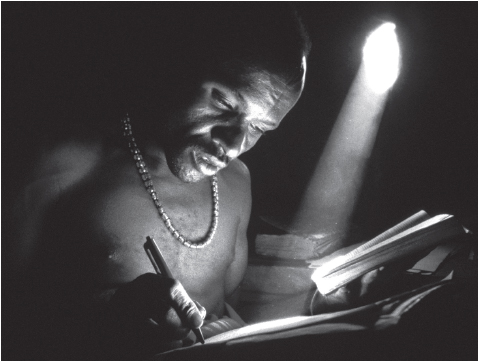
A Kenyan man diligently translates the Bible from Swahili into Samburu, his native language. Copyright © 2021 International Mission Board. All rights reserved.
The tribes are being reached. Geographical barriers, once so formidable, are overcome today by our planes and short-wave radios. The newly developed science of descriptive linguistics breaks the barriers of strange tongues. Witchcraft, killings, superstition, ignorance, fear, and sickness are giving way to the light of the word, literacy, medicine, and contact with the best in the outside world. Tribesmen formerly outside the lifestream of their respective nations are being transformed. Whether the transformation occurs in the mountains of Southern Mexico, the jungles of Amazonia, or the desert plains of Australia, it is a spectacular leap out of the old into the new.
Doors into the tribes are rapidly opening to our type of approach. The way the Bible translation program has moved forward during the past fifty years encourages us to expect the completion of the task. In order to take the word to three thousand more Bibleless tribes, many more translators and support personnel are needed. The pace must be accelerated. Each translation may take from five to twenty-five or more years and involves not only the linguist we send to each tribe but also one or more tribal informants.
Politically, this seems to be the day of neglected countries and neglected tribes. Spiritually, this may be their day as well. The man of Luke 14:16 invited many to the great supper he had prepared, but they declined. Then he sent messengers into the cities and invited the masses on the streets, but still there was room. Finally he sent his messengers to the country trails to bring in guests. They came. Perhaps at long last a special day of opportunity has come for the out-of-the-way tribes who have never had the slightest chance to hear the gospel.
We know that all of them must hear the message of God’s love, for they are included in both the Great Commission and in the prophetic vision of the vast throng of the redeemed recorded in Revelation 7:9.
We know that all of them must hear the message of God’s love, for they are included in both the Great Commission and in the prophetic vision of the vast throng of the redeemed recorded in Revelation 7:9 (KJV),
After this I beheld and lo, a great multitude which no man could number of all nations and kindreds and peoples and tongues, stood before the throne and before the Lamb, clothed with white robes and palms in their hands.
They can get there only if they hear the word in a language they can understand. How else could they be saved?
May God stir the hearts of many to join us in completing our God-given task of reaching every tribe. 
RETURN TO LESSON 8: Pioneers of the World Christian Movement