CHAPTER 29
Charles Van Engen

Charles Van Engen is the Arthur F. Glasser Professor of Biblical Theology of Mission and has taught in the School of Intercultural Studies since 1988. Before coming to Fuller he served as a missionary in Mexico, working primarily in theological education. He continues to boost advanced training in missiology by consulting with a number of training programs in Latin America. He has helped author or edit many books, including Communicating God’s Word in a Complex World and The Good News of the Kingdom.
Adapted from Mission on the Way. Grand Rapids: Baker Book House, 1996. Used by permission.
We live at the dawn of the most exciting missionary era ever. The global reawakening of interest in spirituality, in the spirit world and in religious phenomena provides an unprecedented opportunity for calling people to faith in Jesus Christ. In today’s world, our assertion that Christ is unique is heard as an assessment that other religions are to be disregarded. Chapman pointed out that
to speak of “other religions” is ultimately to refer to two-thirds of the human race. The world’s other religions present a challenge to Christians not only because they have worldviews that conflict at many points with our own, but also because their influence is growing. . . . We must do more . . . than simply reassert the uniqueness of Christ in old categories, more than just produce strategies for reaching people of other faiths. We must first do some hard thinking about religions.1
Three Broad Categories
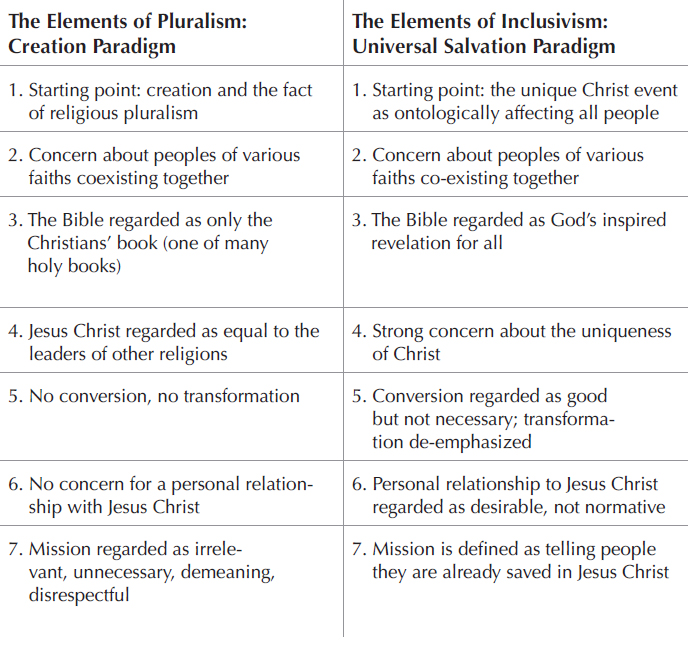
In recent times, the attitudes of Christians toward other religions generally are classified in three broad categories: pluralist, inclusivist, and exclusivist.2 Notice that two of these words sound essentially positive. “Pluralist” is positive in terms of the multicultural and multireligious world in which we live. “Inclusivist” is positive in terms of opening our arms to receive all those who are loved by God. “Exclusivist,” however, sounds like a negative word. Pluralists and inclusivists feel quite negative about the content of the so-called exclusivist position. In fact, few of us would like to be accused of being exclusive, whether it be institutionally, culturally, economically, politically or socially.
Consider the basis on which these positions are compared. If the basis is tolerance, the pluralist and inclusivist would seem to espouse tolerance; the exclusivist would seem to support intolerance. What if the basis for comparison is love? The pluralist loves everyone, as does the inclusivist, for they both refuse, as Clark Pinnock says, “to limit the grace of God to the confines of the Church.”3 It is the so-called exclusivist who “restricts hope” and therefore relegates people of other religions to “zones of darkness,” refusing to love all peoples enough to offer them a “wider hope.”4 If the basis of comparison is global openness versus parochialism, the exclusivist position looks ancient and out-of-date, narrow and parochial. If the basis of comparison is optimism versus pessimism, the inclusivist position is, in Pinnock’s words, “optimistic of salvation”5 while the so-called exclusivists demonstrate a “negative attitude toward the rest of the world,”6 and a “pessimism of salvation, or darkly negative thinking about people’s spiritual journeys.”7
I’m not sure I want to be an exclusivist. I’m even less inclined to be an exclusivist when I hear what the open, accepting, loving and tolerant pluralists say about me! John Hick argues of exclusivists:
[Their] entirely negative attitude to other faiths is strongly correlated with ignorance of them. Today, however, the extreme evangelical Protestant who believes that all Muslims go to hell is probably not so much ignorant as blinded by dark dogmatic spectacles through which he can see no good in religious devotion outside his own group. . . .
If all human beings must, in order to attain the eternal happiness for which they have been created, accept Jesus Christ as their Lord and Savior before they die, then the great majority of humanity is doomed to eternal frustration and misery To say that such an appalling situation is divinely ordained is to deny the Christian understanding of God as gracious and holy love.8
Apparently exclusivists are not nice people! Of course, I’m speaking tongue-in-cheek, but can we not do better? At the very least, it seems that we need to continue our search for better conceptualization and articulation of what a so-called exclusivist position involves. Perhaps we even need a new word. Let me suggest a fourth perspective: the “evangelist” paradigm. I have chosen this name because I want to present a paradigm whose starting point and center is the evangel—the confession by the disciples that “Jesus Christ is Lord.”
An Important Distinction: Faith Does Not Equal Culture
Before we look at the missiological implications of this fourth paradigm of “evangelist,” let’s examine two presup-positions. The first deals with the relationship of faith and culture. Paul Hiebert says:
The gospel must be distinguished from all human cultures. It is divine revelation, not human speculation. Since it belongs to no one culture, it can be adequately expressed in all of them. The failure to differentiate between the gospel and human cultures has been one of the great weaknesses of modern Christian missions. Missionaries too often have equated the good news with their own cultural background. This has led them to condemn most native customs and to impose their own customs on converts. Consequently, the gospel has been seen as foreign in general and Western in particular. People have rejected it not because they reject the lordship of Christ, but because conversion often has meant a denial of their cultural heritage and social ties.9
The difference between faith and culture is supported not only anthropologically but also historically and biblically. Historically, a review of the history of the church demonstrates that the gospel of faith in the lordship of Jesus Christ has always tended to break out of the cultural molds that would imprison it. Originally the gospel was not Western at all—it was Middle Eastern. It began among Aramaic-speaking Jews. Then it took shape in all the cultures surrounding Jerusalem that are referred to in Acts 2—in Greek, Roman, North African, Ethiopian, Indian, Near Eastern, and Arabic cultures. It expanded to the Franks, Scandinavia, the British Isles, and on and on. To closely associate any culture with biblical faith, one must ignore the historical expansion of the church.
Even more profoundly, the distinction between faith and culture is biblically essential. This issue is at the heart of Acts and Romans.11 The issue here is precisely how a single faith in Christ’s lordship can take shape in a variety of cultures. The difference between faith and culture is also essential for an understanding of Galatians, Ephesians, and Colossians. Paul speaks of the mystery “that through the gospel the Gentiles [the ethne, comprising a multiplicity of cultures] are heirs together with Israel, members together of one body, and sharers together in the promise in Christ Jesus” (Eph 3:6 NIV). Revelation and 1 Peter also would be difficult to understand were there no distinction between faith and culture.
The nature of the world in which we now live has made the equation of faith and culture more dangerous than ever. Christians and non-Christians alike share this in common. All are radically impacted by the largest redistribution of people the globe has ever seen. In this new reality, all of us are called upon to find ways of affirming cultural relativity: tolerance, understanding, justice, equality, and coexistence within the new multiculturalism. If one views faith and culture as nearly synonymous and also begins to be open to cultural relativism, the next step is some form of religious pluralism.12 If one goes all the way with this process, one arrives at the pluralist position. If one cannot go that far—feeling strongly constrained to hold tightly to the uniqueness of the cosmic Christ event—one arrives at the inclusivist position.
A Crucial Starting Point: Good People Damned or Condemned People Saved?
The second presupposition deals with the form of the question of salvation asked by each of the four paradigms. We must be conscious of the radical difference between the pluralist/inclusivist stance on the one hand and the exclusivist/ evangelist stance on the other. The bottom-line theology of salvation of the pluralist and inclusivist positions asks, “Given the fact that humanity is basically good, and God is a God of love, how is it possible that God could condemn so much of humanity to eternal punishment?” The exclusivists and evangelists ask the question differently: “Given the fact of the fall, and that ‘all have sinned and fall short of the glory of God’ (Rom 3:23 NIV), how is it possible that so much of humanity can be saved?”
A Foundational Conviction: Knowing the Historic Jesus
Now before developing the major missiological implications of the “evangelist” paradigm, I want to clarify a foundational commitment from which all else derives. I am making a conscious choice to highlight the Christian’s personal relationship with the historic Jesus Christ who was born, lived in Palestine during a specific historical time, ministered, died, rose, ascended, and is coming again. The absolutely radical claim of the canonical text of the Bible is that this Jesus lives today and that He is the one with whom the Christian disciple relates personally by faith.
Even John Hick recognized the implications of this position:
If Jesus was literally God incarnate, the second Person of the holy Trinity, living a human life, so that the Christian religion was founded by God-on-earth in person, it is then very hard to escape from the traditional view that all mankind must be converted to the Christian faith.13
The Fourth Position: Evangelist
In developing the missiological implications of the evangelist paradigm, I will try to present a trinitarian and kingdom-oriented perspective that may help us listen to the other three paradigms and critique them as well. In doing so, we need to be able to move past the pessimism about mission, faith, and the church that is exhibited by pluralists and inclusivists alike. At the same time, we must be more open than traditional exclusivists have been to a modern global village of interreligious encounter and multicultural diversity.
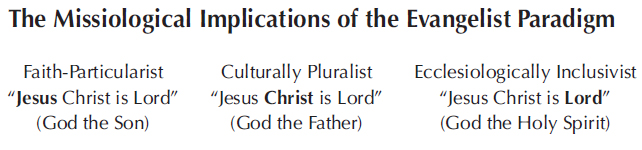
Our study of the implications of the evangelist paradigm will be limited to three basic categories. This paradigm of approaching other religions is a way that is (1) faith-particularist, (2) culturally pluralist, and (3) ecclesiologically inclusivist.
Faith-Particularist
The first element of this new paradigm is personal. In the evangelist paradigm, confession of Jesus as Lord involves a personal relationship that breaks the bonds of all religious systems. It means that we are not so much adherents of Christianity, we are simply disciples of Christ. Following Christ is a vital relationship rather than subscribing to a religious formula. It is not neat, logical, or coherent. It is not exclusive, arrogant, or triumphalistic. Rather, it is humble confession, repentance, and obedience. Thus, the major question is not if one is a member within a particular religious system, even if it is a Christian tradition. Rather, the crucial issue is whether or not one relationally belongs to the person of Jesus Christ. The ultimate question is the question of discipleship—of one’s proximity to, or distance from, Jesus the Lord.
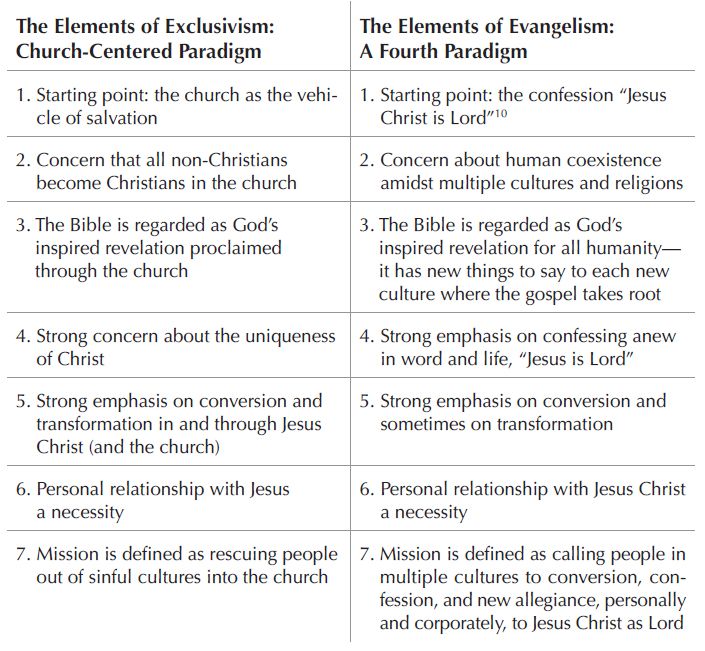
The evangelist paradigm calls into question the institutional structures of all churches and especially of Christianity as a religious system, for the churches now are viewed as the fellowship of disciples whose allegiance is to Jesus more than to a particular institution.
On the other hand, the confession of Jesus as Lord also highlights all that cannot be called “lord” by the Christian. The confession calls for stripping away the layers of cultural accretions that Christians have added to the basic confession. As Paul declares in Romans, and we see modeled in Acts, our faith requires us to confess with our mouths and believe in our hearts that Jesus is Lord. That’s all there is. Nothing else really matters. All else is to be held lightly. Everything else is negotiable. Thus, when we call people of other cultures and faiths to confess “Jesus is Lord,” it is not our Jesus (exclusivist), nor is it a Jesus (pluralist), nor is it the cosmic amorphous idea of Jesus Christ (inclusivist). Rather, it is Jesus the Lord who calls for conversion and transformation of all who confess His name. Because of this, it is only in humility, in personal repentance, and in prayer—with the expectation of a great diversity in cultural forms—that we may invite others to join us in confessing Jesus as Lord.
Culturally Pluralist
Along with the historicity and relationality of Jesus Christ, we must also affirm the universality of Christ’s messianic lordship. Jesus the Christ is the Creator and Sustainer of all the universe, as the first chapters of John, Ephesians, and Colossians all state. All of us are concerned about the whole of humanity and the care of God’s creation. We wonder how humans can live together in peace and justice, especially in the midst of increasingly difficult clashes between conflicting religious allegiances. We must remember that Christ’s lordship is not only over the church but also over all the world. The pluralist and inclusivist perspectives, however, confuse the manner, scope, and nature of Christ’s kingly rule over the church (willing subjects) and over all humanity (unwilling subjects).14
The lordship of Christ brings into question the exclusivist position on other cultures and religions as well. It opens up a much greater breadth for a contextualized encounter between Christians and the many cultures of our world. Not all so-called non-Christian culture is sinful, but neither is everything in culture relative. Rather, we are called to “test the spirits” (1 John 4:1–3). This broad, all-encompassing Christology means that we must listen carefully to the new Christologies that are arising in Asia, Africa, and Latin America. Everything that does not contradict the biblical revelation concerning the historical Jesus Christ our Lord is open for consideration. As Hendrikus Berkhof says:
That Christ is the truth does not mean that there are no truths to be found anywhere outside of Him, but it does mean that all such truths are fragmentary and broken unless they become integrated in Him as the center.15
Ecclesiologically Inclusivist
This third missiological implication of the evangelist paradigm has to do with the kingdom of God and the church (the term “ecclesiological” derives from the Greek word for church, ecclesia). The kingdom leads us to the church, the disciples of Jesus Christ the Lord. The church is not only a gathering of individuals; it is much more because it includes Jesus Christ who is not only Lord of creation but also the head of the church. The church belongs to no human person but to Jesus. Church growth aspires that Jesus Christ be more greatly followed, instead of merely expanding a churchly kingdom.
Because Jesus Christ the Lord is the head of the church, the church’s mission is to participate in the mission of Jesus the Christ. Paul quotes Isaiah to say that Christ’s disciples, the church, are commanded to be a “light to the nations” (Acts 13:47; Isa 49:6). It is the church’s responsibility, therefore, to focus on the whole of humanity. It is the church, not some cosmic idea, that gathers disciples. And the church—of which Christ is head—is called to proclaim that Jesus is the Lord of all humanity, not simply “a christ” for the Christian.
An Outward Movement to the Nations
This world-encountering church is as broad as all humanity (pluralist), as human beings yet it is still the church of Jesus Christ. Just as clearly, the shape of this church needs to be reconsidered in today’s world of multiple religions and cultures.
The Church cannot escape the fact that to confess Jesus as Lord moves it profoundly toward its own universality—a movement outward to the nations. This is climactically presented to us in the Great Commission of Matthew 28:18–20: “Full authority in heaven and on earth has been committed to me. Go forth therefore and make all nations my disciples.” . . . Thus the mission of Jesus becomes inescapable and utterly binding for all of his disciples. They cannot confess Jesus is Lord without at the same time proclaiming His lordship over all people So Jesus Christ, the Lord of all people, all creation, and Lord of the Church, sends His people to a radical encounter with the world.16
Ultimately any new paradigm of the Christian’s response to other cultures involves only a restatement of the mystery of the gospel for all people, a mystery that “for ages past was kept hidden in God, who created all things. His intent was that now, through the church, the manifold wisdom of God should be made known . . . according to His eternal purpose which He accomplished in Christ Jesus our Lord. In him and through faith in Him we may approach God with freedom and confidence” (Eph 3:9–12 NIV). If Paul and the early church could so emphatically state such a conviction in the midst of their amazing cultural and religious diversity, we, too, can feel confident in doing so. Although our subject is incredibly complex, the heart of it is really quite simple: “Jesus Christ is Lord.” In the midst of many cultures and people of many faiths, we must be bold. We must learn more profoundly how to be evangelists who are faith-particularist, culturally pluralist, and ecclesiologically inclusivist. 
RETURN TO LESSON 4: Mandate for the Nations
Notes
1. Chapman’s article in Christianity Today developed some of the themes of his address delivered at Lausanne II (Manila, 1989). Robert Coote reported that “only Colin Chapman . . . dared to broaden the examination of what the gospel means for those who have never heard of Jesus Christ” (1990, 15).
2. The use of these particular terms seems to be a rather recent phenomenon. In No Other Name? (1985) Paul Knitter spoke of “models” of Christian attitudes to other religions: the conservative evangelical, the mainline Protestant, the Catholic, and the theocentric. In doing so, he downplayed the pluralist, inclusivist, and exclusivist typology. In God Has Many Names (1982), John Hick referred to the three major types of approaches, but the words themselves as typological categories are not strongly emphasized (Netland 1994). On the evangelical side Mark Heim in Is Christ the Only Way? (1985) and Ajith Fernando in The Christian’s Attitude toward World Religions (1987) did not structure their works around these three perspectives. In a good reader on Christianity and Other Religions (1980) John Hick and Brian Hebblethwaite mentioned “religious pluralism” and “Christian absolutism,” but did not use the three-part typology. Among the earliest uses of this three-part typology were Paul Knitter’s and Francis Clooney’s articles in Religious Studies Review 15, no. 3 (July 1989): 197–209, surveying significant new books in the field. Carl Braaten seemed to accept the three-fold typology, mentioning Gavin D’Costa and Alan Race as utilizing it, but he did not indicate where it came from (1987, 17).
3. Clark H. Pinnock, A Wideness in God’s Mercy: The Finality of Jesus Christ in a World of Religions (Grand Rapids: Zondervan, 1992), 15.
4. Pinnock, 14.
5. Pinnock, 153.
6. Pinnock, 13.
7. Pinnock, 182.
8. John Hick, God Has Many Names (Philadelphia: Westminster, 1982), 29–31.
9. Paul G. Hiebert, Anthropological Insights for Missionaries (Grand Rapids: Baker Books, 1985), 531.
10. For some discussion of this most essential kerygmatic confession by the early church and some of its missiological implications, see Van Engen, God’s Missionary People, 92–94.
11. For an outline of the faith-culture dynamic in Romans, as seen from a missiological point of view, see Charles Van Engen, Mission on the Way: Issues in Mission Theology (Grand Rapids: Baker Books, 1996), 165–67.
12. Willem A. Visser ‘t Hooft emphasized the importance of the distinction between faith and culture already in 1963: “To transform the struggle between the religions concerning the ultimate truth of God into an intercultural debate concerning values is to leave out the central issue at stake . . . the central affirmation of the faith, that God revealed Himself once for all in Jesus Christ” (85).
13. Hick, God Has Many Names, 19.
14. See Charles Van Engen’s The Growth of the True Church: An Analysis of the Ecclesiology of Church Growth Theory (Amsterdam: Rodopi, 1981), 277–305, and God’s Missionary People: Rethinking the Purpose of the Local Church (Grand Rapids: Baker Books, 1991), 108–17.
15. Hendrikus Berkhof, Christian Faith: An Introduction to the Study of the Faith (Grand Rapids: Eerdmans, 1979), 185.
16. Van Engen, God’s Missionary People, 93–94.